
代糖

Search documents
中粮科技(000930) - 000930中粮科技投资者关系管理信息20251218
2025-12-18 10:26
Group 1: Investor Relations Activity - The investor relations activity involved a concentrated exchange event organized by COFCO Group, attended by various investment institutions and analysts [1] - The meeting took place on December 18, 2025, from 14:00 to 16:30 at COFCO Fulinmen Building [1] Group 2: Product Development and Market Strategy - COFCO Biotechnology has received approval for its alulose as the first new food ingredient in China, with multiple leading food and beverage companies currently testing samples [1] - It is expected that by the end of December 2025, several major companies will launch new products using alulose as an ingredient [1] - The company is promoting 375g and 250g small packaging products on various e-commerce platforms [1] Group 3: Production Technology and Cost Efficiency - The company claims a competitive edge in the enzymatic production of alulose due to its proprietary core technology and industry chain synergy, leading to high conversion rates and lower costs [2] - The internal supply of raw materials, specifically fructose, allows for stable and cost-effective production compared to competitors who need to purchase fructose externally [2] - The company plans to continue optimizing processes and expanding capacity to maintain its leading position in the healthy sweetener market [2] Group 4: Future Market Outlook - The launch of new sweeteners is driven by a trend towards "healthier consumption," with expectations of market expansion and structural upgrades in the food and beverage sector [2] - The company aims to adjust its product matrix and core product structure in response to market trends, focusing on technology and industry chain advantages to build differentiated competitiveness [2] - Future strategies will include consolidating existing market shares and targeting high-end sweetener segments [2]

华安证券:化工行业反内卷推动周期复苏 国产替代引领成长主线
智通财经网· 2025-12-17 04:08
Core Viewpoint - The report from Huazhong Securities highlights the peak of domestic silicon production capacity, the exit of overseas manufacturers, and the potential recovery of the polyester chain's prosperity due to concentrated production capacity in the polyester filament sector [1][3]. Group 1: Industry Trends - Domestic silicon production capacity has reached its peak, while leading companies are driving industry recovery as overseas manufacturers continue to exit [1][3]. - The PTA production capacity expansion is nearing its end, leading to a concentration in polyester filament production capacity, which is expected to improve the prosperity of the polyester chain [1][3]. - The price of caprolactam has dropped to a low point, prompting the industry to initiate self-driven anti-involution measures [3]. - The raw material price index has rebounded after hitting a bottom, with frequent safety incidents causing significant risks to the global supply chain of key pesticides [3]. - The price of spandex has remained below the cost line, leading to widespread industry losses, but a slowdown in new capacity releases may optimize the supply structure and drive price recovery [3]. - The vitamin market is expected to see significant price increases in 2024 due to a tightening global supply [3]. Group 2: Investment Opportunities - The report emphasizes two main investment themes: anti-involution and domestic substitution, particularly in the context of global macroeconomic uncertainties and a slowdown in chemical capital expenditures [2][4]. - The biobased materials sector is receiving strong support from national policies, with companies accelerating technological breakthroughs and industrialization [4][6]. - The lubricating oil additive sector is witnessing rapid technological advancements among domestic companies, with several high-end products achieving international certification [4][6]. - The electronic ceramics market is seeing strong demand driven by AI and automotive sectors, with domestic manufacturers making breakthroughs in MLCC production [4][6]. - The exit of 3M from the fluorinated liquids market is reshaping the competitive landscape, with domestic manufacturers expected to increase their market share [4][6]. - The explosive growth of AI servers is driving demand for electronic-grade polyphenylene ether, with domestic manufacturers achieving technological breakthroughs and entering key supply chains [4][6].

化工行业2026年度投资策略:周期破晓,关注反内卷政策与国产替代两大主线
Huaan Securities· 2025-12-17 02:53
Investment Strategy Overview - The report emphasizes two main investment themes for the chemical industry: anti-involution policies and domestic substitution, which are expected to drive recovery and growth in the sector [4][5][6] Anti-Involution and Cycle Recovery - The report suggests that the chemical industry is at a turning point, with anti-involution measures leading to a recovery in the cycle. Key areas include the peak of new capacity in organic silicon, the end of PTA capacity expansion, and a rebound in prices for certain chemicals due to supply chain disruptions [4][5] - The China Chemical Product Price Index (CCPI) has decreased significantly, dropping to 3865 points by November 30, 2025, down 16.37% from early 2024 and 10.71% from the beginning of 2025 [4][20] Domestic Substitution as a Growth Driver - Domestic substitution is highlighted as a key growth driver, with significant support from national policies for bio-based materials and advancements in technology leading to a more robust domestic supply chain [4][6] - The report identifies several companies positioned to benefit from these trends, including KaiSai Bio and RuiFeng New Materials, which are making strides in bio-based materials and lubricant additives, respectively [5][6] Market Dynamics and Price Recovery - The report notes that while the chemical market is experiencing a downturn, certain segments are expected to see price recovery due to improved supply-demand dynamics and reduced capacity expansion [4][22] - Specific chemical products have shown varied price movements, with some experiencing significant declines while others are stabilizing or recovering [22] Manufacturing Sector Recovery - The manufacturing sector is showing signs of recovery, which is anticipated to support the chemical industry. The report mentions that the real estate market is stabilizing, and automotive production has increased, indicating a potential uptick in demand for chemical products [25][33] Capital Expenditure Trends - Capital expenditure growth in the chemical industry is slowing, with a notable decline in new projects. The report indicates that the total construction in progress for the chemical sector was 327.57 billion yuan in Q3 2025, down 17.64% year-on-year [34][39] Inventory and Consumption Trends - High inventory levels in the chemical sector are being addressed as consumer demand begins to recover. The report suggests that the inventory-to-revenue ratio for the basic chemical industry was 0.62 in Q3 2025, indicating a slight increase from the previous year [41][42] Profitability and Financial Performance - The report highlights a recovery in profitability for the chemical industry, with gross margins and return on equity (ROE) showing improvement in Q3 2025 compared to previous periods [56][60] - Specific sub-sectors, such as agrochemicals and fluorochemicals, have demonstrated significant profit growth, with some exceeding 100% year-on-year increases [55][56]


【投资视角】启示2025:中国代糖行业投融资及兼并重组分析(附投融资事件、产业园区和兼并重组等)
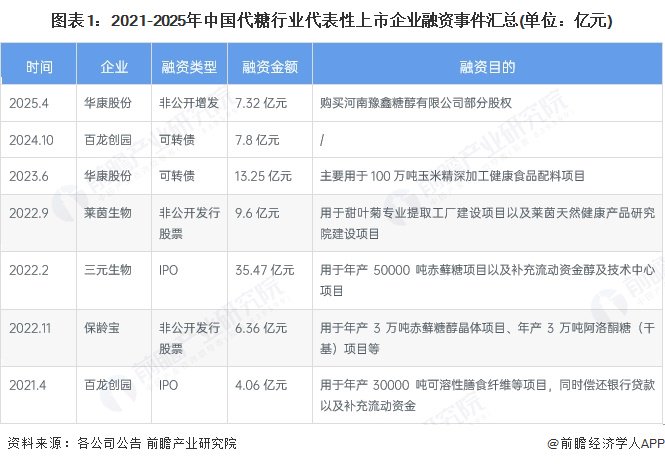
Qian Zhan Wang· 2025-11-21 06:09
Group 1: Core Insights - The financing of listed companies in the sugar substitute industry primarily aims to enhance production capacity [1] - The majority of external investments by representative companies focus on expanding upstream and downstream operations [1][6] Group 2: Financing and Investment - The main financing methods for listed companies include IPOs, private placements, and convertible bonds, with a focus on new projects and capacity enhancement [1] - Notable external investments include significant amounts such as 100 million RMB by Sanyuan Bio and 10 million RMB by Hainan Baolijian [2][3][4] Group 3: Industry Parks and Development - The number of sugar substitute industrial parks in China is limited, with major parks located in Shandong, which is recognized as a global production base [7][8] - The Dezhou High-tech Zone in Shandong has a production capacity of 1.5 million tons and a domestic market share of over 70% [8] Group 4: Mergers and Acquisitions - Recent mergers and acquisitions in the sugar substitute industry are primarily driven by midstream companies seeking to expand scale and secure upstream resources [9][12] - Key acquisitions include Huakang's purchase of Henan Yuxin Sugar Alcohol Co. for 1.098 billion RMB, aimed at increasing market share [12]


辽宁启生源年产6万吨D-阿洛酮糖项目在铁岭开工
Liao Ning Ri Bao· 2025-11-14 01:01
Core Insights - The D-Allulose project by Liaoning Qishengyuan, with an annual production capacity of 60,000 tons, marks a significant step in the establishment of a sugar substitute industry base in Tieling City [1] - The project is expected to enhance the local food industry and promote the transformation of Tieling's corn industry towards green biological manufacturing [1] - The approval of D-Allulose as a new food ingredient in July opens up a vast application market, with projected domestic demand exceeding 1 million tons in the next five years [1] Investment and Economic Impact - The total investment for the first phase of the D-Allulose project is 1 billion yuan, with an anticipated annual output value of 1 billion yuan upon completion [1] - Tieling City is committed to optimizing the business environment and ensuring high standards in project construction, quality, safety, and progress [1]
【行业深度】洞察2025:中国代糖行业竞争格局及市场份额(附营收排名、企业竞争力评价等)
Qian Zhan Wang· 2025-10-31 04:32
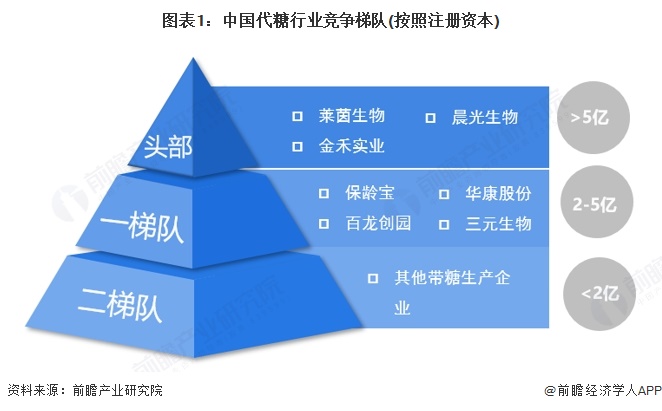
Group 1: Industry Overview - The Chinese sugar substitute industry has a competitive hierarchy, with companies having registered capital exceeding 500 million yuan, such as Rhein Biotech, Jinhui Industrial, and Morning Light Biological, while those with capital between 200 million to 500 million yuan include Baolingbao and Bailong Chuangyuan [1] - The primary production regions for sugar substitute companies in China are Shandong, Hebei, and Anhui provinces, with Shandong housing the most companies, including Sanyuan Biological, Baolingbao, and Bailong Chuangyuan [1] Group 2: Revenue Rankings - In 2024, Huakang Co., Ltd. leads the revenue ranking among listed sugar substitute companies in China, with sales exceeding 1.9 billion yuan. Baolingbao, Rhein Biotech, and Sanyuan Biological follow, each with revenues exceeding 500 million yuan [5] Group 3: Industry Concentration - The concentration levels in the sugar substitute industry are high for products like sucralose, aspartame, and sugar alcohols. Major manufacturers of sucralose include Jinhui Industrial and Shandong Kangbao, while aspartame is primarily produced by companies like Hanguang Sweeteners and the Vito Company [8] Group 4: Company Layout - Companies like Sanyuan Biological and Huakang Co., Ltd. have a high proportion of their business in sugar substitutes. Many companies focus on sugar alcohol products, with Huakang Co., Ltd. producing over 170,000 tons of crystalline sugar alcohol [9][11] - Key sales markets for Chinese sugar substitute companies include China, the Americas, Europe, and Japan and South Korea [9] Group 5: Competitive Analysis - The competitive state of the sugar substitute industry in China shows moderate competition among existing firms, with a significant threat from potential new entrants due to growing health demands [12] - The bargaining power of upstream suppliers is strong, as the main raw materials are sourced from starch and chemical raw material companies, which are generally larger than the sugar substitute manufacturers [12] - The bargaining power of downstream customers is relatively weak, especially for small clients, while industry leaders maintain some pricing power [12]
代糖战来了新角色
经济观察报· 2025-10-11 08:21
Core Viewpoint - The article discusses the emerging market for D-Allulose, a new sugar substitute approved for use in China, highlighting its potential applications and the industry's response to its commercialization [3][5][10]. Group 1: Market Potential and Demand - D-Allulose is recognized as a "new generation sugar substitute" with a sweetness level of 70% compared to sucrose and low caloric content, making it a promising alternative for the food industry [5][12]. - The global market for D-Allulose is projected to reach $14.77 million in 2024, with a compound annual growth rate (CAGR) exceeding 14% from 2025 to 2034 [6]. - The "Healthy China Action (2019-2030)" initiative aims to limit daily added sugar intake to 25 grams per person, increasing the demand for safer and higher-quality sugar substitutes [3][5]. Group 2: Production and Supply Chain - D-Allulose can be produced through two main methods: biological fermentation using E. coli and enzyme-catalyzed conversion, with the latter being more commonly adopted due to lower initial investment requirements [8][9]. - Major companies like COFCO and Baolingbao are ramping up production capabilities, with Baolingbao planning to reach an annual production capacity of approximately 30,000 tons by 2026 [9][12]. - The production process is currently limited by the availability of enzyme preparations, which are crucial for D-Allulose production [9][10]. Group 3: Industry Response and Challenges - Downstream companies, including Wahaha and Mengniu, are interested in testing D-Allulose in their products, but large-scale application is still in the research and testing phase [11][12]. - The cost of D-Allulose remains a significant barrier, with current prices ranging from 20,000 to 24,000 yuan per ton, compared to around 10,000 yuan per ton for erythritol [13][14]. - Concerns about potential overcapacity in the market exist, as seen with erythritol, which experienced a price drop due to oversupply [14][15]. Group 4: Future Outlook - The industry outlook for D-Allulose remains optimistic, with expectations that production costs will decrease as capacity increases [15]. - Key factors for market success include continuous technological innovation, cost control, and the establishment of a complete industrial ecosystem [15].

代糖战来了新角色|科技赋能新消费
Jing Ji Guan Cha Bao· 2025-10-11 07:21
Core Insights - D-Allulose, a new natural sweetener, has been approved for commercial use in China, with significant industry interest and potential applications in food products [1][2][4] Industry Overview - The approval of D-Allulose aligns with the goal of reducing daily sugar intake to 25 grams per person by 2030 as outlined in the Healthy China Action Plan [1] - D-Allulose is recognized for its low-calorie content, being approximately one-tenth the energy of sucrose, and its potential benefits in managing obesity and type 2 diabetes [2] Market Potential - The global market for D-Allulose is projected to reach $14.77 million in 2024, with a compound annual growth rate (CAGR) exceeding 14% from 2025 to 2034 [3] Production and Technology - D-Allulose can be produced through two main methods: fermentation using E. coli and enzyme-catalyzed conversion [4] - Companies like Zhongliang Group have developed proprietary enzymes for D-Allulose production, while others rely on partnerships with research institutions for enzyme sourcing [5][11] Industry Players - Major companies such as Baolingbao, Sanyuan Biotech, and Dongxiao Biotech are expanding their D-Allulose production capabilities, with Baolingbao aiming for an annual capacity of 30,000 tons by 2026 [6][8] - Downstream companies, including Wahaha and Mengniu, are showing interest in testing D-Allulose in their products, although large-scale adoption is still in the experimental phase [7][8] Cost Considerations - The current price of D-Allulose ranges from 20,000 to 24,000 yuan per ton, significantly higher than erythritol, which is around 10,000 yuan per ton [9] - Companies are exploring ways to reduce costs through scale and customized formulations to enhance competitiveness [9][11] Challenges and Risks - The industry faces potential overcapacity risks, as seen with erythritol, which previously experienced a price crash due to oversupply [10] - The successful market penetration of D-Allulose will depend on continuous innovation, cost control, and the establishment of a comprehensive industry ecosystem [11]

代糖战来了新角色
Jing Ji Guan Cha Wang· 2025-10-11 07:09
Core Insights - D-Allulose, a new low-GI sweetener, has been approved for commercial use in China, with significant industry interest and potential applications in food products [1][2][4] - The global market for D-Allulose is projected to reach $14.77 million in 2024, with a compound annual growth rate (CAGR) exceeding 14% from 2025 to 2034 [3] Industry Overview - The approval of D-Allulose aligns with the "Healthy China Action (2019-2030)" initiative, which aims to limit daily added sugar intake to 25 grams per person by 2030 [1] - D-Allulose is recognized for its sugar-like taste, low caloric content (1.67 kJ/g or 0.4 kcal/g), and potential health benefits, including no impact on blood lipids or uric acid levels [2] Production and Supply Chain - D-Allulose can be produced through two main methods: fermentation using E. coli and enzyme-catalyzed conversion [4][5] - Companies like COFCO and Zhongda Hengyuan are actively developing production capabilities, with COFCO utilizing self-developed enzymes for production [5] - The production process is complex, with a need for advanced technology and significant initial investment, leading to a competitive landscape among producers [4][5] Market Dynamics - Downstream companies, including Wahaha and Mengniu, are showing interest in D-Allulose, but large-scale application is still in the testing phase [6][7] - The current cost of D-Allulose is significantly higher than other sweeteners, with prices ranging from 20,000 to 24,000 yuan per ton, compared to around 10,000 yuan per ton for erythritol [8] Future Prospects - The industry is optimistic about D-Allulose's potential, citing its broader application scenarios compared to erythritol, particularly in products sensitive to crystallization [10] - Key factors for market success include ongoing technological innovation, cost control, and the establishment of a complete industry ecosystem [10]
我国高端功能糖实现自主创新突破
Jing Ji Ri Bao· 2025-09-24 11:45
Core Viewpoint - The launch of D-allulose by COFCO Group marks a significant advancement in China's high-end functional sugar market and breaks international technological monopolies in the field of biological manufacturing [1][2]. Group 1: Product Launch and Market Impact - COFCO Group, through its subsidiaries, has introduced the first domestically produced D-allulose product, filling a gap in the high-end functional sugar market in China [1]. - D-allulose is recognized as a promising sugar substitute, with a sweetness level approximately 70% that of sucrose but only 10% of its calories, making it suitable for various food applications [1]. - The global D-allulose market is projected to reach $14.77 million in 2024, with a compound annual growth rate (CAGR) exceeding 14% from 2025 to 2034 [1]. Group 2: Industry and Health Implications - The introduction of D-allulose aligns with national public health initiatives, such as the "Weight Management Year," providing essential support for the Healthy China strategy [2]. - The product opens new innovation opportunities in low-sugar tea and baking industries, allowing consumers to enjoy healthier sweetness without compromising taste [2]. Group 3: Technological Advancements and Research - COFCO Group has invested significantly in research and development, successfully developing high-performance D-allulose-3-epimerase after extensive trials and genetic modifications [2]. - The company has established a comprehensive patent portfolio related to the biological synthesis of D-allulose, covering production strains, enzyme preparations, and separation processes, with 10 core patents already authorized [2][3]. - COFCO Group's commitment to technological innovation is reflected in its strategic initiatives, including policies that incentivize research and development as a core part of its business strategy [3].