癌症早筛

Search documents
Mirxes晶泰强强联手!从早筛到诊疗,千亿赛道引爆价值重估
Ge Long Hui· 2025-12-05 13:25
Core Viewpoint - The strategic collaboration between Mirxes and Jingtai Technology aims to integrate their strengths in early cancer detection and drug development, creating a comprehensive "diagnosis and treatment integration" solution for high-incidence cancers in Asia [1] Collaboration Model - The partnership focuses on building a closed-loop ecosystem of "detection + research" [2] - Mirxes will act as a "frontline detection and risk assessment expert" utilizing its leading position in blood-based miRNA cancer screening [3] - Jingtai Technology will serve as an "intelligent drug discovery engine" leveraging quantum physics, AI, and robotic experimentation [3] - Both companies plan to create a disease database focused on the Asian population to drive the discovery of new diagnostic markers and therapeutic targets [3] Strategic Intent - This collaboration signifies Mirxes' strategic shift from solely "early diagnosis" to a broader "diagnosis and treatment integration" approach [4] - By closely aligning with upstream drug development platforms, the company aims to participate in higher-value treatment segments, enhancing its competitive barriers and customer loyalty [5] Fundamental Support - Mirxes' strategic advancement is backed by improving fundamentals [6] - Recent business expansions include inclusion in the Hang Seng Composite Index, endorsement from Malaysia's sovereign fund, and obtaining key market access qualifications [7] - The company reported a revenue of $10.5 million in the first half of the year, with core early screening business revenue growing by 50% year-over-year [7] - Gross margin improved significantly from 49% to 67.6%, indicating strong product capability and cost control [7] - Cash reserves reached $108 million, providing financial flexibility for R&D collaboration and market expansion [7] Investment Perspective - Mirxes currently exhibits strong growth in core business and a clear long-term strategy [8] - Short-term certainty is based on the commercial progress of its gastric cancer screening and the effectiveness of its high-margin business model [9] - Long-term potential is enhanced by collaborations with major players like Watson and Jingtai, which open avenues for extending from diagnostic data to treatment [9] Conclusion - The strategic partnership between Mirxes and Jingtai Technology represents a forward-looking move to break through the limitations of the early screening industry and tap into the larger precision medicine market [11] - The company is at a critical juncture of "performance realization" and "model transition," necessitating attention to both existing business growth and the potential value creation from the new ecosystem [12]
扬州市邗江区结直肠癌筛查项目三年成果发布,破局公卫项目痛点
Bei Ke Cai Jing· 2025-12-02 09:53
Core Insights - The report highlights the successful implementation of a colorectal cancer screening program in Yangzhou's Hanjiang District, which provided free screenings to approximately 200,000 residents aged 40-74 from 2021 to 2023, detecting 120 cases of colorectal cancer, 1,942 precancerous adenomas, and 859 polyps, thus establishing an effective screening pathway suitable for grassroots healthcare in China [1][2] Group 1: Screening Program Overview - The program covered 15 towns and 146 villages, collaborating with local hospitals to ensure timely diagnosis and treatment for positive screening results, enhancing participation in screenings and providing a practical model for the large-scale application of early screening technologies [2] - The project utilized Kunyan Biotech's blood multi-gene methylation technology for initial screening, followed by colonoscopy for confirmation, creating an integrated service loop from prevention to follow-up [1][2] Group 2: Industry Context and Future Implications - With colorectal cancer incidence and mortality rates rising in China, the early screening industry is experiencing a convergence of policy, technology, and market opportunities, with approximately 520,000 new cases and 240,000 deaths reported in 2022 [1] - The success of the Hanjiang project serves as a sustainable and replicable model for chronic disease management in China, paving the way for the release of the "Expert Consensus on Colorectal Cancer Screening for Community Residents" in April 2024, which will provide technical standards and practical guidelines for nationwide screening efforts [2]
132岁顶级985,排队IPO
3 6 Ke· 2025-11-29 05:18
Group 1 - Wuhan University celebrated its 132nd anniversary, highlighting its achievements in science and technology innovation, with several alumni being elected as academicians of the Chinese Academy of Sciences and the Chinese Academy of Engineering [2][3] - Alumni contributions to the university include significant donations, such as Lei Jun's 1.3 billion yuan scholarship fund, which is the largest single donation in the university's history [2][11] - The "Talent Return to Hubei" initiative has led to over 600 billion yuan in investments from alumni enterprises in Hubei, fostering a strong ecosystem for innovation and entrepreneurship [2][15] Group 2 - Alumni from Wuhan University are increasingly entering the capital markets, with companies like Lingyi iTech and Aimeson filing for IPOs, showcasing the entrepreneurial spirit of the university's graduates [4][6] - Lingyi iTech plans to raise funds for R&D in AI and robotics, while Aimeson focuses on early cancer detection technologies, indicating a trend of alumni-led companies in high-tech sectors [4][5] - Other notable alumni companies, such as EVE Energy and Haisong Aitai, are also pursuing IPOs, further establishing the "Wuda system" as a significant force in the investment landscape [7][8] Group 3 - The university has established numerous platforms for technology transfer and commercialization, collaborating with local governments and enterprises to create a robust innovation ecosystem [13][16] - The alumni network is extensive, with over 317 organizations globally, providing strong support for entrepreneurial initiatives and fostering collaboration among graduates [14] - Local government initiatives, such as the establishment of alumni economic headquarters, aim to leverage alumni resources for regional economic development, further enhancing the entrepreneurial environment [16][17]

早筛的冰与火:雅培210亿美元吞下Exact Sciences,中国同行何以半壁凋零
Hua Xia Shi Bao· 2025-11-28 10:19
Core Viewpoint - Abbott's acquisition of Exact Sciences for $21 billion marks a significant move into the growing multi-cancer early detection market, aiming to enhance its diagnostic business and capitalize on the success of Exact Sciences' flagship product, Cologuard [2][4]. Group 1: Acquisition Details - Abbott announced a cash acquisition of Exact Sciences for $21 billion, with a per-share price of $105, representing a nearly 22% premium over the previous closing price [2]. - This acquisition is Abbott's largest since the $25 billion purchase of St. Jude Medical in 2017, with an estimated enterprise value of $23 billion for Exact Sciences [2]. - The deal is expected to be financed through existing cash and debt, with anticipated annual synergies of approximately $100 million post-transaction completion in Q2 2026 [2]. Group 2: Market Context and Performance - Exact Sciences reported impressive financial results, with Q3 2025 revenue of $851 million, a 20% year-over-year increase, and screening business revenue of $666 million [4]. - The global cancer screening market is projected to grow from $172.3 billion in 2022 to $293.6 billion by 2030, with a compound annual growth rate of about 7% [5]. - Abbott's diagnostic business growth was only 0.4% in Q3 2025, significantly lower than the 17% growth in its medical device segment, highlighting the strategic importance of this acquisition [4]. Group 3: Strategic Implications - The acquisition is seen as a strategic necessity for Abbott's diagnostic business, providing a complete product ecosystem that covers the entire cancer care cycle from screening to monitoring [4][5]. - Exact Sciences' products, including Cologuard and Cancerguard, will benefit from Abbott's extensive global network, facilitating international market expansion, particularly in regions with low penetration [5]. - The acquisition is expected to reshape the competitive landscape of the global cancer early detection industry, potentially increasing Abbott's diagnostic revenue to over $11 billion annually [5]. Group 4: Industry Challenges in China - The Chinese early screening market faces significant challenges, particularly the lack of a supportive payment system, which hampers the adoption of cancer screening technologies [6][8]. - Unlike the U.S., where Cologuard is largely covered by insurance, Chinese policies currently do not support non-treatment cancer screening under national insurance, limiting market growth [6]. - The industry is undergoing a consolidation phase, with companies like NuoHui Health facing severe financial difficulties, highlighting the need for robust product offerings and sustainable business models [7][8].


明星IPO的背后:重大财务造假退市!
Xin Lang Cai Jing· 2025-11-12 09:36
Company Background and Highlights - Nohow Health, founded in 2015, positions itself as a leader in cancer early screening in China, with its core product, Changweiqing, receiving approval in November 2020 as the first colorectal cancer early screening medical device in China [1] - The company went public on the Hong Kong Stock Exchange in February 2021, raising over HKD 2 billion with an initial share price of HKD 26.66, peaking at HKD 89.65 and achieving a market capitalization exceeding HKD 40 billion [1] Core Team and Decision-Making - The CEO and Chairman, Zhu Yeqing, is identified as the orchestrator of fraudulent activities, promoting a "performance-first" strategy that pressured sales teams to meet KPIs at any cost [3] - The organizational culture is highly closed, with sales meetings deemed "top secret" and non-sales staff prohibited from participation [4][5] - There is a prevailing belief in prioritizing loyalty over capability, leading to a culture where questioning the company's practices could result in marginalization or dismissal [6][7] Business Model and Market Performance - The product's logic is flawed, requiring users to collect and send stool samples, resulting in low compliance rates [8] - The high cost of testing, at CNY 1,996, exceeds the willingness to pay for the average consumer, and the lack of insurance coverage has hindered hospital adoption [9][10] - Actual market performance is poor, with total sales for three products in 2022 falling below CNY 20 million, despite claims of significant single-day sales during promotional events lacking third-party verification [11][12] Financial Fraud - The scale of financial fraud is significant, with reported revenues vastly overstated; for instance, in 2021, reported revenue was CNY 211 million, while estimated real revenue was around CNY 30 million, indicating an inflation rate of approximately 85% [14][15] - The fraudulent process involves a four-step closed loop, including shipping products without actual sales, fabricating sample collection, recognizing revenue based on false reports, and recycling funds through various means [15][19][21] Ethical and Regulatory Issues - Claims of having the "world's largest fecal sample library" are misleading, as many samples were collected without consent or proper identification, leading to data contamination [24][26] - The company’s practices have turned medical testing into a tool for financial deception, undermining public trust in cancer screening [27][29] - Regulatory oversight has been inadequate, with the Hong Kong Stock Exchange lacking stringent review processes for biotech companies, and auditors failing to verify the authenticity of samples and user identities [30][32] Timeline of Collapse - Key events leading to the company's downfall include a short-seller report in August 2023 alleging significant revenue fraud, Deloitte's questioning of sales authenticity in March 2024, and subsequent leadership changes culminating in the company's delisting in October 2025 [36][37][40] Investor Challenges - Over 4,000 individual investors have registered for compensation, facing significant losses, with collective litigation being difficult due to the lack of a group lawsuit mechanism in Hong Kong [38][39] - The company's cash has been used to repay priority creditors, complicating asset recovery for ordinary shareholders [39][40] Industry Implications - The collapse of Nohow Health serves as a warning for the Chinese medical technology industry, emphasizing that technological innovation must align with genuine market needs and ethical standards [41][42] - The case highlights the risks of prioritizing rapid growth without validating product-market fit, as well as the necessity for robust regulatory frameworks to prevent exploitation of revenue recognition practices [44]
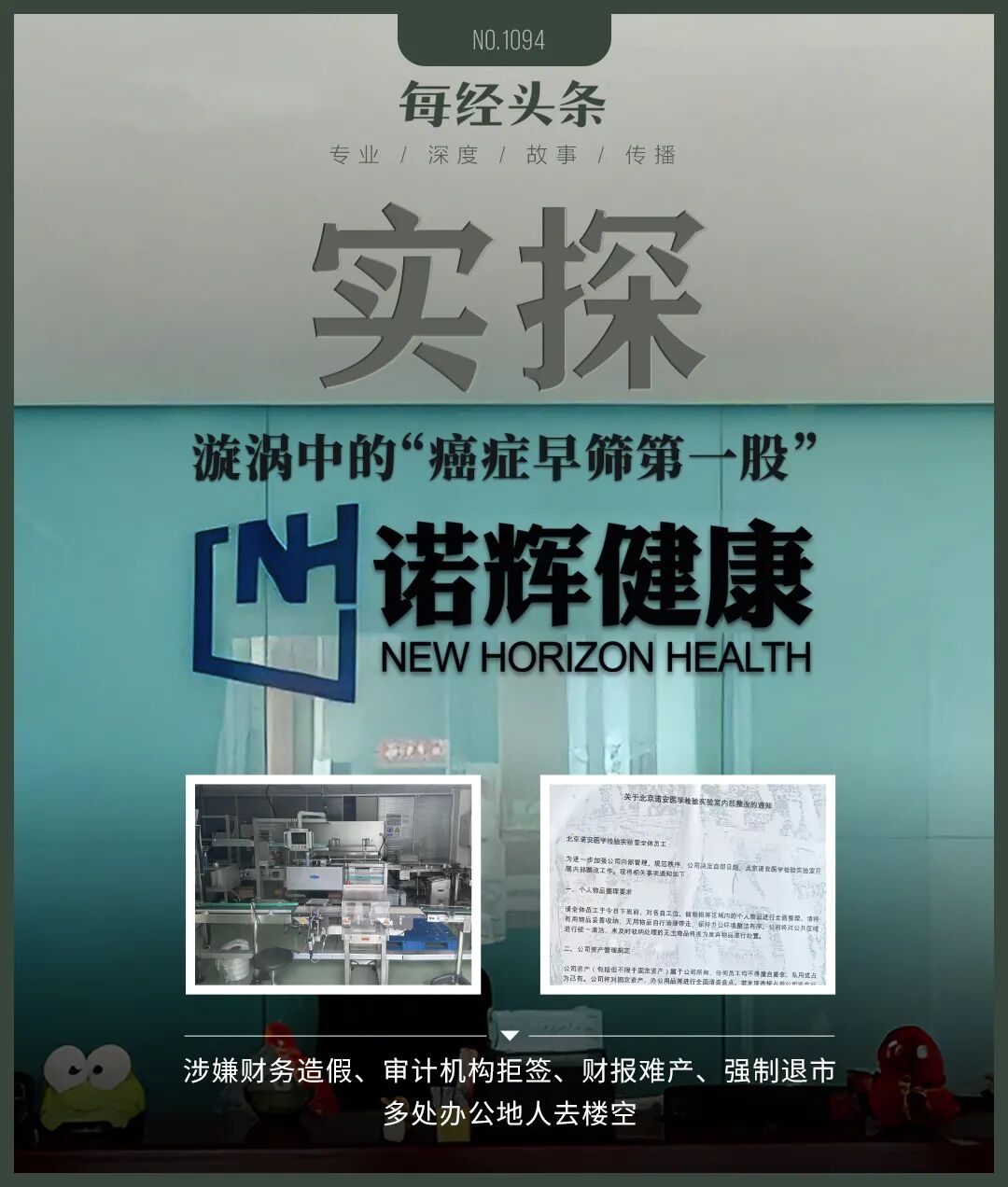
实探诺辉健康:杭州总部多处办公地人去楼空,北京实验室拖欠租金遭催缴,前员工称被曝的只是冰山一角
Mei Ri Jing Ji Xin Wen· 2025-11-08 15:19
Core Viewpoint - The rapid decline of Nohui Health, once a leading player in cancer early screening, is attributed to allegations of financial fraud, leading to its forced delisting from the Hong Kong Stock Exchange within two years [2][21][24]. Company Overview - Nohui Health was established in 2013 and became a prominent company in cancer screening technology, with its headquarters located in Hangzhou, China [4][21]. - The company faced severe operational challenges, including a significant drop in sample reception and a lack of personnel at its facilities [3][8][12]. Financial Allegations - A short-selling report by CapitalWatch in August 2023 accused Nohui Health of inflating its revenue by nearly 90%, claiming that the actual sales for 2022 were only 76.95 million yuan, compared to the reported 765 million yuan [21][24]. - The company’s stock was suspended in March 2024 due to Deloitte's refusal to sign off on its financial statements, leading to its eventual delisting in October 2025 [2][21]. Operational Status - The main office in Hangzhou is now largely abandoned, with only a small portion still operational, indicating a drastic reduction in business activity [6][12]. - The laboratory facilities, including the sample reception area, show signs of inactivity, with no personnel present during visits [8][11]. Legal and Regulatory Challenges - Nohui Health is facing a complex legal situation, including potential liquidation proceedings in the Cayman Islands, which could severely impact individual investors [24][27]. - Over 4,000 individual investors have formed a collective to seek compensation for their losses, with claims exceeding 700 million Hong Kong dollars [24][28]. Product and Market Dynamics - The company’s flagship product, Changweiqing, is facing challenges as its medical device registration certificate is set to expire, raising concerns about its market viability [22][23]. - Despite previous sales successes during promotional events like "Double 11," the current promotional strategies and pricing appear disorganized, leading to potential market confusion [22][23].
4000名投资者血本无归,港股最大造假?
凤凰网财经· 2025-11-01 10:31
Core Viewpoint - The article discusses the downfall of Nohui Health, once hailed as the "first stock in cancer early screening," culminating in its delisting after over 500 days of suspension due to financial fraud allegations and internal conflicts [4][5][6]. Group 1: Company Background and Rise - Nohui Health was founded in 2015 by three Peking University alumni, focusing on cancer early screening, particularly for colorectal cancer, addressing a significant market need in China [23][24][25]. - The company launched its first product, "Changweiqing," a non-invasive home testing kit for colorectal cancer, in 2016, which gained attention and led to multiple rounds of financing, achieving a valuation exceeding $500 million by 2020 [25][26]. - Nohui Health went public on the Hong Kong Stock Exchange in February 2021, raising approximately HKD 2 billion and reaching a market capitalization of over HKD 41 billion on its debut [26][27]. Group 2: Financial Fraud Allegations - In August 2023, a short-selling report by CapitalWatch accused Nohui Health of inflating revenues by over CNY 300 million in 2022 through questionable sales practices, revealing that actual sales might have been only CNY 76.95 million [8][6]. - The report detailed that Nohui Health's revenue recognition practices involved recognizing sales from expired products, creating a misleading picture of sales growth [8][10]. - Deloitte's refusal to endorse Nohui Health's financial statements in March 2024 raised further concerns, leading to the company's suspension from trading [12][13][15]. Group 3: Internal Conflicts and Leadership Changes - Following the financial scandal, Nohui Health's internal power structure began to collapse, culminating in the resignation of CEO Zhu Yeqing in December 2024 due to health reasons and subsequent removal from the board [19][20][22]. - The board's decision to remove Zhu Yeqing indicated significant disagreements regarding management style and corporate governance [19][21]. Group 4: Investor Impact and Market Reaction - Nohui Health's delisting on October 27, 2023, resulted in a market capitalization loss of over HKD 33.6 billion, leaving investors with a valuation of just HKD 0.01 [30][31][32]. - The complex corporate structure of Nohui Health, registered in the Cayman Islands and listed in Hong Kong, has complicated the legal recourse for investors seeking compensation [32][34]. - Over 4,000 individual investors have registered for potential claims, with total investments exceeding CNY 700 million, highlighting the widespread financial damage caused by the company's collapse [34][35].

港股最大造假?4000名投资者血本无归
商业洞察· 2025-10-31 09:41
Core Viewpoint - The article discusses the downfall of Nohui Health, once hailed as the "first stock in cancer screening," which faced severe financial and operational issues leading to its delisting after over 500 days of suspension [5][31]. Group 1: Company Background and Rise - Nohui Health was founded in 2015 by three Peking University alumni, focusing on early cancer screening, particularly for colorectal cancer, addressing a significant market need in China [25][26]. - The company launched its first product, "Changweiqing," in 2016, which was a non-invasive home screening tool for colorectal cancer, gaining attention in the industry [26][27]. - By 2021, Nohui Health went public on the Hong Kong Stock Exchange, raising approximately 2 billion HKD and achieving a market capitalization of over 41 billion HKD on its first day of trading [28]. Group 2: Financial Misconduct and Downfall - In August 2023, a short-selling report from CapitalWatch accused Nohui Health of inflating revenues by over 300 million CNY in 2022 through questionable sales practices [8][10]. - The report claimed that the actual sales revenue for 2022 was only 76.95 million CNY, a stark contrast to the reported 765 million CNY, indicating a nearly ninefold discrepancy [8]. - Deloitte's refusal to endorse Nohui Health's financial statements and subsequent resignation as auditor raised significant concerns about the company's financial integrity [12][14]. Group 3: Impact on Investors - Nohui Health's delisting resulted in a market value loss exceeding 33.6 billion HKD, leaving investors with a valuation of just 0.01 HKD [31][34]. - The complex corporate structure of Nohui Health, registered in the Cayman Islands and listed in Hong Kong, complicated the legal recourse for mainland investors, many of whom faced total losses [35][37]. - Over 4,000 individual investors have registered for potential claims, with total investments exceeding 700 million CNY, highlighting the widespread financial impact of the company's collapse [36][39].
港股最大造假?4000名投资者血本无归
36氪· 2025-10-31 09:17
Core Viewpoint - The article discusses the rise and fall of Nohui Health, a company once celebrated as a leader in cancer early screening, which ultimately faced severe financial and governance issues leading to its delisting from the Hong Kong Stock Exchange [4][6][64]. Group 1: Company Background and Growth - Nohui Health was founded in 2015 by three Peking University alumni, focusing on cancer early screening, particularly for colorectal cancer, addressing a significant market need in China [42][44]. - The company launched its first product, "Changweiqing," in 2016, which was a non-invasive home testing kit for colorectal cancer, gaining attention in the industry [44]. - By 2021, Nohui Health went public on the Hong Kong Stock Exchange, raising approximately HKD 20 billion, with a market valuation exceeding HKD 410 billion at its peak [45][46]. Group 2: Financial Misconduct and Crisis - In August 2023, a short-selling report from Capital Watch accused Nohui Health of inflating its revenue by over HKD 300 million in 2022 through questionable sales practices [13][14]. - The report suggested that the actual sales revenue for 2022 was only HKD 76.95 million, a stark contrast to the reported HKD 765 million, indicating a potential Ponzi scheme-like operation [14][15]. - Deloitte, the company's auditor, raised concerns about the authenticity of Nohui Health's sales data and eventually resigned, which intensified scrutiny and led to the company's suspension from trading [21][24]. Group 3: Governance Issues and Leadership Changes - Following the financial scandal, Nohui Health's internal governance began to crumble, culminating in the resignation of CEO Zhu Yeqing in December 2024 due to health reasons, which was later followed by his removal from the board [34][38]. - The board's decision to remove Zhu highlighted significant differences in management style and philosophy, indicating deeper issues within the company's leadership structure [35][39]. Group 4: Investor Impact and Market Reaction - The company's delisting on October 27, 2023, resulted in a dramatic loss of value, with its market capitalization plummeting from HKD 400 billion to just HKD 0.01, leaving many investors with substantial losses [49][51]. - Over 4,000 individual investors have registered to seek compensation, with total investments exceeding HKD 700 million, reflecting the widespread financial damage caused by the company's collapse [57][58]. - The case has raised concerns about the risks associated with high-growth narratives in the capital market, particularly regarding governance and financial integrity [59][60].
昔日“明星”正式退市!基金抢购赛道竞品
券商中国· 2025-10-29 03:53
Core Viewpoint - Despite the delisting of the first cancer early screening stock in Hong Kong, fund managers are still aggressively purchasing related assets, indicating a strong interest in the cancer early screening sector [1][2]. Industry Overview - Noblue Health, a prominent player in the cancer early screening market, was officially delisted on October 27 due to financial issues and long-term suspension, with its stock valuation adjusted to 0.01 HKD by several public funds [2][3]. - The cancer early screening sector, which integrates genomics and AI medical technology, has gained significant attention from public funds, especially in the context of rising interest in innovative drugs and AI medical assets [2][4]. Market Dynamics - The delisting of Noblue Health has created a scarcity of cancer early screening assets in the Hong Kong market, prompting fund managers to seek alternatives in the U.S. market [4][6]. - Mirxes, a competitor, successfully launched an IPO in Hong Kong, becoming the only cancer early screening stock in the market after Noblue Health's exit [5]. Investment Opportunities - Fund managers are optimistic about the potential of the AI medical sector, with expectations of sustained growth driven by technological advancements and favorable policy support [7][8]. - Investment opportunities in the AI medical sector are identified in three main areas: AI drug development, AI medical applications, and data production and utilization [8].