
统计

Search documents
非农公布机构在数据公布前遭遇技术问题-美股-金融界
Jin Rong Jie· 2025-09-05 12:39
Core Points - The U.S. Bureau of Labor Statistics (BLS) is experiencing "technical issues" ahead of the August employment report release [1] - A statement from the BLS indicates that all data retrieval tools will be unavailable until the issues are resolved [1] - The August non-farm payroll report is scheduled for release at 20:30 Beijing time, but it is unclear if the technical issues will affect the scheduled release [1]
英国通胀“狂飙”至18个月高点!央行降息梦碎?
Jin Shi Shu Ju· 2025-08-20 07:17
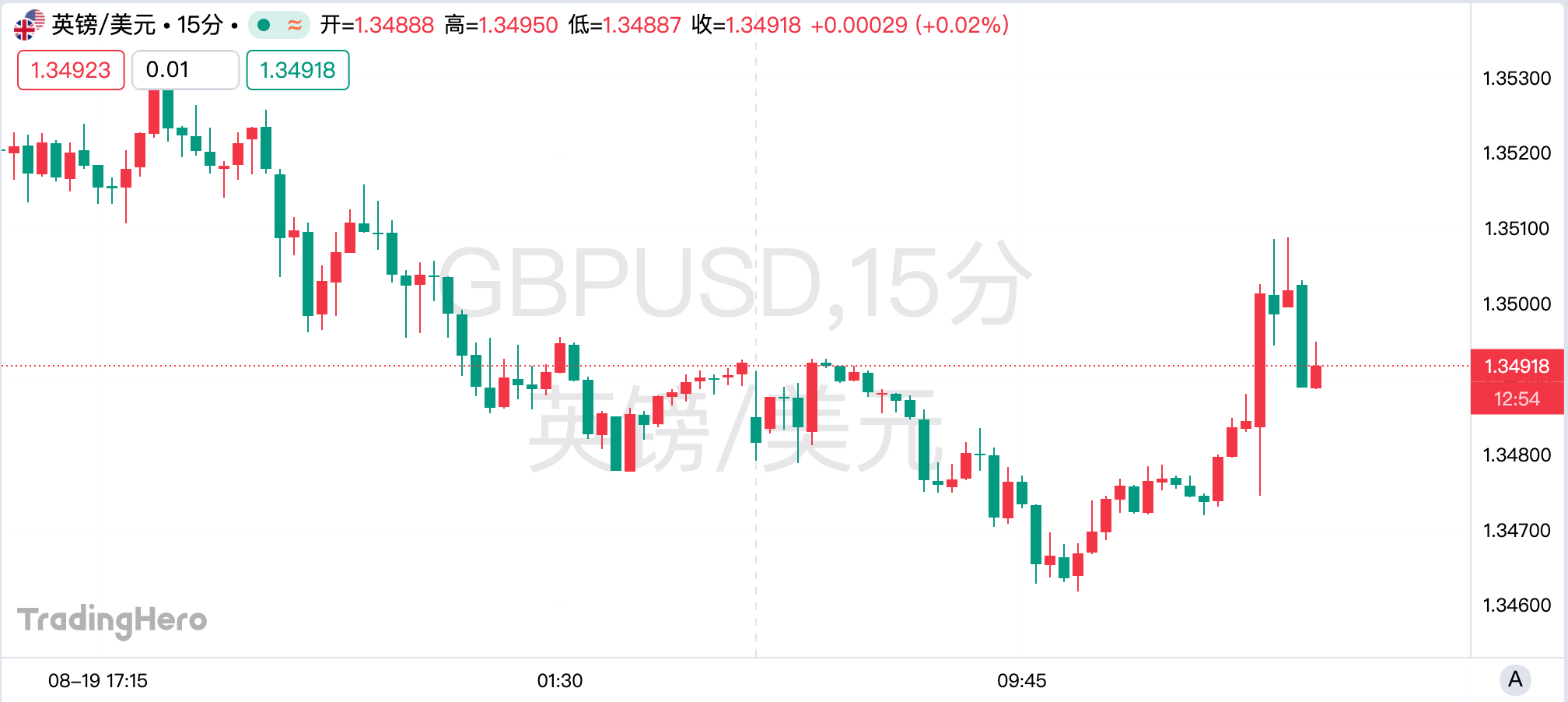
Core Insights - July inflation in the UK unexpectedly accelerated to 3.8%, the fastest rate in a year and a half, impacting expectations for a potential interest rate cut by the Bank of England [1][3] - The inflation rate exceeded the 3.7% forecast by economists and was higher than June's 3.6% [3] - Key drivers of inflation included rising transportation costs, particularly airfares, and automotive fuel prices, with food and non-alcoholic beverage prices increasing by 4.9% year-on-year for the fourth consecutive month [3] Economic Indicators - Service sector inflation rose to 5% in July, up from 4.7% in June, indicating significant price pressures within the economy [3] - The Bank of England faces dual challenges of inflation rebound and sluggish economic growth, having recently cut rates by 25 basis points to 4% while raising inflation forecasts [3][4] - The anticipated inflation for September is projected to reach 4%, double the Bank's target of 2%, with expectations that it will only return to target by 2027 [3] Employment and Economic Growth - There are signs of a weakening job market in the UK, with rising unemployment rates and a decline in employment numbers from May to June, which may hinder wage growth [4] - The UK GDP growth for the second quarter was only 0.3%, a slowdown from 0.7% in the first quarter, influenced by global commodity stockpiling that had previously boosted exports [4] Central Bank Policy Outlook - The unexpected inflation data diminishes the likelihood of a rate cut by the Bank of England in September, with core inflation pressures raising doubts about further policy easing this year [4] - Some analysts suggest that the Bank may overlook certain one-off factors driving price increases and could still consider another rate cut within the year [5]

美国7月CPI今晚登场 银价反弹力度或减弱
Jin Tou Wang· 2025-08-13 03:24
Group 1 - Silver prices are experiencing a rebound, currently reported at $37.78 per ounce, with a high of $37.95 and a low of $37.47 during the trading session [1] - The market is closely watching the upcoming U.S. July CPI data, with expectations of a modest increase of 0.2% month-on-month, while core CPI may see its largest increase in six months at 0.3% [2][3] - Concerns about the reliability of U.S. economic data are rising due to budget cuts and staff shortages at the Bureau of Labor Statistics, leading to increased reliance on estimated data [2][3] Group 2 - The expected year-on-year increase in July CPI is 2.8%, slightly up from 2.7% in June, driven by rising food prices due to labor shortages and tariffs [3] - Core CPI, excluding food and energy, is projected to rise by 0.3%, the highest since January, influenced by tariffs on sensitive goods like auto parts and clothing [3][4] - The interplay of various factors creates a picture of a moderate yet concerning CPI outlook for July [4] Group 3 - Silver prices need to break through $38.00 to continue their upward trend, with key resistance levels at $38.05 and $38.47 [5] - If silver falls below $37.50, it may test the 50-day moving average at $37.03, with further support at $36.22 [5]
机票、房租、油价齐跌!加拿大5月通胀延续降温势头
Xin Hua Cai Jing· 2025-06-24 15:03
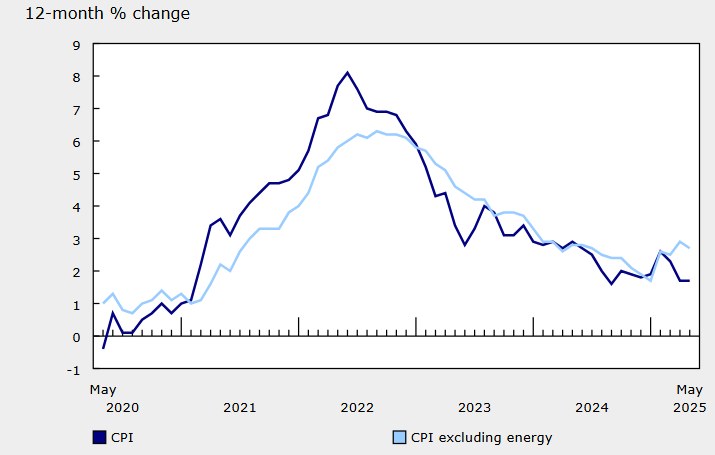
Core Insights - The Consumer Price Index (CPI) in Canada rose by 1.7% year-on-year in May, remaining unchanged from April. Excluding energy, the CPI increased by 2.7%, a slowdown from April's 2.9% [1][4] - Month-on-month, the CPI increased by 0.6%, with a seasonally adjusted increase of 0.2% [1] Price Changes by Category - Housing prices saw a year-on-year increase of 3.0% in May, down from 3.4% in April. Rent prices rose by 4.5%, lower than April's 5.2% [3][5] - Travel prices decreased by 0.2% year-on-year in May, contrasting with a 6.7% increase in April. Airline ticket prices fell by 10.1%, with an expanded decline [3] - Gasoline prices continued to decline, down 15.5% year-on-year in May, compared to an 18.1% drop in April. However, there was a month-on-month increase of 1.9% due to rising refining profits [3] - Mobile service prices saw a reduced year-on-year decline of 5.5% in May, compared to 10.8% in April, with a month-on-month increase of 7.2% due to the end of promotional activities [3] - New car prices increased by 4.9% year-on-year in May, up from 4.6% in April [3] Market Analysis - The slowdown in rent increases and the decline in travel prices exerted downward pressure on the CPI, while the reduced declines in gasoline and mobile service prices provided upward support [4] - The increase in rental supply and a slowdown in population growth in Ontario contributed to the significant deceleration in rent price increases, affecting the national average [4] - Mortgage interest costs have seen a slowdown for the 21st consecutive month, with a year-on-year increase of 6.2% in May, down from 6.8% previously [4] - The Canadian Statistics Agency noted that U.S. tariffs and Canada's countermeasures could impact final consumer prices, but the specific effects are already embedded in the collected final prices, negating the need for special adjustments to the CPI [4]
特朗普政府拟削减劳工统计局预算,经济数据质量面临考验
Hua Er Jie Jian Wen· 2025-06-05 03:00
Group 1 - The Trump administration's budget proposal for the fiscal year 2026 includes an approximately 8% cut to the budget and staffing of the Bureau of Labor Statistics (BLS), which may lead to less reliable economic data that Wall Street heavily relies on [1] - The BLS will focus its resources on core data series known as "major federal economic indicators" (PFEIs), potentially resulting in the elimination of other important economic statistics [1][2] - The budget proposal also suggests restructuring the BLS under the Department of Commerce, merging it with the Bureau of Economic Analysis and the Census Bureau, which is expected to improve efficiency and data quality [1] Group 2 - The BLS has been struggling with a declining budget adjusted for inflation over the years, and has already lost a significant number of staff due to layoffs, early retirements, and a hiring freeze [2] - The collection of some economic data has been affected, with the BLS announcing a reduction in the number of Consumer Price Index (CPI) survey locations due to personnel shortages, which may decrease the reliability of CPI as an inflation measure [3] - The BLS has also announced adjustments to the Producer Price Index (PPI), stopping the calculation of 350 indices, although these indices account for less than 1% of the total PPI [3]
【环球财经】2025年一季度澳大利亚GDP同比增长1.3% 环比增幅降至0.2%
Xin Hua Cai Jing· 2025-06-04 02:30
Economic Growth - Australia's GDP grew by 0.2% quarter-on-quarter and 1.3% year-on-year in Q1 2025, marking the 14th consecutive quarter of quarter-on-quarter growth [1] - The quarter-on-quarter growth rate has decreased from 0.6% in Q4 2024 [1] Per Capita GDP - Per capita GDP in Australia fell by 0.2% quarter-on-quarter in Q1 2025, following a 0.1% increase in Q4 2024 after seven consecutive quarters of decline [1] Government and Private Sector Spending - Government spending remained unchanged quarter-on-quarter, while household consumption increased by 0.4% [2] - Private sector investment grew by 0.7% quarter-on-quarter, driven by residential, new building, and new engineering construction [2] - Public sector investment decreased by 2% quarter-on-quarter [2] Trade and Exports - Exports of goods and services decreased by 0.8% quarter-on-quarter due to adverse weather affecting coal and LNG production and shipping, as well as a lower-than-average increase in international student numbers impacting tourism service exports [2] - Overall imports also fell by 0.4% quarter-on-quarter due to a decrease in capital goods imports and Australians opting for closer, cheaper travel destinations [2] Household Savings and Income - Household savings rate increased to 5.2% in Q1 2025, up from 3.9% in Q4 2024 [2] - Total disposable income for households grew by 2.4%, outpacing the nominal increase in household spending by 1% [2]