
激光雷达

Search documents
万集科技:公司车载激光雷达已完成多家主流车企平台验证,具备前装量产能力
Zheng Quan Ri Bao Wang· 2025-12-18 09:11
Core Viewpoint - Wanji Technology (300552) has completed platform validation for its automotive LiDAR products with several major automotive manufacturers and is actively advancing pre-installation mass production orders [1] Group 1: Company Developments - The company’s automotive LiDAR products, such as the 192-line semi-solid state product, have been validated by multiple mainstream automotive platforms [1] - Wanji Technology's existing production line for automotive LiDAR at its Beijing Shunyi base has the capacity to meet current market demand for both automotive and roadside applications [1]
明星激光雷达公司破产!巅峰市值近千亿,奔驰沃尔沃曾是大客户
首席商业评论· 2025-12-18 05:12
Core Viewpoint - Luminar, a North American laser sensor startup, has filed for Chapter 11 bankruptcy protection, reflecting significant challenges in the lidar industry and the company's operational struggles [6][8][25]. Group 1: Company Overview - Luminar's assets are estimated between $100 million and $500 million, while liabilities range from $500 million to $1 billion [8]. - The company had a market valuation of approximately $11.9 billion at its peak in 2020, which has since declined to about $1.38 billion in 2023 [13]. - Luminar has secured a temporary agreement with creditors to access $25 million in cash to support operations during the bankruptcy process [13]. Group 2: Financial Performance - In Q3 2025, Luminar reported revenue of $18.87 million, with a gross loss of $8.1 million and a free cash flow of -$48.5 million [20]. - The company experienced a net loss of $571 million in 2023, with revenue of approximately $69.78 million [22]. - For 2024, Luminar's revenue slightly increased to $75.4 million, but it still faced a net loss of $273 million [22]. Group 3: Key Events Leading to Bankruptcy - The termination of a contract with Volvo, which accounted for 90% of Luminar's lidar sensor deliveries, was a critical factor leading to the bankruptcy filing [16][18]. - Disputes arose between Luminar and Volvo regarding contract obligations and technology alignment, contributing to the breakdown of their partnership [18]. - The departure of CEO Austin Russell in May 2025 due to an ethics investigation marked the beginning of a series of leadership changes that destabilized the company [24]. Group 4: Market Context - The lidar market in China is thriving, with projections indicating a market size of approximately 13.96 billion yuan in 2024, a significant increase from 7.59 billion yuan in 2023 [14]. - Major Chinese companies like Hesai Technology and RoboSense are capturing over 90% of the market share, contrasting sharply with Luminar's struggles [14]. - The challenges faced by Luminar highlight the structural issues within the lidar industry, including high R&D costs and a concentrated customer base [25].


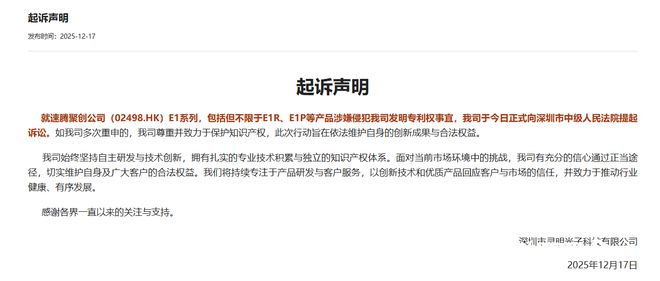
激光雷达行业“专利战”再升级,灵明光子反诉速腾聚创侵权
Nan Fang Du Shi Bao· 2025-12-18 03:05
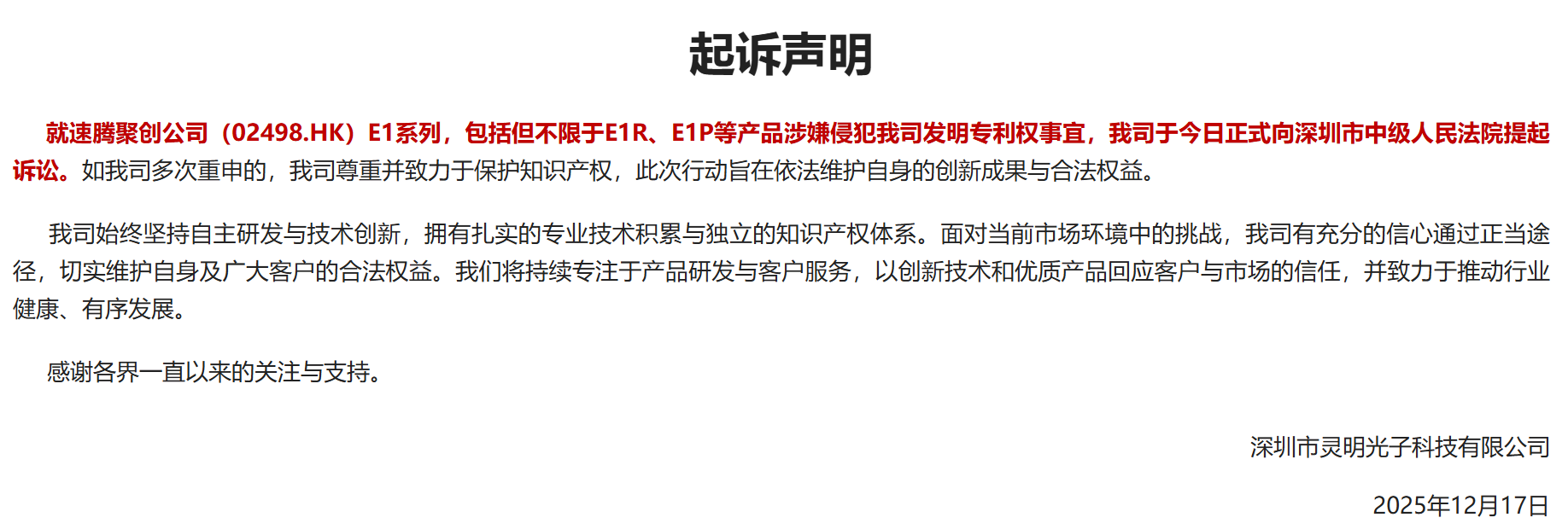
国内激光雷达行业的"专利战"再升级。继本月初速腾聚创(02498.HK)起诉灵明光子窃取商业机密 后,12月17日,深圳市灵明光子科技有限公司(下称"灵明光子")发起反诉,宣布正式向深圳市中级人 民法院起诉速腾聚创侵犯其发明专利权。 在声明中,灵明光子称速腾聚创公司(02498.HK)E1系列,包括但不限于E1R、E1P等产品涉嫌侵犯其 发明专利权。灵明光子表示公司尊重并致力于保护知识产权,此次行动旨在依法维护自身的创新成果与 合法权益。 这标志着这场被称为激光雷达行业"SPAD 芯片第一案"的纠纷,已从单向指控演变为双方互诉的胶着 战。受市场竞争加剧及诉讼消息影响,速腾聚创股价近期承压,12月17日,盘中最低跌至35.6港元/ 股。截至12月17日收盘,报36.16港元/股,微涨0.72%,总市值约170.7亿港元。 灵明光子消息人士:不排除追加起诉 事件的导火索可以追溯到本月初。12月1日,市场传出速腾聚创在11月以"涉嫌侵犯自研SPAD芯片相关 技术秘密"为由,向广东省深圳市中级人民法院提交了起诉灵明光子的立案申请,指控这家曾经的合作 伙伴在合作终止后迅速推出了技术路径相似的芯片产品,涉嫌不正当竞争。 ...
最后的希望破产 打压中国产品难掩美国激光雷达产业窘境
Ke Ji Ri Bao· 2025-12-18 01:49
Group 1 - The U.S. House of Representatives introduced the "Security Lidar Act," aiming to phase out Chinese-made lidar systems and ban new imports after three years, except for research and cybersecurity testing [1] - The act is seen as part of a broader strategy to undermine Chinese technology products and protect U.S. market space, similar to previous actions against Huawei [1] - Chinese companies currently dominate the lidar market, with estimates indicating that four firms—Hesai Technology, RoboSense, Huawei, and TuSimple—will hold 88% of the global automotive lidar market share by 2024 [1] Group 2 - Chinese lidar companies have achieved significant technological advancements and manufacturing capabilities, with Hesai and RoboSense holding over three times the number of relevant patents compared to U.S. leaders Ouster and Luminar [2] - The production efficiency of Chinese firms is highlighted, with Hesai's automated production line capable of producing a lidar unit every 20 seconds, making their products not only technologically advanced but also competitively priced [2] - In contrast, U.S. lidar companies face challenges in scaling production and maintaining competitive pricing, with Luminar's products priced around $1,000 and plans to reduce prices not expected until 2026 [3] Group 3 - The struggles of U.S. lidar companies reflect broader issues within the U.S. manufacturing sector, indicating that reliance on market restrictions against Chinese products may not resolve underlying challenges [4] - Even if the U.S. manages to restrict Chinese products, it may not be able to capitalize on the resulting market space due to its own industry weaknesses [4]

中汽中心发布《激光雷达芯片授权专利》自主创新榜单,速腾聚创居榜首
Ge Long Hui· 2025-12-18 01:36
Core Insights - The article highlights the importance of semiconductor chips in the development of LiDAR technology, indicating that the competition in the LiDAR industry has shifted from traditional optical and mechanical structures to chip-level innovations [1] Group 1: Industry Overview - LiDAR technology is crucial for autonomous driving and intelligent perception, with its core performance now reliant on semiconductor chips [1] - China is positioned as a significant player in the global LiDAR industry, making strides in integrated circuit design, manufacturing, and testing [1] Group 2: Patent Statistics - The top three companies in the LiDAR technology integrated circuit field are Shenzhen Suteng Juchuang Technology Co., Ltd. with 100 patents, Shanghai Hesai Technology Co., Ltd. with 90 patents, and Wuhan Wanjie Optoelectronics Technology Co., Ltd. with 77 patents, collectively holding over 35% of the total patents in the top 20 [2][3] - The analysis is based on a comprehensive patent database, focusing on effective patents granted to domestic innovators in the LiDAR technology integrated circuit sector [2] Group 3: Competitive Landscape - A diverse ecosystem is emerging, with specialized LiDAR companies and cross-industry tech firms collaborating, such as Shenzhen Lidar Intelligent System Co., Ltd. and DJI Innovations, which are leveraging their expertise in electronics to enter the LiDAR market [3] - The competition is characterized by a mix of professional LiDAR firms and semiconductor companies, creating a complementary technological landscape [3] Group 4: Patent Focus Areas - The patent landscape covers essential components of LiDAR technology, including VCSEL driver circuits, SPAD/SiPM detection circuits, and logic integration circuits for main control chips, which are critical for the transition to solid-state LiDAR [5] - The concentration of patents indicates a consensus in the industry regarding the "chipization" technology route, which is vital for reducing costs and enhancing performance [5] Group 5: Future Outlook - The competitive landscape in the LiDAR technology integrated circuit sector is defined by leading companies, collaborative efforts, and precise patent strategies that align with the evolving demands of autonomous driving [6] - Future advancements will focus on enhancing circuit design, multi-module integration, and innovative circuit solutions for emerging technologies like MEMS+Flash hybrid solid-state and OPA+FMCW coherent detection [6]
科技日报:打压中国产品难掩美国激光雷达产业窘境
Ke Ji Ri Bao· 2025-12-18 01:02
Group 1 - The U.S. House of Representatives' "China Task Force" has proposed the "Laser Radar Security Act," aiming to phase out Chinese-made laser radars in the U.S. and ban imports after three years, except for research and cybersecurity testing [1] - The act's proponent, Congressman Raja Krishnamoorthi, claims that Chinese laser radars pose a national security threat and emphasizes the need for the U.S. and its allies to lead in laser radar innovation [1] - Chinese companies currently dominate the laser radar market, with estimates indicating that four firms—Hesai Technology, RoboSense, Huawei, and TuSimple—will hold 88% of the global market share by 2024 [1] Group 2 - Chinese laser radar companies are excelling in both technology and manufacturing, with Hesai Technology and RoboSense holding over three times the number of relevant patents compared to U.S. leaders Ouster and Luminar [2] - The mass production capabilities of Chinese firms are highlighted, with Hesai's automated production line producing a laser radar every 20 seconds and achieving competitive pricing, with some products priced as low as $200 [2] Group 3 - U.S. companies once held a leading position in the laser radar market, with Velodyne dominating with over 80% market share in the 2010s, but have struggled with low-cost mass production [3] - Recent challenges include the bankruptcy of Luminar, which was once highly valued, and difficulties faced by other U.S. laser radar companies, with Ouster's actual shipments being only 7,200 units in Q3 2025 [3] Group 4 - The struggles of the U.S. laser radar industry reflect broader issues within its manufacturing sector, suggesting that relying on market restrictions against Chinese products may not resolve underlying challenges [4]
负债近百亿,明星供应商宣告破产
汽车商业评论· 2025-12-17 23:04
Core Viewpoint - Luminar Technologies, a once-prominent lidar company, has filed for Chapter 11 bankruptcy protection after facing multiple challenges, including layoffs, executive departures, and a deteriorating relationship with its largest customer, Volvo [4][5][7]. Group 1: Bankruptcy Filing and Financial Status - Luminar filed for bankruptcy on December 15, 2023, in Texas, aiming to manage asset disposition while maintaining operational continuity and pursuing the sale of its lidar business [4][5]. - The company's assets are estimated between $100 million and $500 million, while liabilities range from $500 million to $1 billion [7][18]. - Luminar has accumulated approximately $4.88 billion in financing debt, with a net loss of around $2.3 billion by the end of Q3 2025 [16][18]. Group 2: Relationship with Volvo - The relationship with Volvo, which initially involved a framework procurement agreement for approximately 67,300 units in 2023, deteriorated significantly, leading to a 75% reduction in expected orders for 2024 [12][13]. - Volvo's decision to change lidar from standard to optional equipment for the EX90 model resulted in a projected revenue drop of about 90% for Luminar, significantly impacting its financial outlook [13][14]. - The breakdown in the partnership escalated to a public dispute, with Luminar halting shipments to Volvo and Volvo terminating the agreement due to alleged contract breaches [14][18]. Group 3: Business Model and Market Position - Luminar's business model involved not only selling hardware but also providing software solutions for autonomous driving, with a focus on integrating lidar technology into passenger vehicles [9][10]. - The company had previously achieved a high market valuation, reaching approximately $3.4 billion through a SPAC merger in 2020, attracting notable investors [9][10]. - The reliance on a limited number of major clients, such as Tesla and Volvo, has exposed Luminar to significant cash flow and operational risks, particularly as the automotive market's demand for lidar technology fluctuated [10][12]. Group 4: Future Plans and Asset Sales - Luminar plans to sell its semiconductor subsidiary, Luminar Semiconductor, for $110 million, while also seeking buyers for its lidar business during the bankruptcy process [17][18]. - The company aims to continue operations during the bankruptcy proceedings, focusing on minimizing disruptions to customers and suppliers [17][18]. - The board believes that a court-supervised asset sale is the best path forward, with the current CEO emphasizing the commitment to delivering high-quality products during this transition [17].
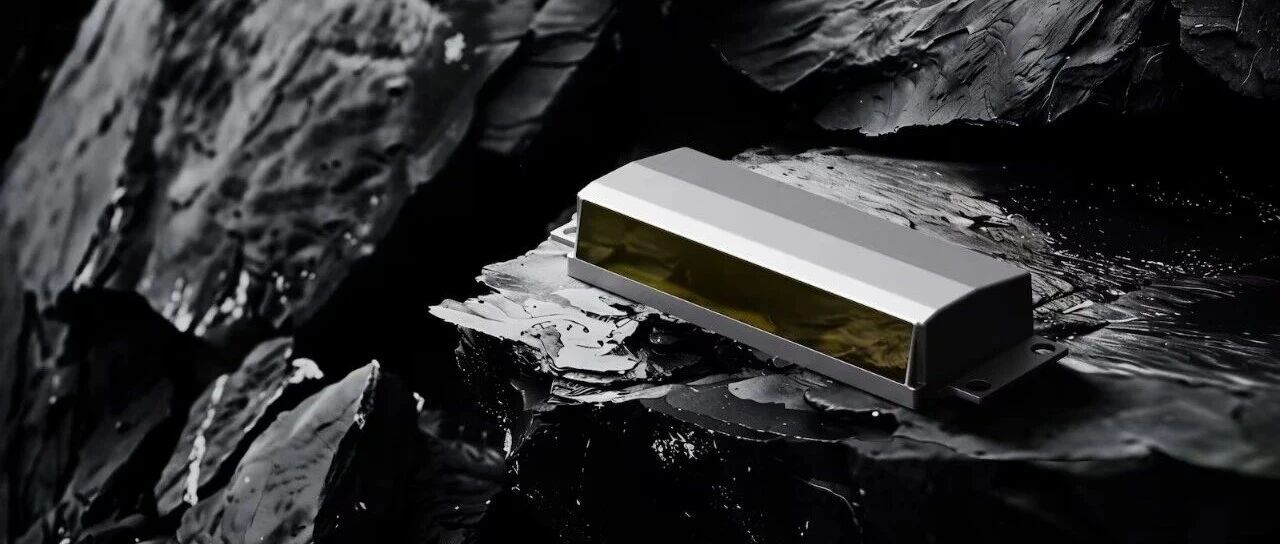
激光雷达知识产权大战升级,灵明光子反诉侵权,速腾聚创再反击
2 1 Shi Ji Jing Ji Bao Dao· 2025-12-17 13:09
Core Viewpoint - The legal battle over intellectual property rights in the lidar semiconductor industry has escalated, with both companies filing lawsuits against each other regarding patent and trade secret infringements [1][2]. Group 1: Legal Actions - In November, Company A (速腾聚创) filed a lawsuit against Company B (灵明光子) for "infringement of trade secrets" [1]. - On December 17, Company B announced it had filed a lawsuit against Company A for patent infringement concerning its E1 series products [1]. - Company A responded by stating it has initiated multiple lawsuits against Company B for trade secret infringement and accused Company B of evading core issues [1][2]. Group 2: Company Statements - Company B emphasized its commitment to protecting intellectual property and stated that its legal action aims to safeguard its innovations and rights [1]. - Company A criticized Company B for not addressing the core allegations of trade secret infringement and for diverting focus by filing a separate patent lawsuit [2]. - Company A has conducted a thorough investigation and claims to have established a complete evidence chain regarding the alleged infringement [2]. Group 3: Industry Context - Legal experts noted that in the manufacturing sector, intellectual property disputes often resolve through mutual licensing agreements rather than escalating into prolonged legal battles [5].
速腾聚创发布声明 回应与灵明光子纠纷 称已启动多起知识产权诉讼
Zheng Quan Shi Bao Wang· 2025-12-17 09:39
Core Viewpoint - The core dispute between SUTENG JUCHUANG and Lingming Photon Technology revolves around allegations of technology secret infringement, with SUTENG JUCHUANG denying any patent infringement claims made by Lingming Photon and asserting its own legal actions against Lingming for alleged misuse of its technology secrets [1][2]. Group 1: Legal Actions and Allegations - Lingming Photon has filed a lawsuit against SUTENG JUCHUANG, claiming that the E1 series products infringe on its invention patent rights [1]. - SUTENG JUCHUANG has initiated multiple lawsuits against Lingming Photon for allegedly infringing on its technology secrets, emphasizing the seriousness of such allegations which could lead to criminal liability [1][2]. - SUTENG JUCHUANG has completed an in-depth investigation and has established a complete evidence chain regarding the alleged misuse of its technology secrets by Lingming Photon [2]. Group 2: Company Position and Strategy - SUTENG JUCHUANG asserts that the nature of patent infringement and technology secret infringement lawsuits is fundamentally different, with the latter being more severe due to its implications of improper acquisition and use of confidential information [2]. - The company emphasizes its commitment to maintaining a fair and transparent business environment, having invested hundreds of millions in the development of its core chip technology [2]. - SUTENG JUCHUANG has filed two lawsuits regarding technology secret and patent infringement, with another patent infringement lawsuit currently in the process of being filed [3]. Group 3: Response to Lingming Photon - In response to Lingming Photon’s public statements and actions following the lawsuit filings, SUTENG JUCHUANG has initiated a commercial defamation lawsuit and has reported the matter to market supervision authorities [3]. - The company is prepared to respond to Lingming Photon’s patent lawsuit through legal means, including filing for patent invalidation [3]. - SUTENG JUCHUANG calls for all parties to address the core issue of technology secret infringement seriously and professionally, warning that any attempts to divert attention from the main dispute could lead to further legal and market risks [3].
惠山经开区:产融共舞 奔赴高质量发展星辰大海
Xin Hua Ri Bao· 2025-12-17 06:49
果下科技上市 引领"AI+"储能革新 果下科技成立于2019年,是聚焦"AI+"储能的可再生能源解决方案及产品提供商,主要从事储能系统及 相关产品的研发、生产与销售,业务覆盖电力侧、电网侧、工商业及住宅等多类应用场景。截至目前, 果下科技取得授权专利82项,其中发明专利18项,先后获评"国家高新技术企业""江苏省独角兽企业"等 称号。 公司秉持"系统化+智能化"发展路径,构建"云—边—端"协同的智能架构,并通过AI算法实现安全预警 与效率优化,持续提升储能系统的安全性、运行效率与全生命周期价值。依托"境内境外市场协同、大 型储能与分布式储能并举"的双轨策略,以及"果下科技"与海外品牌"HANCHU ESS"双品牌驱动,公司 已建立起持续增长的业务格局。 12月16日上午,果下科技股份有限公司正式在香港交易所主板挂牌上市。这家深耕"AI+"储能领域的高 新技术企业由此迈入资本市场新阶段。 值得关注的是,果下科技的成功上市,是无锡惠山经济技术开发区聚焦优质产业、以专业资本赋能企业 成长的又一标杆成果。惠山经开区始终锚定高质量发展首要任务,系统推进金融供给与产业需求深度融 合,坚定成为科创企业的同行者与赋能者,以资 ...