
普钢

Search documents
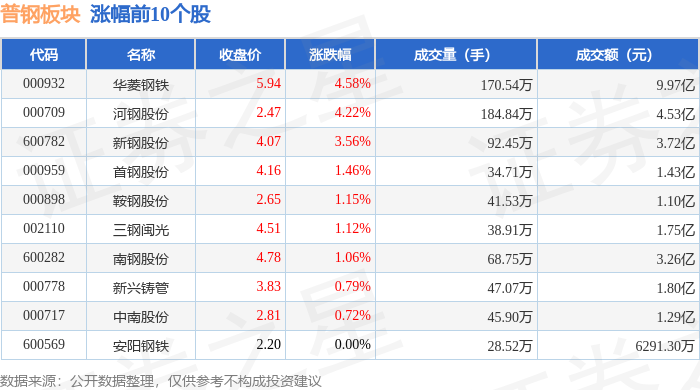
普钢板块8月29日涨0.04%,华菱钢铁领涨,主力资金净流出10.32亿元
Zheng Xing Xing Ye Ri Bao· 2025-08-29 08:36
Market Overview - On August 29, the general steel sector rose by 0.04% compared to the previous trading day, with Hualing Steel leading the gains [1] - The Shanghai Composite Index closed at 3857.93, up 0.37%, while the Shenzhen Component Index closed at 12696.15, up 0.99% [1] Individual Stock Performance - Hualing Steel (000932) closed at 5.94, with a gain of 4.58% and a trading volume of 1.7054 million shares, amounting to a transaction value of 999.7 million yuan [1] - Other notable performers included: - Hebei Steel (000709): closed at 2.47, up 4.22%, with a trading volume of 1.8484 million shares and a transaction value of 453 million yuan [1] - New Steel (600782): closed at 4.07, up 3.56%, with a trading volume of 924,500 shares and a transaction value of 372 million yuan [1] - Shougang Group (656000): closed at 4.16, up 1.46%, with a trading volume of 347,100 shares and a transaction value of 143 million yuan [1] Fund Flow Analysis - The steel sector experienced a net outflow of 1.032 billion yuan from major funds, while retail investors saw a net inflow of 755 million yuan [2] - Notable fund flows for specific stocks included: - Hualing Steel: net outflow of 53.9374 million yuan from major funds and a net inflow of 41.3838 million yuan from retail investors [3] - New Steel: net inflow of 21.1613 million yuan from major funds, but a net outflow of 3.6064 million yuan from retail investors [3] - Hebei Steel: net inflow of 6.6862 million yuan from major funds, with a net outflow of 164.61 thousand yuan from retail investors [3]


华菱钢铁涨2.11%,成交额2.07亿元,主力资金净流入1645.95万元
Xin Lang Cai Jing· 2025-08-29 03:08
Core Viewpoint - Hualing Steel has shown a significant increase in stock price and trading activity, indicating positive market sentiment and potential investment opportunities [1][2]. Financial Performance - For the first half of 2025, Hualing Steel reported operating revenue of 630.92 billion yuan, a year-on-year decrease of 16.93% [2]. - The net profit attributable to shareholders was 1.748 billion yuan, reflecting a year-on-year increase of 31.31% [2]. Stock Performance - As of August 29, Hualing Steel's stock price increased by 42.12% year-to-date, with a recent 5-day increase of 2.47% and a 20-day increase of 2.65% [1]. - The stock was trading at 5.80 yuan per share, with a market capitalization of 40.07 billion yuan [1]. Shareholder Information - As of June 30, 2025, the number of shareholders increased to 90,300, up by 19.94% from the previous period [2]. - The average number of circulating shares per shareholder decreased by 16.63% to 76,500 shares [2]. Dividend Distribution - Hualing Steel has distributed a total of 10.436 billion yuan in dividends since its A-share listing, with 3.934 billion yuan distributed over the past three years [3]. Institutional Holdings - As of June 30, 2025, Hong Kong Central Clearing Limited was the fifth-largest circulating shareholder, holding 134 million shares, an increase of 2.431 million shares from the previous period [3]. - Southern CSI 500 ETF ranked as the eighth-largest circulating shareholder with 61.4662 million shares, an increase of 8.3913 million shares [3].
普钢板块8月28日跌0.13%,友发集团领跌,主力资金净流出7.22亿元
Zheng Xing Xing Ye Ri Bao· 2025-08-28 08:43
Group 1 - The core viewpoint indicates that the steel sector experienced a slight decline, with a 0.13% drop on August 28, led by Youfa Group [1] - The Shanghai Composite Index closed at 3843.6, reflecting a 1.14% increase, while the Shenzhen Component Index closed at 12571.37, showing a 2.25% increase [1] Group 2 - In terms of capital flow, the steel sector saw a net outflow of 722 million yuan from main funds, while retail investors contributed a net inflow of 379 million yuan [2] - Speculative funds recorded a net inflow of 343 million yuan into the steel sector on the same day [2]


柳钢股份(601003)6月30日股东户数3.63万户,较上期减少6.21%
Zheng Quan Zhi Xing· 2025-08-27 11:41
Core Insights - LiuGao Co., Ltd. reported a decrease in the number of shareholders to 36,286 as of June 30, 2025, down by 2,402 or 6.21% from March 31, 2025 [1] - The average number of shares held per shareholder increased from 66,200 to 70,600, with an average market value of 248,600 yuan [1][2] - The stock price of LiuGao Co., Ltd. increased by 17.73% during the period from March 31, 2025, to June 30, 2025, despite the reduction in shareholder numbers [1][2] Shareholder Statistics - As of June 30, 2025, the average number of shareholders in the steel industry was 147,800, indicating that LiuGao Co., Ltd. has a lower shareholder count compared to the industry average [1] - The average market value of shares held by shareholders in the steel industry was 179,700 yuan, while LiuGao Co., Ltd. exceeded this average [1] Financial Flows - During the period from March 31, 2025, to June 30, 2025, LiuGao Co., Ltd. experienced a net inflow of 57.70 million yuan from main funds, while retail funds saw a net inflow of 8.41 million yuan [2] - The company had a net outflow of 66.11 million yuan from speculative funds during the same period [2] - The financing net inflow was 44.39 million yuan, indicating an increase in financing balance [2]


8月27日晚间重要公告一览
Xi Niu Cai Jing· 2025-08-27 10:16
Group 1 - Youyou Food achieved a net profit of 108 million yuan in the first half of 2025, a year-on-year increase of 42.47%, with a revenue of 771 million yuan, up 45.59% [1] - Keda achieved a net profit of 255 million yuan, a year-on-year increase of 16.49%, with a revenue of 2.163 billion yuan, up 14.35% [1] - North Navigation turned a profit with a net profit of 116 million yuan, achieving a revenue of 1.703 billion yuan, a year-on-year increase of 481.19% [1][2] Group 2 - China Satellite Communication reported a net profit of 181 million yuan, a year-on-year decrease of 55.59%, with a revenue of 1.221 billion yuan, up 6.33% [3] - Huqin Technology achieved a net profit of 1.889 billion yuan, a year-on-year increase of 46.3%, with a revenue of 83.939 billion yuan, up 113.06% [4] - Huasen Lithium reported a net loss of 72.739 million yuan, with a revenue of 350 million yuan, up 72.02% [4] Group 3 - Putailai achieved a net profit of 1.055 billion yuan, a year-on-year increase of 23.03%, with a revenue of 7.088 billion yuan, up 11.95% [5] - Suochen Technology reported a net loss of 45.698 million yuan, with a revenue of 57.351 million yuan, up 10.82% [5] - Canqin Technology achieved a net profit of 51.912 million yuan, a year-on-year increase of 51.94%, with a revenue of 287 million yuan, up 52.76% [6] Group 4 - Hengtong achieved a net profit of 99.3648 million yuan, a year-on-year increase of 38.86%, with a revenue of 669 million yuan, down 44.66% [6] - Sanan Optoelectronics reported a net profit of 176 million yuan, a year-on-year decrease of 4.24%, with a revenue of 8.987 billion yuan, up 17.03% [7] - New Dairy achieved a net profit of 397 million yuan, a year-on-year increase of 33.76%, with a revenue of 5.526 billion yuan, up 3.01% [8] Group 5 - Yiling Pharmaceutical achieved a net profit of 669 million yuan, a year-on-year increase of 26.03%, with a revenue of 4.040 billion yuan, down 12.26% [10] - Baosteel achieved a net profit of 4.879 billion yuan, a year-on-year increase of 7.36%, with a revenue of 151.372 billion yuan, down 7.28% [12] - Feikai Materials achieved a net profit of 217 million yuan, a year-on-year increase of 80.45%, with a revenue of 1.462 billion yuan, up 3.8% [13] Group 6 - Lier Chemical achieved a net profit of 271 million yuan, a year-on-year increase of 191.21%, with a revenue of 4.507 billion yuan, up 35.36% [15] - Shaanxi Coal achieved a net profit of 7.638 billion yuan, a year-on-year decrease of 31.18%, with a revenue of 779.83 billion yuan, down 14.19% [16] - Dongfang Materials reported a net profit of 654,400 yuan, a year-on-year decrease of 88.48%, with a revenue of 174 million yuan, down 5.06% [18] Group 7 - Blue Sky Bio achieved a net profit of 26.7163 million yuan, a year-on-year decrease of 8.98%, with a revenue of 652 million yuan, up 7.05% [19] - Shanghai Jiubai achieved a net profit of 23.7897 million yuan, a year-on-year increase of 0.24%, with a revenue of 45.0535 million yuan, down 1.09% [20] - Two Sides Needle reported a net loss of 5.0842 million yuan, with a revenue of 522 million yuan, up 1.02% [21] Group 8 - Shanghai Yashi achieved a net profit of 20.3263 million yuan, a year-on-year increase of 42.56%, with a revenue of 2.044 billion yuan, up 56.75% [23] - Bayi Steel reported a net loss of 697 million yuan, with a revenue of 8.733 billion yuan, down 6.73% [25] - Hongrun Construction plans to repurchase shares worth between 150 million and 300 million yuan [27] Group 9 - Kaile achieved a net profit of 10.9193 million yuan, a year-on-year increase of 280.42%, with a revenue of 137 million yuan, down 17.89% [28] - Jingda achieved a net profit of 306 million yuan, a year-on-year increase of 6.03%, with a revenue of 11.856 billion yuan, up 14.28% [29] - Blue Light Marker reported a net profit of 96.4427 million yuan, a year-on-year decrease of 47.33%, with a revenue of 32.36 billion yuan, up 4.87% [30] Group 10 - KOTAI Power achieved a net profit of 23.994 million yuan, a year-on-year increase of 35.52%, with a revenue of 711 million yuan, up 49.51% [33] - Bo Rui Data reported a net loss of 26.1918 million yuan, with a revenue of 70.1997 million yuan, up 5.19% [34] - Jiuzhoutong achieved a net profit of 1.446 billion yuan, a year-on-year increase of 19.7%, with a revenue of 81.106 billion yuan, up 5.10% [37] Group 11 - Aier Eye Hospital achieved a net profit of 2.051 billion yuan, a year-on-year increase of 0.05%, with a revenue of 11.507 billion yuan, up 9.12% [39] - Nandu Property achieved a net profit of 130 million yuan, a year-on-year increase of 532.87%, with a revenue of 914 million yuan, up 2.75% [41] - Weiyuan reported a net loss of 168 million yuan, with a revenue of 4.601 billion yuan, up 1.82% [42] Group 12 - Zhongke Chuangda achieved a net profit of 158 million yuan, a year-on-year increase of 51.84%, with a revenue of 3.299 billion yuan, up 37.44% [43] - Zhongjuxin reported a net profit of 8.1377 million yuan, a year-on-year decrease of 64.57%, with a revenue of 567 million yuan, up 20.40% [44] - Inspur Information achieved a net profit of 799 million yuan, a year-on-year increase of 34.87%, with a revenue of 80.192 billion yuan, up 90.05% [45] Group 13 - Shenghong Technology achieved a net profit of 2.143 billion yuan, a year-on-year increase of 366.89%, with a revenue of 9.031 billion yuan, up 86.00% [46] - Cambrian achieved a net profit of 1.038 billion yuan, turning a profit, with a revenue of 2.881 billion yuan, up 4347.82% [48] - Longteng Optoelectronics reported a net loss of 121 million yuan, with a revenue of 1.289 billion yuan, down 27.91% [49]





柳钢股份(601003):上半年盈利大幅增长,产品结构持续改善
GOLDEN SUN SECURITIES· 2025-08-27 06:52
Investment Rating - The report maintains a "Buy" rating for the company [4][6]. Core Views - The company has experienced significant profit growth in the first half of 2025, with a net profit of 368 million yuan, a year-on-year increase of 579.54% [1]. - The sales gross margin has gradually improved, with the second quarter of 2025 showing a net profit of 107 million yuan, a year-on-year increase of 545.47% [2]. - The company has increased its steel production and sales significantly, with production reaching 6.68 million tons and sales at 6.71 million tons, both up over 14% year-on-year [3]. - The company is focusing on high-value-added products, with 10 new high-end products developed in the first half of 2025, and the proportion of specialty steel reaching 45.7% [3]. - The company is positioned as a leading steel enterprise in South China, with a favorable outlook for profit recovery as new production capacity comes online [4]. Financial Summary - In the first half of 2025, the company achieved operating revenue of 34.675 billion yuan, a decrease of 8.32% year-on-year [1]. - The projected financials for 2025 include an operating revenue of 71.918 billion yuan and a net profit of 988 million yuan, reflecting a year-on-year growth rate of 328.2% [5]. - The earnings per share (EPS) for 2025 is expected to be 0.39 yuan, with a projected price-to-earnings (P/E) ratio of 15.6 times [5]. - The company has made significant fixed asset investments of 2.061 billion yuan to enhance equipment and production line upgrades [3].
马钢股份跌2.09%,成交额3.38亿元,主力资金净流出3046.70万元
Xin Lang Zheng Quan· 2025-08-27 06:21
Group 1 - The core viewpoint of the news is that Maanshan Iron & Steel Co., Ltd. (Ma Steel) has experienced fluctuations in its stock price and trading volume, with a recent decline in share price despite a year-to-date increase [1][2] - As of August 27, Ma Steel's stock price was reported at 3.75 yuan per share, with a market capitalization of 28.958 billion yuan and a trading volume of 338 million yuan [1] - Year-to-date, Ma Steel's stock has increased by 21.36%, but it has seen a slight decline of 1.32% over the last five trading days [1] Group 2 - Ma Steel's main business segments include flat products (50.83%), long products (39.23%), other products (6.33%), and wheels and axles (3.61%) [1] - The company operates in the steel industry, specifically in the sub-sector of general steel and flat products, and is involved in various concept sectors such as high-speed rail and railway infrastructure [2] - As of March 31, 2025, Ma Steel reported a revenue of 19.425 billion yuan, a year-on-year decrease of 4.74%, while its net profit attributable to shareholders was -144 million yuan, reflecting a year-on-year increase of 53.67% [2] Group 3 - Since its A-share listing, Ma Steel has distributed a total of 15.903 billion yuan in dividends, with 155 million yuan distributed over the past three years [3] - As of March 31, 2025, the number of shareholders for Ma Steel was reported at 135,700, a decrease of 0.46% from the previous period [2][3] - Notable changes in institutional holdings include an increase in shares held by Hong Kong Central Clearing Limited and a decrease in shares held by Southern CSI 500 ETF [3]

8月27日早间重要公告一览
Xi Niu Cai Jing· 2025-08-27 04:04
Group 1 - Aofei Data achieved a net profit of 87.89 million yuan in the first half of 2025, a year-on-year increase of 16.09% [1] - Aofei Data's revenue for the same period was 1.148 billion yuan, up 8.20% year-on-year [1] - The company specializes in IDC services, internet business, system integration, and distributed photovoltaic energy-saving services [1] Group 2 - Meilan De reported a net profit of 63.92 million yuan, a year-on-year decrease of 11.96% [1] - The company's revenue was 241 million yuan, reflecting a growth of 5.62% year-on-year [1] - Meilan De focuses on the research, production, sales, and service of medical devices related to pelvic and obstetric rehabilitation [1] Group 3 - Jiuan Medical posted a net profit of 920 million yuan, a significant year-on-year increase of 52.91% [1] - The company's revenue decreased by 43.35% to 765 million yuan [1] - Jiuan Medical specializes in the research, production, and sales of home medical devices [2] Group 4 - Hanbang Technology's net profit fell by 26.24% to 27.80 million yuan [2] - The company achieved a revenue of 349 million yuan, a growth of 5.99% year-on-year [2] - Hanbang Technology provides professional separation and purification equipment, consumables, and technical solutions for the pharmaceutical and life sciences sectors [2] Group 5 - Jinjing Environment reported a net profit of 78.69 million yuan, a year-on-year increase of 13.73% [2] - The company's revenue was 782 million yuan, reflecting a growth of 1.70% [2] - Jinjing Environment focuses on investment operation management services and equipment manufacturing in the environmental sanitation sector [2] Group 6 - Tianbao Infrastructure achieved a net profit of 118 million yuan, a remarkable year-on-year increase of 2106.58% [3] - The company's revenue decreased by 8.31% to 486 million yuan [3] - Tianbao Infrastructure is involved in real estate development, property leasing, and management [4] Group 7 - Weihuaxin Materials reported a net profit of 83.15 million yuan, a year-on-year decrease of 52.91% [5] - The company's revenue was 437 million yuan, down 30.71% year-on-year [5] - Weihuaxin Materials specializes in the research and production of chlorotoluene and trifluoromethylbenzene products [5] Group 8 - Tianchen Medical posted a net profit of 48.21 million yuan, a year-on-year increase of 67.10% [6] - The company's revenue was 156 million yuan, reflecting a growth of 17.66% [6] - Tianchen Medical focuses on the research, innovation, and production of high-end surgical staplers [6] Group 9 - Greenland Holdings reported a net loss of 3.506 billion yuan in the first half of 2025 [8] - The company's revenue was 9.45 billion yuan, down 18.06% year-on-year [8] - Greenland Holdings is involved in various financial services including securities, futures, and trust [8] Group 10 - Wukuang Capital's net profit decreased by 41.47% to 525 million yuan [9] - The company achieved a total revenue of 623 million yuan, a significant increase of 144.86% [9] - Wukuang Capital operates in the financial sector, providing services such as securities and leasing [9] Group 11 - Yutong Technology reported a net profit of 554 million yuan, a year-on-year increase of 11.42% [10] - The company's revenue was 7.876 billion yuan, reflecting a growth of 7.10% [10] - Yutong Technology specializes in the research, design, production, and sales of paper packaging products [10] Group 12 - Wewei Co. posted a net profit of 120 million yuan, a year-on-year decrease of 20.14% [11] - The company's revenue was 1.521 billion yuan, down 12.76% year-on-year [11] - Wewei Co. focuses on the production and sales of various food and beverage products [11] Group 13 - Tongfang Co. reported a net loss of 256 million yuan in the first half of 2025 [12] - The company's revenue was 5.667 billion yuan, down 10.09% year-on-year [12] - Tongfang Co. is engaged in the development of smart technology and nuclear technology applications [12] Group 14 - Liugang Co. achieved a net profit of 368 million yuan, a year-on-year increase of 579.54% [13] - The company's revenue was 34.675 billion yuan, down 8.32% [13] - Liugang Co. specializes in coke, sintering, iron, steel smelting, and steel processing [13] Group 15 - China National Petroleum Corporation reported a net profit of 83.993 billion yuan, with a proposed dividend of 0.22 yuan per share [14] - The company's revenue was 1.45 trillion yuan, down 6.7% year-on-year [14] - The company is involved in oil and gas exploration, production, refining, and sales [14] Group 16 - Fangda Carbon's net profit decreased by 68.31% to 54.53 million yuan [15] - The company's revenue was 1.690 billion yuan, down 28.13% year-on-year [15] - Fangda Carbon specializes in the research, production, and sales of graphite and carbon materials [15] Group 17 - Xinmai Medical reported a net profit of 31.5 million yuan, a year-on-year decrease of 22.03% [18] - The company's revenue was 714 million yuan, down 9.24% year-on-year [18] - Xinmai Medical focuses on the research, production, and sales of vascular intervention medical devices [18] Group 18 - Hengbao Co. posted a net profit of 35.35 million yuan, a year-on-year decrease of 44.41% [19] - The company's revenue was 430 million yuan, down 8.64% year-on-year [19] - Hengbao Co. specializes in high-end intelligent products and digital security solutions [19] Group 19 - Zhongji Xuchuang reported a net profit of 3.995 billion yuan, a year-on-year increase of 69.40% [20] - The company's revenue was 14.789 billion yuan, reflecting a growth of 36.95% [20] - Zhongji Xuchuang specializes in high-end optical communication modules and devices [20] Group 20 - Guangxian Media achieved a net profit of 2.229 billion yuan, a year-on-year increase of 371.55% [21] - The company's revenue was 3.242 billion yuan, up 143.00% year-on-year [21] - Guangxian Media focuses on investment, production, and distribution of film projects [21] Group 21 - Huarun Pharmaceutical reported a net profit of 37.33 million yuan, a year-on-year decrease of 49.01% [23] - The company's revenue was 624 million yuan, down 19.13% year-on-year [23] - Huarun Pharmaceutical specializes in pharmaceuticals, medical devices, and health products [23] Group 22 - Huawai Technology posted a net profit of 12.7 million yuan, a year-on-year increase of 56.18% [24] - The company's revenue was 937 million yuan, reflecting a growth of 32.62% [24] - Huawai Technology focuses on the research, production, and sales of high-end elastic components [24]




包钢股份涨2.17%,成交额26.08亿元,主力资金净流出1.03亿元
Xin Lang Cai Jing· 2025-08-27 03:15
Core Viewpoint - Baosteel Co., Ltd. has shown significant stock performance with a year-to-date increase of 52.31% and a recent trading volume indicating active market participation [1][2]. Financial Performance - For the first half of 2025, Baosteel reported operating revenue of 31.33 billion yuan, a year-on-year decrease of 11.02%, while net profit attributable to shareholders increased by 39.99% to 151 million yuan [2]. - Cumulative cash dividends since the A-share listing amount to 4.49 billion yuan, with 90.58 million yuan distributed over the past three years [3]. Stock Market Activity - As of August 27, Baosteel's stock price reached 2.83 yuan per share, with a market capitalization of 128.17 billion yuan [1]. - The stock has experienced a trading volume of 2.608 billion yuan on the same day, with a turnover rate of 2.98% [1]. - The stock has appeared on the "Dragon and Tiger List" twice this year, with the latest instance on July 30, where net buying amounted to 374 million yuan [1]. Shareholder Structure - As of June 30, 2025, Baosteel had 929,800 shareholders, an increase of 22.89% from the previous period, with an average of 33,750 circulating shares per shareholder, down by 18.62% [2][3]. - Major shareholders include Hong Kong Central Clearing Limited, holding 1.214 billion shares, and several ETFs, indicating a diversified institutional ownership [3].

新兴铸管(000778):季度盈利环比大增,关注基建需求潜力
GOLDEN SUN SECURITIES· 2025-08-26 06:17
Investment Rating - The report maintains a "Buy" rating for the company, indicating a positive outlook based on its market performance and growth potential [6]. Core Views - The company reported a revenue of 17.728 billion yuan in the first half of 2025, a year-on-year decrease of 5.36%, while the net profit attributable to shareholders was 404 million yuan, down 5.58% year-on-year. However, the second quarter showed a significant recovery with a net profit of 267 million yuan, a year-on-year increase of 3.92% and a quarter-on-quarter increase of 94.77% [1]. - The company is positioned as a leader in the ductile iron pipe industry in China, benefiting from urban pipeline renovations and water conservancy facility construction. The projected net profits for 2025 to 2027 are 820 million yuan, 990 million yuan, and 1.23 billion yuan, respectively, with corresponding P/E ratios of 18.6, 15.4, and 12.4 [3][6]. Summary by Sections Financial Performance - In the first half of 2025, the company achieved a revenue of 17.728 billion yuan, a decrease of 5.36% year-on-year. The net profit attributable to the parent company was 404 million yuan, down 5.58% year-on-year, with basic earnings per share of 0.1018 yuan, a decrease of 5.04% [1]. - The second quarter of 2025 saw a recovery with a net profit of 267 million yuan, marking a year-on-year increase of 3.92% and a quarter-on-quarter increase of 94.77% [1]. Production and Sales - The sales volume of metal products increased by 8.22% year-on-year in the first half of 2025, with ductile iron pipe sales up by 5.43%. The company aims for a production target of 9.92 million tons of metal products in 2025, a year-on-year increase of 22.6% [2]. - The company has successfully launched a 250,000-ton ductile iron pipe project in Egypt and is establishing a distribution network in the Middle East and North Africa [2]. Market Outlook - The water conservancy construction investment in China reached 532.9 billion yuan in the first half of 2025, with various projects underway. Infrastructure investment (excluding electricity) grew by 3.2% year-on-year from January to July 2025, indicating a positive trend for the company's business [3]. - The company is expected to benefit from ongoing government support for infrastructure projects, including urban underground pipeline renovations and large-scale industrial equipment upgrades [3].
