
有色金属冶炼和压延加工业

Search documents
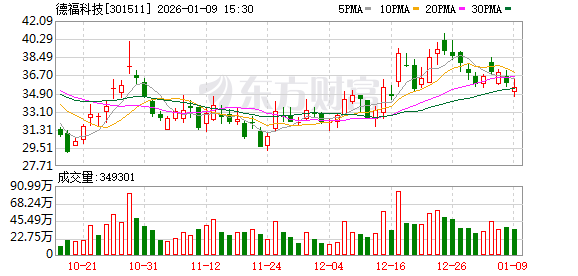
德福科技股价跌10.68%,南方基金旗下1只基金位居十大流通股东,持有288.43万股浮亏损失1093.15万元
Xin Lang Cai Jing· 2026-01-12 01:56
Group 1 - The core point of the news is that Defu Technology's stock price dropped by 10.68% to 31.70 CNY per share, with a trading volume of 150 million CNY and a turnover rate of 1.27%, resulting in a total market capitalization of 19.981 billion CNY [1] - Defu Technology, established on September 14, 1985, is located in the automotive industrial park of Jiujiang, Jiangxi Province, and specializes in the research, production, and sales of high-performance electrolytic copper foil [1] - The company's main business revenue composition includes lithium battery copper foil at 77.53%, electronic circuit copper foil at 14.80%, and other supplementary products at 7.66% [1] Group 2 - From the perspective of the top ten circulating shareholders, a fund under Southern Fund ranks among the top shareholders of Defu Technology, specifically the Southern CSI 1000 ETF (512100), which newly entered the top ten shareholders in the third quarter with 2.8843 million shares, accounting for 0.77% of the circulating shares [2] - The Southern CSI 1000 ETF (512100) was established on September 29, 2016, with a latest scale of 76.63 billion CNY, and has achieved a year-to-date return of 7.05%, ranking 1300 out of 5579 in its category [2] - The fund has a one-year return of 45.31%, ranking 1627 out of 4202 in its category, and a return of 22.43% since its inception [2]
新年已获2亿元订单
Xin Lang Cai Jing· 2026-01-11 22:25
"订单还在持续增加,我们有信心今年实现产值持续增长。"贵州贵材副总经理李衍雷干劲满满。2025 年,贵州贵材年产值8.5亿元,比去年增长约13%,这得益于企业持续以技术革新赋能传统铝材产业升 级。 转自:贵州日报 本报讯(记者 陈露)1月11日,位于贵阳经开区的贵州贵材创新科技股份有限公司车间,生产线飞速运 转,载满铝材的运输车不断发往全国各地。新年伊始,该公司已获2亿元订单,生产计划排至四月。 "中高端产品占比正逐年攀升,企业转型升级的步子迈得稳稳当当。"李衍雷介绍,贵州贵材运用工业 4.0的理念,从2019年开始,用两年时间完成了智能化生产平台打造。该平台集成了生产、销售、采购 等六大板块,打通了信息"孤岛",实现从研发、设计、生产到销售全产业链的协同。 "事实证明,这一平台成为我们提高产量、提升附加值的有力助手。"李衍雷表示,该平台大大缩短了公 司产品的开发周期和交货期,车间生产成本降低20%。 作为国家高新技术企业、国家级绿色工厂、国家专精特新"小巨人"企业,贵州贵材紧扣"富矿精开",向 精深加工延伸。目前,贵州贵材已拥有知识产权数十项,并成功试产8微米电池铝箔,储备5微米超薄铝 箔技术,在目前能制造 ...
德福科技拟收购慧儒科技控股权
Zheng Quan Shi Bao· 2026-01-11 16:52
对于此次交易终止的原因,公告称,根据卢森堡经济部于2026年1月9日出具的最终决定,本次交易虽附 条件获准,但附加限制条件与公司战略诉求存在根本冲突。该项批准所附加的一系列限制条件包括但不 限于,投资者所能购买的股权比例仅能对应少数投票权的水平,且不得对公司决策机制享有否决权,以 及后续关于公司治理、知识产权、商业秘密等经营事项的限制。 与此同时,德福科技选择将战略重心转向国内行业整合。德福科技本次拟收购的标的慧儒科技主要从事 各类高性能电解铜箔的研发、生产和销售,主要产品包括锂电铜箔和电子电路铜箔。截至公告披露日, 慧儒科技电解铜箔产能为2万吨/年,具有成熟的电解铜箔生产能力。 本次交易完成后,慧儒科技将成为德福科技控股子公司。具体交易方案、交易金额等将在公司及聘请的 中介机构完成对标的公司尽职调查,并经交易各方协商后,在最终签署的正式交易协议中明确。本次交 易不构成关联交易,预计不构成重大资产重组。 同时,德福科技披露的另一则公告显示,公司终止对卢森堡高端铜箔企业CFL100%股权的收购交易。 除合同保证金外,公司尚未支付股权转让款,本次交易项下标的股权未交割。交易对方同意于本次交易 终止后10个工作日内 ...

信用分析周报(2026/1/5-2026/1/11):关注边际修复行业的配置机会-20260111
Hua Yuan Zheng Quan· 2026-01-11 13:56
1. Report Industry Investment Rating No relevant content provided. 2. Core Viewpoints of the Report - Since the second half of 2025, the "anti-involution" policy has catalyzed the stabilization and recovery of commodity prices, and the fundamentals of some industries have shown signs of repair. For example, the non-ferrous metals industry has seen an upward shift in the price center of major metals under the multiple positive factors of continuous increase in policy support for stable growth, rapid expansion of downstream emerging industry demand, and steady improvement in domestic resource security capabilities. The profitability, operational capacity, and solvency of issuing entities have been enhanced. In 2026, the excess returns in the credit bond market may come from the value discovery of industries with fundamental repair. For the non-ferrous metals industry with fundamental repair, it is recommended to focus on allocating AA+/AAA-level central enterprises and regional leading state-owned enterprises and appropriately extend the duration, while also paying attention to avoiding the credit risks of bonds issued by small and medium-sized smelting and processing enterprises with low resource self-sufficiency rates and single industrial chain layouts [5][7][48] - Overall, this week, the credit spreads of most industries and ratings were compressed by less than 10BP, while the AA+ credit spread of the non-bank financial sector widened significantly by 20BP. In terms of urban investment bonds, the credit spreads of urban investment bonds with different maturities were compressed by 1-4BP compared with last week. In terms of industrial bonds, the short-term (1Y) credit spreads of industrial bonds widened significantly, while those above 1Y were mostly compressed to varying degrees. In terms of bank capital bonds, the short-term (within 1Y) spreads of bank perpetual and secondary capital bonds widened slightly, the 3Y spreads were significantly compressed, and the medium- and long-term (5-10Y) spreads were slightly compressed [6][47][48] 3. Summary According to the Directory 3.1 This Week's Credit Hot Events - On January 9th, the National Association of Financial Market Institutional Investors (NAFMII) issued a business reminder on further standardizing the issuance of debt financing instruments, emphasizing five aspects: distribution information entry, withdrawal reporting, subscription record-keeping, lead underwriting syndicate mechanism, and information disclosure quality. It is expected that in the short term (Q1 2026), the issuance efficiency of inter-bank bonds may decline, and the issuance difficulty of some weakly qualified issuers may increase. In the long term, the inter-bank bond issuance market will become more standardized and transparent, which is conducive to improving market liquidity and pricing efficiency [11][12][13] - On January 9th, the Guizhou Provincial People's Government issued policies to support the integrated development of industry, county prosperity, and people's well-being. In the short term, the policies will directly support county-level "Three Guarantees" and debt risk mitigation. In the long term, they will support the continuous improvement of local debts through industrial upgrading and fiscal revenue growth. For the existing platform debts in Guizhou, the policies strengthen the financing support for high-quality projects and force county-level platforms to transform into operating entities, which may further intensify regional credit differentiation [14][15] 3.2 Primary Market 3.2.1 Net Financing Scale - This week, the net financing of credit bonds (excluding asset-backed securities) was 115.3 billion yuan, an increase of 191.6 billion yuan compared with last week. The total issuance was 285.5 billion yuan, an increase of 209.2 billion yuan, and the total repayment was 170.3 billion yuan, an increase of 17.6 billion yuan. The net financing of asset-backed securities was 14.7 billion yuan, an increase of 15 billion yuan [16] - By product type, the net financing of urban investment bonds was 30.9 billion yuan, an increase of 37.5 billion yuan; the net financing of industrial bonds was 89.7 billion yuan, an increase of 144.5 billion yuan; and the net financing of financial bonds was -5.4 billion yuan, an increase of 9.6 billion yuan [16] 3.2.2 Issuance Cost - This week, the issuance volume of urban investment bonds and industrial bonds increased significantly, and the issuance rates of AA and AA+ decreased significantly compared with last week. Specifically, the average issuance rates of AA urban investment bonds and industrial bonds were in the range of 2.6-2.8%, the average issuance rates of AA+ urban investment bonds and industrial bonds were in the range of 2.2-2.3%, and the issuance rates of AAA-level bonds of different varieties were all below 2.3% [23] 3.3 Secondary Market 3.3.1 Transaction Volume - In terms of trading volume, the trading volume of credit bonds (excluding asset-backed securities) increased by 554.6 billion yuan compared with last week. Among them, the trading volume of urban investment bonds was 246 billion yuan, an increase of 139.5 billion yuan; the trading volume of industrial bonds was 329.6 billion yuan, an increase of 172.8 billion yuan; the trading volume of financial bonds was 498.8 billion yuan, an increase of 242.3 billion yuan. The trading volume of asset-backed securities was 16.2 billion yuan, an increase of 4.8 billion yuan [24] - In terms of turnover rate, the overall turnover rate of credit bonds increased compared with last week. Specifically, the turnover rate of urban investment bonds was 1.58%, an increase of 0.89 percentage points; the turnover rate of industrial bonds was 1.7%, an increase of 0.89 percentage points; the turnover rate of financial bonds was 3.21%, an increase of 1.56 percentage points. The turnover rate of asset-backed securities was 0.44%, an increase of 0.13 percentage points [25] 3.3.2 Yield - This week, the yields of 5Y credit bonds of different ratings widened slightly, while the yields of credit bonds of other ratings and maturities fluctuated by no more than 3BP compared with last week. Taking AA+ 5Y bonds of each variety as an example, the yields of different varieties all increased to varying degrees [27][28] 3.3.3 Credit Spread - Overall, the credit spreads of most industries and ratings were compressed by less than 10BP this week, while the AA+ credit spread of the non-bank financial sector widened significantly by 20BP. Specifically, the credit spreads of AA media, mining, commercial trade, and transportation industries were compressed by 7BP, 6BP, 7BP, and 6BP respectively; the credit spreads of AA+ building materials and machinery industries were compressed by 8BP and 10BP respectively; the credit spread of the AAA computer industry was compressed by 7BP. The credit spreads of other industries and ratings fluctuated by no more than 5BP [31] - **Urban Investment Bonds**: In terms of maturity, the credit spreads of urban investment bonds of different maturities were compressed by 1-4BP compared with last week. In terms of regions, the credit spreads of urban investment bonds in different regions were compressed to varying degrees [36][37] - **Industrial Bonds**: This week, the short-term (1Y) credit spreads of industrial bonds widened significantly, while those above 1Y were mostly compressed to varying degrees [40] - **Bank Capital Bonds**: This week, the short-term (within 1Y) spreads of bank perpetual and secondary capital bonds widened slightly, the 3Y spreads were significantly compressed, and the medium- and long-term (5-10Y) spreads were slightly compressed [43] 3.4 This Week's Bond Market Sentiment - This week, the implied ratings of 41 bond issues of 8 entities were downgraded, including 16 issues of AVIC Industry Finance Holdings Co., Ltd. and 10 issues of New Hope Wuxin Industrial Group Co., Ltd. The "21 Wantong 02" issued by Guangxi Wantong Real Estate Co., Ltd. was extended; the "H20 Zhengrong 2" issued by Zhengrong Real Estate Holdings Co., Ltd. defaulted substantially; Shandong Zhangqiu Blower Co., Ltd. was placed on the watch list, and its "Zhanggu Convertible Bond" was also placed on the watch list [4][45] 3.5 Investment Recommendations - This week, a total of 1,323.6 billion yuan of reverse repurchases matured in the open market, and the central bank conducted a total of 102.2 billion yuan of reverse repurchase operations, resulting in a net withdrawal of 1,221.4 billion yuan for the whole week. As of the close on Friday, DR001 closed at 1.28% [6] - For the non-ferrous metals industry with fundamental repair, it is recommended to focus on allocating AA+/AAA-level central enterprises and regional leading state-owned enterprises and appropriately extend the duration, while also paying attention to avoiding the credit risks of bonds issued by small and medium-sized smelting and processing enterprises with low resource self-sufficiency rates and single industrial chain layouts [7][48]
收购卢森堡铜箔遇阻 德福科技火速转向国内以解产能“近渴”|速读公告
Xin Lang Cai Jing· 2026-01-11 11:09
Core Viewpoint - Defu Technology has terminated its acquisition of Luxembourg-based Circuit Foil Luxembourg S.a.r.l. due to additional restrictions imposed by the Luxembourg Ministry of Economy and is now shifting its focus to acquiring a domestic company, Anhui Huiru Technology Co., Ltd. [1][3] Group 1: Acquisition Details - The acquisition of Circuit Foil Luxembourg was valued at €2.15 billion, with a net purchase price of €1.74 billion after adjustments [2] - Circuit Foil Luxembourg is a leading global high-end IT copper foil manufacturer, with an annual production capacity of 16,800 tons [2] - The company reported a net profit of -€370,000 in 2024, but projected a profit of €1.67 million in Q1 2025 due to increased product launches [2] Group 2: Strategic Shift - Following the termination of the overseas acquisition, Defu Technology has signed a letter of intent to acquire at least 51% of Anhui Huiru Technology through cash purchase and capital increase [1][3] - Anhui Huiru Technology, established in November 2021, has an annual production capacity of 20,000 tons of high-performance electrolytic copper foil [3] - The acquisition aims to address Defu Technology's near-saturation production capacity and facilitate rapid capacity expansion by integrating advanced production lines and equipment [3]
德福科技(301511.SZ):拟收购慧儒科技不低于51%的股权
Ge Long Hui A P P· 2026-01-11 10:07
Core Viewpoint - Defu Technology (301511.SZ) plans to acquire at least 51% of Anhui Huiru Technology Co., Ltd. through cash purchase and capital increase, making it a subsidiary after the transaction [1] Group 1: Acquisition Details - The acquisition involves cash purchase and capital increase to gain control over Huiru Technology [1] - The transaction aligns with the company's strategic development plan and is categorized as a merger within the same industry [1] Group 2: Huiru Technology Overview - Huiru Technology specializes in the research, production, and sales of high-performance electrolytic copper foil, including lithium battery copper foil and electronic circuit copper foil [1] - As of the announcement date, Huiru Technology has an electrolytic copper foil production capacity of 20,000 tons per year [1] Group 3: Strategic Rationale - The company is experiencing near-saturation in current production capacity due to rapidly growing market demand [1] - The acquisition will allow the company to integrate advanced production lines and equipment, enabling quick capacity expansion to meet increasing downstream demand [1] - Leveraging the listed company's scale advantages, supply chain capabilities, and advanced technology, the company aims to enhance its business scale and profitability [1]
德福科技拟取得慧儒科技不低于51%股权
Zhi Tong Cai Jing· 2026-01-11 08:27
Core Viewpoint - Defu Technology (301511.SZ) plans to acquire at least 51% of Anhui Huiru Technology Co., Ltd. through cash purchase and capital increase, making it a subsidiary after the transaction [1] Group 1: Acquisition Details - The acquisition involves cash purchase and capital increase to gain control over Huiru Technology [1] - Huiru Technology specializes in the R&D, production, and sales of high-performance electrolytic copper foil, including lithium battery copper foil and electronic circuit copper foil [1] Group 2: Production Capacity - As of the announcement date, Huiru Technology has an electrolytic copper foil production capacity of 20,000 tons per year [1] - The company possesses mature production capabilities in electrolytic copper foil [1] Group 3: Strategic Rationale - The acquisition aligns with the company's strategic development plan and is categorized as a merger within the same industry [1] - Due to rapidly growing market demand, the company's current production capacity utilization is nearing saturation [1] - The acquisition will allow the company to integrate existing advanced production lines and equipment, enabling rapid capacity expansion to meet increasing downstream demand [1] - Leveraging the listed company's scale advantages, supply chain capabilities, and advanced technology, the company aims to enhance its business scale and profitability [1]
德福科技(301511.SZ)拟取得慧儒科技不低于51%股权
智通财经网· 2026-01-11 08:23
Core Viewpoint - Defu Technology (301511.SZ) plans to acquire at least 51% equity in Anhui Huiru Technology Co., Ltd. through cash purchase and capital increase, making it a subsidiary after the transaction [1] Group 1: Acquisition Details - The acquisition involves cash purchase and capital increase to gain control over Huiru Technology [1] - Huiru Technology specializes in the R&D, production, and sales of high-performance electrolytic copper foil, including lithium battery copper foil and electronic circuit copper foil [1] Group 2: Production Capacity - As of the announcement date, Huiru Technology has an electrolytic copper foil production capacity of 20,000 tons per year [1] - The company possesses mature production capabilities in electrolytic copper foil [1] Group 3: Strategic Rationale - The acquisition aligns with the company's strategic development plan and is categorized as a merger within the same industry [1] - Due to rapidly growing market demand, the company's current production capacity utilization is nearing saturation [1] - The acquisition will enable the company to integrate existing advanced production lines and equipment, allowing for rapid capacity expansion to meet increasing downstream demand [1] - Leveraging the listed company's scale advantages, supply chain capabilities, and advanced technology, the company aims to enhance its business scale and profitability [1]
德福科技:拟以现金收购及增资方式取得慧儒科技不低于51%股权
Zheng Quan Shi Bao Wang· 2026-01-11 07:50
Group 1 - The core point of the article is that Defu Technology (301511) has signed a letter of intent to acquire at least 51% of Anhui Huiru Technology Co., Ltd. through cash purchase and capital increase, making Huiru Technology a subsidiary of Defu Technology after the transaction is completed [1] - Huiru Technology specializes in the research, production, and sales of various high-performance electrolytic copper foils, including lithium battery copper foils and electronic circuit copper foils [1] - As of the date of the announcement, Huiru Technology has an electrolytic copper foil production capacity of 20,000 tons per year [1]
12月通胀数据解读:2025年通胀回眸
Huachuang Securities· 2026-01-10 07:51
1. Report Industry Investment Rating No information about the industry investment rating is provided in the report. 2. Core Viewpoints of the Report - In 2025, CPI increased by 0.8% year - on - year, with core consumer goods, services, and fresh produce prices improving. PPI's year - on - year decline narrowed to - 1.9%, and prices gradually recovered from upstream to mid - downstream after the "anti - involution" policy [2][3]. - In December 2025, due to the decline in vegetable price growth and the seasonal recovery of consumer goods, CPI's year - on - year increase rebounded to 0.8% under the low - base effect. PPI's month - on - month increase rebounded to 0.2% due to the heating season and the impact of imported non - ferrous metals [29][45]. 3. Summary According to the Directory 2025 Inflation Review CPI - In 2025, CPI increased by 0.8% year - on - year. The factors contributing to the CPI increase from high to low were core consumer goods (0.63 pct), fresh produce (0.4 pct), services (0.25 pct), while livestock and meat (- 0.19 pct) and energy (- 0.3 pct) dragged it down [2][9]. - Core consumer goods: Gold prices contributed half of the increase, and prices of household appliances and daily necessities improved under consumption - promoting policies. Services: Service consumption scenarios mainly related to travel still supported prices, with significant price fluctuations between peak and off - peak seasons. Livestock and meat: Pig production capacity reduction was slow under "large - scale" farming, and terminal demand was weak, leading to a slow decline in prices. Fresh produce: Extreme weather affected production and transportation, tightening supply and driving up prices. Energy: Trade frictions led to weak demand and a downward price trend [2][14][15]. PPI - In 2025, the year - on - year decline of PPI narrowed to - 1.9%. After the "anti - involution" policy in July, mid - stream production materials industries showed positive signals, but the durable consumer goods manufacturing industry related to long - term income expectations and closer to terminal demand was still weak [24]. - Industries with continuous price increases included the imported non - ferrous metal industry chain, which had six consecutive months of price increases. Domestically, industries generally saw price recovery from upstream to mid - downstream, such as coal and black mining in the upstream, the paper - making industry, and then lithium - ion battery manufacturing and non - metallic mineral products industries [27]. December CPI Food Items - CPI food prices increased by 0.3% month - on - month, slightly weaker than the seasonal average, driving CPI up by about 0.05 percentage points. Pork prices decreased slightly due to oversupply, and fresh produce prices were weaker than the seasonal level, with fresh fruit prices rising seasonally and fresh vegetable prices rising less than expected [31]. Non - food Items - The non - food item of CPI increased by 0.1% month - on - month, stronger than the seasonal average, driving CPI up by about 0.12 percentage points. Energy prices decreased slightly, core consumer goods drove CPI up by about 0.16 percentage points (21% contributed by gold price increases), and service prices had limited impact on CPI during the off - travel season [32][37][38]. December PPI Overall - In December, PPI's month - on - month increase rebounded to 0.2% after 19 months, with price increases spreading from the mining industry to raw material and processing industries. Production material prices increased by 0.2%, while downstream living material prices remained flat [45]. By Industry - The number of industries with rising prices among industrial producers remained at 9. Supportive factors included the seasonal increase in demand and prices of coal, gas, and the non - ferrous metal industry chain, as well as the continuous price recovery of the paper - making industry. The drag factor was the imported crude oil industry chain [47][51][59].