Technology

Search documents
投资级TMT:2026 年核心主题-Investment Grade TMT_ Key Themes for 2026
2026-01-13 11:56
Summary of J.P. Morgan's 2026 Investment Grade TMT Outlook Industry Overview - **Industry Focus**: Technology, Media, and Telecommunications (TMT) in Europe - **Key Themes**: The report outlines expectations for European TMT spreads in 2026, emphasizing trade ideas and sector evaluations [1] Core Insights Sector and Issuer Views - **Telecommunications**: - **Rating**: Overweight - **Performance**: Strong earnings and improving free cash flow as fiber capital expenditures peak - **M&A Activity**: Ongoing mergers and acquisitions, particularly in France, Germany, Spain, and Italy, are expected to enhance market conditions - **Valuation**: Tower companies maintain high asset valuations due to robust contracts and proactive management [4][10][13] - **Technology**: - **Rating**: Neutral - **Challenges**: Facing headwinds from increased AI and data center capital expenditures, with major players like Alphabet and Microsoft impacting euro supply - **Market Conditions**: Equipment manufacturers and semiconductor firms are dealing with mature markets and macroeconomic pressures [4][15] - **Media**: - **Rating**: Neutral - **Adaptation**: Advertising agencies and publishers are adjusting to AI disruptions and shifting client demands - **Long-term Demand**: The satellite segment is supported by ongoing demand for secure connectivity and C-band monetization potential despite near-term credit challenges [4][14] Rating Changes - **Upgrades**: ASML, Nokia, Proximus, Telia, T-Mobile US, and WPP to Overweight - **Downgrades**: Inwit, KPN, Pearson, Publicis Groupe, Swisscom, and Verizon to Neutral - **New Coverage**: Initiated Euro coverage on Alphabet (Neutral) and Microsoft (Underweight) [4] Important Data Points - **Investment Grade Spreads**: - Current Euro Investment Grade spread forecast is flat at 90bps, indicating a tight spread environment [10] - TMT sector spreads as of January 7, 2026: Telecommunications at 90bps, Technology at 87bps, Media at 85bps [17] - **Supply Outlook**: - **Telecom**: Expected issuance of ~€38.4 billion in 2026, down from ~€46.4 billion in 2025 - **Media**: Anticipated increase to ~€12.9 billion in 2026 from ~€6.5 billion in 2025 - **Technology**: Expected issuance to rise to ~€31.8 billion in 2026 from ~€26.7 billion in 2025, driven by major players [18][27] Additional Insights - **Macroeconomic Environment**: - European macro backdrop remains supportive, with fiscal stimulus in Germany and improving sovereign ratings in Southern Europe - Corporate fundamentals are strong, with limited fallen angel risk forecasted for 2026 [10][12] - **Regulatory Trends**: - A shift towards supporting infrastructure investment rather than consumer protection is noted, which may benefit telecom operators [13][35] - **Consolidation Prospects**: - Ongoing discussions about consolidation in four-player markets, with potential for significant cost synergies and improved market structures [35][41] - **Investor Sentiment**: - Investors are showing "recession fatigue," indicating a reluctance to price in economic risks until a downturn is confirmed [10] This comprehensive overview captures the key themes, sector evaluations, and important data points from J.P. Morgan's 2026 Investment Grade TMT Outlook, providing insights into the current and future landscape of the TMT industry in Europe.
U.S. Stock market indexes S&P 500, Dow Jones set for slow opening on Tuesday after record-highs
The Economic Times· 2026-01-13 09:52
Market Performance - U.S. stock futures fell slightly, with S&P 500 and Dow Jones Industrial Average futures down nearly 0.1% [1][8] - On Monday, the S&P 500 rose 10.99 points (0.2%) to 6,977.27, the Dow Jones increased by 86.13 points (0.2%) to 49,590.20, and the Nasdaq composite gained 62.56 points (0.3%) to 23,733.90 [5][6] - For the year, the S&P 500 is up 131.77 points (1.9%), the Dow Jones is up 1,526.91 points (3.2%), the Nasdaq is up 491.91 points (2.1%), and the Russell 2000 is up 153.79 points (6.2%) [6] Federal Reserve and Regulatory Concerns - Concerns over the potential weakening of the Federal Reserve's independence in setting interest rates have emerged, with investors speculating that President Trump may push for faster rate cuts [1][8] - Tensions between President Trump and Fed Chair Jerome Powell escalated after the Department of Justice subpoenaed the Fed, threatening a criminal indictment related to Powell's testimony on building renovations [1][8] Sector-Specific Developments - Alphabet, Google's parent company, gained 1% in market value, surpassing USD 4 trillion, following a deal with Apple to enhance Siri using Google's Gemini [7] - Credit card companies experienced significant losses after Trump proposed a one-year, 10% cap on credit card interest rates, impacting their profit margins. Synchrony Financial fell 8.4%, Capital One Financial dropped 6.4%, and American Express decreased by 4.3% [8][9]



25%关税!刚刚,特朗普宣布对伊朗出手!
Zheng Quan Shi Bao Wang· 2026-01-13 04:30
特朗普突然对伊朗"动手"。 当地时间1月12日,美国总统特朗普在其社交媒体"真实社交"发文称,即日起,任何与伊朗伊斯兰 共和国开展商业往来的国家,在与美国进行的任何商业活动中都将被征收25%的关税。特朗普强调,该 决定"最终且不可更改"。受此影响,国际油价短线拉升,布伦特原油期货、WTI原油期货均涨超1%。 美股市场方面,三大指数低开高走,标普500指数、道指再度创下历史新高,美股大型科技股多数 走强,热门中概股大幅跑赢美股大盘,纳斯达克中国金龙指数大涨超4%,阿里巴巴涨超10%,创2025 年8月29日以来最大升幅。 特朗普宣布:25%关税 1月13日,据新华社消息,美国总统特朗普12日下午在社交媒体发文称,任何与伊朗进行商业往来 的国家,其与美国的所有商业往来都将面临25%的关税。该命令即日起生效。 特朗普指出,这项针对伊朗贸易伙伴进口商品的新关税政策即刻生效。 他写道:"此命令为最终决定,且具有终局效力。感谢各位对此事的关注!" 目前,关于这项关税政策的更多细节尚未明确。 另据央视新闻,美国白宫新闻秘书莱维特12日称,面对当前伊朗局势,特朗普认为外交是"首选"方 案。 莱维特说,特朗普"一直强调外交是首 ...
Meta将裁减Reality Labs部门10%岗位,战略转向AI可穿戴设备
Huan Qiu Wang· 2026-01-13 04:01
Core Insights - Meta plans to cut 10% of jobs in its Reality Labs division as part of a strategic shift to reallocate funds from certain virtual reality products to other AI wearable devices [1][4] - The layoffs are expected to begin this week, following CEO Mark Zuckerberg's directive to explore budget cuts within the Reality Labs division [4] - Reality Labs is crucial to Meta's business, focusing on the development of VR headsets, AI glasses, and metaverse products, but has faced significant financial losses, with quarterly losses reaching billions of dollars due to lack of substantial revenue returns from heavily invested products [4] Financial Context - Discussions among Meta executives in December indicated potential budget cuts of up to 30% for the metaverse segment within Reality Labs [4] - Reality Labs currently employs approximately 15,000 staff members [4]

Apple Teams Up With Google for A.I. in Its Products
Nytimes· 2026-01-12 20:09
Core Viewpoint - Apple is facing increasing scrutiny regarding its artificial intelligence plans as other major tech companies invest significantly in the technology [1] Group 1 - Other big tech companies are investing tens of billions in artificial intelligence [1]



Lafayette Digital Acquisition Corp. I Announces Closing of $287,500,000 Initial Public Offering
Globenewswire· 2026-01-12 19:40
Core Viewpoint - Lafayette Digital Acquisition Corp. I has successfully closed its initial public offering, raising a total of $287.5 million through the issuance of 28,750,000 units at an offering price of $10.00 per unit [1][2]. Group 1: IPO Details - The offering included 3,750,000 units from the underwriters' over-allotment option, contributing to the total gross proceeds [1]. - Each unit consists of one Class A ordinary share and one-fourth of a redeemable warrant, with whole warrants exercisable at $11.50 per share after 30 days post-business combination [1]. - The units are listed on Nasdaq under the ticker symbol "ZKPU," with separate trading expected for Class A ordinary shares and warrants under "ZKP" and "ZKPW," respectively [1]. Group 2: Use of Proceeds - The net proceeds from the offering will be utilized to pursue and complete a business combination with one or more businesses, primarily focusing on the technology sector [2][4]. Group 3: Company Overview - Lafayette Digital Acquisition Corp. I is a special purpose acquisition company (SPAC) formed to effect mergers, amalgamations, or similar business combinations [4]. - The management team is led by Samuel A. Jernigan IV, who serves as the Chief Executive Officer and Chairman of the Board of Directors [4].
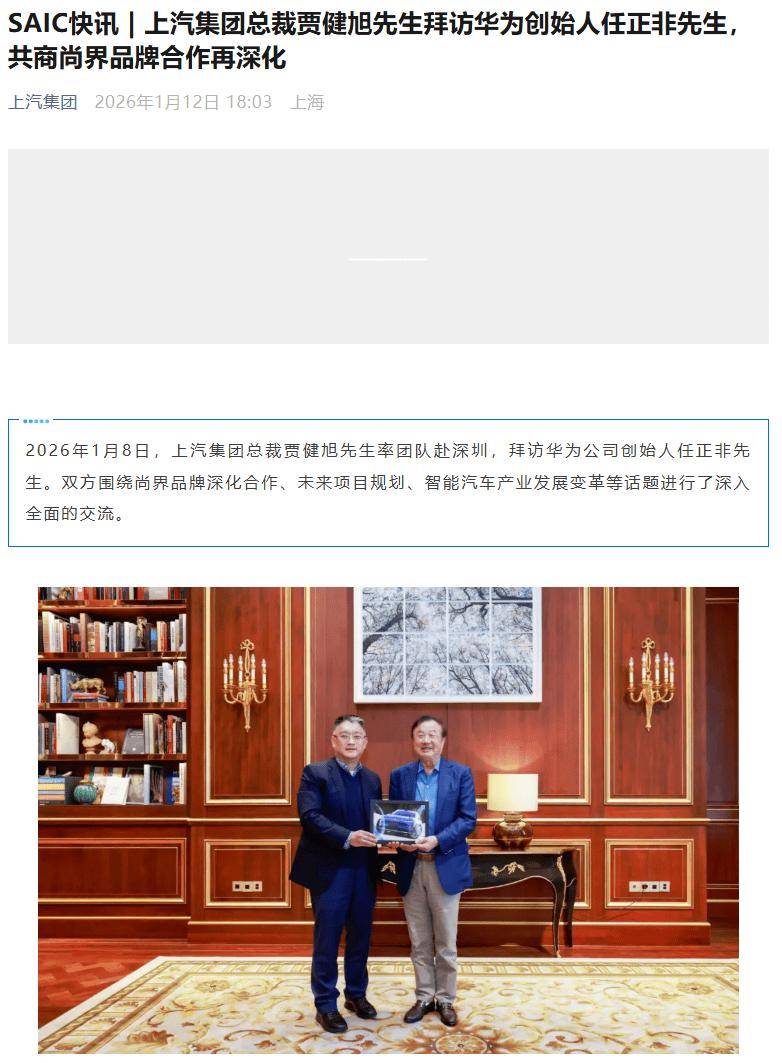
上汽集团总裁贾健旭拜访华为任正非,商讨尚界品牌合作再深化
Sou Hu Cai Jing· 2026-01-12 10:32
Group 1 - SAIC Group's President Jia Jianxu visited Huawei's founder Ren Zhengfei on January 8, 2026, to discuss deepening cooperation on the Shangjie brand and future project planning in the smart automotive industry [1] - Both companies aim to explore broader cooperation opportunities and jointly promote the upward development of the Shangjie brand [4] - On January 5, executives from Jiangqi Group also visited Ren Zhengfei to discuss trends in the intelligent transformation of the automotive industry and future project plans [5] Group 2 - In 2025, executives from several automotive companies, including Xpeng Motors, GAC Group, Changan Automobile, Dongfeng Motor, and Chery Automobile, also visited Ren Zhengfei [5]

Andreessen Horowitz Co-Founder Warns California Wealth Tax Could Trigger Silicon Valley Exodus - Alphabet (NASDAQ:GOOG), Alphabet (NASDAQ:GOOGL)
Benzinga· 2026-01-11 09:48
Core Viewpoint - Ben Horowitz, co-founder of Andreessen Horowitz, argues that California's proposed wealth tax is an effective strategy to disrupt the Silicon Valley network effect, drawing parallels with Norway's entrepreneur exodus due to its unrealized capital gains tax [1][4][5]. Group 1: Impact of Taxes on Entrepreneurs - Norway's unrealized capital gains tax has led to a significant exodus of entrepreneurs, as they are unable to pay taxes on increased valuations of their private companies [2][3]. - In 2022, 261 residents with assets over 10 million kroner left Norway, followed by 254 in 2023, indicating a doubling of departures compared to pre-tax increase levels [6]. Group 2: California Wealth Tax Proposal - The proposed wealth tax in California targets high-net-worth residents to address state budget deficits and fund public services, raising concerns among tech industry leaders [6][7]. - Prominent figures, including LinkedIn co-founder Reid Hoffman, have criticized the wealth tax as poorly designed, suggesting it could undermine innovation in Silicon Valley [7]. Group 3: Reactions from Tech Leaders - The proposed tax has prompted some tech leaders, such as Larry Page and Sergey Brin of Alphabet, to relocate their business entities out of California [8].

王腾新公司已开始公开招聘:有岗位年薪最高可达75万元,暂不招应届生
新华网财经· 2026-01-11 01:51
Group 1 - The core idea of the article is the establishment of a new company named "Today Yixiu" by Wang Teng, former marketing director of Xiaomi, focusing on sleep health products [2][3] - The initial team consists mainly of members from leading tech companies like Xiaomi and Huawei, indicating a strong background in technology [3] - The company is currently recruiting for four positions, requiring a minimum of three years of work experience, with salaries starting at 20,000 yuan per month and the potential for an annual salary of up to 750,000 yuan for the iOS mobile development engineer position [7] Group 2 - The headquarters of the new company is located in Beijing, with plans to consider branches in Shenzhen and Hangzhou in the future [5] - Wang Teng emphasizes the importance of hiring experienced professionals in the early stages of the startup, stating that fresh graduates will be welcomed once the business develops [5] - The company's mission is to help workers improve their energy levels and combat overwork, promoting a culture of taking breaks when needed [5]

Warren Buffett Left Wall Street 3 Deafening Warnings Before Retiring. Was Anyone Paying Attention?
The Motley Fool· 2026-01-10 11:00
Core Insights - Warren Buffett's final moves before retirement may signal caution for investors, particularly regarding the S&P 500's sustainability [2][10] - Berkshire Hathaway has transitioned to a net seller of stocks, indicating a strategic shift in investment approach [5][10] Group 1: Portfolio Adjustments - Berkshire sold its stakes in S&P 500 ETFs, including Vanguard S&P 500 ETF and SPDR S&P 500 ETF, during Q4 2024 [4] - Since the end of 2022, Berkshire has been actively trimming its portfolio, exiting positions in Citigroup and consistently selling shares of Apple and Bank of America [5] - The company has been a net seller of stocks amounting to $184 billion over the past two years [5] Group 2: Cash Reserves - Berkshire's cash and equivalents reached a record $382 billion by the end of Q3, reflecting its cautious stance [6][8] - The company has opted to earn steady interest from Treasury Bills rather than participating in the current bull market [8] Group 3: Investment Philosophy - Recent investments in UnitedHealth Group and Alphabet represent only a small fraction (2%) of Berkshire's total portfolio, indicating a selective approach [9] - Buffett's strategy suggests a belief that the current market levels are unsustainable, advocating for cash accumulation until better buying opportunities arise [10][11] - The investment philosophy emphasizes value investing and avoiding overpriced stocks, aligning with Buffett's contrarian approach [11][12]