Autonomous Driving

Search documents
百度萝卜快跑获迪拜001号自动驾驶牌照,获准在开放道路提供Robotaxi试乘服务
Ge Long Hui· 2025-09-25 06:09
(责任编辑:宋政 HN002) 【免责声明】本文仅代表作者本人观点,与和讯网无关。和讯网站对文中陈述、观点判断保持中立,不对所包含内容 的准确性、可靠性或完整性提供任何明示或暗示的保证。请读者仅作参考,并请自行承担全部责任。邮箱: news_center@staff.hexun.com 格隆汇9月25日丨百度旗下自动驾驶出行平台萝卜快跑在阿联酋迪拜举行的第四届世界自动驾驶交通大 会上,正式获颁迪拜首张自动驾驶测试牌照001号,并获准在开放道路提供Robotaxi试乘服务。根据公 开资料整理,9月24日至25日大会期间,萝卜快跑是唯一被允许在迪拜公开道路进行试乘体验的公司。 ...

车圈一个月48位高管变动,新一轮的变革要开始了......
自动驾驶之心· 2025-09-25 03:45
Group 1 - The automotive industry is undergoing a new round of transformation, with significant executive changes in various companies, including Li Auto, BYD, and Changan Automobile [1] - The autonomous driving sector is rapidly evolving, with a shift in focus from traditional methods to new algorithms and models, emphasizing the need for continuous learning and adaptation [2][3] - The community is actively engaging in discussions about the future of autonomous driving, exploring new article styles and hosting online events with industry leaders [3][6] Group 2 - The community has developed platforms for autonomous driving, embodied intelligence, and large models, aiming to explore new opportunities amidst constant change [3][4] - A comprehensive resource has been created within the community, offering over 40 technical routes and addressing practical questions related to autonomous driving [5][8] - The community is focused on providing a collaborative environment for both beginners and advanced practitioners, facilitating knowledge sharing and networking [10][14] Group 3 - The community offers a variety of learning resources, including video tutorials and structured learning paths for newcomers to the field of autonomous driving [11][13] - Regular discussions and Q&A sessions are held to address industry-related queries, such as entry points into end-to-end autonomous driving and the applicability of multi-sensor fusion [17][19] - The community aims to grow its membership significantly over the next two years, enhancing its role as a hub for technical exchange and career opportunities in the autonomous driving sector [3][19]


港股异动丨百度拉升涨超5%,萝卜快跑获迪拜首张自动驾驶牌照
Ge Long Hui A P P· 2025-09-25 03:16
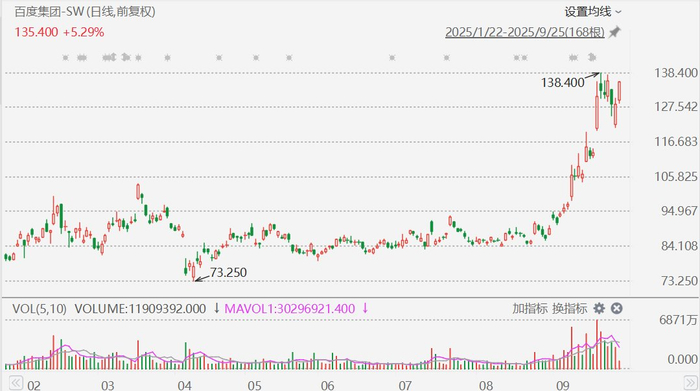
Core Viewpoint - Baidu Group's stock has risen over 5% to HKD 135.4, with a year-to-date increase of 63% [1] Group 1: Autonomous Driving Developments - Baidu's autonomous driving service, "LuoBo Kuaipao," showcased at the "Dubai World Autonomous Driving Traffic Conference" with the first autonomous driving test license in Dubai [1] - The Dubai Roads and Transport Authority (RTA) issued the first batch of 50 autonomous driving test licenses to LuoBo Kuaipao in July [1] - A strategic cooperation agreement signed in March will see LuoBo Kuaipao deploy over 1,000 fully autonomous vehicles in Dubai [1] Group 2: Global Expansion and Service Metrics - LuoBo Kuaipao has expanded its services to 16 cities globally, including Hong Kong, Dubai, and Abu Dhabi, providing over 14 million autonomous rides [1] - The service has achieved a safe driving mileage of over 200 million kilometers [1] - Since July, LuoBo Kuaipao has partnered with global platforms like Uber and Lyft to accelerate its expansion in the Middle East and Eurasia [1]
Pomerantz Law Firm Announces the Filing of a Class Action Against Tesla, Inc. and Certain Officers – TSLA
Globenewswire· 2025-09-24 19:54
Core Viewpoint - A class action lawsuit has been filed against Tesla, Inc. and certain officers for alleged violations of federal securities laws during the Class Period from April 19, 2023, to June 22, 2025, seeking damages for misleading statements regarding the company's business and operations [1]. Group 1: Lawsuit Details - The class action was filed in the United States District Court for the Western District of Texas, seeking to recover damages for all persons and entities that purchased Tesla securities during the specified Class Period [1]. - Investors have until October 4, 2025, to request appointment as Lead Plaintiff for the class [2]. Group 2: Company Operations and Claims - Tesla designs, develops, manufactures, and sells electric vehicles and autonomous driving vehicles, along with energy generation and storage systems globally [4]. - The company has promoted its Robotaxi service as a fully autonomous ride-hailing network, claiming advancements in artificial intelligence differentiate it from competitors [4]. Group 3: Allegations Against Tesla - The Complaint alleges that Tesla made materially false and misleading statements about its autonomous driving technology, overstating its effectiveness and failing to disclose risks associated with its operation [4]. - Specific allegations include the risk of dangerous operation of autonomous vehicles, increased regulatory scrutiny, and overstated business and financial prospects [4]. Group 4: Recent Events and Impact - Tesla launched its Robotaxi service on June 22, 2025, but reports emerged of traffic law violations by the vehicles, leading to scrutiny from the U.S. National Highway Traffic Safety Administration (NHTSA) [5][6]. - Following these incidents, Tesla's stock price fell by $21.13 per share, or 6.05%, closing at $327.55 on June 25, 2025 [7]. - A jury later found Tesla partly liable for a fatal 2019 Autopilot crash, ordering compensation of $329 million [7].

Mercedes mulls investment in Geely-backed smart driving firm, Bloomberg reports
Reuters· 2025-09-24 10:29
Core Insights - Mercedes-Benz Group is preparing to invest in Chongqing Qianli Technology, a developer of autonomous driving systems backed by Geely [1] Company Summary - The investment by Mercedes-Benz Group indicates a strategic move towards enhancing its capabilities in autonomous driving technology [1] - Chongqing Qianli Technology is positioned as a key player in the autonomous driving sector, supported by Geely, which may provide additional resources and expertise [1] Industry Summary - The autonomous driving industry is witnessing increased investments from major automotive players, reflecting a growing trend towards innovation and technological advancement [1] - Collaborations between established automotive companies and technology developers are becoming more common, aiming to accelerate the development and deployment of autonomous driving solutions [1]

自动驾驶之心国庆&中秋节活动开始了(课程八折/星球七折/辅导/硬件优惠)
自动驾驶之心· 2025-09-24 04:00
Group 1 - The article promotes various discounts and offers for courses, including a 70% discount and a reduction of 80 or 99 yuan for specific courses [1][3][4] - A yearly subscription to the "Big Model Planet" is available for 99 yuan, which includes technology, industry insights, and job-seeking assistance [1] - The platform offers a 1v1 tutoring service with a maximum discount of 1000 yuan off a 5000 yuan fee, and a 1v6 paper tutoring service with a 1000 yuan reduction [1] Group 2 - The "Autonomous Driving Heart" section highlights cutting-edge self-driving technology, featuring nearly 40 learning routes including VLA, world models, and closed-loop simulation [6] - The community facilitates face-to-face interactions with industry leaders and academic experts, providing insights into the future direction of autonomous driving [6] - The article mentions seven premium courses aimed at beginners, focusing on essential skills and knowledge in the field [6]

Why Pony AI Stock Popped on Tuesday
The Motley Fool· 2025-09-23 21:27
One pundit tracking the autonomous driving specialist published a bullish update.Chinese autonomous driving tech company Pony AI (PONY 3.84%) motored well higher on the stock exchange Tuesday. On the back of a fresh analyst update, investors crowded into the stock to leave it with a gain of nearly 4% the trading session. That contrasted with the trajectory of the benchmark S&P 500 index, which moved in reverse with a 0.6% decline on the day.Ramping up service hours and road testingWell before market open, G ...
Cathie Wood Goes Bargain Hunting in China: 3 Stocks She Just Bought
Yahoo Finance· 2025-09-23 12:15
Group 1 - Cathie Wood, founder and CEO of Ark Invest, is actively buying stocks, focusing on Chinese companies, including Alibaba, Pony AI, and Baidu [1][2][8] - Alibaba's stock has surged 95% this year, but its revenue growth remains in the single digits for the fourth consecutive year, and it has missed Wall Street profit targets in two recent quarters [3][4] - Alibaba's domestic e-commerce operations, Taobao and Tmall, generate 45% of its consolidated revenue and 113% of its adjusted EBITDA, indicating strong profitability in this segment [5][6] Group 2 - Alibaba has a cash-rich balance sheet, allowing for shareholder returns through dividends and share buybacks, with shares trading at a reasonable forward earnings multiple of 16 times projected earnings [7] - Baidu and Alibaba are trading at forward earnings multiples in the teens, while Pony AI is considered expensive due to its lack of profitability and early revenue growth stage, despite its advantages in autonomous driving [8]

WeRide Joins Nasdaq Golden Dragon Index
Yahoo Finance· 2025-09-23 11:16
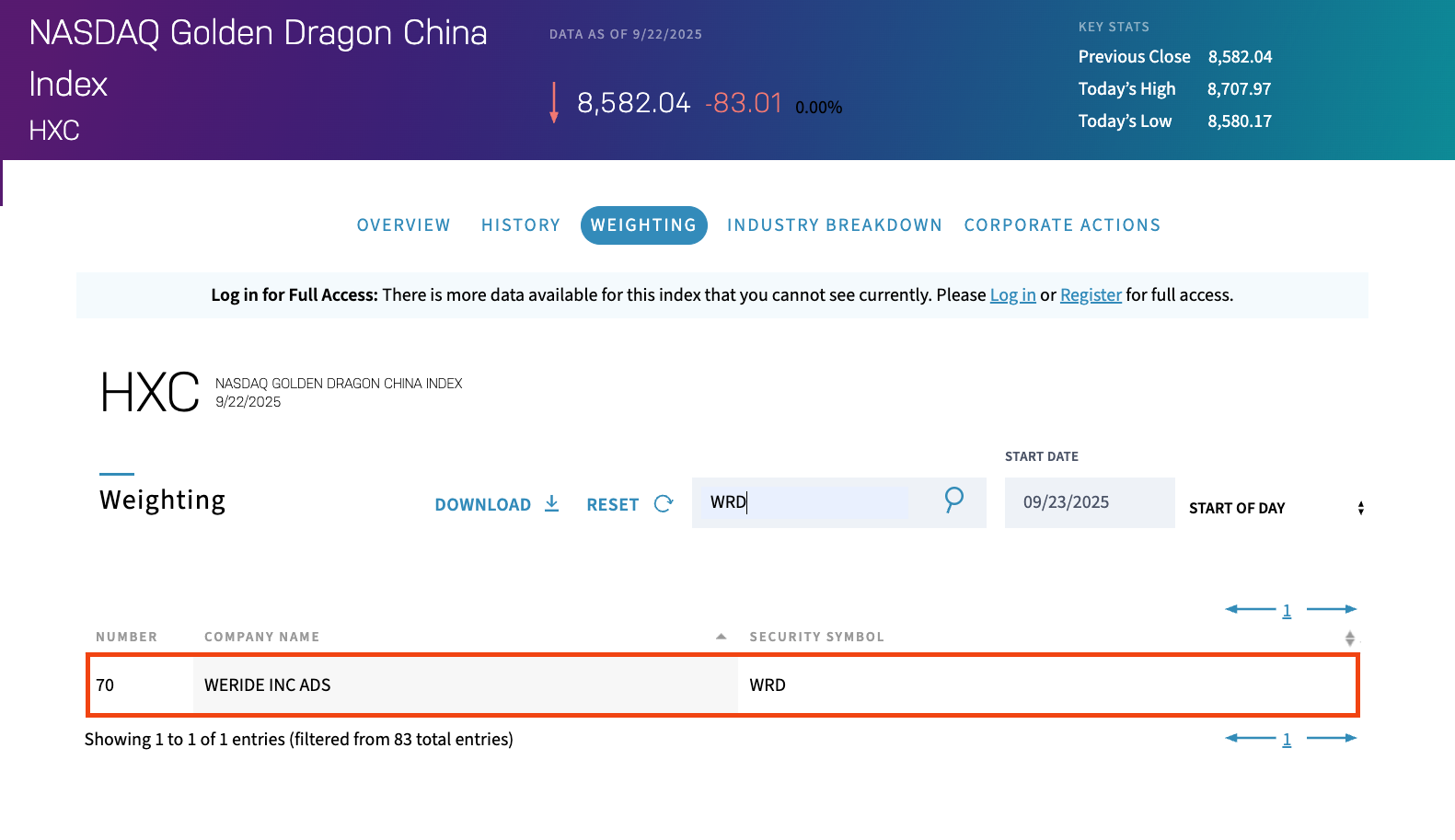
Core Viewpoint - WeRide Inc. has joined the Nasdaq Golden Dragon China Index, enhancing its visibility and potential for investor recognition in the autonomous driving sector [1][2][4]. Group 1: Company Developments - WeRide reported a significant revenue growth of 60% year-over-year, with sales reaching $17.8 million in Q2 2025 [3]. - The robotaxi segment's revenue surged nearly ninefold to $6.4 million, indicating strong demand for its autonomous driving services [3]. - The company has expanded its operations to over 30 cities across 11 nations since going public in October 2024 [5]. Group 2: Strategic Partnerships and Market Expansion - WeRide has formed a partnership with Grab to launch autonomous rides in Singapore and received a permit for its Robobus service in Belgium [5]. - An agreement with Uber is expected to enhance WeRide's presence in Europe and the Middle East over the next five years [6]. Group 3: Market Context - The Nasdaq Golden Dragon China Index, which includes 83 companies like Alibaba and JD.com, has recently seen improved sentiment, reaching its highest point since February 2022 [4]. - Despite the positive developments, WRD stock has experienced a decline of over 30% in the past year [4].

WeRide Included in Nasdaq Golden Dragon China Index
Globenewswire· 2025-09-23 09:00
Core Viewpoint - WeRide has been included in the Nasdaq Golden Dragon China Index, which is expected to enhance its visibility among investors and strengthen its position in capital markets [1][3]. Group 1: Inclusion in Nasdaq Golden Dragon China Index - WeRide's inclusion in the index will lead to automatic allocation of its shares in investment funds tracking the index, providing long-term support [3]. - The index is closely followed by institutional investors, which is likely to increase attention on WeRide and enhance market activity [3]. - This inclusion will bolster WeRide's brand image among global investors, potential clients, and partners, aiding its international business expansion [3][4]. Group 2: Market Context and Performance - The Nasdaq Golden Dragon China Index, which now includes 83 Chinese stocks, has shown an upward trend, reaching its highest level since February 2022, indicating growing optimism in global capital markets regarding Chinese companies [4][5]. - WeRide's inclusion is seen as a significant milestone against the backdrop of improving investor sentiment toward US-listed Chinese stocks [5]. Group 3: Company Milestones and Growth - WeRide was listed on the Nasdaq on October 25, 2024, becoming the first publicly listed Robotaxi company, and operates in over 30 cities across 11 countries [6][8]. - Recent partnerships and milestones include launching Grab's first autonomous vehicle service in Singapore and receiving Belgium's first Level 4 test permit, making WeRide the only company with autonomous driving permits in seven countries [6]. - In Q2 2025, WeRide reported revenue of US$17.8 million, a 60.8% year-on-year increase, with Robotaxi revenue surging 836.7% year-on-year to US$6.4 million [7].