服务业

Search documents
50.1%!重回扩张区间
Zhong Guo Zheng Quan Bao· 2025-12-31 02:34
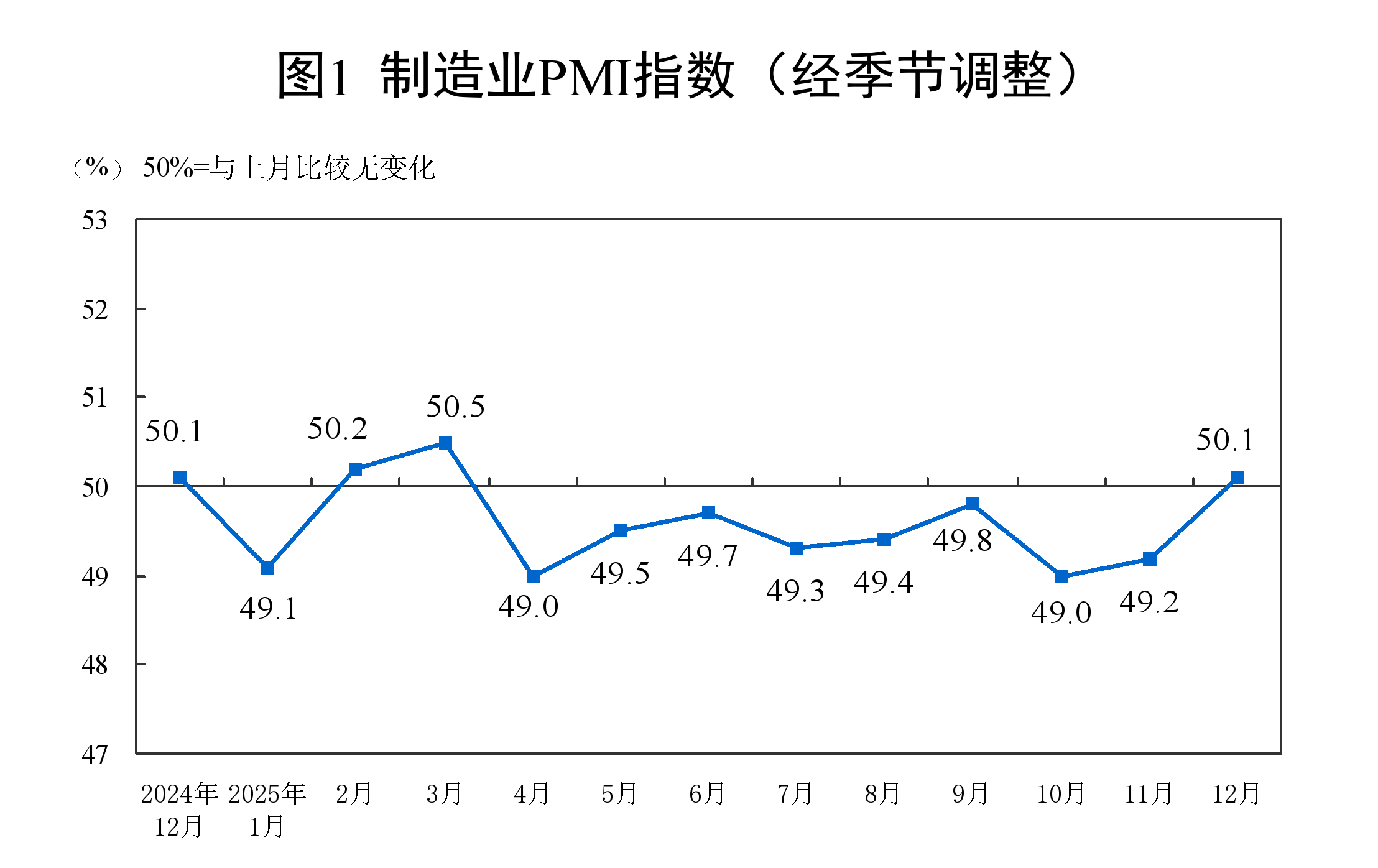
Core Insights - The manufacturing PMI, non-manufacturing business activity index, and composite PMI output index for December are 50.1%, 50.2%, and 50.7% respectively, indicating a general recovery in economic sentiment as all three indices rise into the expansion zone [1][2]. Manufacturing Sector - The manufacturing PMI has risen above the critical point for the first time since April, reaching 50.1%, with 16 out of 21 surveyed industries showing improvement [2]. - Production index and new orders index are at 51.7% and 50.8% respectively, both showing significant increases of 1.7 and 1.6 percentage points from the previous month, indicating notable expansion in production and demand [4]. - The purchasing activity has accelerated, with the purchasing volume index rising to 51.1%, reflecting a positive trend in manufacturing [4]. - Large enterprises' PMI has returned to the expansion zone at 50.8%, while medium-sized enterprises' PMI is at 49.8%, and small enterprises' PMI has decreased to 48.6% [4]. Key Industries - High-tech manufacturing PMI is at 52.5%, up 2.4 percentage points, indicating a positive growth trend [4]. - Equipment manufacturing and consumer goods industries both have PMIs of 50.4%, showing increases of 0.6 and 1.0 percentage points respectively, also entering the expansion zone [4]. - High-energy-consuming industries have a PMI of 48.9%, reflecting a continued recovery despite remaining below the expansion threshold [4]. Non-Manufacturing Sector - The non-manufacturing business activity index is at 50.2%, up 0.7 percentage points, indicating an improvement in non-manufacturing sentiment [6]. - The service sector's business activity index is at 49.7%, with a slight increase of 0.2 percentage points, although it remains in the contraction zone [9]. - The construction sector shows significant improvement with a business activity index of 52.8%, up 3.2 percentage points, indicating a strong recovery [9]. Market Expectations - The production and business activity expectation index is at 55.5%, up 2.4 percentage points, reflecting increased confidence among manufacturing enterprises [5]. - The service sector's business activity expectation index is at 56.4%, indicating enhanced confidence in future market developments [9]. - The construction sector's business activity expectation index is at 57.4%, remaining in a high confidence zone [9].

PMI数据最新解读
清华金融评论· 2025-12-31 02:24
Core Viewpoint - The manufacturing purchasing managers' index (PMI) rose to 50.1% in December, indicating an expansion in the manufacturing sector for the first time since April, reflecting an overall recovery in China's economic climate [4]. Group 1: Manufacturing PMI Insights - The manufacturing PMI reached 50.1%, with 16 out of 21 surveyed industries showing an increase compared to the previous month, indicating improved production and operational conditions [4]. - Both production index and new orders index saw significant increases, with production index at 51.7% (up 1.7 percentage points) and new orders index at 50.8% (up 1.6 percentage points), marking a notable expansion in demand [4]. - Large enterprises' PMI returned to the expansion zone at 50.8%, while medium-sized enterprises' PMI was at 49.8%, and small enterprises' PMI decreased to 48.6%, indicating varied recovery levels across enterprise sizes [4]. Group 2: Key Industry Performance - High-tech manufacturing PMI was at 52.5%, showing a positive growth trend, while equipment manufacturing and consumer goods industries both reached 50.4%, indicating expansion [5]. - The production expectations index rose to 55.5%, reflecting increased confidence among manufacturing enterprises regarding market development, particularly in the agricultural and food processing sectors [5]. Group 3: Non-Manufacturing Sector Insights - The non-manufacturing business activity index increased to 50.2%, indicating an improvement in the non-manufacturing sector's economic conditions [6]. - The service sector's business activity index was at 49.7%, with certain industries like telecommunications and financial services showing strong growth, while retail and catering remained in contraction [7]. - The construction sector's business activity index rose significantly to 52.8%, driven by favorable weather conditions and increased construction activity ahead of the holidays [7]. Group 4: Comprehensive PMI Overview - The comprehensive PMI output index reached 50.7%, indicating overall expansion in production and business activities across sectors, with manufacturing production index at 51.7% and non-manufacturing business activity index at 50.2% [8].

国家统计局:12月制造业PMI为50.1% 较上月上升0.9个百分点
智通财经网· 2025-12-31 01:58
Group 1: Manufacturing PMI Overview - In December, the Manufacturing Purchasing Managers' Index (PMI) was 50.1%, an increase of 0.9 percentage points from the previous month, indicating a return to the expansion zone [3][5] - The production index was 51.7%, up 1.7 percentage points, suggesting accelerated production activities in the manufacturing sector [5] - The new orders index reached 50.8%, an increase of 1.6 percentage points, indicating improved market demand in manufacturing [5] Group 2: Non-Manufacturing PMI Overview - The Non-Manufacturing Business Activity Index was 50.2%, rising by 0.7 percentage points, signaling a return to the expansion zone [8] - The construction industry business activity index was 52.8%, up 3.2 percentage points, while the service industry index was 49.7%, a slight increase of 0.2 percentage points [9] - The new orders index for non-manufacturing was 47.3%, an increase of 1.6 percentage points, indicating a recovery in market demand [11] Group 3: Comprehensive PMI Output Index - The Comprehensive PMI Output Index was 50.7%, an increase of 1.0 percentage point, indicating overall expansion in production and business activities compared to the previous month [18]
12月份制造业采购经理指数为50.1% 升至扩张区间
Zhong Guo Xin Wen Wang· 2025-12-31 01:56
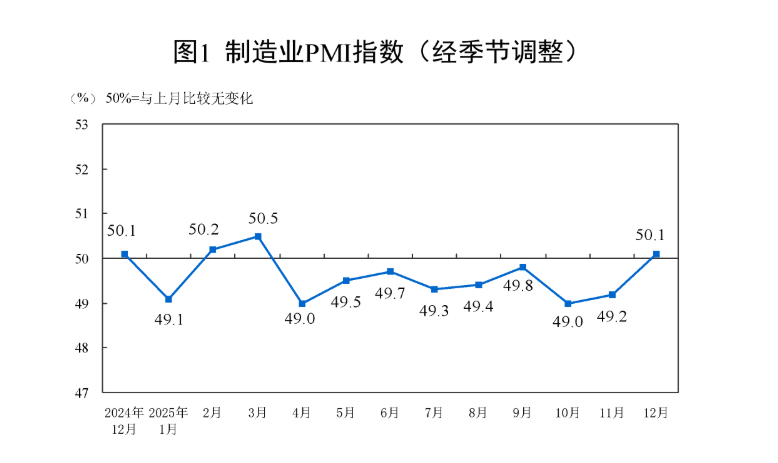
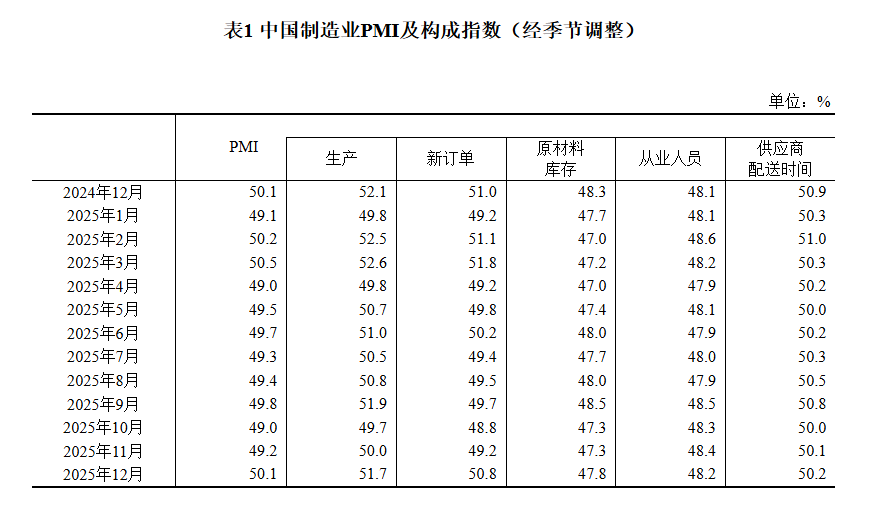
生产指数为51.7%,比上月上升1.7个百分点,表明制造业企业生产活动加快。 12月份制造业采购经理指数为50.1% 升至扩张区间 中新网12月31日电 据国家统计局网站消息,国家统计局、中国物流与采购联合会31日发布2025年12月中国采购经理指数运行情况。 一、中国制造业采购经理指数运行情况 12月份,制造业采购经理指数(PMI)为50.1%,比上月上升0.9个百分点,升至扩张区间。 从企业规模看,大型企业PMI为50.8%,比上月上升1.5个百分点,高于临界点;中型企业PMI为49.8%,比上月上升0.9个百分点,仍低于临界点;小型企业 PMI为48.6%,比上月下降0.5个百分点,低于临界点。 从分类指数看,在构成制造业PMI的5个分类指数中,生产指数、新订单指数和供应商配送时间指数均高于临界点,原材料库存指数和从业人员指数均低于 临界点。 新订单指数为50.8%,比上月上升1.6个百分点,表明制造业市场需求有所改善。 原材料库存指数为47.8%,比上月上升0.5个百分点,表明制造业主要原材料库存量降幅收窄。 从业人员指数为48.2%,比上月下降0.2个百分点,表明制造业企业用工景气度小幅回落。 供应 ...
国家统计局:12月制造业PMI为50.1% 升至扩张区间 经济景气水平总体回升
Guo Jia Tong Ji Ju· 2025-12-31 01:51
Group 1: Manufacturing PMI Overview - The manufacturing Purchasing Managers' Index (PMI) for December is 50.1%, an increase of 0.9 percentage points from the previous month, indicating a return to the expansion zone [1][21] - The new orders index stands at 50.8%, up 1.6 percentage points, reflecting improved market demand [1][22] - The production index is at 51.7%, an increase of 1.7 percentage points, suggesting accelerated production activities in the manufacturing sector [1][22] Group 2: Sector Performance - High-tech manufacturing PMI is 52.5%, up 2.4 percentage points, showing a significant acceleration in growth [1][23] - The consumer goods manufacturing PMI is at 50.4%, an increase of 1 percentage point, indicating stable expansion [1][23] - Large enterprises have a PMI of 50.8%, up 1.5 percentage points, while medium and small enterprises have PMIs of 49.8% and 48.6%, respectively, indicating varied performance across company sizes [3][22] Group 3: Non-Manufacturing Sector - The non-manufacturing business activity index is 50.2%, an increase of 0.7 percentage points, indicating a return to expansion [6][24] - The construction sector's business activity index is 52.8%, up 3.2 percentage points, reflecting significant improvement in the construction industry [9][24] - The service sector's business activity index is 49.7%, a slight increase of 0.2 percentage points, with some industries like telecommunications showing strong performance [9][24] Group 4: Future Expectations - The production and business activity expectations index for manufacturing is 55.5%, up 2.4 percentage points, indicating increased confidence among manufacturers [1][23] - The business activity expectations index for the non-manufacturing sector is 56.4%, reflecting growing optimism about future market developments [15][24] - Overall, the composite PMI output index is 50.7%, an increase of 1.0 percentage point, indicating overall expansion in business activities [18][25]
国家统计局:12月中国PMI指数均升至扩张区间
Di Yi Cai Jing· 2025-12-31 01:50
我国经济景气水平总体回升。 12月31日,国家统计局服务业调查中心和中国物流与采购联合会发布了中国采购经理指数。对此,国家 统计局服务业调查中心首席统计师霍丽慧进行了解读。 (三)重点行业PMI均高于上月。高技术制造业PMI为52.5%,比上月上升2.4个百分点,行业增长态势 向好。装备制造业和消费品行业PMI均为50.4%,分别比上月上升0.6个和1.0个百分点,双双升至扩张区 间。高耗能行业PMI为48.9%,比上月上升0.5个百分点,景气水平继续回升。 (四)预期指数升至较高景气区间。生产经营活动预期指数为55.5%,比上月上升2.4个百分点,制造业 企业对市场发展信心继续增强。从行业看,受节前备货等因素带动,农副食品加工、食品及酒饮料精制 茶等行业生产经营活动预期指数均升至60.0%以上高位景气区间,相关企业对近期行业发展更为乐观。 二、非制造业商务活动指数重回扩张区间 12月份,非制造业商务活动指数为50.2%,比上月上升0.7个百分点,非制造业景气水平改善。 (一)服务业景气度小幅回升。服务业商务活动指数为49.7%,比上月上升0.2个百分点。从行业看,电 信广播电视及卫星传输服务、货币金融服务、 ...
国家统计局:12月份制造业采购经理指数(PMI)为50.1%
Yang Shi Wang· 2025-12-31 01:47
央视网消息:国家统计局12月31日公布2025年12月中国采购经理指数运行情况: 一、中国制造业采购经理指数运行情况 12月份,制造业采购经理指数(PMI)为50.1%,比上月上升0.9个百分点,升至扩张区间。 从企业规模看,大型企业PMI为50.8%,比上月上升1.5个百分点,高于临界点;中型企业PMI为49.8%, 比上月上升0.9个百分点,仍低于临界点;小型企业PMI为48.6%,比上月下降0.5个百分点,低于临界 点。 从分类指数看,在构成制造业PMI的5个分类指数中,生产指数、新订单指数和供应商配送时间指数均 高于临界点,原材料库存指数和从业人员指数均低于临界点。 二、中国非制造业采购经理指数运行情况 12月份,非制造业商务活动指数为50.2%,比上月上升0.7个百分点,重返扩张区间。 分行业看,建筑业商务活动指数为52.8%,比上月上升3.2个百分点;服务业商务活动指数为49.7%,比 上月上升0.2个百分点。从服务业行业看,电信广播电视及卫星传输服务、货币金融服务、资本市场服 务等行业商务活动指数均位于60.0%以上高位景气区间;零售、餐饮等行业商务活动指数均低于临界 点。 新订单指数为47.3 ...
国家统计局:12月官方制造业PMI为50.1% 升至扩张区间
Guo Jia Tong Ji Ju· 2025-12-31 01:45
(原标题:国家统计局:12月官方制造业PMI为50.1% 升至扩张区间) 一、中国制造业采购经理指数运行情况 12月份,制造业采购经理指数(PMI)为50.1%,比上月上升0.9个百分点,升至扩张区间。 从分类指数看,在构成制造业PMI的5个分类指数中,生产指数、新订单指数和供应商配送时间指数均 高于临界点,原材料库存指数和从业人员指数均低于临界点。 生产指数为51.7%,比上月上升1.7个百分点,表明制造业企业生产活动加快。 新订单指数为50.8%,比上月上升1.6个百分点,表明制造业市场需求有所改善。 原材料库存指数为47.8%,比上月上升0.5个百分点,表明制造业主要原材料库存量降幅收窄。 从业人员指数为48.2%,比上月下降0.2个百分点,表明制造业企业用工景气度小幅回落。 供应商配送时间指数为50.2%,比上月上升0.1个百分点,表明制造业原材料供应商交货时间继续加快。 分行业看,建筑业商务活动指数为52.8%,比上月上升3.2个百分点;服务业商务活动指数为49.7%,比 上月上升0.2个百分点。从服务业行业看,电信广播电视及卫星传输服务、货币金融服务、资本市场服 务等行业商务活动指数均位于60.0 ...
国家统计局解读:12月份中国采购经理指数均升至扩张区间
智通财经网· 2025-12-31 01:45
Group 1 - The manufacturing Purchasing Managers' Index (PMI) rose to 50.1% in December, marking the first time it has entered the expansion zone since April [4] - Among the 21 surveyed industries, 16 reported an increase in PMI compared to the previous month, indicating improved production and operational conditions [4] - The production index and new orders index were 51.7% and 50.8%, respectively, both showing significant increases from the previous month [4] Group 2 - The non-manufacturing business activity index reached 50.2% in December, reflecting an improvement in the non-manufacturing sector's economic climate [6] - The service sector's business activity index was 49.7%, with certain industries like telecommunications and financial services showing strong growth [6] - The construction sector's business activity index rose to 52.8%, indicating a notable recovery in the industry due to favorable weather and increased construction activity [7] Group 3 - The comprehensive PMI output index increased to 50.7%, suggesting overall expansion in production and business activities across sectors [8] - The manufacturing production index and non-manufacturing business activity index were 51.7% and 50.2%, respectively, contributing to the rise in the comprehensive PMI [8]
2025年12月中国采购经理指数运行情况
Guo Jia Tong Ji Ju· 2025-12-31 01:38
国家统计局服务业调查中心 中国物流与采购联合会 一、中国制造业采购经理指数运行情况 从企业规模看,大型企业PMI为50.8%,比上月上升1.5个百分点,高于临界点;中型企业PMI为49.8%, 比上月上升0.9个百分点,仍低于临界点;小型企业PMI为48.6%,比上月下降0.5个百分点,低于临界 点。 从分类指数看,在构成制造业PMI的5个分类指数中,生产指数、新订单指数和供应商配送时间指数均 高于临界点,原材料库存指数和从业人员指数均低于临界点。 生产指数为51.7%,比上月上升1.7个百分点,表明制造业企业生产活动加快。 新订单指数为50.8%,比上月上升1.6个百分点,表明制造业市场需求有所改善。 原材料库存指数为47.8%,比上月上升0.5个百分点,表明制造业主要原材料库存量降幅收窄。 从业人员指数为48.2%,比上月下降0.2个百分点,表明制造业企业用工景气度小幅回落。 供应商配送时间指数为50.2%,比上月上升0.1个百分点,表明制造业原材料供应商交货时间继续加快。 12月份,制造业采购经理指数(PMI)为50.1%,比上月上升0.9个百分点,升至扩张区间。 表1 中国制造业PMI及构成指数(经季 ...