信息技术服务业

Search documents
8月经济数据点评:供需分化的三个结果
Soochow Securities· 2025-09-15 10:33
Supply and Demand Analysis - In August, industrial added value grew by 5.2% year-on-year, down from 5.7% in July, while the service production index increased by 5.6%, down from 5.8%[4] - External demand weakened with exports growing by 4.4% year-on-year, down from 7.2% in July, and below the expected 5.9%[4] - Domestic demand also declined, with retail sales growing by 3.4%, unchanged from July, and below the expected 3.8%[4] - Fixed asset investment (FAI) showed a cumulative growth of 0.5%, down from 1.6% in July, with monthly growth dropping from -5.2% to -6.3%[6] Economic Outlook - The divergence between supply and demand is expected to lead to three outcomes: GDP growth will align more closely with supply data, with Q3 GDP growth projected around 5%[4] - Strong supply relative to weak demand may increase price pressures, necessitating stronger policy support for price recovery[4] - Historically, if demand does not strengthen, supply will follow suit, indicating greater pressure on Q4 GDP compared to Q3[4] Sector Performance - High-tech manufacturing remains a key driver of production resilience, with its added value growing by 9.3% year-on-year in August[4] - The restaurant sector showed a rebound in consumption, with retail sales in this category growing by 2.1%, up from 1.1% in July[5] - Fixed asset investment in infrastructure and real estate continued to decline, with infrastructure investment dropping from -1.9% to -6.4% and real estate investment from -17.2% to -19.4%[6]
达实智能:上市公司及控股子公司的担保额度总金额约为8.24亿元
Mei Ri Jing Ji Xin Wen· 2025-09-12 08:46
Group 1 - The core point of the article is that Dasan Intelligent (SZ 002421) announced a total guarantee amount of approximately 824 million yuan, with the total balance of external guarantees being about 759 million yuan, which accounts for 22.36% of the company's latest audited net assets [1] - As of the announcement date, the company and its subsidiaries do not have any guarantees provided to entities outside the consolidated financial statements, nor do they have overdue debts related to guarantees, litigation-related guarantees, or guarantees due to judgments against them [1] - For the first half of 2025, the revenue composition of Dasan Intelligent is entirely from the information technology services sector, accounting for 100% [1] Group 2 - The current market capitalization of Dasan Intelligent is 7.5 billion yuan [1]

达实智能:实际控制人、董事长刘磅计划减持公司股份不超过约3041万股
Mei Ri Jing Ji Xin Wen· 2025-09-10 11:54
Group 1 - The actual controller and chairman of the company, Liu Pang, plans to reduce his holdings by up to approximately 30.41 million shares, accounting for 1.43% of the total share capital, within three months after 15 trading days from the announcement date [1] - The general manager, Su Junfeng, intends to reduce his holdings by up to approximately 1.96 million shares, representing 0.09% of the total share capital, within the same timeframe [1] - The company's total share capital is approximately 21.2 billion shares, with Liu Pang holding about 1.22 billion shares (5.74%) and Su Junfeng holding about 7.86 million shares (0.37%) [1] Group 2 - As of the report, the market capitalization of the company is 7.4 billion yuan [3] - For the first half of 2025, the company's revenue composition is entirely from the information technology services sector, accounting for 100% [2]
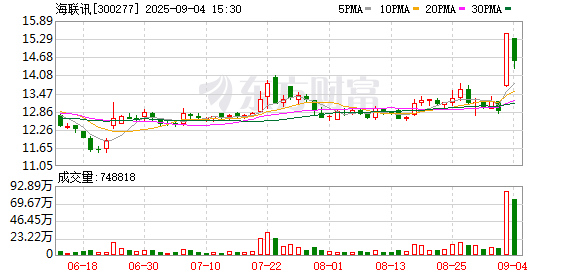
海联讯:2025年第三次临时股东会决议公告
Zheng Quan Ri Bao· 2025-09-04 13:36
证券日报网讯 9月4日晚间,海联讯发布公告称,公司2025年第三次临时股东会于2025年9月4日召开, 审议通过了《关于拟变更注册地址暨修订的议案》。 (文章来源:证券日报) ...


中央重磅部署“人工智能+” 推动一二三产业向智能化跃迁
2 1 Shi Ji Jing Ji Bao Dao· 2025-08-26 16:17
Core Viewpoint - The document outlines the "Artificial Intelligence +" initiative, emphasizing its integration into six key areas: scientific technology, industrial development, consumption enhancement, public welfare, governance capabilities, and global cooperation, with specific goals set for 2027, 2030, and 2035 [1][10]. Group 1: Key Areas of Focus - The initiative aims to achieve widespread integration of AI in six areas, including scientific technology, industrial development, consumption enhancement, public welfare, governance capabilities, and global cooperation [3][4]. - The document highlights the importance of AI in accelerating scientific discovery and creating new job opportunities while enhancing traditional roles [3][4]. - The initiative emphasizes the need for intelligent transformation across all sectors, including agriculture, industry, and services, to foster new business models and enhance productivity [7][8]. Group 2: Goals and Phases - By 2027, the goal is to achieve over 70% penetration of new intelligent terminals and applications, with significant growth in the core industries of the intelligent economy [10][12]. - By 2030, the aim is for AI to fully empower high-quality development, with over 90% penetration of intelligent applications, establishing AI as a crucial growth driver for the economy [10][12]. - By 2035, the vision is for China to enter a new stage of intelligent economy and society, providing strong support for the realization of socialist modernization [10][12]. Group 3: Implementation Strategy - The document outlines a systematic approach to implementing AI across various sectors, focusing on creating a collaborative ecosystem that includes researchers, businesses, consumers, and government entities [4][6]. - It emphasizes the need for a robust foundational support system, including advancements in models, data supply, computing power, and regulatory frameworks [9][12]. - The initiative aims to break down data silos and lower barriers for small and medium enterprises to adopt AI technologies, fostering a positive cycle of innovation and application [6][12].
小红书收购新公司,业务含藏品鉴定评估服务
Qi Lu Wan Bao· 2025-08-25 10:10
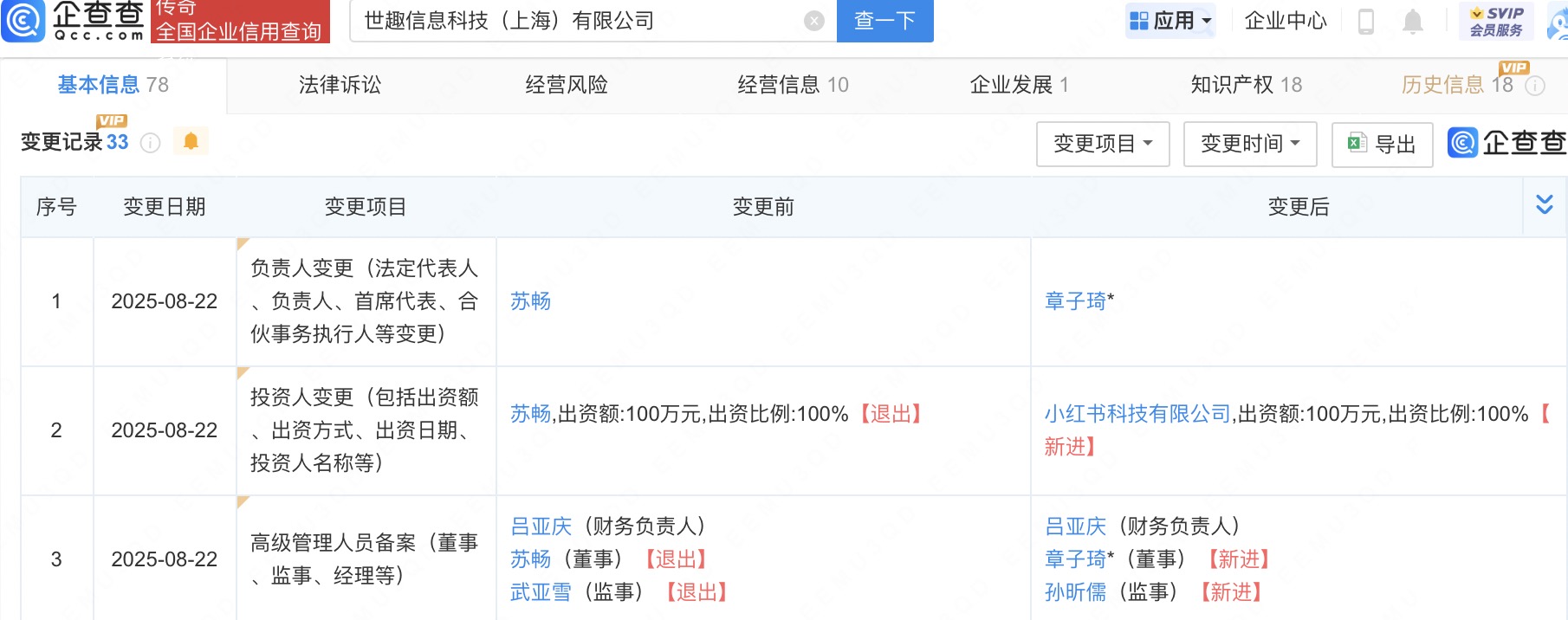
Core Viewpoint - Shiqu Information Technology (Shanghai) Co., Ltd. has undergone a significant change in ownership, with the original shareholder exiting and Xiaohongshu Technology Co., Ltd. becoming the sole shareholder [1][4]. Company Information - Shiqu Information Technology was established in 2021 and its business scope includes the sale of arts and crafts, professional design services, and appraisal services for artworks and collectibles [1][4]. - The company registered the copyright for its software "Kaiyan Jianbao" in December 2023 [1][3]. Ownership Changes - On August 22, 2025, there was a change in the company's legal representative and management, with Su Chang exiting as the investor and a capital contribution of 1 million yuan [2][4]. - The new sole shareholder is Xiaohongshu Technology Co., Ltd., which has taken over the entire ownership from the previous shareholder [1][4]. Business Registration Details - The company is registered with a capital of 1 million yuan and is located in Yangpu District, Shanghai [4]. - The business is currently active and has a workforce of fewer than 50 employees [4]. Software Registration - The software "Kaiyan Jianbao" is listed under version V2.8.8 with registration number 2023SR156858 [3].
恒锋信息:董事会收到独立董事梁明煅、非独立董事陈朝学的书面辞职报告
Mei Ri Jing Ji Xin Wen· 2025-08-21 13:14
Group 1 - The company Hengfeng Information (SZ 300605) announced the resignation of independent director Liang Mingduan and non-independent director Chen Chaoxue due to board restructuring [1] - Liang Mingduan will no longer hold any position in the company after his resignation, while Chen Chaoxue will continue as the vice president [1] - For the fiscal year 2024, the company's revenue composition is 82.72% from information technology services and 17.28% from smart elderly care services [1] Group 2 - The current market capitalization of Hengfeng Information is 2.8 billion yuan [2]
恒锋信息:8月21日召开董事会会议
Mei Ri Jing Ji Xin Wen· 2025-08-21 13:03
Group 1 - The company, Hengfeng Information, announced the convening of its fourth board meeting for the second time in 2025 on August 21, 2025, to review proposals including the adjustment of the specialized committee members of the board [2] - For the fiscal year 2024, the revenue composition of Hengfeng Information is as follows: 82.72% from information technology services and 17.28% from smart elderly care services [2]
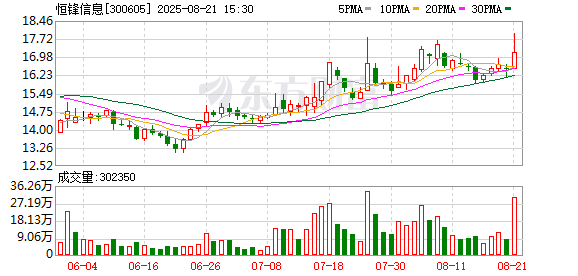
达实智能:实际控制人刘磅累计质押股数为5571万股
Mei Ri Jing Ji Xin Wen· 2025-08-15 11:07
Group 1 - The core business of Dasan Intelligent is entirely focused on the information technology service industry, with a revenue composition of 100.0% for the first half of 2025 [1] Group 2 - On August 15, Dasan Intelligent announced that its major shareholder and actual controller, Liu Pang, has pledged and released part of his shares. As of the announcement date, the total number of pledged shares by Changdu Dasan is 77.07 million, accounting for 28.44% of its holdings [3] - Liu Pang has pledged a total of 55.71 million shares, which represents 45.79% of his holdings [3]
联合创始人曾秀莲再卸任小红书旗下公司职务
Qi Lu Wan Bao· 2025-08-15 08:21
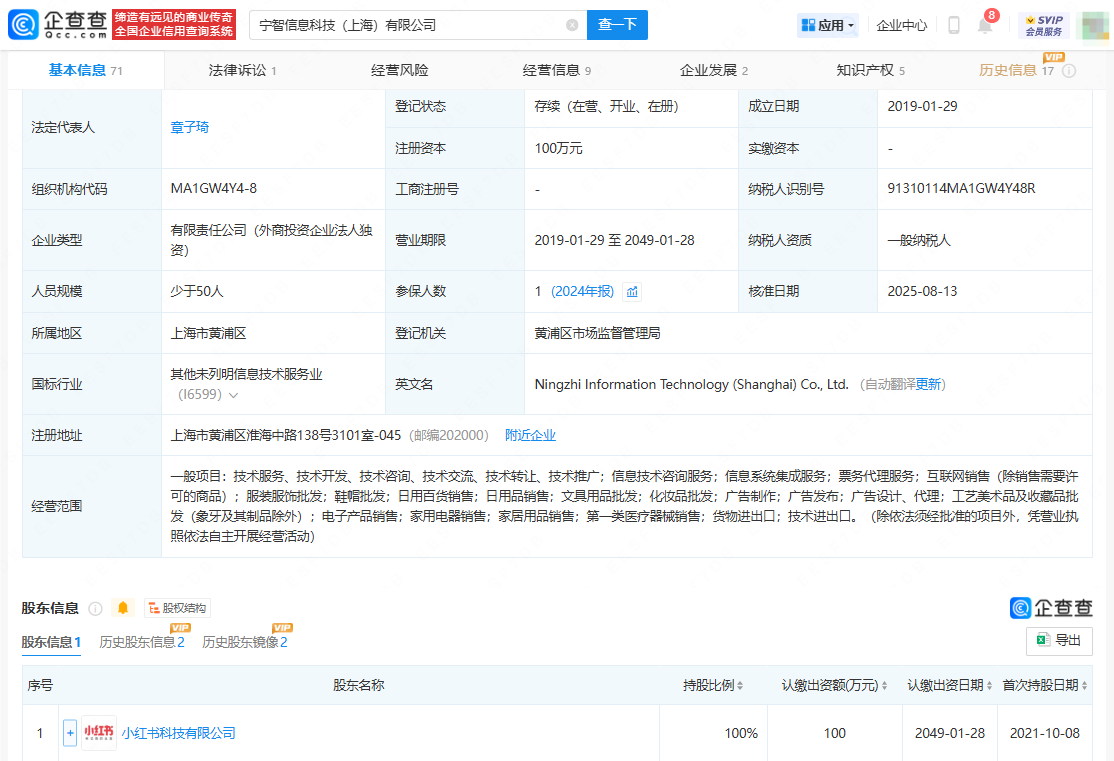
Company Overview - Ningzhi Information Technology (Shanghai) Co., Ltd. was established in January 2019 with a registered capital of 1 million RMB and is wholly owned by Xiaohongshu Technology Co., Ltd. [1][2] - The company is currently active and registered in Huangpu District, Shanghai, with a business scope that includes technology services, consulting, and various sales activities [2]. Management Changes - Recently, there was a change in the legal representative of Ningzhi Information Technology, with Zeng Xiulian stepping down and Zhang Ziqi taking over [1][2]. - Zeng Xiulian, a co-founder of Xiaohongshu, has also resigned from her positions in Xiaohongshu Technology Co., Ltd. and Xingyin Information Technology (Shanghai) Co., Ltd. [1].