
供需分化

Search documents
一季度《中国经济观察》发布:经济韧性与分化并存,政策蓄力构建再平衡
Sou Hu Cai Jing· 2026-02-12 09:18
Group 1 - The core viewpoint of the articles indicates that China's economy is projected to reach 140 trillion yuan in 2025, with a real GDP growth of 5.0%, meeting the initial target growth rate [2] - In 2025, the industrial production showed steady improvement, with the manufacturing value-added growing by 6.1% year-on-year, supported by strong export demand and domestic equipment renewal policies [5] - The retail sales of consumer goods in 2025 increased by 3.7% year-on-year, although the fourth quarter saw a decline of 1.8%, marking the first quarterly negative growth since 2023 [9] - Fixed asset investment in 2025 experienced a decline of 3.8%, marking the first annual negative growth since records began, with significant contractions in real estate and infrastructure investments [12] - Exports in 2025 grew by 5.5%, with a trade surplus reaching nearly 1.2 trillion USD, the highest on record, driven by high-end manufacturing categories like integrated circuits and new energy products [15] Group 2 - Looking ahead to 2026, the central economic work conference emphasizes higher quality requirements for economic growth, with macro policies expected to maintain a steady expansion [3] - The government plans to support domestic demand and optimize supply, with a focus on increasing investment in human capital and lowering financing barriers for private enterprises [3] - The manufacturing PMI for January 2026 was reported at 49.8%, indicating a contraction in manufacturing activity, primarily due to insufficient domestic demand recovery [18] - The non-manufacturing business activity index for January 2026 was at 49.4%, with the construction sector returning to contraction territory, influenced by adverse weather and the upcoming holiday [19] - Public fiscal revenue in 2025 saw a year-on-year decline of 1.7%, with expenditures also falling short of budgeted growth, reflecting a cautious fiscal environment [22]


下游逐步进入年度收尾阶段 沥青期货以震荡为主
Jin Tou Wang· 2026-02-04 06:02
Core Viewpoint - The asphalt futures market shows a strong performance with the main contract reaching 3370.00 yuan/ton, reflecting a 1.97% increase [1] Group 1: Market Data - As of February 3, the Shanghai Futures Exchange reported that the oil asphalt factory warehouse futures inventory stood at 26,490 tons, unchanged from the previous trading day [2] - The asphalt warehouse futures inventory was 13,580 tons, also unchanged from the previous trading day [2] - The asphalt operating rate decreased by 1.3 percentage points week-on-week to 25.5%, which is 2.6 percentage points lower than the same period last year, indicating a relatively low level compared to recent years [2] - As of January 26, 2026, the total inventory of 104 social warehouses for asphalt in China reached 1.205 million tons, an increase of 2.6% from January 22 and a year-on-year increase of 21.0% [2] Group 2: Institutional Insights - New Lake Futures notes that with the Spring Festival approaching, market supply and demand are showing regional disparities, with southern projects nearing completion and limited terminal releases, while northern markets exhibit low trading activity [4] - Guoxin Futures reports that the daily operating load rate for asphalt in China is at 28.95%, maintaining a relatively low range, providing stable support [4] - Demand for winter asphalt is generally weak, and geopolitical uncertainties in regions like the Middle East are impacting asphalt prices from the cost side [4] - Short-term trading strategies are recommended to focus on a range-bound approach [4]

贺博生:10.30黄金原油震荡回落最新行情走势分析及今日独家多空操作建议
Sou Hu Cai Jing· 2025-10-29 23:52
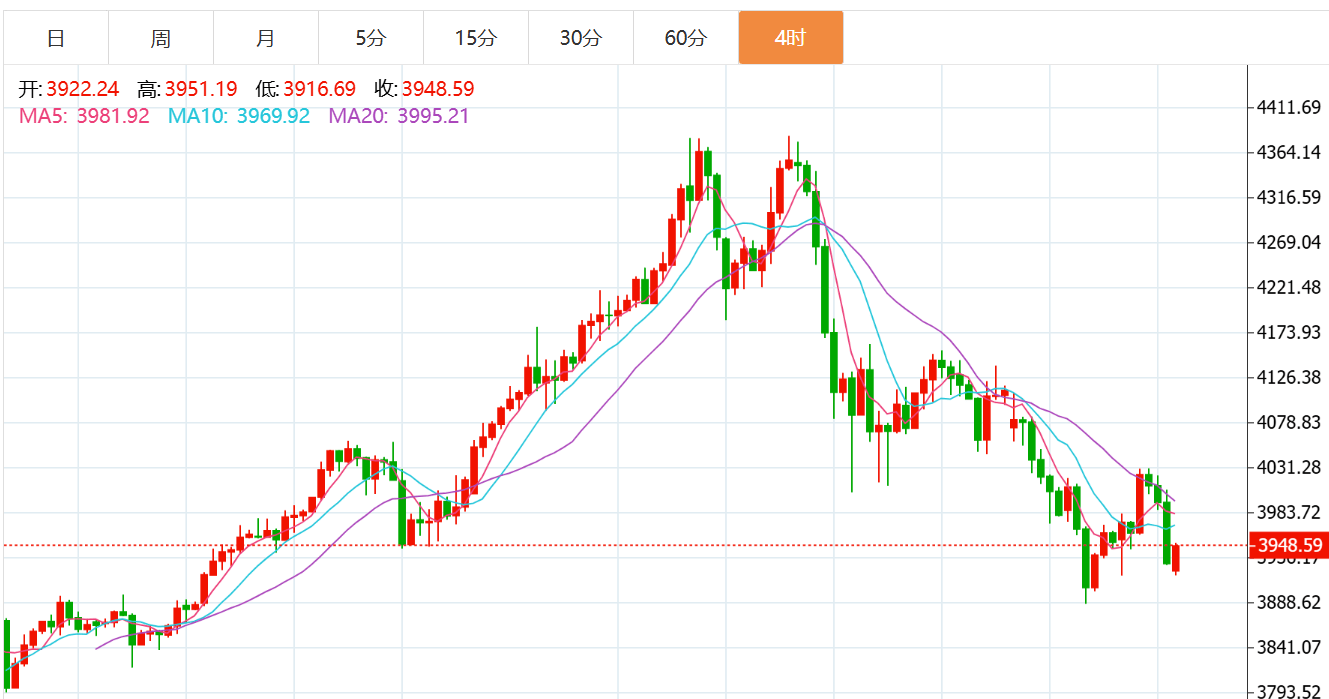
Market Overview - Recent market volatility has left many investors confused, often leading to losses due to frequent trading without a solid plan [1] - New investors are particularly prone to chasing trends, resulting in significant financial setbacks [1] Gold Market Analysis - On October 29, gold prices experienced a dramatic fluctuation, initially rising nearly 2% to reach a peak of $4029.90 per ounce due to safe-haven demand and Federal Reserve rate cut expectations [2] - Following the Fed's decision to cut rates by 25 basis points, hawkish comments from Chairman Powell dampened bullish sentiment, causing gold to drop to a low of $3916.56 per ounce, closing around $3930, marking a daily decline of approximately 0.57% [2] - The anticipation of a potential trade agreement between the U.S. and China has reduced gold's safe-haven appeal, contributing to a decline in demand [2] Technical Analysis of Gold - The daily chart shows a long upper shadow bearish candle, with prices breaking below the recent trading range [4] - Key resistance levels are identified at $3950 and $4000, while support is seen at $3910 and $3900 [4] - The recommendation is to wait for clearer bottom signals before entering long positions, with a focus on shorting during rebounds [4] Oil Market Analysis - International oil prices have declined for three consecutive days, with Brent crude falling below $65 per barrel, reflecting a cumulative drop of over 2% [5] - U.S. crude oil inventories decreased by approximately 4 million barrels, but regional supply-demand disparities are evident, particularly with rising inventories at the Cushing storage hub [5] - Overall market sentiment remains pessimistic, with concerns about potential oversupply leading to three months of declining oil prices [5] Technical Analysis of Oil - The daily chart indicates that oil prices have entered a consolidation phase after three consecutive bullish candles [6] - Short-term trends are bearish, with resistance levels at $62.5 to $63.5 and support at $59.0 to $58.0 [6] - The strategy suggested is to focus on buying on dips while considering short positions during price rebounds [6]
宏观量化经济指数周报20251026:四季度供需分化格局仍将对物价造成影响-20251026
Soochow Securities· 2025-10-26 11:05
Supply and Demand Analysis - The weekly ECI supply index is at 50.02%, up 0.03 percentage points from last week, while the demand index remains stable at 49.91%[6] - For October, the supply index is at 50.00%, down 0.03 percentage points from September, indicating a stronger supply side compared to demand[7] - The ECI investment index is at 49.90%, unchanged from last week, while the consumption index is at 49.73%, down 0.01 percentage points[6] Economic Indicators - The average wholesale price of pork has decreased by 27.1% year-on-year as of October 24, maintaining a similar decline as in September[7] - The export index for October shows a slight decline but remains resilient, with the cumulative cargo throughput at ports showing a slowdown compared to September[7] - The ELI index is at -0.66%, down 0.06 percentage points from last week, indicating liquidity pressure as the month-end tax period approaches[11] Consumer and Investment Trends - New energy vehicle retail sales are showing marginal recovery, driven by tax incentives set to reduce in 2026[7] - The average daily sales of passenger cars recorded 63,163 units in the week ending October 19, a slight increase from the previous year[23] - Infrastructure investment shows stability, with the asphalt plant operating rate at 35.80%, up 1.30 percentage points from the previous week[29] Price and Inflation Outlook - The Brent crude oil futures price is at $63.37 per barrel, up $1.38 from the previous week, while COMEX gold futures are at $4,163.46 per ounce, down $39.72[41] - The average wholesale price of 28 monitored vegetables is at 5.22 yuan per kilogram, up 0.21 yuan from the previous week[41]
三季度和9月经济数据点评:经济“温差”如何影响宏观调控?
Soochow Securities· 2025-10-20 08:55
Economic Growth - Q3 GDP growth rate is 4.8% year-on-year, with a cumulative growth of 5.2% for the first three quarters, indicating resilience in the economy[3] - Industrial added value in September increased by 6.5% year-on-year, up from 5.2% in August, while the service production index remained stable at 5.6%[3] - Exports exceeded expectations with a year-on-year growth of 8.3% in September, compared to 4.3% in August, surpassing the consensus forecast of 5.9%[3] Demand and Investment - Domestic demand remains under pressure, with retail sales growth declining from 3.4% in August to 3.0% in September, below the expected 3.1%[3] - Fixed asset investment showed a cumulative year-on-year decline of 0.5%, down from a growth of 0.5% in August, indicating a weakening investment environment[3] - Real estate investment continues to struggle, with a cumulative year-on-year decline of 13.9% in September, worsening from -12.9% in August[4] Price Pressure and Policy Implications - The GDP deflator index improved slightly from -1.3% in Q2 to -1.1% in Q3, reflecting a balance between downward price pressure and "anti-involution" policies[3] - The potential for monetary policy easing remains, with possibilities for interest rate cuts and reserve requirement ratio reductions to stimulate demand[3] - Recent policy measures, including 500 billion yuan in policy financial tools and another 500 billion yuan in special bonds, are expected to boost investment growth[3] Consumer Behavior - Per capita income growth slowed from 5.1% in Q2 to 4.5% in Q3, with property income growth turning negative at -0.3%[4] - Per capita consumption growth also declined from 5.2% in Q2 to 3.4% in Q3, with a corresponding drop in consumption propensity to 68.1%[4] - Service consumption growth outpaced goods consumption, with service retail growth at 5.0% in Q3 compared to goods retail growth of only 3.6%[4]
8月经济数据点评:供需分化的三个结果
Soochow Securities· 2025-09-15 10:33
Supply and Demand Analysis - In August, industrial added value grew by 5.2% year-on-year, down from 5.7% in July, while the service production index increased by 5.6%, down from 5.8%[4] - External demand weakened with exports growing by 4.4% year-on-year, down from 7.2% in July, and below the expected 5.9%[4] - Domestic demand also declined, with retail sales growing by 3.4%, unchanged from July, and below the expected 3.8%[4] - Fixed asset investment (FAI) showed a cumulative growth of 0.5%, down from 1.6% in July, with monthly growth dropping from -5.2% to -6.3%[6] Economic Outlook - The divergence between supply and demand is expected to lead to three outcomes: GDP growth will align more closely with supply data, with Q3 GDP growth projected around 5%[4] - Strong supply relative to weak demand may increase price pressures, necessitating stronger policy support for price recovery[4] - Historically, if demand does not strengthen, supply will follow suit, indicating greater pressure on Q4 GDP compared to Q3[4] Sector Performance - High-tech manufacturing remains a key driver of production resilience, with its added value growing by 9.3% year-on-year in August[4] - The restaurant sector showed a rebound in consumption, with retail sales in this category growing by 2.1%, up from 1.1% in July[5] - Fixed asset investment in infrastructure and real estate continued to decline, with infrastructure investment dropping from -1.9% to -6.4% and real estate investment from -17.2% to -19.4%[6]