
托育

Search documents
事关养老、托育等,六部门联合发布!
证券时报· 2026-01-20 14:49
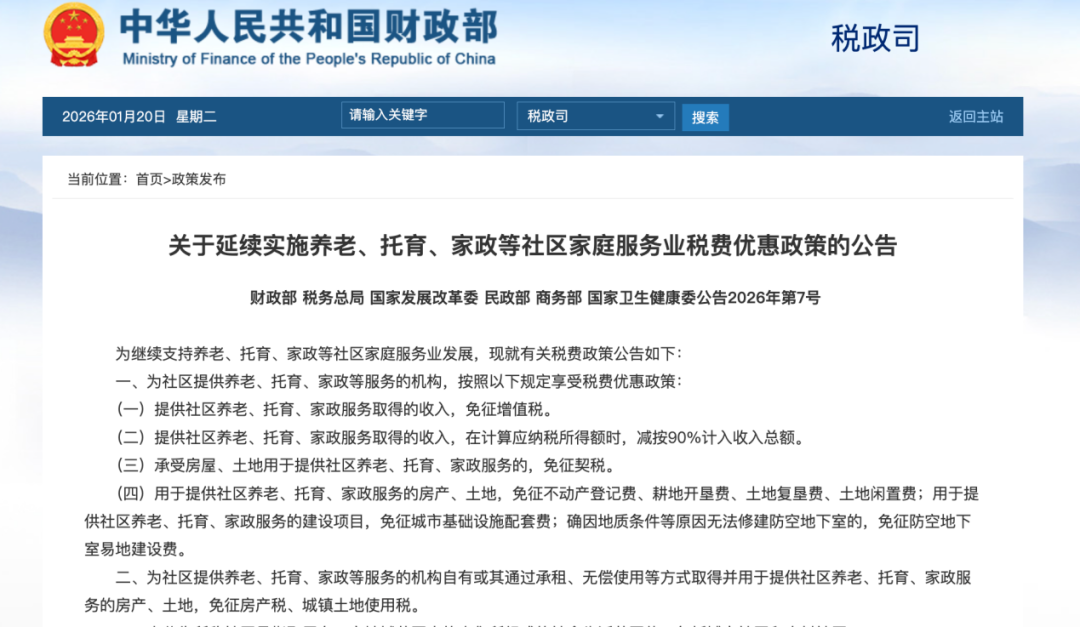
一、为社区提供养老、托育、家政等服务的机构,按照以下规定享受税费优惠政策: 利好来了。 (一)提供社区养老、托育、家政服务取得的收入,免征增值税。 今日(1月20日),财政部、税务总局等六部门发布公告,为继续支持养老、托育、家政等社区家庭服务业发展,提供相关服务取得的收入免征增值税; 为社区提供养老、托育、家政等服务的机构自有或通过承租等方式取得的房产、土地,免征房产税、城镇土地使用税。本公告自2026年1月1日起执行至 2027年12月31日。 与此同时,消费行业也迎来利好政策。财政部20日发布五项财政金融协同促内需一揽子政策,包括加力提振消费、扩大民间投资两个方面。财政部副部长 廖岷介绍,提振消费是改善民生的重要内容,也是经济增长的持久动力。为了更好回应社会期盼,对服务业经营主体贷款贴息和个人消费贷款贴息两项政 策从四个方面进行了优化,重点是希望政策更解渴、更方便、更持久。 六部门重磅发布 1月20日, 财政部、税务总局、国家发展改革委、民政部、商务部和国家卫生健康委公告,为继续支持养老、托育、家政等社区家庭服务业发展,现就有 关税费政策公告如下: 另外,公告还明确,符合下列条件的家政服务企业提供家政服务 ...


六部门,利好发布!
中国基金报· 2026-01-20 12:33
Core Viewpoint - The announcement by six government departments aims to continue tax and fee preferential policies for community family service industries, including elderly care, childcare, and domestic services, to support their development [2][3]. Group 1: Tax and Fee Preferential Policies - Institutions providing community elderly care, childcare, and domestic services will enjoy tax exemptions, including exemption from value-added tax (VAT) on income earned from these services [3][4]. - Income from community elderly care, childcare, and domestic services will be calculated at 90% for taxable income purposes [3][4]. - Properties and land used for providing these services will be exempt from property tax and urban land use tax [4]. Group 2: Specific Conditions for Domestic Service Enterprises - Domestic service enterprises that meet specific conditions will also be exempt from VAT on income earned from providing domestic services [6]. - Conditions include signing a tripartite agreement with domestic service workers and clients, paying wages to domestic service workers, and managing them through a business management system [7]. Group 3: Compliance and Documentation - Taxpayers benefiting from these policies must retain documentation such as service agreements and proof of service provision for verification [5]. - Failure to provide adequate documentation may result in the recovery of tax benefits and penalties [5]. Group 4: Implementation Timeline - The policies will be effective from January 1, 2026, to December 31, 2027 [8].

六部门,利好发布!
Zhong Guo Ji Jin Bao· 2026-01-20 12:21
Core Viewpoint - The announcement by six government departments aims to continue tax and fee preferential policies to support the development of community family services, including elderly care, childcare, and domestic services. Group 1: Tax and Fee Policies - Institutions providing community elderly care, childcare, and domestic services will enjoy tax exemptions, including exemption from value-added tax (VAT) on income earned from these services [1][2] - Income from community elderly care, childcare, and domestic services will be calculated at 90% for taxable income purposes [3] - Properties and land used for providing community services will be exempt from deed tax, property tax, and urban land use tax [4] Group 2: Definitions and Scope - The term "community" refers to a social living community composed of people in a specific geographic area, including urban and rural communities [5] - Institutions providing elderly care services are defined as those offering various forms of care to elderly residents in the community [5] - Institutions providing childcare services are defined as those offering care and supervision for children under three years old [5] - Institutions providing domestic services are defined as those offering household services to community residents [5] Group 3: Compliance and Oversight - Taxpayers benefiting from these policies must retain documentation such as service agreements and proof of service provision for verification [6] - Specific conditions must be met for domestic service enterprises to qualify for VAT exemptions, including signing tripartite agreements and managing service personnel [6] - Coordination among civil affairs, health, commerce, and tax departments is essential for effective supervision and implementation of these policies [6] Group 4: Implementation Timeline - The announcement will be effective from January 1, 2026, to December 31, 2027 [7]
刚刚,利好来了!六部门,重磅发布!
券商中国· 2026-01-20 12:12
Core Viewpoint - The announcement from six departments aims to support the development of community family services such as elderly care, childcare, and domestic services by providing tax exemptions and financial incentives to relevant institutions [2][4][10]. Group 1: Tax and Fee Policies - Institutions providing community elderly care, childcare, and domestic services will enjoy tax exemptions on income from these services, specifically exempting them from value-added tax [4]. - Income from community elderly care, childcare, and domestic services will be calculated at 90% for taxable income purposes [5]. - Properties and land used for these services will be exempt from deed tax, property tax, and urban land use tax [6][7]. - Specific conditions for domestic service companies to qualify for tax exemptions include signing tripartite agreements with service workers and clients, paying wages, and managing service workers [8]. Group 2: Financial Policies to Boost Consumption - The Ministry of Finance has introduced five financial policies to stimulate domestic demand, focusing on enhancing consumption and expanding private investment [10]. - The implementation period for loan interest subsidies for service industry operators and personal consumption loans has been extended to December 31, 2026, maintaining a subsidy rate of 1% [10]. - Optimizations to personal consumption loan subsidies include expanding the support scope to include credit card installment payments, increasing subsidy limits, and broadening the range of eligible financial institutions [11][12].

养老托育等免税政策再续两年,有两点小变化
Di Yi Cai Jing· 2026-01-20 12:00
Core Viewpoint - The announcement extends tax and fee incentives for community service industries such as elderly care, childcare, and domestic services until December 31, 2027, to support the growing demand due to an aging population and to encourage childbirth [1]. Group 1: Policy Extension - The Ministry of Finance and six other departments have released an announcement to extend tax incentives for community service industries, originally set to expire at the end of last year, for an additional two years [1]. - The extension aims to improve people's livelihoods, support the elderly care sector, promote childbirth, increase employment, and expand service consumption to stimulate domestic demand [1]. Group 2: Tax Incentives Details - The announcement maintains previous tax incentives, including exemption from value-added tax for income generated from community services, and a 90% reduction in taxable income for these services [2]. - Properties and land used for providing community services will be exempt from deed tax, property tax, and urban land use tax [2]. Group 3: Enhanced Compliance Measures - The new announcement emphasizes strengthened tax administration to ensure the effective implementation of the tax incentives [3]. - Taxpayers must retain specific documentation, such as registration receipts and service agreements, to validate their eligibility for the tax benefits [3]. - Provincial departments will regularly share necessary information with tax authorities to ensure the proper execution of the incentive policies [3].
关于延续实施养老、托育、家政等社区家庭服务业税费优惠政策的公告公告2026年第7号
蓝色柳林财税室· 2026-01-20 11:45
Core Viewpoint - The announcement extends tax and fee preferential policies for community family services such as elderly care, childcare, and housekeeping from January 1, 2026, to December 31, 2027, to support the development of these services [4]. Group 1: Tax and Fee Policies - Institutions providing community elderly care, childcare, and housekeeping services will enjoy the following tax benefits: - Exemption from value-added tax (VAT) on income from these services [1]. - A 90% reduction in the income included in the taxable income calculation [1]. - Exemption from deed tax for properties and land used for these services [1]. - Exemptions from various fees related to property registration and construction for these services [1]. - Properties and land used for community services will be exempt from property tax and urban land use tax [1]. Group 2: Definition and Scope - The term "community" refers to a social living community composed of people in a specific geographic area, including urban and rural communities [2]. - Institutions providing elderly care services are defined as those offering services such as daily care, rehabilitation, meal assistance, emergency rescue, and emotional support to the elderly [2]. - Institutions providing childcare services are defined as those offering care, supervision, meals, and nurturing for children under three years old [2]. - Institutions providing housekeeping services are defined as those offering services such as cleaning and cooking within family residences [2]. Group 3: Compliance and Documentation - Taxpayers benefiting from these policies must retain documentation such as registration receipts for elderly and childcare institutions, service agreements with community organizations, and evidence of service provision for verification [3]. - Failure to provide the required documentation or if the documentation is found to be false may result in the recovery of enjoyed tax benefits [3]. Group 4: Coordination and Oversight - Relevant departments, including civil affairs, health, commerce, and finance, are required to enhance coordination and establish a mechanism for information sharing to ensure the effective implementation of these policies [3].

财政部等六部门:延续实施养老、托育、家政等社区家庭服务业税费优惠政策
Sou Hu Cai Jing· 2026-01-20 11:04
Core Viewpoint - The announcement by the Ministry of Finance and other departments aims to support the development of community family services, including elderly care, childcare, and domestic services, by providing various tax exemptions and reductions from January 1, 2026, to December 31, 2027 [1][7]. Tax Exemption Policies - Income from community elderly care, childcare, and domestic services will be exempt from value-added tax (VAT) [1][5]. - When calculating taxable income, 90% of the income from these services will be included in the total income [2][5]. - Properties and land used for providing these community services will be exempt from deed tax [3][5]. - Various fees related to real estate and land, such as property registration fees and urban infrastructure fees, will be waived for properties used in these services [3][5]. Eligibility and Requirements - Institutions providing community services must retain documentation such as service agreements and registration receipts to prove compliance with the tax exemption criteria [4][5]. - Specific conditions must be met for domestic service companies to qualify for VAT exemption, including signing tripartite agreements and managing service personnel [6][5]. Coordination and Oversight - Relevant departments, including civil affairs and health, are required to enhance coordination and establish information-sharing mechanisms to ensure the effective implementation of these tax policies [7].
服务业贷款贴息上限提至一千万元
第一财经· 2026-01-20 07:20
Core Viewpoint - The Chinese government is enhancing its loan interest subsidy policy for service industry operators to further stimulate domestic demand, extending the policy until December 31, 2026, and expanding the scope of supported sectors [2][3]. Group 1: Policy Extension and Scope - The Ministry of Finance and other departments have announced the extension of the loan interest subsidy policy for service industry operators, which was set to expire at the end of last year, for an additional year [2]. - The policy now includes three new categories: digital, green, and retail sectors, in addition to the previously supported eight sectors such as catering, health, elderly care, childcare, housekeeping, cultural entertainment, tourism, and sports [2]. Group 2: Increased Financial Support - The maximum loan amount eligible for interest subsidies has been increased from 1 million yuan to 10 million yuan per borrower, with a subsidy period not exceeding one year [3]. - The annual interest subsidy rate remains at 1%, consistent with previous regulations [3]. - The number of banks eligible to process these loans has been expanded to include city commercial banks with a financial regulatory rating of 3A or above, provincial rural commercial banks, rural commercial banks in provincial capital cities, and foreign banks [3]. Group 3: Economic Impact - The Ministry of Finance aims to leverage this policy to provide more low-cost financial resources to service industry operators, thereby improving the flow of capital in the real economy and better meeting the growing demand for high-quality service consumption among the public [3].
财政部等四部门:延长服务业经营主体贷款贴息政策实施期限至2026年底
Sou Hu Cai Jing· 2026-01-20 06:44
Core Viewpoint - The Ministry of Finance and other departments have announced an extension of the loan interest subsidy policy for service industry operators until December 31, 2026, with specific provisions for loans issued between March 16, 2025, and December 31, 2025 [1] Group 1: Policy Extension - The loan interest subsidy policy for service industry operators will be extended until December 31, 2026 [1] - Loans issued during the period from March 16, 2025, to December 31, 2025, will follow the existing subsidy policy guidelines [1] Group 2: Subsidy Limits - The maximum loan amount eligible for interest subsidies is set at 10 million yuan per borrower for new loans issued in 2026 [1] - The interest subsidy period will not exceed one year, with an annual subsidy rate of 1% [1] - The funding for the subsidies will be shared between the central government (90%) and provincial governments (10%) [1] Group 3: Expanded Support Areas - The policy will expand its support to include three additional consumption sectors: digital, green, and retail, alongside the existing eight sectors such as catering, health, elderly care, childcare, housekeeping, cultural entertainment, tourism, and sports [1]
服务业贷款贴息上限提至一千万元
Di Yi Cai Jing· 2026-01-20 06:07
Group 1 - The core viewpoint of the news is the extension and expansion of the fiscal interest subsidy policy for service industry operators in China, aimed at boosting domestic demand [1][2] Group 2 - The fiscal interest subsidy policy for service industry operators has been extended for one year until December 31, 2026, with a possibility of further extension based on circumstances [1] - The policy now includes three additional consumption sectors: digital, green, and retail, expanding the previous eight sectors [1] Group 3 - The maximum loan amount eligible for interest subsidies has been increased from 1 million yuan to 10 million yuan per borrower for new loans issued in 2026, with a subsidy period not exceeding one year [2] - The annual interest subsidy rate remains at 1%, consistent with previous regulations [2] Group 4 - The number of banks eligible to process these loans has been expanded to include city commercial banks, provincial rural commercial banks, rural commercial banks in provincial capital cities, and foreign banks, in addition to the previously designated 21 national banks [2] - The Ministry of Finance aims to leverage this policy to provide low-cost financial resources to service industry operators, thereby enhancing the supply of high-quality service consumption to meet growing public demand [2]