污水处理

Search documents
天津创业环保股份与天津市政总院签订工程设计服务合同
Zhi Tong Cai Jing· 2026-02-12 11:25
天津创业环保(600874)股份(01065)公布,于2026年2月12日,董事会审议通过关于公司与天津市政总 院签订工程设计服务合同,据此,公司委托天津市政总院就咸阳路污水处理厂迁建二期工程提供工程设 计服务。工程设计服务合同总价格为人民币986万元(含税)。 ...

贵州遵义通报“民企8亿建厂遭强行接管”调查结果
Xin Lang Cai Jing· 2026-02-12 10:25
为依法妥善解决问题和分歧,遵义市政府已责成仁怀市对临时接管行为进行整改。2026年2月4日,仁怀 市政府就结束临时接管状态及后续有关事宜与贵州泰克签订协议,安龙场废水处理厂经营权已全面移交 贵州泰克。下一步,遵义市联合调查组将督促各方当事人,根据有关法律法规和PPP项目合同约定,推 进项目竣工验收、工程造价审计、投资金额核定、财务决算等工作。对调查中发现的涉嫌违纪违法线 索,遵义市已按程序移交纪检监察机关依规依纪依法追责问责。 通报来源:遵义市联合调查组 关于仁怀市涉企有关问题的调查通报 2025年9月,有关媒体报道重庆泰克公司在仁怀投资有关情况引发社会关注。遵义市委、市政府高度重 视,成立联合调查组,全面开展了调查工作。现将调查情况通报如下。 2017年8月14日,仁怀市政府授权有关职能部门与重庆泰克环保科技股份有限公司(以下简称重庆泰 克)等企业组成的联合体签订安龙场废水处理厂建设项目PPP项目合同(以下简称PPP项目合同)。 2017年12月12日,仁怀市水务投资开发有限责任公司作为仁怀市政府方出资代表,与重庆泰克等社会资 本方代表共同出资组建项目公司——贵州泰克中铝环保有限公司(后更名为贵州泰克领秀环 ...


遵义市联合调查组发布通报
中国能源报· 2026-02-12 09:28
贵州遵义市联合调查组发布仁怀市涉企有关问题的调查通报。 2月12日,贵州遵义市联合调查组发布仁怀市涉企有关问题的调查通报,通报如下: 2025 年 9 月 , 有 关 媒 体 报 道 重 庆 泰 克 公 司 在 仁 怀 投 资 有 关 情 况 引 发 社 会 关 注 。 遵 义 市 委、市政府高度重视,成立联合调查组,全面开展了调查工作。现将调查情况通报如下。 2017年8月14日,仁怀市政府授权有关职能部门与重庆泰克环保科技股份有限公司(以 下简称"重庆泰克")等企业组成的联合体签订安龙场废水处理厂建设项目PPP项目合同 (以下简称"PPP项目合同")。2017年12月12日,仁怀市水务投资开发有限责任公司 作为仁怀市政府方出资代表,与重庆泰克等社会资本方代表共同出资组建项目公司——贵 州 泰 克 中 铝 环 保 有 限 公 司 ( 后 更 名 为 贵 州 泰 克 领 秀 环 保 有 限 公 司 , 以 下 简 称 " 贵 州 泰 克"),由重庆泰克控股,共同推进项目建设。2021年1月1日,项目开始试运行。在试 运行过程中,仁怀市政府认为项目公司存在重大违约行为,污水处理量不符合PPP项目合 同约定,存在 ...
遵义市联合调查组发布调查通报
第一财经· 2026-02-12 09:18
遵义市将依法平等保护各类经营主体的合法权益,不断优化法治化营商环境,诚挚感谢并真诚欢迎社会 各界监督。 2月12日,贵州遵义市联合调查组发布仁怀市涉企有关问题的调查通报,通报如下: 来源|央视新闻 2025年9月,有关媒体报道重庆泰克公司在仁怀投资有关情况引发社会关注。遵义市委、市政府高度 重视,成立联合调查组,全面开展了调查工作。现将调查情况通报如下。 编辑 |瑜见 2017年8月14日,仁怀市政府授权有关职能部门与重庆泰克环保科技股份有限公司(以下简称重庆泰 克)等企业组成的联合体签订安龙场废水处理厂建设项目PPP项目合同(以下简称PPP项目合同)。 2017年12月12日,仁怀市水务投资开发有限责任公司作为仁怀市政府方出资代表,与重庆泰克等社会 资本方代表共同出资组建项目公司——贵州泰克中铝环保有限公司(后更名为贵州泰克领秀环保有限公 司,以下简称贵州泰克),由重庆泰克控股,共同推进项目建设。2021年1月1日,项目开始试运行。 在试运行过程中,仁怀市政府认为项目公司存在重大违约行为,污水处理量不符合PPP项目合同约定, 存在白酒废水溢流和爆管的较大环境污染风险。2022年6月10日,仁怀市政府安排有关 ...

贵州发布仁怀涉企问题调查通报
Xin Lang Cai Jing· 2026-02-12 09:14
关于仁怀市涉企有关问题的调查通报 经调查,仁怀市政府在未履行告知、听证等程序的情况下实施临时接管,不符合相关法律法规规定,解 除合同行为不符合PPP项目合同约定。贵州泰克存在未按有关规定和PPP项目合同约定实施招投标、法 人治理结构和财务管理不规范、未落实安全生产主体责任造成2人死亡的安全生产事故等问题。 2025年9月,有关媒体报道重庆泰克公司在仁怀投资有关情况引发社会关注。遵义市委、市政府高度重 视,成立联合调查组,全面开展了调查工作。现将调查情况通报如下。 遵义市联合调查组 2026年2月12日 为依法妥善解决问题和分歧,遵义市政府已责成仁怀市对临时接管行为进行整改。2026年2月4日,仁怀 市政府就结束临时接管状态及后续有关事宜与贵州泰克签订协议,安龙场废水处理厂经营权已全面移交 贵州泰克。下一步,遵义市联合调查组将督促各方当事人,根据有关法律法规和PPP项目合同约定,推 进项目竣工验收、工程造价审计、投资金额核定、财务决算等工作。对调查中发现的涉嫌违纪违法线 索,遵义市已按程序移交纪检监察机关依规依纪依法追责问责。 2017年8月14日,仁怀市政府授权有关职能部门与重庆泰克环保科技股份有限公司(以下 ...
贵州遵义市联合调查组发布仁怀市涉企有关问题的调查通报
Yang Shi Xin Wen· 2026-02-12 09:04
央视新闻消息,2月12日,贵州遵义市联合调查组发布仁怀市涉企有关问题的调查通报,通报如下: 关于仁怀市涉企有关问题的调查通报 2025年9月,有关媒体报道重庆泰克公司在仁怀投资有关情况引发社会关注。遵义市委、市政府高度重 视,成立联合调查组,全面开展了调查工作。现将调查情况通报如下。 经调查,仁怀市政府在未履行告知、听证等程序的情况下实施临时接管,不符合相关法律法规规定,解 除合同行为不符合PPP项目合同约定。贵州泰克存在未按有关规定和PPP项目合同约定实施招投标、法 人治理结构和财务管理不规范、未落实安全生产主体责任造成2人死亡的安全生产事故等问题。 为依法妥善解决问题和分歧,遵义市政府已责成仁怀市对临时接管行为进行整改。2026年2月4日,仁怀 市政府就结束临时接管状态及后续有关事宜与贵州泰克签订协议,安龙场废水处理厂经营权已全面移交 贵州泰克。下一步,遵义市联合调查组将督促各方当事人,根据有关法律法规和PPP项目合同约定,推 进项目竣工验收、工程造价审计、投资金额核定、财务决算等工作。对调查中发现的涉嫌违纪违法线 索,遵义市已按程序移交纪检监察机关依规依纪依法追责问责。 遵义市将依法平等保护各类经营主体 ...
行稳致远开新局 | 阔步逐“绿”向“新”,转型奋“晋”如何奏响强音?
Yang Guang Wang· 2026-02-12 05:48
编者按:乘势而上,阔步向前。2026年是"十五五"开局之年,是全面建设社会主义现代化国家新征程的关键起步期。开局即发力,各地动能澎湃,锐意进 取。央广网特别策划推出《行稳致远开新局》,讲述过去五年来各地迎难而上、砥砺奋进的万千气象,呈现经济实力、科技实力、综合国力跃上新台阶背后 的发展肌理,以走在前、作示范、挑大梁的责任担当和发展韧性,为"十五五"开好局、起好步凝心聚力,不断开创中国式现代化建设新局面。 沿着山西长城一号旅游公路行驶,沿途山峦之上,烽火台、城墙等遗迹在车窗外形成一幅流动的画卷。当游人还沉浸在古老长城带来的视觉震撼中时,沿途 朔州广武国际滑雪场里游客的欢笑与雪板飞驰的呼啸,又为晋北大地奏响了一曲冰雪乐章。这座国家级滑雪旅游度假地毗邻广武明长城、旧广武城等历史遗 迹,每年吸引着大批滑雪爱好者前来体验"与长城同滑"的独特魅力,直接带动周边村庄农民人均增收千元以上。 5年里,山西在加快经济社会发展全面绿色转型中奏响奋"晋"强音。全长1.3万公里的三个一号旅游公路,将五千年山西好风光串珠成链,以"文旅+"赋能城 乡蓬勃脉动;全省智能化煤矿达到400座,煤炭先进产能占比提高到84%;黄河干流山西段达到Ⅱ类 ...

加强公用事业反垄断 有力服务高质量发展 ——解读《关于公用事业领域的反垄断指南》
Zhong Guo Jing Ji Wang· 2026-02-11 12:14
Core Viewpoint - The newly released "Antitrust Guidelines for Public Utilities" marks a significant step in China's antitrust legal framework, specifically targeting essential public services such as water, electricity, gas, heating, sewage treatment, waste management, and public transportation, aiming to enhance regulatory precision and support high-quality development [1] Group 1: Need for the Guidelines - Public utilities exhibit significant public, foundational, and network-dependent characteristics, with natural monopoly attributes primarily in infrastructure sectors [2] - Some public utility companies have misused their market power in natural monopoly sectors to extend monopolistic advantages into competitive areas, harming consumer rights [2] - Since the implementation of the Antitrust Law, 43 antitrust cases in the public utility sector have been investigated, highlighting both the accumulation of enforcement experience and existing challenges in the regulatory landscape [2] Group 2: Institutional Innovations - The Guidelines consist of seven chapters and 50 articles, emphasizing four major innovations: - A modern governance approach of "differentiated regulation and precise measures," focusing on distinguishing between natural monopoly and competitive sectors [4] - Clear analysis factors for identifying abuse of market dominance in public utilities, detailing specific behaviors and legitimate justifications [5] - Systematic regulation of fair competition reviews and the abuse of administrative power to eliminate competition [6] - A "flexible and multi-faceted" incentive and constraint mechanism encouraging companies to comply proactively [7] Group 3: Practical Significance - The implementation of the Guidelines will provide a professional and clear enforcement toolbox for regulatory agencies, enhancing case handling quality and efficiency [8] - For public utility operators, the Guidelines serve as an authoritative compliance guide, helping them identify risks associated with extending monopolistic advantages into competitive areas [8] - The Guidelines aim to enhance consumer welfare by regulating unfair pricing, refusal to deal, and other practices that harm public interests, ensuring better access to essential services [8] Group 4: Future Outlook - The release of the Guidelines signifies a solid step in China's antitrust legal system, with a mission to support high-quality development and common prosperity [9] - Strengthening antitrust enforcement in public utilities is crucial for building a unified national market, addressing hidden barriers that hinder free flow of resources [9] - Antitrust enforcement must adapt to emerging trends in digitalization, addressing potential new forms of monopolistic behavior in smart utilities and platform services [10]
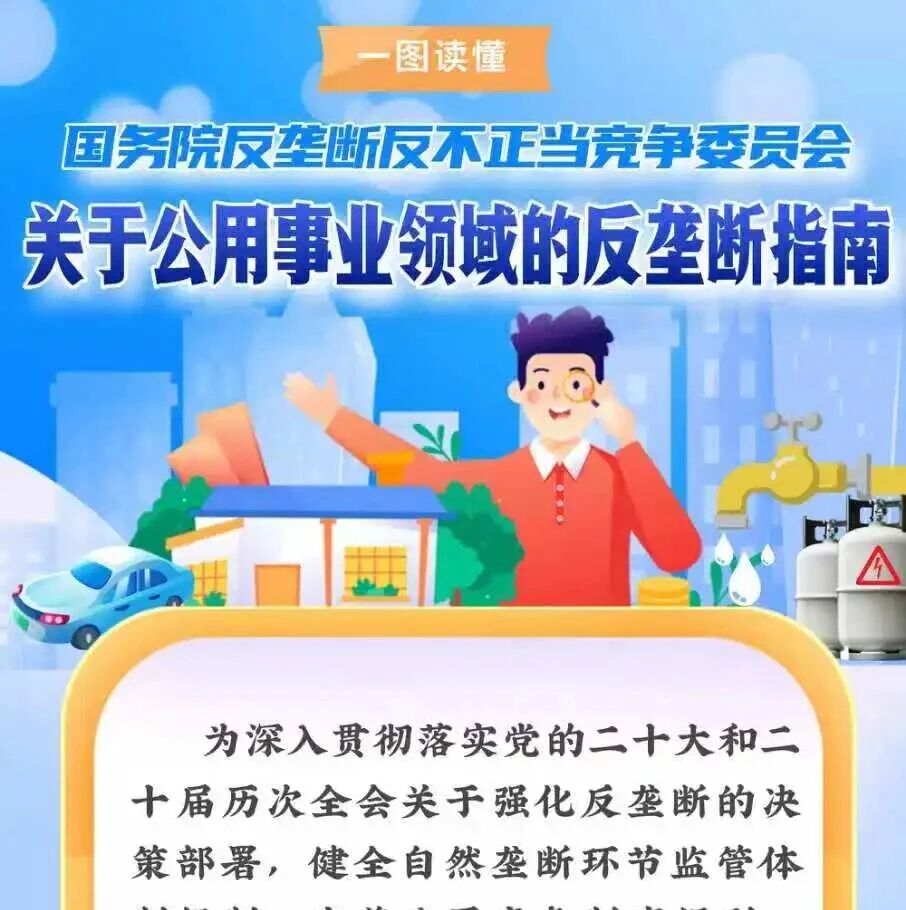
事关水电气热等领域,公用事业领域反垄断指南出台
证券时报· 2026-02-11 12:14
Core Viewpoint - The article discusses the issuance of the "Antitrust Guidelines for the Public Utilities Sector" by the State Council, aimed at preventing and curbing monopolistic behaviors in public utilities, ensuring fair market competition, and protecting consumer and public interests [1][4]. Group 1: Background and Purpose - The public utilities sector, which includes water supply, electricity, gas, heating, sewage treatment, waste disposal, and public transportation, often exhibits natural monopolistic characteristics [7]. - Recent years have seen a rise in monopolistic behaviors within this sector, where operators extend their monopolistic advantages to upstream and downstream competitive segments, limiting market competition [2][8]. - The guidelines consist of seven chapters and 50 articles, summarizing enforcement experiences and providing clear rules for identifying monopolistic behaviors in public utilities [2][9]. Group 2: Key Contents of the Guidelines - The guidelines outline the overall principles for antitrust enforcement in the public utilities sector, emphasizing the need for operators and industry associations to establish compliance management systems to prevent risks [12][14]. - Specific provisions include the clarification of the rights and procedures for whistleblowers, and the prohibition of monopolistic behaviors through data algorithms [15][16]. - The guidelines detail the forms of monopolistic agreements and the conditions under which certain agreements may be exempt from prohibition [18][21]. Group 3: Market Dominance and Abuse - The guidelines provide a framework for analyzing the abuse of market dominance, including factors for determining whether a public utility operator holds a dominant market position [22][24]. - They specify considerations for identifying unfair pricing, refusal to deal, and other abusive practices, along with common justifications that may not be accepted as valid [26][27]. - The guidelines also address the review of operator concentrations, particularly in natural monopoly segments, and the potential requirement for operators to report concentrations that may restrict competition [27][28]. Group 4: Legal Responsibilities and Enforcement - The guidelines clarify the legal responsibilities of public utility operators and industry associations in cases of antitrust law violations, including the consequences of aiding in monopolistic agreements [32][34]. - They emphasize the importance of compliance with antitrust regulations and the potential for penalties to be recorded in credit histories, highlighting the collaborative enforcement approach among regulatory bodies [34].
事关水电气热等领域,公用事业领域反垄断指南出台
中国能源报· 2026-02-11 10:52
Core Viewpoint - The article discusses the release of the "Antitrust Guidelines for Public Utilities" by the State Council Antitrust Committee, aimed at preventing monopolistic behaviors in public utility sectors such as water, electricity, gas, heating, sewage treatment, waste management, and public transportation [1][3]. Group 1: General Principles - The purpose of the guidelines is to prevent and stop monopolistic behaviors in public utilities, guide operators in antitrust compliance, strengthen regulation of natural monopoly sectors, and protect fair market competition and consumer interests [3]. - The guidelines emphasize maintaining fair competition, scientifically regulating the sector, enhancing public welfare, and supporting high-quality development [4][5]. Group 2: Antitrust Compliance - Public utility operators are encouraged to strengthen antitrust compliance management and identify potential legal risks [5]. - Industry associations in the public utility sector should enhance antitrust compliance management and self-discipline to avoid violations of antitrust laws [5]. Group 3: Reporting and New Monopolistic Behaviors - Any individual or organization can report suspected monopolistic behaviors in the public utility sector to antitrust enforcement agencies, which must keep the whistleblower's identity confidential [6]. - Public utility operators are prohibited from using data, algorithms, technological, capital advantages, or platform rules to engage in monopolistic behaviors [6]. Group 4: Market Definition - The guidelines provide a framework for defining relevant markets in the public utility sector, considering factors such as product characteristics, usage costs, and consumer dependency [8][9]. - The geographic market is defined based on the physical network or infrastructure coverage of the public utility operator [7]. Group 5: Monopolistic Agreements - The guidelines outline the criteria for identifying monopolistic agreements, including horizontal and vertical agreements that restrict competition [9][10]. - Public utility operators must not engage in practices that could be deemed as price-fixing, market division, or limiting production [10][11]. Group 6: Abuse of Market Dominance - The guidelines specify the framework for identifying abuse of market dominance, including unfair pricing and refusal to deal [12][13]. - Factors such as market share, dependency of consumers, and barriers to market entry are considered in determining market dominance [14][15]. Group 7: Operator Concentration - Public utility operators can legally concentrate through fair competition and voluntary cooperation, but must report to antitrust authorities if they meet certain thresholds [19][20]. - The guidelines emphasize the need for scrutiny of concentrations that may harm competition, especially in natural monopoly sectors [25][26]. Group 8: Fair Competition Review - Administrative bodies must conduct fair competition reviews for policies affecting public utility operators to ensure equal access to resources and fair market participation [28][29]. - The guidelines prohibit the abuse of administrative power to limit competition in the public utility sector [30][31]. Group 9: Legal Responsibilities - Violations of antitrust laws by public utility operators, industry associations, and administrative bodies will be subject to legal consequences as outlined in the guidelines [39][40]. - The guidelines encourage cooperation with investigations and provide for leniency in penalties for those who actively assist in compliance [45][46].