
金融监管

Search documents
进一步防范和处置虚拟货币等相关风险
Qi Huo Ri Bao Wang· 2026-02-08 18:33
Core Viewpoint - The joint notice issued by eight Chinese regulatory bodies aims to further prevent and address risks associated with virtual currencies and tokenization of real-world assets, emphasizing that such activities are illegal financial activities and do not hold the same legal status as fiat currencies [1][2]. Group 1: Regulatory Framework - The notice reiterates that virtual currencies do not have the same legal status as fiat currencies and that any related business activities are considered illegal financial activities [1]. - It prohibits foreign entities and individuals from providing virtual currency-related services to domestic entities in any form [1]. - The notice emphasizes that tokenization of real-world assets is also illegal unless approved by relevant authorities, and foreign entities cannot provide related services to domestic entities [1]. Group 2: Specific Measures - Three specific measures are outlined: 1. Establishing a collaborative work structure between central and local governments to enhance risk prevention and management [3]. 2. Strengthening risk prevention and response through cross-departmental cooperation, including monitoring risks, managing funds and information flows, and regulating virtual currency mining [3]. 3. Enhancing organizational implementation by clarifying responsibilities among departments and regions, and promoting public awareness of risks associated with virtual currencies and tokenization [4]. Group 3: Importance of the Notice - The notice is significant for maintaining national financial sovereignty and ecological stability by enforcing strict regulations and combating illegal cross-border arbitrage [4]. - It aims to protect investor rights by implementing thorough regulatory measures to eliminate illegal financial bubbles [4]. - The notice also seeks to define the boundaries of financial innovation, discouraging fraudulent innovations while supporting compliant development of blockchain technology and data assets [4].
非银金融:中国RWA监管框架落地,香港Web3产业迎新变局
ZHESHANG SECURITIES· 2026-02-08 12:34
Investment Rating - The industry investment rating is "Positive" (maintained) [3] Core Insights - The regulatory framework for Real World Assets (RWA) has been established in China, expanding the scope from virtual currencies to include tokenization of both virtual currencies and real-world assets [2] - The new regulations emphasize cross-border supervision, prohibiting domestic entities from issuing stablecoins linked to the Renminbi abroad without consent, and restricts foreign entities from providing RWA-related services to domestic subjects [2] - The policy aims to facilitate the orderly development of RWA by allowing domestic entities and financial institutions to operate abroad under clear regulatory requirements, enhancing Hong Kong's position as a hub for asset outflow and promoting the normalization of RWA practices [2] Summary by Sections - **Regulatory Developments**: The recent notification from multiple Chinese regulatory bodies defines RWA and outlines a clear framework for domestic enterprises to engage in overseas RWA activities, categorizing them into four types: external debt RWA, asset securitization RWA, equity RWA, and other forms of RWA [3] - **Operational Guidelines**: The guidelines require domestic entities to file with the China Securities Regulatory Commission (CSRC) before engaging in RWA activities abroad, ensuring compliance with necessary reporting and documentation [3] - **Market Participants**: Key participants in the Hong Kong RWA industry include digital asset exchanges, intermediary institutions (especially domestic financial institutions' overseas subsidiaries), and technology service providers [4]
中国人民银行、中国证监会等八部门联合发布《关于进一步防范和处置虚拟货币等相关风险的通知》|金融与科技
清华金融评论· 2026-02-07 09:21
Core Viewpoint - The article emphasizes the need for stringent measures to prevent and address risks associated with virtual currencies and the tokenization of real-world assets (RWA) to maintain national security and social stability [4][5]. Summary by Sections Nature of Virtual Currencies and RWA Tokenization - Virtual currencies do not possess the same legal status as fiat currencies and are characterized by their non-issuance by monetary authorities, use of encryption technology, and existence in digital form. They lack legal tender status and should not circulate as currency [5]. - Activities related to virtual currencies are classified as illegal financial activities, including exchanges between fiat and virtual currencies, trading virtual currencies, and issuing tokens without authorization [5]. - RWA tokenization involves converting ownership and income rights of assets into tokens using encryption and distributed ledger technology, which is also deemed illegal without proper authorization [6]. Collaborative Mechanisms - A collaborative mechanism among various departments, including the People's Bank of China and the China Securities Regulatory Commission, is established to coordinate efforts in preventing and addressing risks related to virtual currencies and RWA tokenization [8]. Risk Monitoring and Management - Continuous improvement of monitoring technologies and systems is essential for risk assessment related to virtual currencies and RWA tokenization. Local governments are tasked with effective online and offline monitoring to identify and share risk information promptly [10]. Regulation of Financial and Service Institutions - Financial institutions are prohibited from providing services related to virtual currencies, including account opening and fund transfers. They must also refrain from offering custody or settlement services for unauthorized RWA tokenization activities [11]. - Internet companies are restricted from providing platforms for virtual currency and RWA tokenization activities, and must report any illegal activities to authorities [11]. Advertising and Registration Management - Market regulatory authorities are to enhance management of business registrations, ensuring that names and business scopes do not include terms related to virtual currencies or RWA tokenization [12]. Enforcement Against Illegal Activities - Local financial management departments are responsible for investigating and addressing illegal financial activities related to virtual currencies and RWA tokenization, with severe penalties for violations [13]. International Business Regulations - Strict regulations are imposed on domestic entities engaging in virtual currency activities abroad, ensuring compliance with local laws and regulations [15][16]. Organizational Leadership and Public Awareness - A strong organizational framework is necessary for risk prevention, with a focus on public education regarding the risks associated with virtual currencies and RWA tokenization [18][19].


八部门:禁止在境外发行人民币稳定币
Sou Hu Cai Jing· 2026-02-07 09:05
Core Viewpoint - The People's Bank of China and eight other departments emphasize the need to prevent and manage risks associated with virtual currencies and the tokenization of real-world assets, highlighting the implications for monetary sovereignty and the legal status of stablecoins linked to fiat currencies [1][2]. Regulatory Framework - The notification reiterates that virtual currencies do not hold the same legal status as fiat currencies, and any related business activities within China are deemed illegal [2][3]. - It specifies that no domestic or foreign entities may issue stablecoins linked to the Renminbi without proper authorization [2][3]. - The notification categorizes the tokenization of real-world assets as activities that convert ownership and income rights into tokens, which are subject to strict regulatory oversight [2][3]. Enforcement Measures - Activities related to the tokenization of real-world assets and associated intermediary services are prohibited unless authorized by relevant authorities [3][4]. - The notification mandates that any domestic entities engaging in overseas tokenization activities must comply with strict regulatory principles, ensuring that similar risks are managed under the same rules [3][5]. - It calls for enhanced management of financial, intermediary, and information technology service institutions to ensure compliance with the new regulations [4][5]. Coordination and Implementation - The notification outlines a collaborative framework between central and local authorities to effectively manage risks associated with virtual currencies and asset tokenization [5][6]. - Central departments, including the People's Bank of China and the China Securities Regulatory Commission, are tasked with establishing mechanisms to address these risks, while local governments are responsible for implementing these measures within their jurisdictions [6].
央行、证监会等八部门划红线:虚拟货币与RWA代币化迎严管
2 1 Shi Ji Jing Ji Bao Dao· 2026-02-07 08:51
Core Viewpoint - The regulatory stance on Real World Asset (RWA) tokenization activities in China has been clearly defined, emphasizing a complete ban on domestic activities and strict regulation on cross-border operations [1][4][3]. Regulatory Framework - The recent notice from the People's Bank of China and other departments outlines three main regulatory points regarding RWA tokenization: 1. A total prohibition on any form of issuance, trading, and related services within the domestic market [1][4]. 2. Domestic entities engaging in cross-border RWA activities must adhere to the principle of "same business, same risk, same rules," with strict oversight from relevant authorities [1][5]. 3. Foreign entities and individuals are prohibited from providing RWA-related services to domestic subjects in any form [2][7]. Financial Institutions Guidelines - Financial institutions are reminded not to provide services for unauthorized RWA tokenization activities and related financial products. Additionally, foreign subsidiaries must manage risks prudently when offering RWA services abroad [2][6]. Definition and Scope of RWA Tokenization - RWA tokenization is defined as the use of encryption technology and distributed ledger technology to convert ownership and income rights of assets into tokens or similar rights for issuance and trading. The notice categorically bans any such activities within China [4][5]. Cross-Border Regulation - Cross-border RWA activities involving domestic entities will be strictly regulated, ensuring that any business with underlying assets in China complies with domestic financial regulations, regardless of where the activity occurs [5][6]. Compliance Requirements - The notice imposes stringent compliance requirements on various service providers, including financial, intermediary, and technology firms, prohibiting them from supporting unauthorized RWA tokenization activities [5][6]. Virtual Currency Stance - The notice reiterates a strict prohibition on all virtual currency activities within China, including trading and exchange services, categorizing them as illegal financial activities [9][10]. Risk Management Mechanism - A comprehensive risk prevention and management mechanism has been established, covering both domestic and international operations, and emphasizing the principle of "same business, same risk, same rules" [11][12]. Collaborative Governance - The notice establishes a collaborative governance framework involving multiple departments at both central and local levels to enhance policy implementation and risk response capabilities [13].
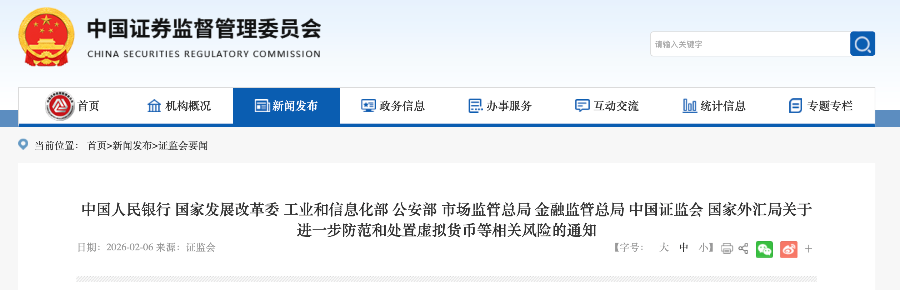
中国证监会:严管境内资产通过加密、区块链技术在境外代币化发行!“不得损害国家利益与社会公共利益”
新浪财经· 2026-02-07 08:25
Core Viewpoint - The China Securities Regulatory Commission (CSRC) has issued regulatory guidelines to manage the issuance of tokenized securities abroad that are backed by domestic assets, aiming to prevent speculative risks associated with virtual currencies and maintain financial order and public asset safety [2]. Regulatory Scope - The new regulations cover tokenized equity certificates issued abroad that are backed by cash flows generated from domestic assets. Such activities must comply with cross-border investment, foreign exchange management, and data security regulations, and require necessary approvals and safety reviews [2]. Prohibited Circumstances - Six specific scenarios are explicitly prohibited, including: - Entities or assets that are banned from financing by the state - Activities that may endanger national security - Entities with criminal records related to corruption in the past three years - Ongoing investigations for major illegal activities that are unresolved - Assets with ownership disputes or that are legally non-transferable - Types of domestic asset securitization that are restricted [2]. Core Regulatory Mechanism - The core of the regulation is a filing management system, requiring entities that control relevant assets domestically to submit complete and truthful filing reports and issuance materials to the CSRC. Approved filings will be publicly disclosed, and non-compliant entities will not be allowed to file [2]. Risk Reporting and Collaboration - After filing is completed, any significant risks or major events must be reported promptly. Additionally, the CSRC will enhance collaboration with overseas regulatory bodies to share information and prevent cross-border risk transmission, while legally combating violations [2].
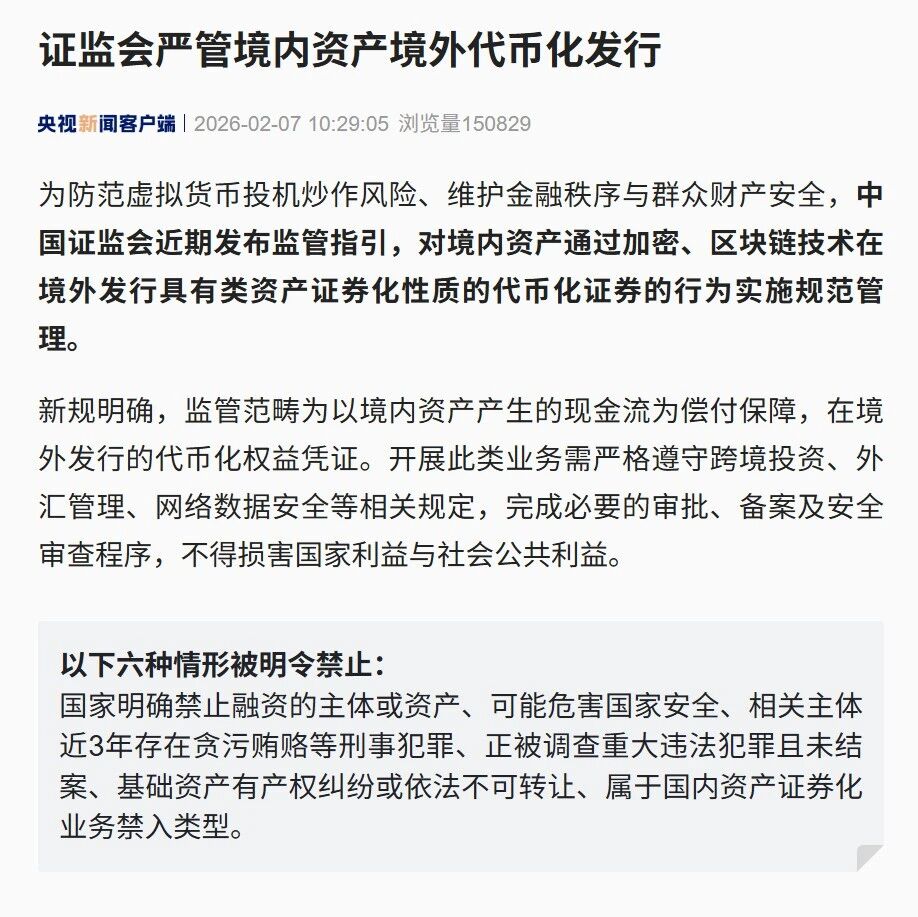
中国证监会:严管境内资产通过加密、区块链技术在境外代币化发行!“不得损害国家利益与社会公共利益”
Mei Ri Jing Ji Xin Wen· 2026-02-07 03:45
Core Viewpoint - The China Securities Regulatory Commission (CSRC) has issued regulatory guidelines to manage the issuance of tokenized securities abroad that are backed by domestic assets, aiming to prevent speculative risks associated with virtual currencies and protect financial order and public property safety [1] Regulatory Scope - The new regulations cover tokenized equity certificates issued abroad that are backed by cash flows generated from domestic assets [1] - Businesses engaging in such activities must comply with cross-border investment, foreign exchange management, and data security regulations, and must complete necessary approvals, filings, and security reviews [1] Prohibited Activities - Six specific scenarios are explicitly prohibited, including: - Entities or assets that are explicitly banned from financing by the state - Activities that may endanger national security - Entities with criminal records related to corruption or bribery in the past three years - Entities currently under investigation for major illegal activities that are unresolved - Assets with ownership disputes or that are legally non-transferable - Types of domestic asset securitization that are prohibited [1] Core Regulatory Mechanism - The core of the regulation is a filing management system, requiring entities that control relevant assets domestically to submit complete and truthful filing reports and issuance materials to the CSRC [1] - Upon approval, relevant information will be publicly disclosed, and non-compliant entities will not be allowed to file [1] - After filing, any significant risks or major events must be reported promptly [1] International Cooperation - The CSRC will enhance collaboration with overseas regulatory bodies to share information and prevent cross-border risk transmission, while also legally combating illegal activities to strengthen financial security [1]
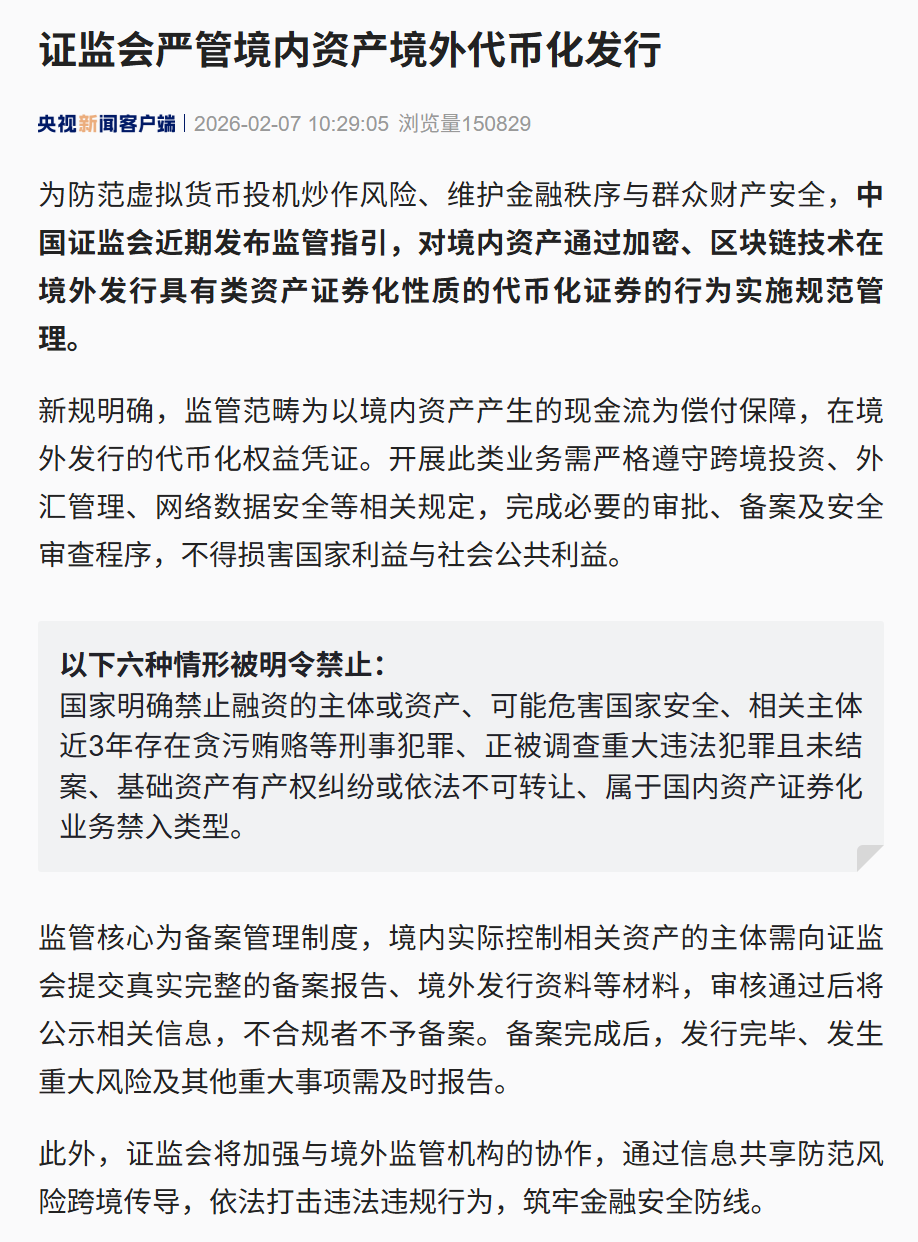
证监会严管境内资产境外代币化发行
Jing Ji Guan Cha Wang· 2026-02-07 03:04
Core Viewpoint - The China Securities Regulatory Commission (CSRC) has issued regulatory guidelines to manage the issuance of tokenized securities based on domestic assets abroad, aiming to prevent speculative risks associated with virtual currencies and maintain financial order and public asset safety [1] Group 1: Regulatory Scope - The new regulations specify that the scope of supervision includes tokenized equity certificates issued abroad, backed by cash flows generated from domestic assets [1] - Businesses engaging in such activities must comply with cross-border investment, foreign exchange management, and cybersecurity regulations, and must complete necessary approvals, filings, and security reviews [1] Group 2: Prohibited Circumstances - Six specific scenarios are explicitly prohibited, including financing entities or assets that are banned by the state, those that may endanger national security, and entities involved in serious criminal activities within the last three years [2] - The core of the regulation is a filing management system, requiring entities controlling relevant assets to submit complete and truthful filing reports to the CSRC for approval [2] Group 3: Compliance and Cooperation - Upon approval, relevant information will be publicly disclosed, and non-compliant entities will not be allowed to file [2] - The CSRC will enhance cooperation with overseas regulatory bodies to share information and prevent cross-border risk transmission, while also taking legal action against illegal activities [2]
监管部门对RWA代币化境内严禁、境外严管
证券时报· 2026-02-06 15:51
Core Viewpoint - The regulatory authorities have adopted a principle of "strict prohibition domestically and strict management overseas" regarding the tokenization of real-world assets (RWA) [1][2]. Group 1: Domestic Regulations - The People's Bank of China and the China Securities Regulatory Commission have issued a notice prohibiting RWA tokenization activities within the country, including any form of issuance and trading of RWA tokens [1]. - Domestic entities are not allowed to provide services related to RWA tokenization, including marketing and payment facilitation, for activities conducted within China [1]. - Any domestic entity or individual must not engage in RWA tokenization activities without approval from relevant authorities [1]. Group 2: Overseas Management - The notice outlines requirements for financial, intermediary, and technical services related to RWA tokenization provided by domestic financial institutions' overseas subsidiaries, emphasizing risk management [2]. - Intermediary and IT service providers must comply with legal regulations and report their activities to relevant management departments [2]. - Foreign entities are prohibited from providing RWA tokenization services to domestic subjects in any form [2]. Group 3: Risk Mitigation - The regulation aims to cut off the risk transmission path of RWA tokenization within the country by holding domestic institutions accountable and prohibiting support for overseas RWA projects [3]. - The authorities have not approved any RWA tokenization activities, and unauthorized activities may involve illegal fundraising and other financial crimes [3]. - The notice emphasizes strict enforcement against illegal financial activities and fraud related to RWA tokenization [3]. Group 4: Regulatory Guidelines - The China Securities Regulatory Commission will enforce strict regulations on RWA tokenization based on the principle of "same business, same risk, same rules" for activities involving domestic asset ownership and income rights [4]. - Domestic enterprises must file with the China Securities Regulatory Commission before engaging in related activities and submit necessary documentation [4][5]. - The activities must comply with laws and regulations regarding cross-border investment, foreign exchange management, and data security [5].

央行等八部门:任何单位和个人不得在境外发行挂钩人民币的稳定币
Bei Ke Cai Jing· 2026-02-06 13:50
新京报贝壳财经讯 2月6日,中国人民银行、国家发展改革委、工业和信息化部、公安部、市场监管总 局、金融监管总局、 中国证监会、国家外汇局发布了关于进一步防范和处置虚拟货币等相关风险的通 知。 二、健全工作机制 (三)部门协同联动。中国人民银行会同国家发展改革委、工业和信息化部、公安部、市场监管总局、 金融监管总局、中国证监会、国家外汇局等部门健全工作机制,并与中央网信办、最高人民法院、最高 人民检察院加强协调、形成合力,统筹指导各地区开展虚拟货币相关非法金融活动风险防范和处置工 作。 中国证监会会同国家发展改革委、工业和信息化部、公安部、中国人民银行、市场监管总局、金融监管 总局、国家外汇局等部门健全工作机制,并与中央网信办、最高人民法院、最高人民检察院加强协调、 形成合力,统筹指导各地区开展现实世界资产代币化相关非法金融活动风险防范和处置工作。 (四)强化属地落实。各省级人民政府统筹负责本行政区域内虚拟货币、现实世界资产代币化相关风险 防范和处置工作,具体由地方金融管理部门牵头,国务院金融管理部门分支机构、派出机构以及电信主 管、公安、市场监管等部门参加,与网信部门、人民法院、人民检察院联动配合,健全常态化 ...