
商业零售

Search documents
中百集团宣布已关30家大卖场,学胖东来学了1年多,近三个季度仍亏5.8亿元
Mei Ri Jing Ji Xin Wen· 2025-12-04 22:35
Core Viewpoint - Zhongbai Group is implementing a "subtraction" strategy by closing underperforming stores to address ongoing financial losses and adapt to market changes [1][6] Group 1: Store Closures - Zhongbai Group has closed a total of 30 warehouse hypermarkets, with 13 closures occurring in the first half of 2025, resulting in an estimated loss of 180 million yuan [1][7] - The primary reason for the closures is "store losses," with 23 out of the 30 closed stores identified as such, accounting for 76.7% of the closures [4] - Some long-established stores, including those opened nearly 20 years ago, have been closed, indicating a shift in consumer behavior and market dynamics [4][6] Group 2: Financial Impact - The closures are expected to generate a one-time loss of approximately 180 million yuan, adding to the company's existing financial pressures, which include a net loss of 528 million yuan in 2024 and 580 million yuan in the first three quarters of 2025 [8] - The company acknowledges that the financial pain from these closures is unavoidable in the short term, despite the potential long-term benefits of improving overall operational quality [8] Group 3: Strategic Adjustments - In response to the negative impact of store closures, Zhongbai Group is actively pursuing new growth opportunities, including significant reforms in the supply chain and the introduction of private label products, which generated sales of 328 million yuan [9] - The company is also innovating its business model by entering the hard discount sector and launching new local service platforms to enhance consumer engagement [9] - Additionally, Zhongbai Group is working on revitalizing its existing assets by reducing vacant space and optimizing its property portfolio [9] Group 4: Company Background - Zhongbai Group is a state-owned commercial listed company founded in 1937, with its operations primarily centered in Hubei province and extending to regions like Chongqing and Hunan [11] - As of the end of 2024, the company had over 1,600 outlets, annual revenue exceeding 10 billion yuan, and total assets surpassing 10 billion yuan [11]


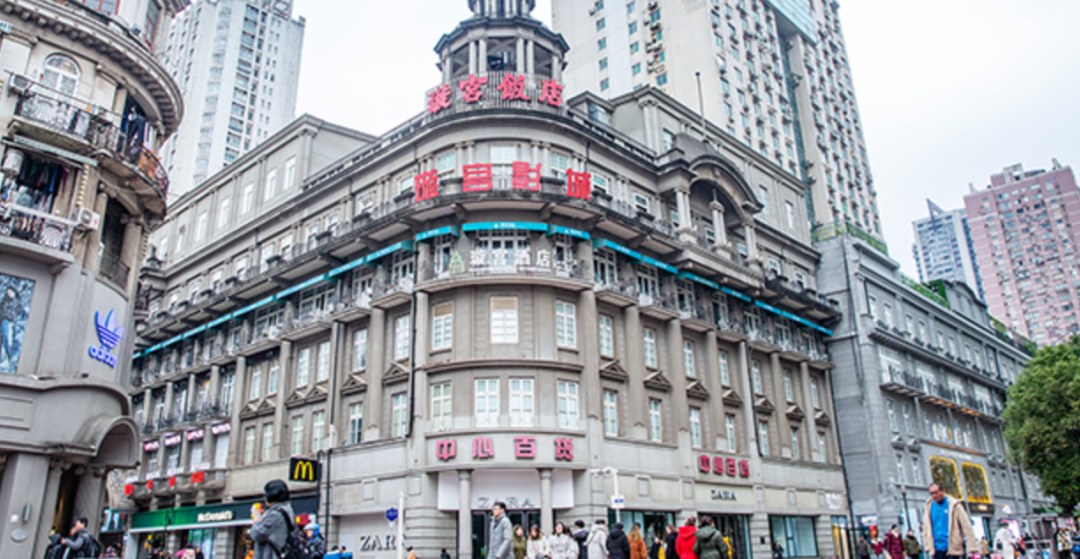
武商集团全资子公司拟收购小电科技70%-100%股权
Xi Niu Cai Jing· 2025-12-04 03:04
Core Viewpoint - The acquisition of 70%-100% equity in Xiaodian Technology by Wushang Group's subsidiary aims to transform a traditional retail enterprise into a commercial technology company, while also revitalizing Xiaodian Technology, which was once a prominent player in the shared economy [1]. Group 1: Acquisition Details - The acquisition will occur in two phases: first, Wushang Group will acquire 70% of Xiaodian Technology, with the remaining 30% held by founder Tang Yongbo and an employee stock ownership platform; second, after the profit commitment period, Wushang Group will negotiate to acquire the remaining 30% [3]. - Xiaodian Technology, founded in 2016, specializes in shared charging services and has expanded into various sectors, covering over 2,700 cities and serving more than 450 million users [4]. Group 2: Wushang Group's Challenges - Wushang Group has faced difficulties in recent years, with over 90% of its revenue still reliant on the local market, and its core operations concentrated in 10 shopping centers and supermarkets [3]. - The company's revenue fluctuated from 6.337 billion yuan in 2022 to 7.178 billion yuan before dropping to 6.704 billion yuan, while net profit has remained stagnant between 200 million to 300 million yuan for three consecutive years [3]. - In the first three quarters of 2025, Wushang Group's revenue declined by 11.64%, with Q3 revenue at 1.341 billion yuan, a year-on-year decrease of 9.13%, and a net loss of 37.42 million yuan, widening by 26.63% year-on-year [3]. Group 3: Xiaodian Technology's Market Position - Xiaodian Technology's path to an IPO has been challenging, initially aiming for the ChiNext board before shifting to a Hong Kong listing, while facing competition from Monster Charging, which has already gone public on NASDAQ [4]. - The shared charging industry has matured, leading to challenges such as a single business structure, ongoing pressure on profitability, and competition for market share [4]. Group 4: Industry Insights - Industry experts view this merger as a collaborative attempt by two struggling companies to seek breakthroughs, with the ultimate outcome of this cross-industry partnership remaining uncertain [5].


合百集团:公司高度关注广德“三件套”走红催生的区域消费热潮
Zheng Quan Ri Bao Zhi Sheng· 2025-12-03 11:09
Group 1 - The company is focusing on the regional consumption boom driven by the popularity of the "three-piece set" in Guangde [1] - The company plans to enhance marketing collaboration, optimize product supply, and upgrade experiential scenarios to further activate consumption potential at its outlets [1]

离境退税“即买即退”激活入境消费,市南把流量变实实在在增量
Qi Lu Wan Bao· 2025-12-02 05:55
Core Viewpoint - The implementation of the "immediate tax refund" policy in Qingdao's Sima District is significantly enhancing the inbound consumption experience for foreign tourists, transforming the "China tour" enthusiasm into increased local shopping activity [1][2]. Group 1: Policy Implementation and Impact - The State Taxation Administration has promoted the "immediate tax refund" initiative nationwide, allowing foreign travelers to receive tax refunds at the point of purchase rather than at the airport, thus reducing consumer hesitation [2]. - Sima District has quickly optimized processes and upgraded services to ensure that the benefits of the policy translate into real experiences for foreign tourists [2]. - The tax refund can reach up to 9% of the purchase amount, with a maximum single refund of 20,000 yuan, leading to a 143% year-on-year increase in tax refund amounts during the 2025 National Day holiday [3]. Group 2: Consumer Experience Enhancements - Qingdao Hisense Plaza has integrated policy benefits with service upgrades, allowing foreign travelers to process tax refunds directly at the customer service center [3]. - The plaza has become the first inbound payment-friendly shopping center in Shandong, fully covering Alipay+ payment options, enabling foreign customers to pay using familiar e-wallets [3]. - Future plans include allowing foreign travelers to fill out tax refund information online and facilitating direct refunds to electronic wallets or bank cards, enhancing service efficiency [4]. Group 3: Service Optimization and Promotion - Continuous optimization of services is essential for the policy's effectiveness, with plans to add multilingual service personnel for better assistance in tax refund processing and product inquiries [4]. - The Sima District Business Bureau aims to promote the tax refund service network to more shopping areas, ensuring that foreign tourists find it easy and enjoyable to shop in the district [4].
长三角议事厅·周报|从国际化消费试点看长三角城市新梯度
Xin Lang Cai Jing· 2025-12-02 03:47
Core Insights - The Ministry of Commerce and the Ministry of Finance have jointly announced the list of "Pilot Cities for International Consumption Environment Construction," with Shanghai leading the Yangtze River Delta as an international consumption center, while Nanjing and Hangzhou have made their debut on the list [1][3][4] Group 1: Consumption Landscape - Shanghai remains at the top of the consumption hierarchy, with projected international tourism revenue of $11.09 billion in 2024, a growth of 79.3%, and domestic tourism revenue of approximately ¥497.26 billion, a growth of 35.2% [3] - Hangzhou is recognized as the "E-commerce Capital," with online retail sales exceeding ¥1 trillion in 2022, supported by over 128 e-commerce platforms and 1.25 million online stores [3][4] - Nanjing excels in offline shopping districts and cultural scenes, with a focus on revitalizing historical areas and enhancing night economy, leading to a higher density of cultural offerings compared to similar cities [4] Group 2: Absence of Strong Manufacturing Cities - Notable absences from the pilot list include major manufacturing cities like Suzhou, Ningbo, and Wuxi, which, despite their economic strength, have not developed corresponding international consumption environments [5][6] - Suzhou is projected to surpass ¥1 trillion in retail sales in 2024, yet its service sector's contribution to GDP is only about 52.4%, indicating a reliance on manufacturing income rather than a robust consumer market [5][6] - Ningbo and Wuxi also exhibit similar trends, with low inbound tourism numbers and a lack of international consumption experiences, highlighting a disconnect between industrial strength and consumer engagement [5][6] Group 3: Regional Consumption Gradient - The Yangtze River Delta has established a preliminary consumption gradient, with Shanghai at the internationalization peak, followed by Hangzhou and Nanjing as innovation hubs, while Suzhou, Ningbo, and Wuxi lag behind in consumer engagement [6][7] - This entrenched structure may weaken the overall domestic demand potential of the Yangtze River Delta and create new imbalances in urban capabilities and regional roles [6] Group 4: Challenges in Consumption Coordination - Despite advancements in transportation integration, the consumption landscape has not evolved correspondingly, with a lack of clear regional consumption function division [7][8] - The absence of a unified data framework hampers regional collaboration, as cities rely on disparate data sources, leading to a fragmented understanding of consumer behavior across the region [8] Group 5: Recommendations for Regional Benefits - To transform the pilot cities' advantages into regional benefits, it is essential to address institutional shortcomings and establish unified standards for cross-city operations [9][10] - Shanghai should continue to serve as a global entry point, while Nanjing and Hangzhou can focus on cultural and digital consumption experiences, respectively, to create a cohesive regional consumption ecosystem [9][10] - Developing a regional consumption big data platform could enhance policy precision and foster sustainable cross-city consumption habits [10]
茂业国际合共出售2511.35万股茂业商业股份
Mei Ri Jing Ji Xin Wen· 2025-12-02 00:54
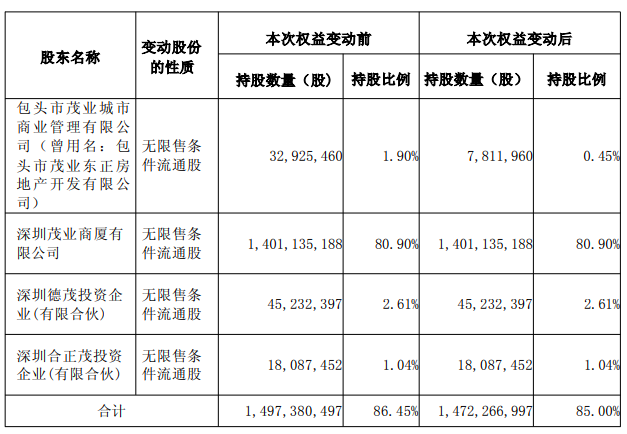
每经AI快讯,12月2日,茂业国际发布公告,公司的间接全资附属公司包头市茂业城市商业管理公司(曾 用名:包头市茂业东正房地产开发有限公司)分别于2025年11月28日及2025年12月1日在公开市场出售 200万股及2311.35万股(总计2511.35万股)茂业商业(600828)股份,占茂业商业截至本公告已发行股本 约1.45% ,总代价约为人民币1.61亿元(不包括交易成本),每股茂业商业的平均出售价约为人民币6.40 元。出售事项后,公司合并持有的茂业商业的权益将由86.45%减少至85%。 ...

茂业国际(00848.HK)减持茂业商业2511.35万股 总代价1.61亿元
Ge Long Hui· 2025-12-01 23:23
Core Viewpoint - Maoye International (00848.HK) announced the sale of a total of 25.1135 million shares of Maoye Commercial (600828.SH), representing approximately 1.45% of Maoye Commercial's issued share capital, for a total consideration of approximately RMB 160.77 million, reducing its stake from 86.45% to 85% [1] Summary by Sections - **Share Sale Details** - The indirect wholly-owned subsidiary of Maoye International, Baotou Maoye Urban Commercial Management Co., Ltd., sold 2 million shares on November 28, 2025, and 23.1135 million shares on December 1, 2025 [1] - The average selling price per share of Maoye Commercial was approximately RMB 6.40 [1] - **Impact on Shareholding** - Following the sale, the company's consolidated equity interest in Maoye Commercial will decrease from 86.45% to 85% [1]
深圳老牌商业零售龙头,5天股价暴涨40%,股东高位“精准”套现
Shen Zhen Shang Bao· 2025-12-01 15:35
Core Viewpoint - The stock price of Maoye Commercial (600828) surged over 40% in five consecutive trading days, leading to significant shareholder sell-offs at high prices, raising concerns among investors about potential "high-level harvesting" [1][3]. Stock Performance - On December 1, 2023, Maoye Commercial's stock hit a three-year high, closing at 5.94 CNY per share after a drop of 3.41% on the same day, despite a cumulative increase of over 40% in the previous five trading days [1]. - Since the low point of 2.84 CNY per share on April 7, 2023, the stock has appreciated nearly 90% [1]. Shareholder Actions - The controlling shareholder, Baotou Maoye Urban Commercial Management Co., Ltd., reduced its stake by 25.11 million shares, representing 1.45% of the total share capital, while still retaining an 85% ownership [1][2]. - The timing of the share reduction coincided with the stock's peak performance, indicating a strategic exit by the shareholder [3]. Financial Performance - Despite the recent stock market success, Maoye Commercial has faced declining financial performance, with revenue dropping from 4.168 billion CNY in 2021 to 2.716 billion CNY in 2024, and net profit plummeting from 409 million CNY to only 37.15 million CNY during the same period [4]. - For the first three quarters of 2025, the company reported total revenue of 1.824 billion CNY, a year-on-year decrease of 14.20%, and a net profit of 41.73 million CNY, down 72.88% year-on-year [7].
茂业商业(600828.SH):包头茂业商管合计减持1.45%公司股份
Ge Long Hui A P P· 2025-12-01 12:19
Core Viewpoint - Maoye Commercial (600828.SH) announced that its controlling shareholder's concerted action party, Baotou Maoye Urban Commercial Management Co., Ltd., plans to reduce its shareholding by a total of 25.1135 million shares, accounting for 1.45% of the company's total share capital, between November 28 and December 1, 2025 [1] Summary by Relevant Sections - Shareholding Reduction - Baotou Maoye Urban Commercial Management Co., Ltd. will reduce its stake in Maoye Commercial through centralized bidding and block trading [1] - The total number of shares to be reduced is 25.1135 million [1] - This reduction represents 1.45% of the total share capital of the company [1]
武商集团:公司始终以股东利益为核心
Zheng Quan Ri Bao Wang· 2025-12-01 10:15
Group 1 - The company emphasizes that it prioritizes shareholder interests amid performance challenges and industry competition [1] - The company has implemented a series of tangible transformation and quality improvement actions [1]