
种植业

Search documents
秸秆还田多挖10厘米每亩粮食增产600斤
Xin Hua Ri Bao· 2026-01-20 22:36
Group 1 - The fourth Yangtze River Delta Agricultural and Rural Ecological Green Low-Carbon Development Academic Seminar was held in Rugao, showcasing new technologies for straw returning and soil quality improvement [1] - The province produces approximately 40 million tons of straw annually, with straw returning technology having been promoted for 13 years, facing challenges such as slow decomposition and pest issues [1] - New technologies presented include flame deactivation technology, which can quickly deactivate surface microorganisms on straw, leading to a yield increase of 65 kilograms per mu for rice when combined with biological agents [1] Group 2 - The provincial agricultural research team's microbial synergistic degradation technology has significantly increased straw degradation rates, while deep plowing returning technology reduces greenhouse gas emissions and enhances soil organic matter [2] - The team has innovatively proposed deep plowing to a depth of 20-25 centimeters, promoting microbial activity and accelerating the conversion of straw carbon to soil organic carbon [2] - In demonstration bases in Rugao, deep plowing has resulted in a yield increase of 600 jin per mu, with a 46% improvement in seedling emergence rates compared to conventional tillage [2] - These technologies have been promoted across various types of problematic soils in Jiangsu, improving soil quality by 0.5 to 1 grade [2]
人工杂交育种历经太空诱变
Xin Lang Cai Jing· 2026-01-20 19:54
如何分辨彩色小麦和普通小麦呢?杨艳霞说,目前田里的麦子还处于麦苗阶段,现在种植的紫色小麦品 种比普通小麦矮小一些,如果只从叶片或外形来看其实差别不大,一般很难分辨。随后,她向记者展示 了紫色、黑色、绿色等颜色的麦粒,"最直观的办法是等麦子结出麦穗,通过麦穗颜色来进行分辨。" 杨艳霞介绍,彩色小麦的种植过程、田间管理等和普通小麦没有太大区别,彩色小麦的抗病性、抗倒伏 要强一些,结出来的麦粒比普通的麦粒要小一些。 紫色、黑色、绿色……专家揭秘彩色小麦: 从左至右依次为黑色、紫色、绿色的小麦麦粒。 紫色、黑色、绿色的麦粒,你见过吗?近期,新品种彩色小麦在成都种下,它结出的麦粒颠覆了人们的 认知,不是普通的黄色,而是紫色、黑色、绿色等。彩色小麦是怎么来的?和普通小麦有什么区别?近 日,记者进行了实地走访,同时采访了农业专家进行揭秘。 彩色小麦和普通小麦 仅从麦粒颜色分辨 在成都市郫都区一处农田,记者看到田里整齐长着几厘米高的麦苗,一片绿油油的海洋。"这些就是彩 色小麦。"家庭农场负责人杨艳霞指着身后介绍,这些彩色小麦是2025年11月下旬种植的,由于遇到下 雨,比正常种植期晚了10天左右,预计今年5月左右收割。"今年 ...


美国农业部(USDA)月度供需报告数据分析专题:美国 2026 年牛价景气预计维持向上,全球玉米、大豆 25/26 产季期末库存环比调增-20260120
Guoxin Securities· 2026-01-20 13:54
Investment Rating - The report maintains an "Outperform" rating for the agricultural sector [3][5]. Core Insights - The agricultural sector is expected to experience upward price trends, particularly in beef and dairy, while grain prices are stabilizing at historical lows [1][3][5]. - The supply-demand dynamics for corn and soybeans remain loose, with global ending stocks projected to increase, while domestic prices are expected to find strong support at current low levels [1][2][3]. Summary by Relevant Sections Corn - The USDA January supply and demand report forecasts a global corn production increase of 13.05 million tons (approximately +1.02%) to 1.283 billion tons for the 25/26 season, with a corresponding increase in the global ending stocks-to-use ratio by 0.86 percentage points to 22.38% [15][16]. - Domestic corn prices are currently at a historical low, with a slight month-on-month increase of 0.04% and a year-on-year increase of 10.30% [18]. Soybeans - The USDA report indicates a global soybean production increase of 3.14 million tons, with ending stocks projected to rise by 2.04 million tons (approximately +1.67%) to 124 million tons for the 25/26 season [33][34]. - Short-term support for soybean prices is expected from import costs, while long-term trends are anticipated to improve as Brazilian soybeans come to market [35]. Wheat - The USDA report predicts a global wheat production increase of 4.36 million tons (approximately +0.52%) for the 25/26 season, with the ending stocks-to-use ratio increasing by 0.37 percentage points to 33.77% [47][48]. - Domestic wheat prices are expected to stabilize at low levels, with current prices at 2,515 yuan per ton, reflecting a month-on-month decrease of 0.15% [50]. Beef - The USDA forecasts a decrease in U.S. beef production for 2026, with prices expected to rise by approximately 5.1% year-on-year [3][19]. - Domestic beef prices are anticipated to maintain an upward trend due to reduced production capacity and lower imports [3][19]. Dairy - The USDA predicts a slight reduction in U.S. milk ending stocks, with prices expected to remain favorable due to a contraction in domestic dairy cow capacity [3][24]. - The interplay between meat and dairy sectors is expected to drive a recovery in dairy prices [3][24]. Pork - The USDA projects a 2.69% increase in U.S. pork production for 2026, with prices expected to remain stable at high levels [4][28]. - Domestic breeding sow capacity is being managed to support industry profitability [4][29]. Poultry - U.S. chicken production is expected to recover, with prices projected to perform well due to improved consumer demand [6][30]. - Domestic egg supply is anticipated to be ample, with a year-on-year increase in ending stocks by 23.5% [6][33]. Investment Recommendations - Recommended stocks include leading companies in the livestock, pork, poultry, and pet sectors, such as YouRan Agriculture and MuYuan [5][8].

美国农业部(USDA)月度供需报告数据分析专题:中国2026年牛价景气预计维持向上,全球玉米、大豆25、26产季期末库存环比增长-20260120
Guoxin Securities· 2026-01-20 13:52
Investment Rating - The report maintains an "Outperform" rating for the agricultural sector [1][3]. Core Insights - The report indicates that the beef prices in the US are expected to maintain an upward trend in 2026, while global corn and soybean ending stocks for the 25/26 season are projected to increase [1][3]. - The agricultural products in the planting chain are currently in a bottom consolidation phase, awaiting upward movement [1][2]. Summary by Relevant Sections Corn - The USDA's January supply and demand report forecasts a global corn production increase of 13.05 million tons (approximately +1.02%) to 1.283 billion tons for the 25/26 season, with a corresponding increase in global ending stocks [15][16]. - The ending stocks-to-use ratio is expected to rise by 0.86 percentage points to 22.38%, with China's ratio increasing by 1.94 percentage points [15][17]. - Domestic corn prices are at historical lows, with a current price of 2318 CNY/ton, reflecting a month-on-month increase of 0.04% and a year-on-year increase of 10.30% [18]. Soybeans - The USDA report predicts a global soybean production increase of 3.14 million tons for the 25/26 season, with ending stocks projected to rise by 2.04 million tons (approximately +1.67%) to 124 million tons [33][34]. - The ending stocks-to-use ratio is expected to increase by 0.39 percentage points to 29.40% [33][34]. - Short-term focus is on South American weather, while long-term trends are expected to improve due to reduced domestic soybean stocks and strong import support [35][37]. Wheat - The USDA's January report indicates a global wheat production increase of 4.36 million tons (approximately +0.52%) for the 25/26 season, with ending stocks projected to rise by 3.38 million tons [47][48]. - The ending stocks-to-use ratio is expected to increase by 0.37 percentage points to 33.77% [47][48]. - Domestic wheat prices are currently at 2515 CNY/ton, reflecting a month-on-month decrease of 0.15% [50][52]. Beef - The USDA forecasts a decrease in US beef production for 2026, with an expected overall price increase of approximately 5.1% [3][19]. - The report anticipates that domestic beef prices will maintain a bottoming upward trend due to reduced production capacity and import constraints [3][22]. Dairy - The report notes a slight decrease in US milk ending stocks for 2026, with expectations for domestic raw milk prices to begin an upward trend due to reduced production capacity and import reductions [3][24][26]. Pork - The USDA predicts a 2.69% increase in US pork production for 2026, with overall prices expected to remain high [4][28]. - Domestic breeding sow capacity is being steadily controlled, which is expected to support industry profitability [4][29]. Poultry - The report indicates that US chicken supply is expected to recover, with a slight increase in production and consumption [6][30]. - Domestic egg supply is projected to remain ample, with a year-on-year increase in ending stocks by 23.5% [6][33][34]. Investment Recommendations - The report recommends investing in leading companies in the livestock, pork, poultry, and pet sectors, including YouRan Agriculture, Modern Agriculture, and MuYuan Co., among others [6][8].
中国借助科技创新赋能农业发展
Xin Hua She· 2026-01-20 13:52
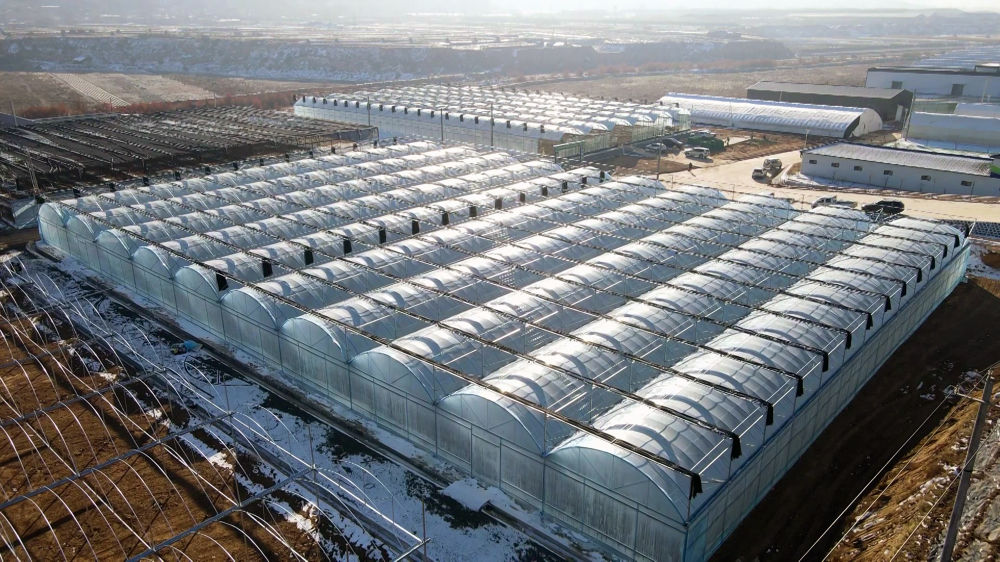
Group 1 - The core viewpoint of the articles emphasizes the role of technological innovation in empowering agricultural development in China, particularly in Gansu Province, where smart greenhouse projects are thriving despite the winter season [2][3][4] - Gansu Province has rapidly developed facility agriculture, achieving "four seasons of freshness and year-round stable supply" through the implementation of smart agricultural technologies [3][4] - The establishment of 14 intensive smart seedling bases and 1,265 standardized greenhouses equipped with IoT devices has enabled precise control of water, light, and nutrients, enhancing the growth of fruits and vegetables [3][4] Group 2 - The "super factory" for roses in Linxia Hui Autonomous Prefecture showcases the integration of advanced technologies, producing over 72 million fresh-cut roses annually, with plans for significant exports by 2025 [3][4] - The shift from traditional agriculture to smart agriculture is highlighted by the use of digital and intelligent systems for real-time monitoring and management of crops and livestock across various regions in China [4][6] - Gansu Agricultural Group is leading the modernization of agriculture by adopting new technologies and establishing smart agriculture demonstration zones, significantly improving farming efficiency [4][6] Group 3 - The development of new cold-resistant oilseed rape varieties in Gansu is a practical example of enhancing agricultural productivity and combating desertification [6][7] - The implementation of 104 key technologies and 62 intelligent equipment breakthroughs during the 14th Five-Year Plan period reflects China's commitment to advancing smart agriculture [6][7] - The transition from "experience-based management" to "technology-driven farming" is effectively empowering agricultural industry development [7]
滨州今年将新改建高标准农田20万亩以上,培育壮大富民产业
Qi Lu Wan Bao· 2026-01-20 09:05
Group 1 - The core focus of the report is on the comprehensive revitalization of Binzhou, emphasizing agricultural modernization and enhancing the quality and efficiency of agricultural production [1] - By 2026, Binzhou aims to strengthen its food security by protecting arable land, utilizing saline-alkali land, and constructing over 200,000 acres of high-standard farmland [1] - The report highlights the implementation of the "0543" project to enhance grain production capacity, improve seed breeding, and strengthen disaster prevention and mitigation capabilities [1] Group 2 - The report outlines the goal of creating a higher standard and more beautiful countryside by learning from the "Ten Thousand Projects" experience and promoting rural revitalization in an orderly manner [2] - Plans include the construction of 220 kilometers of new rural roads and the renovation of water supply networks in 80 villages, alongside initiatives to improve rural living conditions [2] - The report emphasizes the development of new income-generating models and the establishment of 10 new service centers for modern agricultural operators to ensure no large-scale poverty occurs [2]
种植业板块1月20日跌0.83%,神农种业领跌,主力资金净流出3.46亿元
Zheng Xing Xing Ye Ri Bao· 2026-01-20 08:51
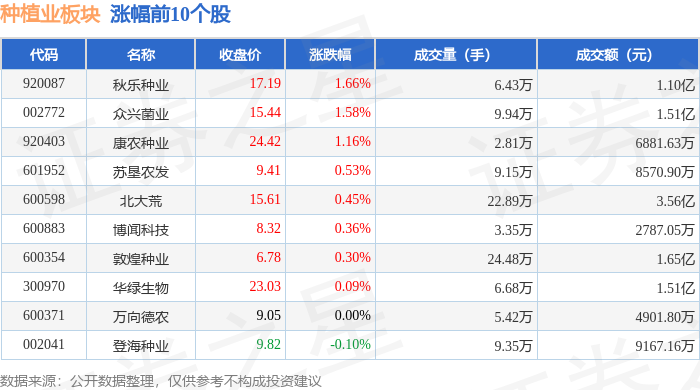
Core Viewpoint - The planting industry sector experienced a decline of 0.83% on January 20, with Shennong Seed Industry leading the drop [1] Group 1: Market Performance - The Shanghai Composite Index closed at 4113.65, down 0.01%, while the Shenzhen Component Index closed at 14155.63, down 0.97% [1] - The planting industry sector saw a net outflow of 346 million yuan from main funds, while retail investors contributed a net inflow of 287 million yuan [2] Group 2: Individual Stock Performance - Shennong Seed Industry (300189) closed at 6.72, down 7.82%, with a trading volume of 1.8634 million shares and a transaction value of 126.7 million yuan [2] - Qiu Le Seed Industry (920087) closed at 17.19, up 1.66%, with a trading volume of 64,300 shares and a transaction value of 110 million yuan [1] - Zhongxing Fungi Industry (002772) closed at 15.44, up 1.58%, with a trading volume of 99,400 shares and a transaction value of 151 million yuan [1] Group 3: Fund Flow Analysis - Major funds saw a net inflow in Qiu Le Seed Industry of 8.296 million yuan, while retail investors had a net inflow of 264,100 yuan [3] - North China Agricultural University (600598) had a net outflow of 11.4282 million yuan from major funds, but a net inflow of 8.2526 million yuan from retail investors [3] - The overall fund flow indicates a mixed sentiment, with retail investors showing interest despite the overall sector decline [2][3]


寒潮来袭,农业生产这些防护措施不能少
Yang Shi Xin Wen Ke Hu Duan· 2026-01-20 06:05
Group 1 - The current cold wave is primarily characterized by temperature drops and snowfall in northern regions, which benefits wheat by providing insulation and maintaining soil moisture for winter growth [2] - Snow cover acts as a protective layer for wheat, reducing soil temperature decline compared to air temperature, and helps protect root growth points from frost damage [2] - In years with frost damage, conditions often include both drought and low temperatures, leading to soil cracks that increase moisture evaporation and exacerbate cold temperatures [4] Group 2 - In southern regions, freezing rain is expected, which may affect winter rapeseed leaves; farmers are advised to implement proper management practices and drain excess water after rainfall [5] - Some farmers are already using drones to spray anti-frost agents as a preventive measure, suggesting a potential for technology adoption in frost protection [7] - For simple greenhouses, wet snow poses a risk of collapse and damage; farmers are recommended to reinforce structures and remove snow promptly [9]

关注2026首场大范围寒潮丨小麦如何战风雪
He Nan Ri Bao· 2026-01-19 23:58
Group 1 - The recent snowfall and cold wave in Zhoukou National Agricultural High-tech Zone have delayed the growth of winter wheat, posing a risk of frost damage to weak seedlings [1] - Zhoukou Agricultural Technology Development Company utilized drones for precise fertilization to enhance the root and tiller development of late-sown wheat before the adverse weather [1] - The company implemented a smart agriculture system to predict and respond to frost risks, mobilizing agricultural technicians to guide farmers in managing crops during the cold weather [1] Group 2 - Agricultural experts indicated that the snowfall has improved soil moisture conditions, benefiting the root growth of late-sown wheat and reducing the risk of drought and frost [2] - Following the cold weather, the Zhoukou National Agricultural High-tech Zone will conduct assessments of frost damage to wheat seedlings and advise farmers on fertilization to strengthen the plants [2]
【宝鸡】科技之光照亮乡村振兴之路
Shan Xi Ri Bao· 2026-01-19 23:17
Core Insights - The articles highlight the significant role of technology specialists in promoting agricultural innovation and improving productivity in rural areas of Baoji City, China [1][2][6][9] Group 1: Technology Promotion and Agricultural Innovation - Liu Xiaoting, a technology specialist, has successfully increased soybean yields to approximately 1,000 yuan per mu through direct guidance and the introduction of new seed varieties [1] - The implementation of a dual promotion mechanism combining project-driven initiatives with demonstration effects has led to the expansion of soybean planting areas and increased farmer income [1] - Wang Boshen, another technology specialist, has improved the survival rate of white feather chickens by 5% through tailored feeding strategies and has addressed industry challenges such as low resource efficiency and environmental pollution [2][3] Group 2: Training and Capacity Building - Training sessions organized by technology specialists have resulted in the development of local experts, enhancing the sustainability of the poultry industry in Meixian County [3] - Zhang Jiayuan has created a "farm calendar" to provide timely technical guidance to farmers, leading to a 20% increase in cherry yields and improved fruit quality [4][5] - The technology specialists have conducted 1,930 training sessions, benefiting over 31,641 farmers and cultivating 1,937 demonstration households and leaders in wealth creation [8] Group 3: Economic Impact and Industry Transformation - The introduction of new sweet potato varieties by Wang Zhao has generated an additional output value of 11 billion yuan, significantly contributing to the local economy [6][7] - The promotion of mechanized farming and integrated water and fertilizer management techniques has been adopted across over 8 million mu, resulting in an economic benefit exceeding 4 billion yuan [7] - The technology specialist system has led to the establishment of 108 enterprises and cooperatives, impacting over 208,000 farmers and enhancing the overall agricultural landscape in Baoji [8][9]