肉奶周期共振

Search documents
肉奶周期共振,盈利改善可期
Donghai Securities· 2026-03-04 14:24
Investment Rating - The report maintains a bullish outlook on the industry, indicating a potential upward trend in the market over the next six months [56]. Core Insights - The report highlights that the raw milk price has been at a low point, with a potential turning point in supply and demand expected soon. The average price of fresh milk as of February 26, 2026, was 3.03 yuan/kg, down 1.9% year-on-year, and has been below the cost line for an extended period [7][54]. - The beef cattle price is entering an upward cycle, with significant price increases expected due to supply constraints and rising demand for quality protein as GDP per capita increases [33][54]. - The report emphasizes the resonance between the meat and milk cycles, suggesting that profitability in the industry is likely to improve as conditions stabilize [54]. Summary by Sections Section 1: Raw Milk Price and Supply-Demand Dynamics - Raw milk prices have been in a downward trend for over four years, returning to levels seen in 2010. The average price has fluctuated between 3.02 and 3.04 yuan/kg since the second half of 2025, indicating prolonged industry losses [7][54]. - The report notes a significant reduction in dairy cow inventory, with an expected decrease of approximately 300,000 heads in 2024 and 250,000 to 300,000 heads in 2025, leading to a cumulative reduction of about 9% over two years [16]. Section 2: Beef Cattle Price Trends - The beef cattle industry has faced severe losses, but prices are rebounding, with the average price of fattened bulls at 25.74 yuan/kg as of February 28, 2026, reflecting an 8.7% year-on-year increase [33]. - The report anticipates that beef prices will continue to rise until 2027, driven by supply constraints and increasing demand for beef in the domestic market [54]. Section 3: Opportunities in Dairy Processing - The demand for deep-processed dairy products is on the rise, with liquid milk accounting for 92.7% of total dairy product output. The report highlights a significant growth opportunity in the deep processing sector, where the current processing rate is below 10% compared to over 40% in developed markets [17][54]. - The B-end dairy product market is expanding rapidly, with projected demand for products like cream and butter increasing significantly by 2028, indicating a substantial market opportunity for domestic dairy companies [25][54]. Section 4: Investment Recommendations - The report suggests focusing on leading dairy companies such as Yili and Mengniu, as well as companies involved in low-temperature dairy products, which are expected to see rapid growth [54]. - It also recommends monitoring top livestock companies like Modern Dairy and Yuanran Dairy, which are likely to benefit from the improving profitability outlook in the beef and dairy sectors [54].
伊利股份近期动态:益生菌获准、董事长减持与分红计划
Jing Ji Guan Cha Wang· 2026-02-12 08:07
Group 1 - The core point of the news is that Yili Co., Ltd. has made significant advancements in the probiotic industry, including the development of a new probiotic strain for infant food and a commitment to maintaining a high dividend payout ratio [1][3]. - Yili's self-developed probiotic strain YLGB-1496 has been included in the list of probiotics approved for infant food by the National Health Commission, marking a breakthrough in China's local probiotic industry [1]. - The company plans to maintain a dividend payout ratio of no less than 75% from 2025 to 2027 to enhance shareholder returns [1]. Group 2 - Yili's stock price has shown a downward trend over the past seven trading days, with a decline from 27.08 yuan to 26.61 yuan, representing a cumulative drop of 2.21% [2]. - The latest closing price on February 12 was 26.61 yuan, with a trading volume of approximately 9.18 billion yuan, indicating relatively low market activity [2]. - Institutional views on Yili remain neutral to slightly optimistic, with a target price of 34.55 yuan, suggesting an upside potential of about 28.58% from the current stock price [3].

美国农业部(USDA)月度供需报告数据分析专题:美国 2026 年牛价景气预计维持向上,全球玉米、大豆 25/26 产季期末库存环比调增-20260120
Guoxin Securities· 2026-01-20 13:54
Investment Rating - The report maintains an "Outperform" rating for the agricultural sector [3][5]. Core Insights - The agricultural sector is expected to experience upward price trends, particularly in beef and dairy, while grain prices are stabilizing at historical lows [1][3][5]. - The supply-demand dynamics for corn and soybeans remain loose, with global ending stocks projected to increase, while domestic prices are expected to find strong support at current low levels [1][2][3]. Summary by Relevant Sections Corn - The USDA January supply and demand report forecasts a global corn production increase of 13.05 million tons (approximately +1.02%) to 1.283 billion tons for the 25/26 season, with a corresponding increase in the global ending stocks-to-use ratio by 0.86 percentage points to 22.38% [15][16]. - Domestic corn prices are currently at a historical low, with a slight month-on-month increase of 0.04% and a year-on-year increase of 10.30% [18]. Soybeans - The USDA report indicates a global soybean production increase of 3.14 million tons, with ending stocks projected to rise by 2.04 million tons (approximately +1.67%) to 124 million tons for the 25/26 season [33][34]. - Short-term support for soybean prices is expected from import costs, while long-term trends are anticipated to improve as Brazilian soybeans come to market [35]. Wheat - The USDA report predicts a global wheat production increase of 4.36 million tons (approximately +0.52%) for the 25/26 season, with the ending stocks-to-use ratio increasing by 0.37 percentage points to 33.77% [47][48]. - Domestic wheat prices are expected to stabilize at low levels, with current prices at 2,515 yuan per ton, reflecting a month-on-month decrease of 0.15% [50]. Beef - The USDA forecasts a decrease in U.S. beef production for 2026, with prices expected to rise by approximately 5.1% year-on-year [3][19]. - Domestic beef prices are anticipated to maintain an upward trend due to reduced production capacity and lower imports [3][19]. Dairy - The USDA predicts a slight reduction in U.S. milk ending stocks, with prices expected to remain favorable due to a contraction in domestic dairy cow capacity [3][24]. - The interplay between meat and dairy sectors is expected to drive a recovery in dairy prices [3][24]. Pork - The USDA projects a 2.69% increase in U.S. pork production for 2026, with prices expected to remain stable at high levels [4][28]. - Domestic breeding sow capacity is being managed to support industry profitability [4][29]. Poultry - U.S. chicken production is expected to recover, with prices projected to perform well due to improved consumer demand [6][30]. - Domestic egg supply is anticipated to be ample, with a year-on-year increase in ending stocks by 23.5% [6][33]. Investment Recommendations - Recommended stocks include leading companies in the livestock, pork, poultry, and pet sectors, such as YouRan Agriculture and MuYuan [5][8].

东海证券晨会纪要-20260120
Donghai Securities· 2026-01-20 05:41
Group 1: Key Recommendations - The Spring Festival stocking has started, with a resonance in the meat and dairy cycle, which is expected to boost the performance of food companies in Q1 due to delayed stocking caused by the festival's timing this year [5][6] - Frozen products are entering a peak sales season, with leading companies experiencing reduced competition, and income growth in Q1 is anticipated to increase due to extended stocking time and weather factors [5][6] - E-commerce activities for the Spring Festival have been extended, benefiting the demand for snacks and other stocking needs [5] Group 2: Industry Dynamics - The average price of fresh milk as of January 8 is 3.02 yuan/kg, showing a week-on-week decrease of 0.3%, marking a continuous decline for over four years [6] - The price of culling cows is 19.88 yuan/kg, up 2.2% from the beginning of the year, indicating a gradual shift in supply and demand dynamics in the industry [6] - Companies like Yuanji Food and Jinxing Beer have submitted listing applications, with projected revenues for Yuanji Food of 2.026 billion yuan in 2023 and 2.561 billion yuan in 2024, and Jinxing Beer expecting revenues of 356 million yuan in 2023 and 730 million yuan in 2024 [7] Group 3: Market Performance - The food and beverage sector saw a decline of 2.10%, underperforming the CSI 300 index by 1.53 percentage points, ranking 25th among 31 first-level sectors [6] - The overall market performance showed mixed results, with the Shanghai Composite Index closing at 4114 points, up 0.29%, while the Shenzhen Component Index and ChiNext Index displayed varied performances [20][21] - The average daily trading volume was 34.283 billion yuan, indicating increased market activity compared to the previous value of 28.287 billion yuan [12]
食品饮料行业周报:春节备货启动,肉奶周期共振
Donghai Securities· 2026-01-19 12:24
Investment Rating - The industry investment rating is "Overweight" indicating a positive outlook for the sector in the next six months [1]. Core Insights - The food and beverage industry is expected to benefit from the extended Chinese New Year stocking period, which may lead to improved performance in Q1 2026 [5]. - The raw milk price has been stabilizing at a low level, with the average price at 3.02 CNY/kg as of January 8, 2026, indicating a potential turning point in supply and demand dynamics [5]. - The secondary market performance showed a decline of 2.10% in the food and beverage sector, underperforming the CSI 300 index by 1.53 percentage points [10]. Summary by Sections 1. Secondary Market Performance - The food and beverage sector ranked 25th among 31 sectors, with all sub-sectors under pressure, particularly health products which saw a smaller decline of 0.72% [10]. - The top five performing stocks included CITIC Nia, Good Idea, and others, with gains ranging from 5.05% to 8.85% [10]. 2. Major Consumer Goods and Raw Material Prices - As of January 9, 2026, the retail price of fresh milk was 12.18 CNY/liter, and yogurt was 15.88 CNY/kg, showing slight weekly increases [26]. - The price of live pigs was 12.78 CNY/kg, with a weekly increase of 1.19% but a year-on-year decrease of 18.91% [26]. 3. Industry Dynamics - Yuanji Food Group and Jinxing Beer have submitted applications for listing on the Hong Kong Stock Exchange, with projected revenues of 2.026 billion CNY and 3.56 billion CNY respectively for 2023 [53]. - The dairy farming sector in Shandong is experiencing a recovery in raw milk prices, with a reported average cost of 3.34 CNY/kg for dairy farming [54].
食品饮料行业周报:春节备货启动,肉奶周期共振-20260119
Donghai Securities· 2026-01-19 11:53
Investment Rating - The industry investment rating is "Overweight" indicating a positive outlook for the sector relative to the market index [1]. Core Insights - The food and beverage industry is expected to benefit from the extended Chinese New Year stocking period, which may lead to improved performance in Q1 2026 [5]. - The raw milk price has been stabilizing at a low level, with the average price at 3.02 CNY/kg as of January 8, 2026, indicating a potential turning point in supply and demand dynamics [5]. - The secondary market performance showed a decline of 2.10% in the food and beverage sector, underperforming the CSI 300 index by 1.53 percentage points [10]. - Key companies such as Yuanji Food and Jinxing Beer have submitted applications for listing on the Hong Kong Stock Exchange, indicating growth and expansion in the sector [53]. Summary by Sections 1. Secondary Market Performance - The food and beverage sector experienced a decline of 2.10%, ranking 25th among 31 sectors [10]. - The top five gainers included CITIC Nia, Good Idea, and others, with gains ranging from 5.05% to 8.85% [10]. 2. Major Consumer Goods and Raw Material Prices - As of January 9, 2026, the retail price of fresh milk was 12.18 CNY/liter, and yogurt was 15.88 CNY/kg, showing slight increases [26]. - The price of live pigs was 12.78 CNY/kg, with a week-on-week increase of 1.19% [26]. 3. Industry Dynamics - Yuanji Food reported revenues of 2.026 billion CNY and 2.561 billion CNY for 2023 and 2024, respectively, with a net profit increase of 31% in the first nine months of 2025 [53]. - Jinxing Beer achieved revenues of 3.56 billion CNY and 7.30 billion CNY for 2023 and 2024, respectively, with a significant increase in net profit [53].
国泰海通 · 晨报260107|策略、食饮、固收
国泰海通证券研究· 2026-01-06 14:27
Group 1: AI Industry Investment Insights - The article analyzes historical technology bull markets to provide insights into the current AI industry investment phase, emphasizing the importance of historical patterns for future investment decisions [3][4] - It identifies two key phases in technology bull markets: valuation expansion and profit-driven periods, highlighting the characteristics of stock price performance during these phases [3][5] Group 2: Valuation Expansion Phase - During the valuation expansion phase, new technologies emerge without profit support, leading to increased valuations driven by industry and policy catalysts [4] - Historical data shows that high industry crowding indicators are common, but the likelihood of price corrections increases within 20 trading days after reaching extreme values, while longer-term trends tend to see new highs [4] - Risk premium is a better measure for valuation boundaries; when the industry risk premium falls below one standard deviation of the rolling two-year average, the market tends to enter a consolidation phase [4] Group 3: Profit-Driven Phase - In the profit-driven phase, exceeding earnings expectations becomes the core driver of market performance, with historical examples including iPhone sales and mobile game penetration rates [5] - Valuation constraints under terminal thinking are crucial, as leading companies' peak stock prices often correspond to future three-year valuation levels around 30-40 times PE [5] - The risk of intensified competition and overcapacity during profit upturns can negatively impact profitability, signaling the end of investment trends [5] Group 4: Investment Recommendations - For overseas computing power, the profit-driven phase is expected to continue, with reasonable long-term valuations around 20-30 times PE, indicating no bubble [6] - Domestic computing power is in the valuation expansion phase, with low risk premiums suggesting that the next market movement may depend on performance realization or systemic declines in risk-free rates [6] - AI applications are also in the valuation expansion phase, with high valuation potential but challenges in predicting the timing and areas of successful applications [6]


国泰海通|食饮:政策落地,景气上行——牧业跟踪报告
国泰海通证券研究· 2026-01-05 12:55
Core Viewpoint - The implementation of safeguard measures for imported beef is expected to boost domestic demand, leading to a sustained upward trend in the beef cattle industry [1][4]. Group 1: Import Beef Safeguard Measures - The Ministry of Commerce has announced safeguard measures for imported beef, which will include a 55% tariff on imports outside of the quota starting January 1, 2026 [2][4]. - The total quota for major supplying countries will be reduced by nearly 6% in 2026, with Brazil and Australia facing quota reductions of over 20% [3][4]. - The safeguard measures will last for three years, with annual quota limits gradually relaxed, and unused quotas cannot be carried over to the next year [2][3]. Group 2: Domestic Market Impact - In the first half of 2025, beef imports decreased by 9.5% year-on-year to 1.302 million tons, while live cattle and beef prices have rebounded approximately 20% and 10% from previous lows [4]. - The domestic beef demand is expected to be stimulated by the implementation of the safeguard measures and the reduction in the number of breeding cows [4]. - The beef cattle industry is anticipated to experience a continued upward cycle due to the combined effects of stable raw milk prices and reduced supply-side pressures [2][4].

乳业跟踪报告:政策落地,景气上行
GUOTAI HAITONG SECURITIES· 2026-01-04 11:58
Investment Rating - The report assigns an "Accumulate" rating for the dairy industry, indicating a positive outlook for investment opportunities [5]. Core Insights - The report highlights that the stabilization of raw milk prices and the expected upward trend in 2026 are driven by the reduction in supply-side expansion and decreased breeding stock, alongside the release of processing capacity on the demand side. The domestic beef demand is anticipated to be boosted by the implementation of import beef safeguard policies, leading to a sustained upward cycle in the beef industry [2][4]. Summary by Sections Investment Recommendations - The report suggests that the dairy industry will benefit from the easing of supply-side pressures and a reduction in breeding stock, with a strong likelihood of an upward trend in profitability for leading companies such as YouRan Dairy and Modern Farming [4][7]. Import Beef Safeguard Measures - The report details that starting January 1, 2026, a 55% tariff will be imposed on beef imports outside of the quota, with a nearly 6% reduction in quotas for major supplying countries. This policy is expected to enhance domestic beef demand and support the beef industry's growth cycle [2][4]. Beef Import Data - In 2024, the total beef import volume was 2.87 million tons, with Brazil, Argentina, and Australia being the largest suppliers, accounting for over 93% of imports. The report notes a projected decrease of 5.7% in quotas for 2026 compared to the previous 12 months, with significant reductions for Brazil and Australia [6][4]. Profit Forecast and Valuation - The report provides earnings per share (EPS) forecasts for key companies, with YouRan Dairy expected to achieve an EPS of 0.33 yuan in 2026, and Modern Farming projected to reach 0.05 yuan. The price-to-earnings (PE) ratios for these companies are also discussed, indicating a favorable valuation outlook [7].
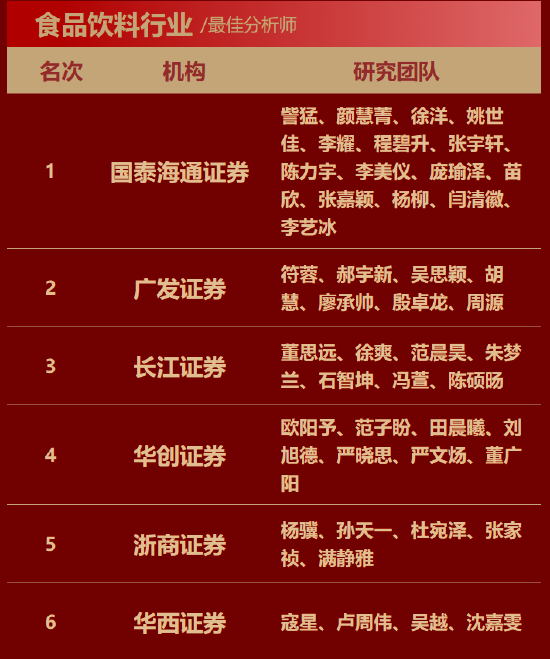
国泰海通证券訾猛团队荣获第七届金麒麟食品饮料行业最佳分析师第一名 最新研究观点:周期筑底,期待反转
Xin Lang Zheng Quan· 2025-12-01 08:13
Core Viewpoint - The Guotai Junan Zimeng team has achieved significant recognition in the food and beverage research sector, winning the title of "Best Analyst in the Food and Beverage Industry" at the 2025 Analyst Conference and the 7th Sina Finance "Golden Unicorn" Awards, reflecting their deep understanding of consumer trends and a mature research framework [1][2]. Group 1: Team Performance - The Guotai Junan Zimeng team moved from second place in the 2024 awards to first place in 2025, indicating a strong competitive potential and improvement in research capabilities [2]. - The competition landscape changed significantly, with the GF Securities team ranking second and Huachuang Securities team dropping to fourth place [2]. Group 2: Award Details - The Guotai Junan team members include Zimeng, Yan Huijing, Xu Yang, Yao Shijia, Li Yao, Cheng Biheng, Zhang Yuxuan, Chen Liyu, Li Meiyi, Pang Yuze, Miao Xin, Zhang Jiaying, Yang Liu, Yan Qinghui, and Li Yibing [1]. - The awards highlighted the top teams in the food and beverage sector, with Guotai Junan taking first place, GF Securities second, and Changjiang Securities third [3]. Group 3: Industry Insights - The Zimeng team believes that the liquor industry is currently undergoing a rapid clearing adjustment phase, with inventory levels decreasing and stock prices potentially rising amidst market pessimism [9]. - The beer industry is expected to clear earlier than the liquor sector, with increasing differentiation within the industry, suggesting investors should focus on regionally competitive beer leaders [9].