软件

Search documents
金银,低开低走
Shang Hai Zheng Quan Bao· 2026-02-16 00:55
Market Overview - Spot gold and silver prices experienced significant declines, with gold dropping over 0.8% and silver falling by 3.5% during early trading on Monday [1] - The U.S. stock market indices recorded declines last week, with the S&P 500 down 1.4%, the Dow Jones down 1.2%, and the Nasdaq down 2.1% due to concerns over the disruptive impact of artificial intelligence (AI) [3] AI Disruption Concerns - Concerns regarding the disruptive potential of AI have spread from the software sector to other industries, including real estate, trucking, logistics, and financial services [3] - Barclays reported that while the U.S. market has shown some resilience, fears about AI's disruptive effects are increasing, leading to heightened market volatility and disparities among sectors [3] Sector Rotation and Investment Trends - Funds are flowing out of large tech companies and into more defensive traditional sectors, with energy, materials, and consumer staples seeing net inflows [3] - The technology sector is expected to experience internal differentiation, with defensive assets becoming more attractive, and companies that can effectively leverage AI for revenue generation are likely to be favored by the market [4] Upcoming Economic Data and Events - Key U.S. macroeconomic data to be released this week includes the preliminary Q4 GDP, monthly consumer confidence survey, and the December Personal Consumption Expenditures (PCE) price index, which is closely monitored by the Federal Reserve [6] - The market is awaiting the release of the Federal Open Market Committee (FOMC) meeting minutes, which may provide insights into future interest rate cuts [6] Earnings Reports - Major companies, including mining giants BHP, Glencore, Rio Tinto, and retail giant Walmart, are set to release their earnings reports, with Walmart's report on Thursday being particularly significant for insights into consumer spending trends [7]
影响万亿资本的市场叙事争夺:一边是“AI颠覆一切”,一边是“AI回报不够”
华尔街见闻· 2026-02-15 10:56
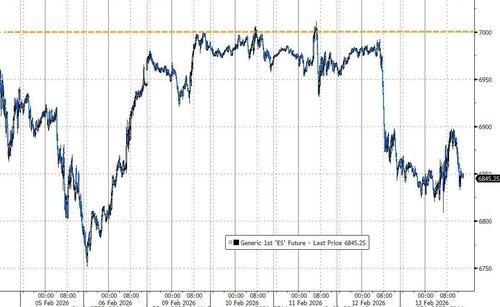
Core Viewpoint - The current global market is experiencing a rare period of "high noise and high velocity," making it difficult for even seasoned traders to navigate [2] - The core anxiety in the market stems from two opposing narratives regarding AI, leading to significant volatility and risk transfer [3][8] Group 1: Market Dynamics - The S&P 500 index has stalled around the 7000-point mark this year, indicating underlying tensions despite a seemingly calm surface [3] - Goldman Sachs' "AI leaders vs. laggards" trade saw its largest single-day gain recently, primarily driven by short-selling of "laggards" [3] - There is a notable shift in global capital allocation, with increasing funds flowing into non-U.S. markets as the U.S. market narrative becomes more complex [5] Group 2: Regional Market Performance - The South Korean KOSPI index has doubled since the end of 2024, recently achieving its best weekly performance in five years, driven by corporate value enhancement plans and strong earnings expectations [6] - The MSCI Korea index has risen 28% year-to-date in USD terms, with Goldman Sachs raising its KOSPI target to 6400 points based on impressive earnings growth and attractive valuations [12] - Japan's Nikkei index has recently increased by 5%, indicating a shift in market dynamics where a stronger yen and lower interest rates are not hindering stock market performance [16] Group 3: Investment Strategies - The current market environment is characterized by contradictory signals, making investment decisions particularly challenging [6] - There is a rare phenomenon of simultaneous buying of cyclical assets and defensive assets, indicating uncertainty in market sentiment [6] - Hedge funds have shown remarkable resilience, with macro discretionary funds accumulating significant profit buffers, suggesting a favorable environment for active management strategies [14]



AI恐慌交易蔓延,美股“2月寒流”何时结束?
Di Yi Cai Jing Zi Xun· 2026-02-15 04:44
Market Overview - The US stock market experienced a decline this week due to "AI panic trading" and an increased probability of the Federal Reserve maintaining its policy unchanged after January's non-farm employment report [2] - Despite a favorable macro environment with steady job growth and easing inflation, concerns over cost and profit margin pressures for tech companies have suppressed optimism, making it difficult for the stock market to gain upward momentum [2] Economic Data - Retail sales data showed weakness, with December's retail sales unchanged month-on-month, below the previous value of 0.6% and the expected 0.4%. The control group saw a 0.1% decline, contrary to the expected increase of 0.4% [3] - The Atlanta Fed's GDPNow model revised its forecast for Q4 GDP from 4.2% to 3.7% due to the retail sales data [3] - The job market remains strong, with January non-farm payrolls increasing by 130,000, significantly above the market expectation of 65,000. The unemployment rate fell from 4.4% in December to 4.3%, lower than the expected 4.4% [3] - The Consumer Price Index (CPI) rose by 0.2% month-on-month in January, below the expected 0.3%, and year-on-year growth was 2.4%, also below the expected 2.5% [3] Federal Reserve Outlook - The mixed signals from economic data suggest that the Federal Reserve is likely to remain patient and assess whether these data points reflect a genuine trend change or are merely statistical noise [4][5] - The yield curve for US Treasuries has flattened, with the 2-year yield dropping to its lowest level since 2022, approaching 3.40%. The pricing of federal funds futures indicates a potential rate cut in June, with a nearly 90% probability of two rate cuts this year [5] Market Sentiment and Sector Performance - The US stock indices fell, with investors continuing to reduce exposure to technology stocks. The S&P 500 index turned negative for the year [6] - Concerns about how new AI tools will impact specific industries have led to market volatility, initially affecting software and financial stocks, and later spreading to office real estate and logistics companies [7] - The financial sector saw the largest decline this week, down 4.8%, followed by communication services down 3.5%, and non-essential consumer goods and technology sectors down over 2% [7] AI Impact on Market - The launch of new AI tools has raised concerns about job displacement, leading to a sell-off in various sectors, including real estate and logistics. This "AI panic trading" has caused investors to adopt a "sell first, ask questions later" approach [8] - Despite the strong US economy and previous stock market highs driven by significant investments in AI infrastructure, AI is now viewed as a potential threat to existing business models, creating a paradox for Wall Street [8] Future Market Outlook - The significant decline in Treasury yields typically serves as a bullish catalyst for the stock market, but bearish confirmation signals in the tech sector suggest potential further downside risks in the short term [9] - The volatility index (VIX) remains around 20, indicating that the market is seeking protective measures and may maintain higher-than-average volatility in the near term [9]

AI恐慌交易蔓延,美股“2月寒流”何时结束?
第一财经· 2026-02-15 04:37
Core Viewpoint - The article discusses the impact of "AI panic trading" and the rising probability of the Federal Reserve maintaining its policy after the January non-farm employment report, leading to a decline in the US stock market [3]. Economic Data Summary - The upcoming week will require investors to digest a significant amount of economic data, which is expected to show mixed results [6]. - Monthly retail sales data was weak, with December sales unchanged month-on-month, below the previous value of 0.6% and the expected 0.4% [6]. - The Atlanta Fed's GDPNow model revised the US Q4 GDP forecast down from 4.2% to 3.7% [7]. - The job market showed strong performance, with January non-farm payrolls increasing by 130,000, significantly above the market expectation of 65,000 [7]. - The unemployment rate decreased from 4.4% in December to 4.3%, lower than the expected 4.4% [7]. - The Consumer Price Index (CPI) rose by 0.2% month-on-month in January, below the expected 0.3%, and the year-on-year increase was 2.4%, also below the expected 2.5% [7]. Federal Reserve and Interest Rate Expectations - There is a slight increase in expectations for a Federal Reserve rate cut, with the probability of two cuts this year approaching 90% [8]. - The flattening of the US Treasury yield curve indicates a significant drop in long-term yields, with the 2-year yield nearing 3.40%, the lowest since 2022 [8]. Market Reactions and Sector Performance - The US stock indices fell over the past week, with investors continuing to reduce exposure to technology stocks [11]. - Concerns about the impact of new AI tools on specific industries have led to market volatility, initially affecting software and financial stocks, and later spreading to real estate and logistics sectors [12]. - The financial sector experienced the largest decline, down 4.8%, followed by communication services at 3.5%, while utilities saw a significant increase of 7.1% due to safe-haven inflows [12][13]. Future Market Outlook - The article suggests that the market may still need to find a bottom, with technical indicators showing bearish confirmation signals for the Nasdaq [14]. - The volatility index (VIX) remains around 20, indicating that the market is seeking protective measures and may maintain higher-than-average volatility in the short term [14].

影响万亿资本的市场叙事争夺:一边是“AI颠覆一切”,一边是“AI回报不够”
美股IPO· 2026-02-15 04:09
当前全球市场正处于一个罕见的"高噪音、高流速"时期,其混乱程度令即便是最资深的交易员也感到困惑。高盛对冲基金业务主管 Tony Pasquariello 直言,除了全球金融危机或新冠疫情等重大创伤期外,很难回忆起市场环境如此"极度开放"且难以预测的时刻。 他在最新的报告中发出警告:没人真正知道这一切将如何收场。 市场核心的焦虑源于两种截然相反的AI叙事正在激烈博弈: 一方面,市场认为人工智能带来的颠覆性风险正在延长,这导致了 对"受害者"板块的猛烈抛售;而另一方面,投资者又开始质疑AI资本支出的回报率是否足够理想。 这种内在的张力导致了剧烈的波 动——只要市场感知到边际上的AI风险,抛售便会变得异常猛烈。 目前标普500指数今年以来在7000点关口前止步不前,未能实现突破,指数平静的表面之下暗流涌动。高盛的"AI领跑者与落后者"配 对交易在上周创下了历史上最大的单日涨幅,但这主要是由做空"落后者"所驱动的。这种"先开火再瞄准"的做空情绪,正在软件等核 心板块引发剧烈的叙事波动和风险转移。 市场正陷入"AI颠覆一切"与"AI回报不够"的双重叙事博弈:前者引发对软件等"受害者"的恐慌性抛售(估值腰斩),后者则加剧 ...

美股点金丨AI恐慌交易蔓延 美股“2月寒流”何时结束?
Di Yi Cai Jing· 2026-02-15 03:25
Group 1 - The US stock market experienced a decline this week due to "AI panic trading" and increased probabilities of the Federal Reserve maintaining its policy unchanged after the January non-farm employment report [1] - Despite a generally favorable macro environment with steady job growth and easing inflation, concerns over cost and profit margin pressures for tech companies have dampened investor optimism [1] - The ability of tech stocks to stabilize and the strengthening of interest rate cut expectations from the Federal Reserve will be crucial for market recovery in the coming week [1] Group 2 - The Federal Reserve's interest rate cut expectations have slightly increased, with mixed economic data being digested by investors [2] - Retail sales data showed weakness, with December sales flat month-on-month, below the previous value of 0.6% and the expected 0.4% [2] - The January non-farm payroll report indicated a significant increase of 130,000 jobs, surpassing the market expectation of 65,000, with the unemployment rate dropping to 4.3% [2] Group 3 - Economic signals are mixed, with the January employment report contradicting the narrative of stagnant hiring, while retail sales data challenges the view of strong consumer spending [3] - The yield curve for US Treasury bonds has flattened, with the 2-year yield dropping to its lowest level since 2022, approaching 3.40% [3] - The inflation report appears encouraging, with housing prices slowing and tariff-related impacts diminishing, leading to expectations of two interest rate cuts later this year [3] Group 4 - The recent decline in retail sales is viewed as a temporary pause following strong spending, with tax refunds and robust wage growth expected to support consumption recovery in the coming months [4] - The significant increase in non-farm employment is concentrated, raising questions about its sustainability due to demographic constraints and weakening labor demand in other sectors [4] Group 5 - The US stock indices fell over the past week, with investors continuing to reduce exposure to tech stocks, leading to a decline in the S&P 500 index [5] - Concerns regarding the impact of new AI tools on specific industries have caused market volatility, initially affecting software and financial stocks, and later spreading to real estate and logistics companies [5] Group 6 - The financial sector experienced the largest decline this week, down 4.8%, followed by communication services down 3.5%, while utilities saw a significant increase of 7.1% due to safe-haven inflows [6] - Other sectors such as real estate and materials also recorded gains of over 3%, while energy, consumer staples, and industrial sectors showed positive performance [6] Group 7 - The introduction of AI tools by companies like Altruist has raised concerns about job displacement, leading to a cautious sentiment among traders [7] - The market's reaction to AI-related news has resulted in a "sell first, ask questions later" approach, with fears of AI disruption affecting various sectors beyond just software [7] Group 8 - The outlook for the next week suggests that a significant decline in Treasury yields could typically act as a bullish catalyst for the stock market, but bearish signals in the tech sector indicate potential further downside risks [8] - The volatility index (VIX) remains around 20, indicating that the market is seeking protective measures and may maintain higher-than-average volatility in the short term [8]
美股点金丨AI恐慌交易蔓延,美股“2月寒流”何时结束?
Di Yi Cai Jing Zi Xun· 2026-02-15 03:25
Group 1 - The US stock market experienced a decline this week due to "AI panic trading" and increased probabilities of the Federal Reserve maintaining its policy unchanged after the January non-farm employment report [1] - Concerns over cost and profit margin pressures for technology companies have suppressed optimism, despite a generally favorable macroeconomic environment characterized by steady job growth and easing inflation [1] - The ability of technology stocks to stabilize and the strengthening of interest rate cut expectations from the Federal Reserve will be critical for market recovery in the coming week [1] Group 2 - The retail sales data showed weakness, with December retail sales unchanged month-on-month, below the previous value of 0.6% and the expected 0.4% [2] - The Atlanta Fed's GDPNow model revised its forecast for Q4 GDP from 4.2% to 3.7% due to the retail sales performance [2] - The January non-farm payrolls increased by 130,000, significantly above the market expectation of 65,000, with the unemployment rate dropping to 4.3% from 4.4% [2] - The Consumer Price Index (CPI) for January rose by 0.2% month-on-month, lower than the expected 0.3%, and the year-on-year increase was 2.4%, also below the expected 2.5% [2] Group 3 - Economic signals are mixed, with the January employment report contradicting the narrative of stagnant hiring, while retail sales data challenges the view of strong consumer spending [3] - The flattening of the US Treasury yield curve indicates a significant drop in long-term yields, with the 2-year yield approaching 3.40%, and the probability of two rate cuts this year nearing 90% [3] - The inflation report shows encouraging signs, particularly with housing prices slowing and tariff-related impacts diminishing, which may lead the Federal Reserve to consider rate cuts later this year [3] Group 4 - The recent signals are unlikely to persist, as the decline in retail sales may be a temporary pause following strong spending, and the sustainability of the significant increase in non-farm employment is questionable [4] - The cooling inflation data provides a favorable environment for the Federal Reserve to potentially restart rate cuts later in the year [4] Group 5 - The US stock indices fell over the past week, with investors continuing to reduce exposure to technology sectors, and the S&P 500 index turned negative for the year [5] - Concerns regarding the impact of new AI tools on specific industries have led to market volatility, initially affecting software and financial stocks, and later spreading to real estate and logistics sectors [5] Group 6 - The financial sector experienced the largest decline this week, down 4.8%, followed by communication services down 3.5%, and both non-essential consumer goods and technology sectors fell over 2% [6] - Utility stocks surged by 7.1% due to safe-haven inflows, while real estate and materials rose over 3% [6] Group 7 - The launch of AI tools by companies like Altruist and Anthropic has heightened fears of job displacement, leading to a cautious sentiment among traders regarding US stock exposure [7] - The sell-off pressure in the market is primarily driven by concerns over the disruptive effects of AI, affecting not only software stocks but also real estate and logistics [7] Group 8 - The significant decline in US Treasury yields typically serves as a bullish catalyst for the stock market, but bearish confirmation signals in the Nasdaq indicate potential further downside risks [8] - The volatility index (VIX) remains around 20, suggesting that the market is seeking protective measures and may maintain higher-than-average volatility in the short term [8]
影响万亿资本的市场叙事争夺:一边是“AI颠覆一切”,一边是“AI回报不够”
Hua Er Jie Jian Wen· 2026-02-15 01:29
Group 1 - The current global market is experiencing a rare "high noise, high velocity" period, making it difficult for even seasoned traders to navigate. Goldman Sachs' hedge fund business head, Tony Pasquariello, noted that this level of unpredictability is reminiscent of major trauma periods like the global financial crisis or the COVID-19 pandemic [1] - The core anxiety in the market stems from two opposing narratives regarding AI: one that sees AI as a disruptive risk leading to sell-offs in "victim" sectors, and another that questions the return on investment from AI capital expenditures. This tension is causing significant volatility, with aggressive sell-offs occurring whenever marginal AI risks are perceived [1][4] - The S&P 500 index has stalled around the 7000-point mark this year, failing to break through, while beneath the surface, there are turbulent undercurrents. Goldman Sachs' "AI leaders vs. laggards" pair trade recently achieved its largest single-day gain, primarily driven by shorting "laggards" [1][4] Group 2 - Global capital allocation is subtly shifting due to crowded U.S. markets and valuation pressures, with incremental funds increasingly flowing overseas. The South Korean and Japanese stock markets have recently shown strong performance, particularly the KOSPI index, which has doubled since the end of 2024 and achieved its best weekly performance in five years [3][8] - The current market environment is filled with contradictory signals, making investment challenging. There is a rare phenomenon of simultaneous buying in both cyclical assets (like industrial stocks and raw materials) and defensive assets (like consumer staples and utilities) [4] - The debate surrounding AI's fundamental impact is intensifying, focusing on who the beneficiaries and victims are, and whether AI leads to value creation or destruction. This debate has resulted in increased volatility for related stocks and thematic baskets, particularly in the software sector [6] Group 3 - The U.S. stock market has seen a stagnation in the wake of non-farm payroll and CPI data releases, while overseas markets have experienced a surge. According to Goldman Sachs strategist Ryan Hammond, non-U.S. equity funds have seen an inflow of $89 billion this year, compared to only $16 billion for U.S. equity funds [8] - The South Korean stock market is leading this trend, with the MSCI Korea index rising 28% year-to-date in U.S. dollar terms. Goldman Sachs' chief equity strategist for Asia Pacific, Tim Moe, maintains an overweight rating and has raised the KOSPI index target to 6400 points, citing impressive earnings growth and attractive valuations [10] - The Japanese market has also performed well, with the Nikkei index recently rising by 5%. Notably, the correlation between the Japanese stock market and the currency has seemingly reversed, indicating a shift from "currency depreciation trades" to healthier "reflation trades" [12] Group 4 - Despite the uncertain macro environment, hedge funds have shown remarkable resilience. Tony Pasquariello observed that macro discretionary funds accumulated significant profit buffers in January, while long-short equity strategies have generally avoided risks [14] - Looking ahead, market trends appear to favor active management over passive investment, and liquidity is becoming more favorable for liquid assets rather than illiquid ones. Strategies that can adapt to narrative changes in this noisy and fast-paced market seem to be gaining an advantage [14]
华尔街市场逆转 年初高共识交易集体失效
Huan Qiu Wang· 2026-02-15 01:06
Group 1 - In early 2026, Wall Street investors' risk appetite reached a high, with cash holdings at a historical low and a significant reduction in hedging positions [2] - The acceleration of AI technology applications has shifted market logic, leading to concerns about the replacement of light asset and white-collar industries such as software, wealth management, brokerage, and tax consulting [2] - The S&P 500 index experienced increased volatility, dropping to its lowest level since November of the previous year, with a rebound driven by moderate inflation data [2] Group 2 - A survey by Bank of America in January revealed that investor cash positions fell to a historical low of 3.2%, with nearly half of fund managers lacking downside protection, the lowest level since 2018 [2] - The correlation among various asset classes has increased, raising the risk of market-wide adjustments triggered by the sell-off of single assets [3] - Investment-grade bond ETFs performed strongly due to safe-haven demand, while U.S. Treasury prices rose, marking the largest weekly gain for long-term Treasury ETFs since April of the previous year [3]

群核科技港股IPO及境内未上市股份“全流通”获中国证监会备案
Zhi Tong Cai Jing· 2026-02-14 12:06
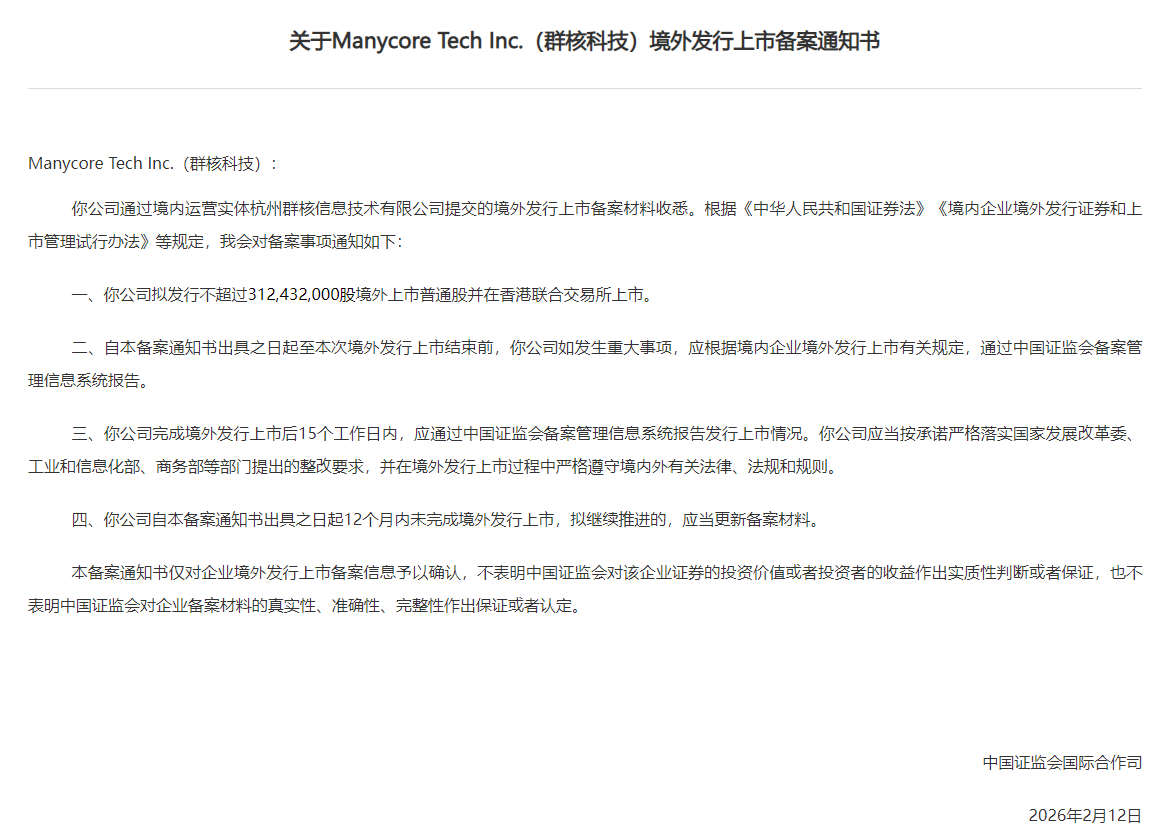
Group 1 - The China Securities Regulatory Commission (CSRC) has issued a notification regarding Manycore Tech Inc.'s overseas issuance and listing, allowing the company to issue up to 312,432,000 shares for listing on the Hong Kong Stock Exchange [1] - Manycore Tech Inc. submitted its initial listing application to the Hong Kong Stock Exchange in February 2025 and updated its prospectus in August of the same year, with JPMorgan and CCB International acting as joint sponsors [3] - Manycore is recognized as one of the "Hangzhou Six Little Dragons" and is a leading provider of cloud-native spatial design software, with applications across various business scenarios including residential, office, retail, and commercial projects [3] Group 2 - The company's software leverages artificial intelligence (AI) technology and dedicated graphics processing unit (GPU) clusters, enabling designers and businesses to create engaging designs with real-time and immersive visual effects [3]