
信托

Search documents
家人失能房子怎么办?广州试点不动产+信托,特殊家庭有保障
Nan Fang Du Shi Bao· 2025-12-24 01:32
Core Viewpoint - Guangzhou has successfully registered the first real estate trust property for special patient families in Guangdong Province, marking a significant step in exploring real estate trust registration services to meet the asset management and care needs of special groups [2][3] Group 1: Real Estate Trust Property Registration - Real estate trust property registration refers to the legal act where the real estate registration authority processes the transfer or pre-registration of trust property based on the application from the trustee and the trust institution, recording relevant rights and legal matters in the real estate registration book [2] - This registration serves multiple purposes, including clearly distinguishing trust property from the principal's other assets, effectively safeguarding asset independence, achieving risk isolation, and ensuring orderly inheritance [2] - It provides long-term and stable asset management and care solutions for families with special needs, such as those with dementia or elderly individuals, allowing them to establish sustainable protection arrangements without selling their properties [2] Group 2: Innovative Mechanisms and Procedures - Guangzhou has innovatively introduced a pre-registration mechanism to address the challenge of completing property transfer registration due to reasons like unpaid taxes, allowing for the advance processing of trust property transfer pre-registration [3] - The registration process involves trust companies operating in Guangzhou, with applications typically submitted jointly by the principal and the trust institution to the real estate registration authority [3] - The pre-registration mechanism allows for the initial processing of trust property transfer when direct transfer conditions are not met, ensuring that any disposition of the property without the trust institution's consent does not have property rights effect [3] Group 3: Required Materials for Registration - Required materials for real estate trust pre-registration include: (1) trust documents containing pre-registration agreements; (2) notification of completion of trust product pre-registration [4] - Required materials for real estate trust registration include: (1) real estate property certificate; (2) trust documents and notification of completion of trust product pre-registration; (3) proof of tax payment (or exemption) [4]


光大信托挂牌转让苏州中南中心项目不良债权,本息合计约12.71亿元
Xin Lang Cai Jing· 2025-12-24 00:44
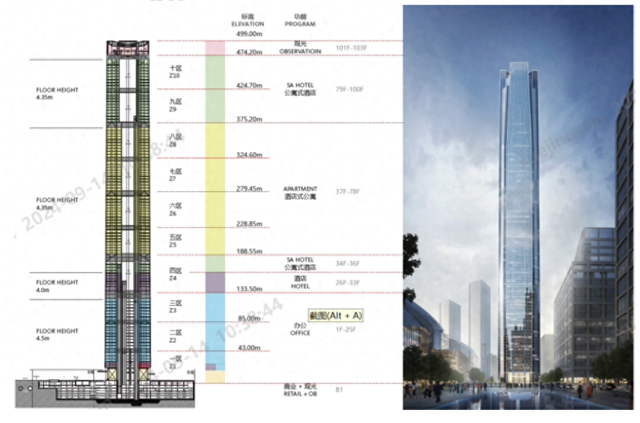
Core Viewpoint - The announcement regarding the transfer of non-performing debt related to the Suzhou Zhongnan Center project highlights significant financial and operational challenges faced by the project, including ongoing legal proceedings and multiple rounds of asset seizures [1][3]. Group 1: Project Overview - The Suzhou Zhongnan Center project has a total non-performing debt of approximately 1.271 billion yuan (about 127.1 million) as of March 31, 2024, consisting of 1.2 billion yuan in principal and 71.37 million yuan in interest [1]. - The project is located in the Suzhou Industrial Park and was initially planned to be the tallest building in Suzhou at a height of 499.15 meters, with a total construction area of 364,300 square meters [3][4]. - Construction began on January 3, 2014, but has faced significant delays, with work effectively halting after April 2015 due to various setbacks, including legal issues and ownership changes [3][5]. Group 2: Financial and Legal Aspects - The debt is secured by multiple guarantees, including pledges from Zhongnan Holdings Group and its chairman, Chen Jinshi, as well as equity pledges from related companies [3]. - The project has been subject to multiple asset seizures, including 53 properties in Hangzhou, and has entered judicial proceedings initiated by creditors since December 11, 2022 [1][3]. - The project was originally intended to be completed within five years, but the timeline has been significantly extended due to the ongoing issues [5].

转型深化 质效提升 信托业锚定高质量发展新航向
Zhong Guo Zheng Quan Bao· 2025-12-24 00:21
Core Insights - The trust industry in China is experiencing significant growth and structural optimization, with total trust assets reaching 32.43 trillion yuan by mid-2025, marking a year-on-year increase of 20.11% [1][3]. Regulatory Framework - The "1+N" regulatory system is crucial for the sustainable development of the trust industry, with the implementation of policies aimed at high-quality transformation [2]. - Key policy documents, including the "Asset Management Trust Management Measures (Draft for Comments)" and the revised "Trust Company Management Measures," provide a comprehensive framework for industry restructuring [2]. - The "three-category" policy delineates three main business directions: asset service trusts, asset management trusts, and public welfare trusts, guiding the industry in redefining its business functions [2]. Structural Optimization - The trust industry's asset scale has significantly increased, with a 9.73% growth from the end of the previous year, positioning it as a key player in the overall asset management sector, which totals 174.50 trillion yuan [3]. - The asset management trust and asset service trust models have replaced traditional financing and channel trust models, becoming the primary drivers of growth since 2021 [3]. - By mid-2025, asset management trusts accounted for approximately 75.33% of total trust assets, while asset service trusts made up about 24.67% [3]. Investment Focus - As of mid-2025, 61.60% of funds from trust investments were directed towards financial markets, a significant increase from the end of 2022, indicating a shift towards providing stable funding for capital markets [4]. - Trust companies are moving away from traditional lending models to create a framework that supports the real economy and enhances public welfare [4]. Future Outlook - The trust industry is poised for further growth, driven by increasing demand for wealth management and comprehensive services due to demographic changes and wealth transfer needs [6]. - Family trusts are recognized as a core area for development, with expectations for significant market expansion in the next 3-5 years as regulatory barriers are reduced [6]. - Challenges remain in risk management, business transformation, and talent development, necessitating improvements in research capabilities and operational systems [6].
刘建军卸任,中信银行行长芦苇出任中国邮政集团副总经理
Bei Jing Shang Bao· 2025-12-23 13:14
与刘建军一样,此次"接棒"的芦苇亦具备深厚的金融行业积淀,从业经历覆盖银行、信托等多个核心金 融领域。芦苇1971年10月出生,澳大利亚迪肯大学会计学硕士,1994年7月参加工作,1997年1月入职中 信银行,曾任中信银行党委委员、副行长,同时兼任中信银行深圳分行党委书记、行长及阿尔金银行董 事;历任中信银行总行营业部(现北京分行)副总经理、中信银行计划财务部总经理、资产负债部总经 理、董事会秘书、公司秘书、授权代表、业务总监、香港分行筹备组副组长及中信百信银行股份有限公 司董事。2023年3月起芦苇任中信信托有限责任公司总经理,2024年5月起任中信信托有限责任公司董事 长。 2025年2月,中信银行发布公告称,刘成因工作调整,辞去其所担任的该行执行董事、行长、董事会风 险管理委员会主席、董事会战略与可持续发展委员会委员职务;同日,中信银行召开董事会,同意聘任 芦苇为该行行长,自监管机构核准其行长任职资格之日起正式就任,任期三年。 业内普遍认为,在履行相应程序后,芦苇将接替刘建军担任邮储银行行长职位。 北京商报讯(记者 宋亦桐)12月23日,据中国邮政网发布的消息,12月23日,中国邮政集团有限公司 召开党 ...


厦门国际信托获批增资至51.6亿元
Xin Lang Cai Jing· 2025-12-23 12:20
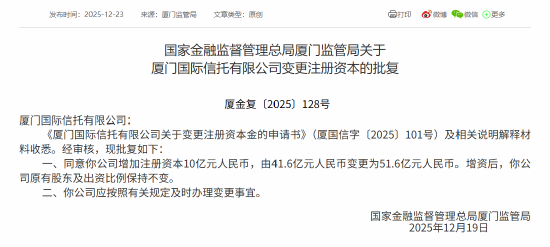
12月23日金融一线消息,国家金融监督管理总局厦门监管局发布批复,同意厦门国际信托有限公司增加 注册资本10亿元人民币,由41.6亿元人民币变更为51.6亿元人民币。增资后,公司原有股东及出资比例 保持不变。 责任编辑:王馨茹 12月23日金融一线消息,国家金融监督管理总局厦门监管局发布批复,同意厦门国际信托有限公司增加 注册资本10亿元人民币,由41.6亿元人民币变更为51.6亿元人民币。增资后,公司原有股东及出资比例 保持不变。 责任编辑:王馨茹 ...
中粮资本:12月23日召开董事会会议
Mei Ri Jing Ji Xin Wen· 2025-12-23 11:05
每经AI快讯,中粮资本(SZ 002423,收盘价:11.5元)12月23日晚间发布公告称,公司第六届第五次 董事会会议于2025年12月23日在宁夏银川市以现场与网络视频相结合的方式召开。会议审议了《关于公 司及下属子公司2026年度利用临时闲置资金委托理财的议案》等文件。 2025年1至6月份,中粮资本的营业收入构成为:保险占比72.02%,信托占比15.3%,期货占比12.23%, 其他占比0.46%。 截至发稿,中粮资本市值为265亿元。 每经头条(nbdtoutiao)——地产"优等生"受困20亿元到期债务,首次债务展期仍在博弈,明年还有超 百亿元公开债到期 (记者 曾健辉) ...

陕国投A:截至2025年12月19日股东总户数103981户
Zheng Quan Ri Bao· 2025-12-23 10:39
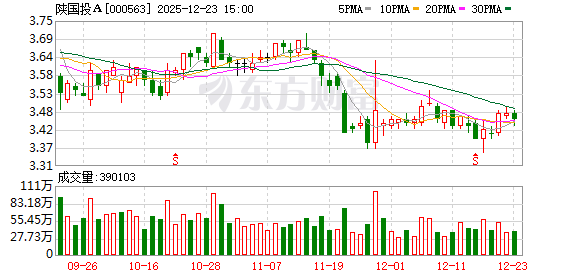
证券日报网讯 12月23日,陕国投A在互动平台回答投资者提问时表示,权益登记日:2025年12月19日, 股东总户数103981户。 (文章来源:证券日报) ...

厦门国际信托获批增资10亿元
Bei Jing Shang Bao· 2025-12-23 10:04
北京商报讯(记者 岳品瑜 董晗萱)12月23日,据国家金融监督管理总局行政许可信息,同意厦门国际 信托有限公司增加注册资本10亿元人民币,由41.6亿元人民币变更为51.6亿元人民币。增资后,公司原 有股东及出资比例保持不变。 ...
估值近10亿的广发银行股权被挂出拍卖,持股人为元老级股东、被交银信托追债
Xin Lang Cai Jing· 2025-12-23 10:03
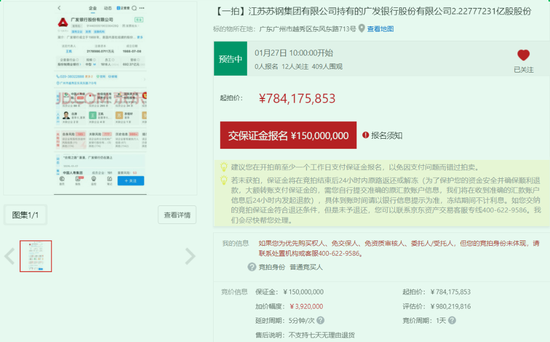
Core Viewpoint - The equity stake of Guangdong Development Bank, valued at nearly 1 billion yuan, is set to be publicly auctioned in early 2026, with a starting price of 784 million yuan, significantly below the bank's net asset value per share [1][12]. Group 1: Auction Details - Jiangsu Sugang Group Co., Ltd. will auction 223 million shares of Guangdong Development Bank on January 27, 2026, with an assessed value of 980 million yuan, translating to 4.40 yuan per share, and a starting price of 784 million yuan, which is approximately 20% lower than the assessed value, equating to a starting price of 3.52 yuan per share [1][13]. - The auction is being conducted by the Beijing First Intermediate People's Court, linked to a financial loan dispute between Jiangsu Sugang Group and China International Trust [1][15]. Group 2: Background of the Dispute - In September 2017, a loan agreement was signed between China International Trust and Beijing University Founder Information Industry Group, with Jiangsu Sugang Group providing equity pledge guarantees using its shares in Guangdong Development Bank [2][15]. - The loan agreement stipulated that the Beijing University Founder Information Industry Group would repay the loans by November 2019, but they failed to do so, leading to Jiangsu Sugang Group's inability to fulfill its guarantee obligations [2][15]. Group 3: Shareholder Information - Jiangsu Sugang Group has been a long-term shareholder of Guangdong Development Bank, initially holding 9.31% of shares in 2005, but its stake has decreased over the years to 1.022% by the end of 2022, making it the eighth largest shareholder [5][22]. - The group has undergone several changes in its controlling interests, with its current major shareholder being Founder Commercial Real Estate Co., Ltd., and the ultimate beneficiary being Ping An Insurance Group [22][24]. Group 4: Bank Performance - Guangdong Development Bank, established in 1988, has total assets of 3.69 trillion yuan as of mid-2025, with a revenue of 33.044 billion yuan in the first half of the year, reflecting a year-on-year decline of 4.39%, while net profit increased by 3.78% to 8.621 billion yuan [11][25]. - The latest net asset value per share of Guangdong Development Bank is 11.65 yuan, which is 2.65 times the assessed auction value and 3.31 times the starting price [11][25].
中信“老将”芦苇拟任邮储银行行长,深耕金融系统超28年
Jin Rong Jie· 2025-12-23 08:00
54岁的中信银行"老将"芦苇,在中信系统深耕28年后,将执掌全国网点最多的国有大行。 据悉,中国邮政集团有限公司党组成员、副总经理兼邮储银行党委书记、行长刘建军现已年满60岁。作 为接棒者,中信银行行长芦苇已调任中国邮政集团有限公司党组成员、副总经理,并拟任邮储银行行长 一职。 履历丰富:深耕中信系统超28年 在中信银行总行营业部(现北京分行)工作期间(1997年1月至2013年3月),芦苇曾在多家分支行担任 要职,历任公司业务部副科长、副处长(期间曾公派英国汇丰银行泽西支行工作),西单支行负责人、 副行长、行长,京城大厦支行行长,金融同业部总经理,总行营业部党委委员、总经理助理、副总经理 等职务,积累了扎实的基层管理与金融业务经验。 复合型人才:经历覆盖银行前中后台及信托 随着管理能力的不断提升,2013年起,芦苇步入中信银行总行管理层,先后担任计划财务部副总经理 (主持工作)、计划财务部(现财务会计部)总经理、资产负债部总经理,全面负责银行的财务与资本 管理。2017年,芦苇进入中信银行高层,出任董事会秘书、公司秘书和授权代表;2019年起,他又调任 深圳分行党委书记、行长,并担任银行业务总监。2020年 ...