信托贷款

Search documents
棕榈股份:为子公司吉首棕吉2.83亿元信托贷款本息提供差额补足
Jin Rong Jie· 2026-02-05 08:44
Core Viewpoint - The company announced its commitment to provide a financial guarantee for a trust loan related to a PPP project, indicating a strategic move to support its subsidiary's financing needs [1] Group 1: Company Actions - The company holds a 90% stake in Jishou Pangji, which is seeking financing from Shanghai Trust for a PPP project [1] - The company agreed to assume the obligation to cover any shortfall in the principal and interest of the trust loan, amounting to 283 million yuan [1] - The board of directors approved this proposal on February 5, pending shareholder meeting approval [1] Group 2: Financial Implications - Jishou Pangji will provide project receivables as a second-ranking pledge guarantee for the loan [1] - As of the disclosure date, the company's total external guarantees amounted to 1.568 billion yuan, representing 94.53% of the net assets projected for the end of 2024 [1]

江苏国信股份有限公司关于子公司诉讼事项的进展公告
Shang Hai Zheng Quan Bao· 2025-12-26 20:29
Core Viewpoint - The lawsuit involving Jiangsu Guoxin Co., Ltd. and its subsidiary Jiangsu International Trust Co., Ltd. has reached a second-instance judgment, with the court upholding the original ruling that requires the borrower to repay the loan amount and associated interest and penalties [1][4]. Group 1: Lawsuit Background - In August 2024, Jiangsu Trust filed a lawsuit against Guangzhou Jiasui Real Estate Co., Ltd. and Huizhou Jiazhaoye Investment Co., Ltd. regarding a financial loan contract dispute [2]. - In February 2025, the Nanjing Intermediate People's Court ruled that Jiasui Real Estate must return the principal of 2.5 billion yuan and pay interest of 759 million yuan, overdue interest, and penalties [2]. Group 2: Recent Developments - Recently, Jiangsu Trust received a judgment from the Jiangsu Provincial High People's Court, which dismissed the appeal and upheld the original ruling [4]. - The lawsuit involves a trust loan established under a trust plan commissioned by specific institutional investors, with the risk borne by the trust property formed by the funds provided by the clients [5]. Group 3: Financial Impact - The outcome of this lawsuit is not expected to affect the company's current or future profits [1][5].

江苏国信:关于子公司诉讼事项的进展公告
Zheng Quan Ri Bao· 2025-12-26 11:12
Core Viewpoint - Jiangsu Guoxin announced that its subsidiary, Jiangsu Trust, has faced a legal dispute involving a trust loan of 2.5 billion yuan with Jiasui Real Estate and Huizhou Jiazhaoye, which was upheld by the Jiangsu Provincial High Court in the second instance, maintaining the original ruling [2] Summary by Categories Legal Proceedings - The Jiangsu Provincial High Court rejected the appeal and upheld the original judgment regarding the 2.5 billion yuan trust loan dispute [2] Financial Impact - The company stated that the trust assets carry their own risk and that this legal matter is not expected to affect the current or future profits [2]

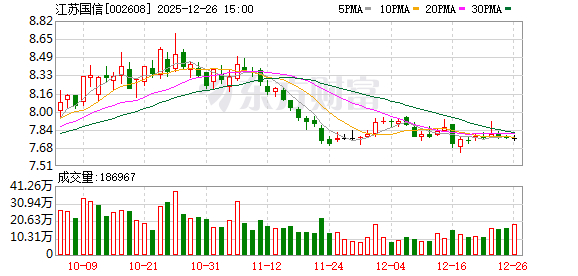
江苏国信:子公司金融借款诉讼二审维持原判,涉案25亿
Xin Lang Cai Jing· 2025-12-26 08:45
Core Viewpoint - Jiangsu Guoxin announced that its subsidiary Jiangsu Trust has filed a lawsuit against Jiasui Real Estate and Huizhou Jiazhaoye regarding a financial loan contract dispute involving a principal amount of 2.5 billion yuan and corresponding interest [1] Group 1 - The Nanjing Intermediate Court ruled in February 2025 that Jiasui Real Estate must return the principal of 2.5 billion yuan and pay interest, overdue interest, and penalties [1] - Jiasui Real Estate and Huizhou Jiazhaoye appealed the decision, seeking to overturn the ruling regarding the assessment fees [1] - Recently, Jiangsu Trust received a second-instance judgment from the provincial high court, which rejected the appeal and upheld the original ruling [1] Group 2 - The outcome of the lawsuit is expected to have no impact on the company's current or future profits [1]
估值近10亿的广发银行股权被挂出拍卖,持股人为元老级股东、被交银信托追债
Xin Lang Cai Jing· 2025-12-23 10:03
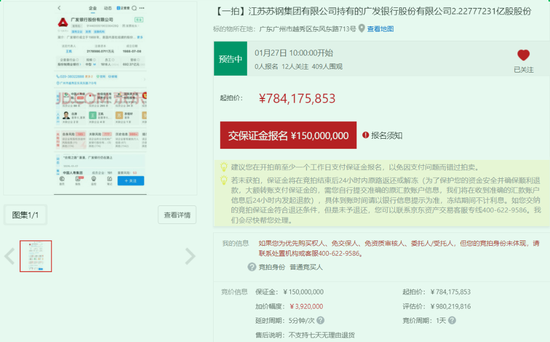
Core Viewpoint - The equity stake of Guangdong Development Bank, valued at nearly 1 billion yuan, is set to be publicly auctioned in early 2026, with a starting price of 784 million yuan, significantly below the bank's net asset value per share [1][12]. Group 1: Auction Details - Jiangsu Sugang Group Co., Ltd. will auction 223 million shares of Guangdong Development Bank on January 27, 2026, with an assessed value of 980 million yuan, translating to 4.40 yuan per share, and a starting price of 784 million yuan, which is approximately 20% lower than the assessed value, equating to a starting price of 3.52 yuan per share [1][13]. - The auction is being conducted by the Beijing First Intermediate People's Court, linked to a financial loan dispute between Jiangsu Sugang Group and China International Trust [1][15]. Group 2: Background of the Dispute - In September 2017, a loan agreement was signed between China International Trust and Beijing University Founder Information Industry Group, with Jiangsu Sugang Group providing equity pledge guarantees using its shares in Guangdong Development Bank [2][15]. - The loan agreement stipulated that the Beijing University Founder Information Industry Group would repay the loans by November 2019, but they failed to do so, leading to Jiangsu Sugang Group's inability to fulfill its guarantee obligations [2][15]. Group 3: Shareholder Information - Jiangsu Sugang Group has been a long-term shareholder of Guangdong Development Bank, initially holding 9.31% of shares in 2005, but its stake has decreased over the years to 1.022% by the end of 2022, making it the eighth largest shareholder [5][22]. - The group has undergone several changes in its controlling interests, with its current major shareholder being Founder Commercial Real Estate Co., Ltd., and the ultimate beneficiary being Ping An Insurance Group [22][24]. Group 4: Bank Performance - Guangdong Development Bank, established in 1988, has total assets of 3.69 trillion yuan as of mid-2025, with a revenue of 33.044 billion yuan in the first half of the year, reflecting a year-on-year decline of 4.39%, while net profit increased by 3.78% to 8.621 billion yuan [11][25]. - The latest net asset value per share of Guangdong Development Bank is 11.65 yuan, which is 2.65 times the assessed auction value and 3.31 times the starting price [11][25].
亿达中国:现正寻求法律意见并就偿还贷款的未偿还本金金额及累计利息的清偿安排积极协商
Zhi Tong Cai Jing· 2025-12-22 12:29
Core Viewpoint - Yida China (03639) announced that its subsidiaries, Rongtai Company and Zhengzhou Yida, failed to repay the principal and corresponding interest on a loan from Northern Trust, leading to a civil lawsuit filed against them [1] Group 1: Legal Proceedings - The Tianjin Second Intermediate People's Court has delivered a civil complaint from Northern Trust against Rongtai Company (the borrower and mortgagor), Zhengzhou Yida (the co-borrower and mortgagor), and two other companies as mortgagors [1] - The lawsuit requests the defendants to repay approximately RMB 482 million in principal and corresponding interest, penalties, and default fees, totaling around RMB 612 million by September 21, 2025 [1] Group 2: Financial Obligations - The plaintiff claims the right to priority compensation from the mortgaged assets provided by the defendants within the agreed mortgage amount [1] - The company is currently seeking legal advice and actively negotiating repayment arrangements for the outstanding principal and accumulated interest [1] Group 3: Ongoing Monitoring - The company will continue to monitor the developments of the legal proceedings and will issue further announcements to update on the situation as it progresses [1]
2025年11月金融数据点评:社融同比多增,企业债券融资规模增加
BOHAI SECURITIES· 2025-12-16 04:10
Group 1: Financing Trends - In November, social financing (社融) increased by nearly 160 billion yuan year-on-year, driven by significant growth in corporate direct financing and off-balance-sheet financing[3] - Corporate direct financing rose by over 100 billion yuan, primarily due to the expansion of the sci-tech bond market, which saw net financing of 182.3 billion yuan in November, an increase of 100 billion yuan year-on-year[15] - Off-balance-sheet financing also increased by over 100 billion yuan, largely attributed to the upcoming implementation of revised trust company regulations[15] Group 2: Loan and Deposit Dynamics - In November, RMB loans decreased by 190 billion yuan year-on-year, reflecting weak demand for loans and a supply-side contraction due to financial institutions' "anti-involution" measures[4] - Short-term loans for enterprises increased by 100 billion yuan, indicating a rise in short-term operational funding needs, while medium and long-term loans decreased by 40 billion yuan year-on-year[22] - Resident deposits showed a significant reduction, with both household and corporate deposits declining year-on-year, indicating a trend of deleveraging among residents[26] Group 3: Monetary Supply Metrics - M2 growth rate fell to 8% in November, down 0.2 percentage points from October, while M1 growth rate decreased to 4.9%, down 1.3 percentage points[26] - The decline in M1 and M2 growth rates is attributed to reduced "loan creation deposits" and limited fiscal fund injections, with non-bank financial institution deposits also showing a year-on-year decrease[26] Group 4: Future Outlook and Risks - The overall financial data for November indicates persistent weakness in private sector financing demand, with potential positive impacts from new policy financial tools expected to gradually materialize[6] - The high base effect from government bond financing is likely to continue to weigh on social financing growth, which may stabilize or slightly decline in the near term[6] - Risks include unexpected changes in the economic environment and policy adjustments that could significantly impact market financing demand and liquidity conditions[7]
11月金融数据点评:社融结构改善,但信贷内生修复仍偏弱
LIANCHU SECURITIES· 2025-12-15 09:29
Group 1: Social Financing and Credit - The stock growth rate of social financing remains stable at 8.5%, with new social financing of 2.49 trillion yuan in November, an increase of 159.7 billion yuan year-on-year[1] - Corporate short-term loans increased by 100 billion yuan, a year-on-year increase of 110 billion yuan, indicating a marginal improvement in corporate credit structure[3] - New corporate medium- and long-term loans increased by 170 billion yuan, a year-on-year decrease of 40 billion yuan, showing a significant reduction in decline compared to the previous month[3] Group 2: Household Credit and Economic Sentiment - Household short-term loans decreased by 215.8 billion yuan, a year-on-year decrease of 178.8 billion yuan, reflecting weak consumer demand[4] - New household medium- and long-term loans increased by only 10 billion yuan, a year-on-year decrease of 290 billion yuan, indicating a cautious sentiment in the housing market[4] - The transaction area of commercial housing in 30 major cities fell by 33.1% year-on-year, with declines across first, second, and third-tier cities[4] Group 3: Monetary Supply and Economic Outlook - M1 growth rate fell to 4.9%, a decrease of 1.3 percentage points month-on-month, influenced by market adjustments[5] - M2 growth rate decreased to 8.0%, a month-on-month decline of 0.2 percentage points, primarily due to weak credit generation[5] - Overall liquidity remains ample, but the transmission efficiency to the real economy needs improvement[5] Group 4: Risk Factors - Risks include macroeconomic performance falling short of expectations, weaker-than-expected real estate sales, unexpected U.S. tariff policies, and geopolitical risks[6]
金融数据点评:表外融资支撑社融增速走平
SINOLINK SECURITIES· 2025-12-13 12:53
Report Summary 1. Industry Investment Rating No industry investment rating is provided in the report. 2. Core Viewpoints - In November, the new social financing scale was not low, mainly driven by corporate credit and off - balance - sheet financing. However, the credit structure remained poor, with bill financing reaching a record high for the same period, corporate medium - and long - term loans at the lowest level since 2016 for the same period, and both short - term and medium - and long - term household loans at record lows for the same period. The credit demand of the real sector was significantly weak. Looking ahead, the net financing scale of government bonds in December may decline slightly month - on - month, still dragging down social financing. The intensive implementation of 500 billion yuan of policy - based financial instrument support projects from October to December may boost social financing to some extent, but the weak credit demand and the banks' desire to reserve projects for January next year may cause significant disturbances to social financing [6][33]. 3. Summary by Content Social Financing Aggregate - In November, the stock growth rate of social financing remained flat at 8.5%. The new social financing in November was 2.49 trillion yuan, an increase of 159.7 billion yuan year - on - year. Compared with the average of 2.3 trillion yuan in the same period of the past five years, the new social financing scale in November this year was not much different from the historical average, falling at the upper edge of the new scale in the same period of the past five years [2][8]. Factors Contributing to the Increase in Social Financing - Off - balance - sheet financing was one of the main contributors to the year - on - year increase in social financing this month. In November, trust loans and undiscounted bank acceptance bills in the off - balance - sheet financing items both increased year - on - year, supporting social financing. The new trust loan scale in November has generally declined compared with October since 2020, but this month's trend was anti - seasonal, possibly related to the recently launched new policy - based financial instrument support projects. In addition, corporate bonds were another supporting item for the increase in social financing this month. In November, new corporate bonds increased by 178.8 billion yuan to 416.9 billion yuan, the highest level in the same period since 2020, and were the only item with an increase in direct financing projects [3][15][18]. Credit Structure - There was a divergence between the total social financing and the credit structure. Although the overall performance of social financing in November was not bad, credit was still weak. Corporate sector credit increased by 360 billion yuan year - on - year to 610 billion yuan, mainly driven by short - term corporate loans and bill financing, while medium - and long - term corporate loans decreased year - on - year. Household sector credit had a negative growth for the first time in the same period in history [4][20]. - New medium - and long - term corporate loans were at the lowest level in the same period since 2016. The reasons for the year - on - year increase in corporate sector credit this year were the low base of corporate sector credit in November 2024 and the simultaneous efforts of short - term corporate loans and bill financing in November this year, which pushed up the corporate credit scale this month. In November, short - term corporate loans increased by 110 billion yuan year - on - year to 100 billion yuan, higher than the average of 50.2 billion yuan in the same period of the past five years. The new short - term corporate loan scale this year has always been at the upper edge of the historical same period, possibly because although the economy was sluggish, enterprises still needed a certain amount of funds for business turnover, and banks may also have vigorously issued short - term corporate loans at the end of the quarter to boost the scale. The new bill financing scale in November was at a record high for the same period, indicating that corporate credit issuance was still weak, and bill financing was used to increase the total credit scale. Medium - and long - term corporate loans decreased by 40 billion yuan year - on - year to 170 billion yuan, the lowest level in the same period since 2016, and the growth rate of the balance of medium - and long - term corporate loans further declined by 0.05 percentage points to 7.8%, having declined for 28 consecutive months [4][20][21]. - Household sector credit had a negative growth for the first time in the same period in history. In November, household sector credit decreased by 476.3 billion yuan year - on - year to - 206.3 billion yuan. Among them, short - term household loans decreased by 178.8 billion yuan year - on - year to - 215.8 billion yuan, also setting a record low for the same period. Contrary to short - term corporate loans, short - term household loans have basically been at the lower edge of the historical same period this year, and have even set record lows for the same period many times, possibly indicating weak household consumption willingness against the background of unstable income expectations. Medium - and long - term household loans decreased by 290 billion yuan year - on - year to 1 billion yuan, also the lowest value for the same period. The year - on - year growth rate of the sales area of commercial housing in 30 large and medium - sized cities in November declined to - 30.91%, the lowest level since May 2024, while the growth rate of the commercial housing sales area in the same period last year was 11.6%, indicating that current household home - buying willingness was also weak [5][24]. M1 and M2 - The growth rate of M1 continued to decline by 1.3 percentage points. In November this year, the monthly incremental scale of M1 was 0.89 trillion yuan, while the incremental scale of M1 in November last year was 2.15 trillion yuan. As the impact of the ban on manual interest compensation had gradually dissipated and the low - base effect faded, the growth rate of M1 continued to decline by 1.3 percentage points to 4.9% in November [6][25]. - Fiscal expenditure had limited support for M2. In terms of deposits, both household and corporate deposits decreased year - on - year in November, indicating that deposit creation was also not ideal against the background of sluggish loans. At the same time, non - bank deposits decreased by 100 billion yuan year - on - year to 80 billion yuan, and the new scale was significantly lower than that in the same period since 2022. Historically, the growth rate of the non - bank deposit balance had a certain similarity with the trend of the Shanghai Composite Index. The stock market had a slight correction in November, which may have led to a low new non - bank deposit scale in November. In summary, the growth rate of M2 further declined by 0.2 percentage points to 8% in November. In addition, fiscal deposits decreased by 190 billion yuan year - on - year to - 50 billion yuan. The fiscal expenditure intensity was generally weaker than that from 2021 to 2023 and stronger than that in 2024, but its support for the M2 growth rate was limited [6][30].
【广发宏观钟林楠】如何理解11月金融数据
郭磊宏观茶座· 2025-12-13 01:24
Core Viewpoint - The financial data for November indicates a notable improvement in corporate financing demand, with the initial effects of policy financial tools becoming evident. However, the residential sector remains a significant shortcoming, primarily due to the ongoing adjustments in the real estate market [4][11]. Group 1: Social Financing and Credit - In November, social financing increased by 2.49 trillion yuan, exceeding market expectations of 2 trillion yuan, with a year-on-year increase of 159.7 billion yuan. The stock growth rate of social financing remained stable at 8.5% [1][5]. - The increase in real credit was 405.3 billion yuan, showing a year-on-year decrease of 116.3 billion yuan, marking the fifth consecutive month of decline. The decline was primarily driven by a reduction in residential loans [6][7]. - Corporate loans remained strong, aligning with the high BCI corporate financing environment index for November, indicating a shift in bank assessments towards corporate sectors due to weak residential loan demand [2][7]. Group 2: Government and Corporate Bonds - Government bond financing amounted to 1.2 trillion yuan, a year-on-year decrease of 104.8 billion yuan, with expectations for December financing to remain around 1.2 trillion yuan [8]. - Corporate bond financing increased by 416.9 billion yuan, a year-on-year increase of 178.8 billion yuan, driven by policy encouragement for technology finance and lower financing costs [8][9]. Group 3: Trust and Other Financing Instruments - The amount of undiscounted bank acceptance bills increased by 149 billion yuan, reflecting a significant expansion in bank bill issuance, likely influenced by lower interest rates [9]. - Trust loans increased by 84.4 billion yuan, a year-on-year increase of 75.3 billion yuan, partly due to the spillover effects of policy financial tools on infrastructure financing [9]. Group 4: Monetary Supply and Growth Rates - M1 grew by 4.9% year-on-year, a decline of 1.3 percentage points from the previous month, indicating a continued downward trend following a peak in September [10]. - M2 growth was recorded at 8.0%, a decrease of 0.2 percentage points, primarily due to reduced credit generation [10]. Group 5: Future Outlook - The main highlight of the November financial data is the improvement in corporate financing demand, with a need to monitor the impact of policy financial tools in the upcoming quarters, especially in the construction sector [4][11].