
种植业

Search documents
“鱼米之乡”万象新
Xin Lang Cai Jing· 2026-01-17 02:21
Core Viewpoint - The article emphasizes the modernization of agriculture in Hubei Province, focusing on enhancing food production, improving rural living conditions, and increasing farmers' income through technological advancements and infrastructure development [2][5][19]. Group 1: Agricultural Modernization - Hubei aims to transform agriculture into a modern industry, ensuring stable grain and aquatic product production while enhancing the rural environment and living conditions [2]. - The province has implemented a grain production capacity enhancement action, targeting a total grain output of 55.824 billion jin by 2025, maintaining over 50 billion jin for 13 consecutive years [7]. - Agricultural technology innovation is prioritized, with a mechanization rate of 75.5% and a contribution rate of agricultural technology progress at 68% [7]. Group 2: Technological Integration - Farmers in Hubei are utilizing advanced technologies such as drones for precision farming, significantly reducing labor time and increasing crop yields by 100 jin per mu [3]. - The province has promoted over 58,600 sets of various agricultural smart terminals, covering all aspects of farming from planting to storage [7]. - Smart aquaculture systems are being adopted, allowing farmers to monitor and control water quality remotely, leading to a 20% increase in fish production [9]. Group 3: Industry Development - Hubei is focusing on developing a diverse range of agricultural products, including rice, tea, and specialty aquatic products, with a comprehensive output value of 550 billion yuan from nine key brands [12]. - The province is enhancing the agricultural supply chain by integrating various agricultural sectors, leading to a projected output value of 1.19 trillion yuan from ten key agricultural industry chains by 2025 [13]. - The promotion of winter shrimp farming technology has enabled year-round availability of products, expanding market reach to over 600 cities [10]. Group 4: Rural Infrastructure and Quality of Life - Hubei has constructed over 294,000 public charging stations and 25,000 village-level service points to improve rural infrastructure and enhance residents' quality of life [16]. - The establishment of a rural logistics system has improved access to goods and services, facilitating online shopping for residents [18]. - The province has seen a significant increase in returnee entrepreneurs, with over 60,000 new returnees each year contributing to rural development [19].


我国农业发展全面绿色转型迈入关键阶段
Xin Lang Cai Jing· 2026-01-16 18:01
Group 1 - The core viewpoint of the articles highlights that China's agricultural development is entering a critical stage of comprehensive green transformation by 2025, with significant progress in green agricultural development achieved in recent years [1][2] - The supply capacity of high-quality agricultural products in China has steadily improved, with a total of 86,000 green, organic, and geographical indication agricultural products currently available [1] - The quality of agricultural products is steadily increasing, with a rising proportion of high-quality rice, specialized wheat, and high-oil, high-protein soybeans, alongside accelerated promotion of healthy livestock and aquaculture [1] Group 2 - Agricultural resource conservation capabilities have been enhanced year by year, with the national arable land area reaching 1.94 billion acres, an increase of 28 million acres since 2020 [2] - The Yangtze River's ten-year fishing ban has shown significant results, with the number of indigenous fish species increasing by 36, and the ecological integrity index improving by two levels in the Yangtze River and Poyang Lake [2] - The utilization rates of fertilizers and pesticides for the three major grain crops have improved, reaching 43.3% and 44.1% respectively, with livestock manure resource utilization at 80.1% [2]
巴彦淖尔市玉米吨粮田种植技术培训月开启
Xin Lang Cai Jing· 2026-01-16 18:01
Core Insights - The training month for corn cultivation techniques has been officially launched in Bayannur City to enhance corn yield and optimize high-density planting technology [1][2] - The training aims to empower over 200 corn growers and agricultural technicians with advanced techniques and practical experiences to improve corn production [1][2] Group 1: Training Program Details - The training will adopt a巡回授课模式, providing lessons across various banners and counties [2] - The program focuses on three core areas: high-yield planting techniques, green pest control methods, and sharing successful cultivation experiences [1] Group 2: Importance and Goals - Enhancing corn yield is crucial for ensuring regional food security and increasing agricultural efficiency and farmers' income [1] - The initiative is seen as a significant step towards overcoming technical bottlenecks in corn production and supporting the construction of high-yield corn fields [2]
新华社聚焦湖北:“鱼米之乡”万象新
Xin Hua She· 2026-01-16 16:12
Core Viewpoint - The article emphasizes the modernization of agriculture in Hubei Province, focusing on enhancing food production, improving rural living conditions, and increasing farmers' income through technological advancements and infrastructure development [2][5][6]. Group 1: Agricultural Modernization - Hubei aims to transform agriculture into a modern industry, ensuring stable food production and improving rural environments [2]. - The province has implemented a "billion-jin" grain production capacity enhancement action, with a target of reaching a total grain output of 558.24 billion jin by 2025, maintaining over 500 billion jin for 13 consecutive years [6]. - The comprehensive mechanization rate for crop farming has reached 75.5%, with agricultural technology contributing 68% to productivity [6]. Group 2: Technological Integration - Farmers in Hubei are utilizing advanced technologies such as drones for precision farming, significantly reducing labor time and increasing yields by 100 jin per mu [3][5]. - The province has promoted over 58,600 units of various smart agricultural terminals, covering all aspects of farming from planting to storage [6]. - Smart farming equipment, including AI-driven weeding machines and automated greenhouses, is being deployed to enhance efficiency and crop quality [5]. Group 3: Aquaculture Development - Hubei is expanding its aquaculture sector, focusing on the large-scale farming of specialty aquatic products like crayfish and yellow eels, contributing to the region's reputation as a "land of fish and rice" [9][12]. - The province's freshwater aquaculture area exceeds 8 million mu, with a projected output of 5.4643 million tons of freshwater products in 2024, maintaining the top position in the country for 29 consecutive years [11]. Group 4: Brand and Market Expansion - Hubei has introduced brand policies to enhance the market presence of local products, with nine key brands generating a combined output value of 550 billion yuan [13]. - The province is focusing on the integration of various agricultural products, enhancing the value chain from production to processing, and promoting regional specialties [15]. Group 5: Rural Infrastructure and Quality of Life - Hubei is improving rural infrastructure, including the establishment of over 294,000 public charging stations and 24,000 village-level service points to enhance logistics and accessibility [16][21]. - The province has seen a significant increase in returnees starting businesses in agriculture and tourism, contributing to rural vitality and economic growth [23].

国家现代农业产业园实现“零”的突破!枣庄农业发展获佳绩
Qi Lu Wan Bao· 2026-01-16 15:34
Core Viewpoint - The news conference highlighted the progress and future plans of Zaozhuang in modernizing agriculture and rural revitalization during the 14th Five-Year Plan period, emphasizing food security and agricultural productivity as top priorities [1] Group 1: Agricultural Modernization - Zaozhuang has constructed 2.535 million acres of high-standard farmland by 2024, a 24.6% increase from 2020, with a crop variety coverage rate of 99% and an agricultural mechanization rate of 93.4%, up by 4.6 percentage points [1] - The total grain output reached 1.893 million tons, a 4.8% increase from 2020, with consistent high yields in wheat and corn [1] - The total output value of agriculture, forestry, animal husbandry, and fishery is projected to reach 40.9 billion yuan, a 28.1% increase from 2020 [1] Group 2: Industry Development - Zaozhuang has prioritized the pomegranate industry, aiming for a total output value of over 5.5 billion yuan by 2025, a 37.5% increase from 2023 [2] - The number of large-scale agricultural processing enterprises has increased by 113% since 2020, with 7 national-level and 17 provincial-level agricultural industrial strong towns established [2] - The city has developed 81 provincial-level smart agriculture application bases and launched the "Zao Taste Pomegranate" brand, receiving provincial government support [2] Group 3: Rural Revitalization - Zaozhuang has built 514 beautiful villages and 110,000 beautiful courtyards, implementing a "double ten hundred thousand" project to create themed agricultural areas [3] - The city has achieved 100% effective management of domestic sewage and harmless treatment of household waste in administrative villages, with a toilet renovation rate of 93% [3] - The rural road network has been expanded by 1,311 kilometers, and the scale of rural water supply has reached 98.4% [3] Group 4: Reform and Innovation - Zaozhuang has developed 12,000 new agricultural operating entities and over 4,200 agricultural social organizations serving nearly 440,000 households [4] - The city has completed 3,861 online transactions worth 480 million yuan through a regional rural property trading platform [4] Group 5: Poverty Alleviation - The city has included 1,236 households and 3,359 individuals in its poverty prevention monitoring and assistance program [5] - A total of 7.7 billion yuan has been allocated for various projects, resulting in an average increase of 475,100 yuan in collective operating assets for villages with impoverished populations [5] - The per capita disposable income of rural residents is expected to increase by 35.3% by 2024 compared to 2020 [5] Group 6: Future Outlook - Zaozhuang aims to stabilize grain production at over 1.91 million tons by the end of the 15th Five-Year Plan, focusing on high-efficiency agricultural models [6] - The city plans to enhance its agricultural industry clusters from "1+5+15" to "3+4+7" by the end of the 15th Five-Year Plan [7] - The goal is to establish around 100 city-level agricultural areas and 1,000 beautiful villages, covering over two-thirds of administrative villages [7]
【活力中国调研行·河北篇】“米袋子”“菜篮子”充足丰盈 夯实基础惠民生
Xin Lang Cai Jing· 2026-01-16 13:38
Core Insights - The article emphasizes the importance of food security and agricultural productivity in Hebei province, highlighting the integration of new varieties, technologies, equipment, and training for farmers to enhance grain production and ensure a stable supply of food [1][5]. Group 1: Grain Production - Hebei province has developed over 350 superior varieties of crops, maintaining a coverage rate of high-quality varieties at 98% [6][7]. - The province's grain sowing area reached 96.915 million acres, with a total production of 78.4 billion pounds and an average yield of 404.5 kg per acre, showing steady growth in all three metrics compared to the previous year [7]. - The implementation of precision agriculture techniques, such as smart water and fertilizer integration systems, has led to continuous increases in grain yields [6][7]. Group 2: Vegetable Production - Hebei's vegetable production is supported by the establishment of nine key counties with over 200,000 acres each, contributing to a total vegetable planting area of over 7.2 million acres in the surrounding areas of Beijing [4][9]. - The total vegetable production in Hebei is projected to exceed 58 million tons by 2025, with facility vegetables maintaining a leading position nationally [8]. - Hebei vegetables account for 43.04% of the major agricultural products in Beijing's wholesale market, indicating a strong market presence [8]. Group 3: Agricultural Strategies - The province is focusing on the "Four New" integration strategy, which includes new varieties, technologies, equipment, and training for farmers, to transform traditional farming into data-driven practices [2][6]. - Policies such as machinery purchase subsidies and complete cost insurance for grain are being implemented to help farmers reduce costs and increase profits [7]. - The ongoing development of specialty agricultural clusters and modern agricultural parks aims to invigorate the agricultural landscape in Hebei [9].
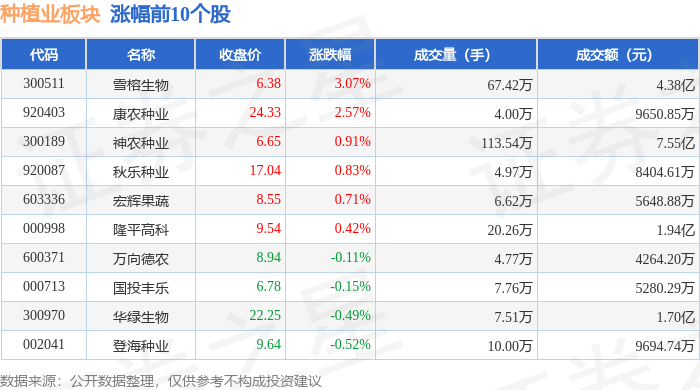
种植业板块1月16日跌0.76%,新赛股份领跌,主力资金净流出8318.76万元
Zheng Xing Xing Ye Ri Bao· 2026-01-16 08:49
Market Overview - The planting industry sector experienced a decline of 0.76% on January 16, with XinSai Co. leading the drop [1] - The Shanghai Composite Index closed at 4101.91, down 0.26%, while the Shenzhen Component Index closed at 14281.08, down 0.18% [1] Stock Performance - Notable gainers in the planting sector included: - Xuecheng Biological (300511) with a closing price of 6.38, up 3.07% and a trading volume of 674,200 shares, totaling 438 million yuan [1] - Kangnong Agriculture (920403) closed at 24.33, up 2.57% with a trading volume of 40,000 shares, totaling 96.51 million yuan [1] - Major decliners included: - XinSai Co. (600540) closed at 4.56, down 1.94% with a trading volume of 114,200 shares, totaling 52.47 million yuan [2] - XinNong Development (600359) closed at 7.30, down 1.75% with a trading volume of 84,100 shares, totaling 61.75 million yuan [2] Capital Flow - The planting industry sector saw a net outflow of 83.19 million yuan from main funds, while retail funds experienced a net inflow of 132 million yuan [2] - Retail investors had a net outflow of 49.15 million yuan [2] Individual Stock Capital Flow - Key stocks with significant capital flow included: - ShenNong Agriculture (300189) with a main fund net inflow of 22.47 million yuan, but a retail net outflow of 30.31 million yuan [3] - Kangnong Agriculture (920403) had a main fund net inflow of 18.03 million yuan and a retail net inflow of 1.14 million yuan [3] - Notable outflows were observed in: - NuoPin (002215) with a main fund net inflow of 11.38 million yuan but a retail net outflow of 27.58 million yuan [3]

“谁来种地”关乎未来
Ren Min Ri Bao· 2026-01-16 05:32
不惧风吹日晒,顺四时、应节气,一项项农事安排有条不紊;能辨稗草、蹚水田,也能驾驶大型农 机、操纵无人机;管理连片大田,也服务一家一户……近年来,越来越多青春的身影出现在田野阡陌 间。 2022年,习近平总书记在给徐淙祥的回信中说,"我记得你这个安徽太和的种粮能手。得知你家种 植的小麦喜获丰收,儿孙也跟着你干起了农业,我感到很高兴。" 让年轻人留得下、种得好、有奔头,势必要打造更友好的发展环境。聚焦乡村人才培育问题,中央 一号文件连年进行具体部署;人力资源社会保障部等7部门出台相关意见,提出从技术、融资、营销渠 道、联络机制等层面"强化返乡下乡入乡创业支持引导";各地持续开展高素质农民培育项目,一些地方 将新型职业农民纳入乡村振兴人才库……聚焦"投资于人",更多资源正投入到返乡人才的保障和发展 中。要加快健全农村实用人才评价制度,提高新农人的社会认同和职业荣誉感,让兴业、联农、带村形 成更可持续的良性循环。 大地上的故事最动人。期待更多年轻人在希望的田野上施展才能,与农业强国建设同频共振,共同 书写乡村的美好未来。 作者:有鱼 乡村全面振兴的宏伟蓝图,吸引着人才持续回流。有报告显示,近年来大批大中专毕业生、外出 ...
这群种粮的年轻人
Ren Min Ri Bao· 2026-01-16 00:55
Core Insights - The article highlights the transition of agricultural practices from traditional methods to modern techniques, emphasizing the role of a new generation of farmers who are embracing technology and innovation in farming [1][2][3]. Group 1: Modernization of Agriculture - Young farmers like Zhang Yangyang are utilizing advanced machinery and techniques, significantly increasing their productivity, with service areas reaching over 10,000 acres per month [2]. - The integration of modern agricultural tools, such as drones and automated machinery, is reshaping farming practices, allowing for more efficient crop management and higher yields [7][10]. - The article discusses the importance of adapting traditional farming wisdom to modern practices, showcasing how younger farmers are blending old and new techniques to enhance productivity [3][5]. Group 2: Community and Economic Impact - New farming models, such as cooperatives, are creating job opportunities and stable incomes for local villagers, with initiatives leading to the establishment of over 50 jobs in communities [10]. - The introduction of innovative agricultural practices is not only improving individual farmer's incomes but also enhancing the overall economic landscape of rural areas [10][12]. - The article emphasizes the role of local governments in supporting new farmers through policies and resources, fostering an environment conducive to agricultural entrepreneurship [12]. Group 3: Personal Growth and Development - The narrative illustrates how returning to farming has allowed young individuals to find personal fulfillment and a sense of purpose, as they contribute to their communities while pursuing their passions [6][11]. - Young farmers are increasingly recognized for their expertise and contributions, with some achieving notable recognition in their fields, such as being listed among the top agricultural experts in their regions [7][10]. - The article highlights the importance of continuous learning and adaptation in modern agriculture, as young farmers acquire new skills and knowledge to thrive in a competitive environment [7][12].
【人民日报】这群种粮的年轻人
Ren Min Ri Bao· 2026-01-16 00:46
Core Viewpoint - The new generation of farmers is redefining agricultural practices, blending traditional knowledge with modern technology to enhance productivity and sustainability in farming [1][3][10]. Group 1: Modernization of Agriculture - Young farmers like Zhang Yangyang have significantly increased their operational scale, with service areas expanding from 70 acres to over 10,000 acres through the use of modern machinery [2]. - The introduction of advanced farming equipment, such as drones and precision agriculture tools, has transformed traditional farming methods, allowing for greater efficiency and productivity [4][6]. - The shift from manual labor to mechanized farming is evident, with new farmers embracing technology to improve crop yields and operational efficiency [8][10]. Group 2: Integration of Traditional Knowledge - Despite the modernization, traditional farming wisdom remains relevant, as younger farmers learn from the experiences of their elders, combining old practices with new technologies [3][7]. - The philosophy of "working with nature" and understanding local conditions continues to guide the practices of new farmers, ensuring that they remain adaptable and resilient [3][9]. Group 3: Community and Economic Impact - New farming models, such as cooperatives, are creating job opportunities and stable incomes for local communities, enhancing the economic landscape of rural areas [10]. - Initiatives like the "cooperative + base + farmer + leading enterprise" model are fostering collaboration among farmers, leading to improved agricultural practices and increased income [10]. - The integration of smart agricultural systems has led to a 20% increase in land efficiency, demonstrating the economic benefits of modern farming practices [6][10]. Group 4: Support Systems for New Farmers - Local governments are providing comprehensive support systems for new farmers, including funding, training, and access to resources, facilitating their growth and sustainability [12]. - The establishment of agricultural education programs and mentorship initiatives is encouraging more young people to engage in farming, ensuring the continuity of agricultural practices [12].