
Funds

Search documents
联博、淳厚基金前高管接连起诉“老东家”,“和平”的离职公告暗藏纠纷
Sou Hu Cai Jing· 2026-01-07 23:36
本报(chinatimes.net.cn)记者张玫 北京报道 一家是国际资管巨头在华的独资公募,另一家是深陷股权纷争的本土"个人系"基金,2026年开年,联博 基金与淳厚基金面临相同的窘境:离职高管因劳资纠纷,在上海与"老东家"对簿公堂。 2026年1月19日,上海静安区人民法院将开庭审理朱建荣诉联博基金管理有限公司(下称"联博基金") 的劳动争议案。三个月后的4月10日,上海浦东新区人民法院开庭,淳厚基金管理有限公司(下称"淳厚 基金")将因其前固定收益投资部总监祁洁萍提起的劳动合同纠纷而站上被告席。 因"个人原因"离职 一段维持15个月的副总经理任职,在因"个人原因"离任三个月后,骤然升级为一场对簿公堂的劳动争 议。 根据联博基金此前发布的高管任职公告,朱建荣系于2024年6月25日正式出任公司副总经理。然而,其 任职仅维持了15个月,公司于2025年9月6日发布公告,副总经理朱建荣因个人原因,已于2025年9月4日 正式离任,且未转任公司其他工作岗位。 接连的高管变动与即将到来的诉讼,为这家正处于中国市场开拓期的外资公募,增添了新的不确定性。 《华夏时报》记者2025年12月30日向联博基金发送采访函询 ...


FOF供求两旺 基金发行“开门红”
Zhong Guo Zheng Quan Bao· 2026-01-07 22:37
Core Insights - The fund issuance market in early 2026 is experiencing a significant surge, particularly in FOF (Fund of Funds) products, driven by customer demand, product transformation, and channel support [1][2][4] Group 1: FOF Product Performance - The first FOF product of 2026, Wanjiatai's "Stable Three-Month Holding FOF," sold out in just one day on January 5, marking a strong start for new fund issuance [1] - Following this, Guangfa's "Stable Three-Month Holding FOF" also announced an early closure of its fundraising after just two trading days [2] - FOF products are becoming the main drivers of sales for various banks, with many companies planning to launch multi-asset FOF products through different banking channels [3] Group 2: Market Dynamics - A significant amount of residential fixed deposits, totaling 20.7 trillion yuan for 2-year, 9.6 trillion yuan for 3-year, and 1.3 trillion yuan for 5-year terms, will mature in 2026, creating a demand for new investment vehicles [4] - The low interest rates on fixed deposits are failing to meet investors' needs for capital preservation and growth, prompting a shift towards multi-asset and multi-strategy FOF products [4] - The design of FOF products offers advantages over traditional funds by diversifying underlying assets and capturing more alpha opportunities [4] Group 3: Channel and Marketing Strategies - Major banks are actively promoting FOF products, establishing dedicated marketing lines and sections for FOF on their wealth management platforms [5] - The selection criteria for fund managers in FOF products have become stricter, focusing on those with experience in multi-asset management and strong volatility control capabilities [6] Group 4: Fund Issuance Trends - From January 5 to 7, 38 new funds were launched, with a total of 77 public funds planned for issuance in January 2026, indicating a peak in fund issuance activity [7] - Equity products remain dominant, with 26 index funds and 26 actively managed equity funds among the new offerings, alongside a diversified product line including 12 bond funds, 11 FOFs, and 2 QDII funds [7]


基金销售新规落地: 理财“加权益”与公募 “强适配”时代开启
Zhong Guo Zheng Quan Bao· 2026-01-07 22:21
Core Viewpoint - The newly released regulations on the management of sales fees for publicly offered securities investment funds have relaxed the redemption fee constraints for bond funds, which is expected to enhance the role of bond ETFs in liquidity management and trading for financial institutions [1][2] Group 1: Changes in Redemption Fees - The formal regulations allow fund managers to set different redemption fee standards for institutional investors holding bond fund shares for more than 30 days, which is a significant change from the previous draft [2] - The exemption clause for certain fund types, including ETFs and money market funds, remains in place, allowing fund managers to set redemption fees based on the investment characteristics of the products [2] Group 2: Shift in Fund Allocation - The adjustments in subscription fees, particularly the significant reduction for index equity funds, are expected to increase the allocation of financial institution funds to equity funds [3] - The upper limits for subscription fees have been refined, with passive index funds seeing a reduction from 0.8% to 0.3%, while some mixed funds have seen an increase [3] Group 3: Product Adaptation and Collaboration - The collaboration between public funds and financial institutions is deepening, with a focus on optimizing product lines to meet the changing allocation needs of financial institutions [4] - Companies are developing tailored fixed-income product lines, such as credit bond products categorized by duration, to provide effective asset allocation tools for financial institutions [5]
什么原因?百亿公募基金经理被告上法庭
Guo Ji Jin Rong Bao· 2026-01-07 13:11
Group 1 - The lawsuit against Guotou Ruijin Fund and fund manager Shi Cheng is based on a financial trust contract dispute, with the court hearing scheduled for January 13, 2026 [1] - Guotou Ruijin Fund has over 20 years of establishment, with a public fund management scale of 236.89 billion yuan as of the end of Q3 last year, where over 80% of the assets are in money market and bond funds [1] - Shi Cheng, who joined Guotou Ruijin Fund in 2017, currently manages six funds with a total scale of 10.736 billion yuan, previously achieving significant growth through investments in the new energy sector [1] Group 2 - In the 2025 Q3 fund report, Shi Cheng highlighted the potential of AI and electrical systems as significant investment directions, indicating a shift from air cooling to liquid cooling [2] - Shi Cheng expressed optimism about the recovery of profitability in growth sectors like new energy and TMT, and the acceleration of new demands in energy storage and AI [2]
从籍籍无名中闯出天地,6万亿ETF市场5年养成
2 1 Shi Ji Jing Ji Bao Dao· 2026-01-07 12:45
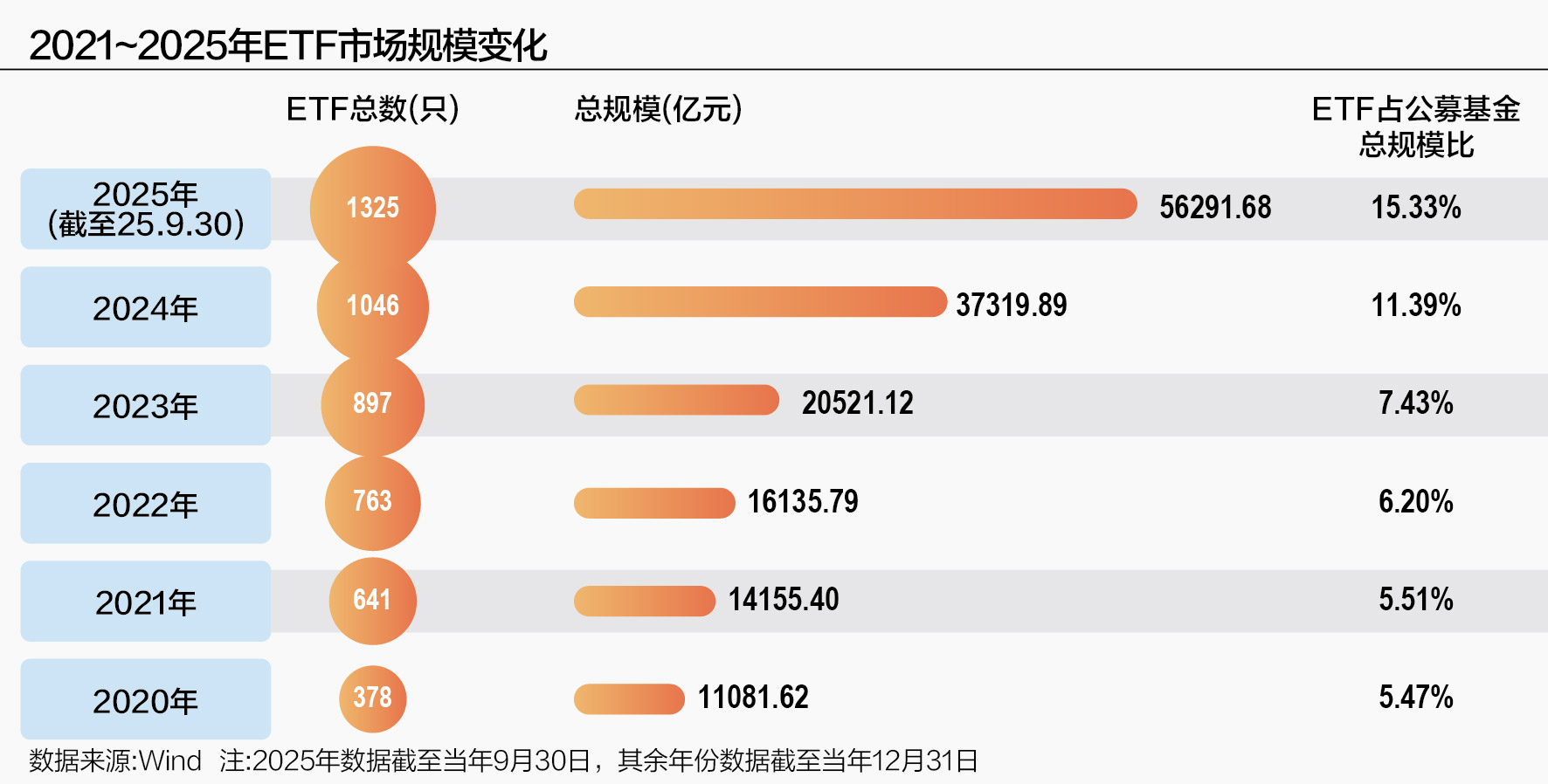
Core Insights - The ETF market in China has reached a significant milestone, with total assets surpassing 6 trillion yuan, reflecting a growth of over 60% year-on-year [3][5] - The rapid expansion of the ETF market is characterized by a shift from slow accumulation to accelerated growth, with a cumulative increase of 452.53% over the past five years [5][6] - The market is witnessing a consolidation of leading fund companies, with a clear top tier emerging in ETF management [7][10] Market Overview - As of December 2025, the total ETF market size reached 6.03 trillion yuan, with an increase of 2.29 trillion yuan within the year [3] - The number of ETF products has grown from 326 to 1402 over the past five years, with a total issuance of 1076 new products [6] - The total trading volume of ETFs has surged from 843.48 billion yuan to 3.96 trillion yuan, marking a growth of 369.51% [6] Management Competition - The top seven fund companies have maintained their positions in the ETF management scale, with 华夏基金 (China Asset Management) leading the market [7][10] - 华夏基金's ETF management scale increased from 187.9 billion yuan in 2020 to 957 billion yuan by the end of 2025 [10] - The entry threshold for the top ten ETF managers has significantly risen, with the requirement increasing from 30 billion yuan five years ago to 200 billion yuan by the end of 2025 [11] Index Performance - The 沪深300 index remains the most popular, with ETF assets linked to it reaching 1.185 trillion yuan by the end of 2025 [14] - The 中证A500 index has emerged as a new favorite, with its ETF size surpassing 300 billion yuan, reflecting a shift towards quality assets [15] - The diversification of asset classes in the top ten indices indicates changing investor preferences, with new themes and sectors gaining traction [16] Holder Structure - Institutional investors have solidified their dominance in the ETF market, increasing their share from 69.07% at the end of 2020 to 76.84% by mid-2025 [20] - The absolute scale of institutional holdings has grown from 743.8 billion yuan to 3.3 trillion yuan, indicating a fourfold increase [20] - Individual investors have shown consistent participation in equity ETFs, maintaining a net value share close to that of institutional investors [21] National Team Involvement - The "national team" has increasingly utilized ETFs as a tool for market stabilization, with significant purchases made during market fluctuations [22][23] - By the end of 2024, the central government’s holdings in ETFs had surged to over 1 trillion yuan, reflecting a strategic shift towards broader ETF investments [23][24] - The national team's involvement in ETFs is expected to play a crucial role in the future of China's capital market ecosystem [24]
科创债ETF鹏华(551030)收涨6bp,盘中成交额101.13亿
Sou Hu Cai Jing· 2026-01-07 09:08
Group 1 - The core viewpoint is that the 科创债 ETF (Penghua, 551030) is experiencing active market trading, with a slight increase of 0.06% and a turnover rate of 42.27%, amounting to a transaction volume of 10.113 billion yuan [1] - The bond market is facing multiple pressures, including a strong stock market, rising supply pressures, temporary inflation increases, and limited central bank bond purchases, which negatively impact the bond market [1] - Despite these challenges, rising bond yields are improving the relative value of bonds compared to loans, and the valuation of bonds is becoming competitive with stocks, indicating a potential stabilization in the bond market [1] Group 2 - 华西证券 believes that the 科创债 market has significant growth potential under favorable policies, and the 科创债 ETF is expected to continue to highlight its long-term allocation value and market influence [2] - The flexibility of the 科创债 ETF as a tool caters to investors' demand for stable returns while providing liquidity and investment opportunities [2] - Penghua Fund has been actively developing a "fixed income tool product" strategy since the second half of 2018, aiming to become a domestic expert in fixed income indices by offering high-quality bond index investment tools [2]
ETF主力榜 | A500ETF基金(159356)主力资金净流出863.07万元,居股票型ETF基金第一梯队-20260107
Xin Lang Cai Jing· 2026-01-07 09:00
与此同时,该基金最新成交量为6328.45万份,最新成交额达8190.47万元,当日主力资金净流出成交额 占比达10.54%。 2026年1月7日,A500ETF基金(159356.SZ)收涨0.15%,主力资金(单笔成交额100万元以上)净流出 863.07万元,居股票型ETF基金第一梯队。(数据来源:Wind) A500ETF基金(159356.SZ),场外联接(A类:022440;C类:022441;Y类:022967)。 拉长时间看,该基金近5个交易日有3天主力资金净流出,合计流出3627.16万元,居可比基金前3。(数 据来源:Wind) ...
ETF主力榜 | A500ETF嘉实(159351)主力资金净流出1.94亿元,居全市场第一梯队-20260107
Xin Lang Cai Jing· 2026-01-07 09:00
A500ETF嘉实(159351.SZ),场外联接(A类:022453;C类:022454;Y类:022905)。 拉长时间看,该基金近3天主力资金加速流出,合计流出3.33亿元,居股票型ETF基金前3。(数据来 源:Wind) 与此同时,该基金最新成交量为12.78亿份,最新成交额跌破16.00亿元,当日主力资金净流出成交额占 比达12.14%。 2026年1月7日,A500ETF嘉实(159351.SZ)收跌0.08%,主力资金(单笔成交额100万元以上)净流出 1.94亿元,居全市场第一梯队。(数据来源:Wind) ...
平安基金罗春风的十五年
Xin Lang Cai Jing· 2026-01-07 05:35
Core Insights - The article highlights the significant role of leadership in asset management, emphasizing that a capable leader can navigate market fluctuations and generate consistent returns, while an unsuitable one can lead to failure [1] Company Overview - As of the end of 2025, Ping An Fund, which embodies the "Ping An gene," has nearly 900 billion yuan in assets under management and has generated 80 billion yuan in profits for clients, serving 970 institutional clients and over 170 million channel clients [3][12] - The company was established in 2011, with its chairman, Luo Chunfeng, playing a pivotal role in its development alongside the growth of China's asset management industry [3][12] Early Development - Luo Chunfeng was tasked with establishing Ping An's public fund company in late 2008, and the company officially launched in 2011, with Luo initially serving as the vice president in charge of marketing [3][13] - The early years were characterized by a youthful team and a strong work ethic, guided by the philosophy of preparing for future opportunities while managing current resources [3][13] Strategic Direction - In 2015, Luo established the "first fixed income, then equity" strategy, which proved effective as the company capitalized on market trends, such as the surge in money market funds and the transformation of bank wealth management products [4][15] - By the end of 2025, the public management scale of Ping An Fund's fixed income products exceeded 600 billion yuan, solidifying its position as a leading fixed income provider [5][15] Research and Development Framework - The company has developed a platform-based research and investment system emphasizing long-term value creation, with a focus on talent and diverse strategies [6][16] - By the end of 2025, the active equity management scale doubled, with an average annual return of 48.31%, and notable performance in the long-term rankings [6][16] Product Innovation - Under Luo's leadership, Ping An Fund has launched several innovative products, including the first domestic new energy vehicle ETF and the first artificial intelligence theme ETF, anticipating market trends [7][17] - The company has also invested in developing the Archimedes system for asset allocation, significantly increasing its management scale in this area [7][17] Operational Philosophy - Luo emphasizes the importance of long-term stability over rapid growth, advocating for a gradual increase in fund manager responsibilities based on proven capabilities [8][18] - The company has established a unique risk control system that integrates industry standards with Ping An Group's capabilities, enhancing its operational resilience [8][19] Conclusion - Over fifteen years, Ping An Fund has evolved from a newcomer to a significant player in the asset management industry, demonstrating the value of long-term commitment to client interests [9][19]
创纪录!
Zhong Guo Ji Jin Bao· 2026-01-07 05:33
Core Insights - The public fund industry in 2025 experienced a record high in management changes, with a total of 462 changes involving 162 fund management companies, marking a historical peak in both numbers and coverage [1][3]. Group 1: Management Changes - The turnover of key positions, specifically chairpersons and general managers, reached unprecedented levels, with 116 chairperson changes and 94 general manager changes, affecting 55 and 45 fund management companies respectively [4]. - Over 40% of public fund management companies (79 firms) experienced changes at the chairperson or general manager level, with notable firms like E Fund, China Merchants, and others undergoing significant leadership transitions [4][5]. Group 2: Retirement Trends - The industry is witnessing a "retirement wave" among core executives, with several long-serving leaders stepping down due to age, including notable figures like Xie Wei from交银施罗德基金 and Pan Fuxiang from诺德基金 [6][7]. - The retirement trend is attributed to the aging of early industry professionals, many of whom are from the "60s" and "70s" generations, coinciding with a peak retirement period from 2025 to 2030 [7]. Group 3: Strategic Shifts - The strategic focus of new leadership is shifting from mere scale expansion to enhancing professional capabilities and long-term competitiveness, emphasizing high-quality development as a core strategy [9][10]. - Many companies are undergoing strategic adjustments in research, operations, and product systems under the guidance of new leaders, reflecting a broader trend in the industry towards quality over quantity [10].