
信用债

Search documents
3月25日信用债异常成交跟踪
SINOLINK SECURITIES· 2026-03-25 15:38
1. Report Industry Investment Rating - Not provided in the document 2. Core View of the Report - Based on Wind data, among the bonds traded at a discount, '24 Chanrong 02' has a relatively large deviation in bond valuation price. Among the bonds with rising net prices, '19 Jintou 27' ranks high in terms of valuation price deviation. Among the Tier 2 and perpetual bonds with rising net prices, '24 Pufa Bank Tier 2 Capital Bond 01B' has a relatively large deviation in valuation price; among the commercial financial bonds with rising net prices, '25 Agricultural Bank TLAC Non - capital Bond 01C(BC)' ranks high in terms of valuation price deviation. Among the bonds with a trading yield higher than 5%, non - banking financial bonds rank high. Credit bond valuation yield changes are mainly distributed in the [-5,0) range. The trading terms of non - financial credit bonds are mainly distributed between 2 and 3 years, with the highest proportion of discount transactions in the 0.5 - 1 - year variety; the trading terms of Tier 2 and perpetual bonds are mainly distributed between 4 and 5 years, with the highest proportion of discount transactions in the within - 1 - year variety. By industry, the bonds in the light manufacturing industry have the largest average deviation in valuation price [2] 3. Summary According to Relevant Catalogs 3.1 Discounted Bond Transaction Tracking - Bonds such as '24 Chanrong 02', '24 Chanrong 04', etc. in the non - banking financial sector have a relatively large negative deviation in valuation price, with a deviation of - 1.36%. Bonds in the urban investment and comprehensive sectors also have varying degrees of negative deviation, such as '20 Shuanglong 01' with a deviation of - 0.18% [3] 3.2 Tracking of Bonds with Rising Net Prices - '19 Jintou 27' in the urban investment sector has a relatively large positive deviation in valuation price, with a deviation of 0.47%. Other bonds in sectors such as public utilities, comprehensive, and non - banking financial also show different degrees of positive deviation [5] 3.3 Tracking of Tier 2 and Perpetual Bond Transactions - '24 Pufa Bank Tier 2 Capital Bond 01B' in the share - holding bank category has a relatively large deviation in valuation price, with a deviation of 0.11%. Bonds of state - owned banks and city commercial banks also have certain valuation price deviations [6] 3.4 Tracking of Commercial Financial Bond Transactions - '25 Agricultural Bank TLAC Non - capital Bond 01C(BC)' in the state - owned bank category has a relatively large deviation in valuation price, with a deviation of 0.16%. Other bonds in the state - owned bank, share - holding bank, and city commercial bank categories also show varying degrees of deviation [7] 3.5 Tracking of Bonds with a Trading Yield Higher than 5% - Bonds in the non - banking financial and real estate sectors, such as '23 Chanrong 08', '21 Jindi 04', 'H3 Vanke 01', etc., have a trading yield higher than 5% [8] 3.6 Distribution of Credit Bond Transaction Valuation Deviations on the Day - Credit bond valuation yield changes are mainly concentrated in the [-5,0) range [2] 3.7 Distribution of Non - financial Credit Bond Transaction Terms on the Day - The trading terms of non - financial credit bonds are mainly distributed between 2 and 3 years, and the 0.5 - 1 - year variety has the highest proportion of discount transactions [2] 3.8 Distribution of Tier 2 and Perpetual Bond Transaction Terms on the Day - The trading terms of Tier 2 and perpetual bonds are mainly distributed between 4 and 5 years, and the within - 1 - year variety has the highest proportion of discount transactions [2] 3.9 Discount Transaction Ratio and Transaction Scale of Non - financial Credit Bonds in Each Industry - The bonds in the light manufacturing industry have the largest average deviation in valuation price [2]
大类资产早报-20260324
Yong An Qi Huo· 2026-03-24 02:20
1. Report Industry Investment Rating - No relevant information provided 2. Core View of the Report - The report presents the performance of global asset markets including 10 - year and 2 - year government bonds of major economies, exchange rates of the US dollar against major emerging - economy currencies, major economy stock indices, and credit bond indices [3] 3. Summary by Relevant Catalogs Global Asset Market Performance - **10 - year government bonds**: The latest yields of 10 - year government bonds in the US, UK, France, Germany, Italy, Spain, Switzerland, Greece, Japan, Brazil, China, South Korea, Australia, and New Zealand are 4.345, 4.915, 3.709, 3.002, 3.875, 3.513, 0.382, 3.855, 2.304, 6.298, 1.840, N/A, 5.118, 4.883 respectively [3] - **2 - year government bonds**: The latest yields of 2 - year government bonds in the US, UK, Germany, Japan, Italy, China (1 - year yield), South Korea, and Australia are 3.854, 4.412, 2.571, 1.293, 2.827, 1.250, N/A, 4.817 respectively [3] - **Exchange rates**: The latest exchange rates of the US dollar against the Brazilian real, Russian ruble, South African rand, South Korean won, Thai baht, and Malaysian ringgit are 5.235, N/A, 16.820, 1488.350, 33.000, N/A respectively. The latest on - shore and off - shore RMB exchange rates are 6.884, the RMB central parity rate is 6.904, and the 12 - month NDF is 6.728 [3] - **Stock indices**: The latest values of major economy stock indices such as the S&P 500, Dow Jones Industrial Index, NASDAQ, Mexican index, UK index, French CAC, German DAX, Spanish index, Russian index, Nikkei, Hang Seng Index, Shanghai Composite Index, Taiwan index, South Korean index, Indian index, Thai index, Malaysian index, Australian index, and emerging - economy index are 6581.000, 46208.470, 21946.760, 64370.950, 9894.150, 7726.200, 22653.860, 16888.200, N/A, 51515.490, 24382.470, 3813.283, 32722.500, 5405.750, N/A, 1397.340, N/A, 8552.642, 1419.950 respectively [3] - **Credit bond indices**: The latest values of US investment - grade, euro - area investment - grade, emerging - economy investment - grade, US high - yield, euro - area high - yield, and emerging - economy high - yield credit bond indices are 3518.560, 263.418, 286.650, 2900.390, 404.460, 1807.438 respectively [3] Stock Index Futures Trading Data - **Index performance**: The closing prices of A - shares, CSI 300, SSE 50, ChiNext, and CSI 500 are 3813.28, 4418.00, 2792.33, 3235.22, 7440.75 respectively, with percentage changes of - 3.63%, - 3.26%, - 3.17%, - 3.49%, - 4.11% [4] - **Valuation**: The PE (TTM) of CSI 300, SSE 50, CSI 500, S&P 500, and German DAX are 13.61, 11.11, 33.60, 25.75, 16.36 respectively, with环比 changes of - 0.41, - 0.33, - 1.48, 0.29, 0.20 [4] - **Risk premium**: The 1/PE - 10 - year interest rate of S&P 500 and German DAX are - 0.46, 3.11 respectively, with环比 changes of - 0.01, - 0.04 [4] - **Fund flow**: The latest values of fund flow in A - shares, the main board, small and medium - sized enterprise board, ChiNext, and CSI 300 are - 1165.82, - 790.08, N/A, - 247.62, - 273.17 respectively, and the 5 - day average values are - 1062.59, - 815.58, N/A, - 166.72, - 172.62 respectively [4] Transaction Data of Other Markets - **Transaction amount**: The latest transaction amounts of the Shanghai and Shenzhen stock markets, CSI 300, SSE 50, small and medium - sized board, and ChiNext are 24315.18, 6717.20, 1739.93, 4659.68, 6124.16 respectively, with环比 changes of 1447.07, 562.57, 382.62, 494.51, - 471.44 [5] - **Main contract basis**: The basis of IF, IH, and IC are - 73.60, - 16.33, - 205.75 respectively, with basis spreads of - 1.67%, - 0.58%, - 2.77% [5] - **Treasury futures**: The closing prices of T2303, TF2303, T2306, and TF2306 are 108.15, 105.92, 108.11, 105.72 respectively, with percentage changes of - 0.10%, - 0.06%, - 0.08%, - 0.07% [5] - **Funding rates**: The R001, R007, and SHIBOR - 3M are 1.3961%, 1.4763%, 1.5182% respectively, with daily changes of - 8.00 BP, 0.00 BP, 0.00 BP [5]
【公募基金】震荡盘整,防御优先——公募基金指数跟踪周报(2026.03.16-2026.03.20)
华宝财富魔方· 2026-03-23 09:20
Equity Market Review and Outlook - The core variable affecting the market remains the Middle East, with both short-term trading logic and long-term "stagflation risk" expectations dependent on whether the geopolitical conflict can be resolved quickly [1][5] - Until uncertainties in the geopolitical situation decrease or commodity price volatility declines, the market will continue to be impacted by event narratives and liquidity shocks, leading to a focus on long-term expectations [5][6] - A-shares are expected to maintain a volatile trend, with structural opportunities being more prominent than overall opportunities; recommended sectors include energy-related stocks (oil, green energy, coal, coal chemical), low valuation and low volatility stocks (state-owned banks, utilities), and sectors that can maintain high prosperity independent of geopolitical and oil price influences (energy storage, domestic AIDC) [1][5][6] Fixed Income Market Review and Outlook - The bond market showed significant differentiation between short and long ends, with the 1-year government bond yield decreasing by 2.00 basis points to 1.26%, while the 10-year and 30-year yields increased by 1.56 basis points to 1.83% and 2.16 basis points to 2.39%, respectively [2][7] - The current bond market is in a volatile state, with extreme risk aversion driving down short-end yields, while long-end yields are rising due to escalating geopolitical conflicts and heightened inflation expectations [7][8] - The market sentiment is cautious, with a focus on short-end credit products showing strong allocation value; however, long-end yields have limited downward momentum, and liquidity may face certain shocks as the quarter-end approaches [2][7] Market Performance - The A-share market experienced a volatile decline, with average daily trading volume at 22,091 billion, a decrease from the previous week; the ongoing disruption in the Strait of Hormuz has led to a significant drop in global risk assets [4][5] - Funds are shifting from macro-sensitive cyclical sectors to technology manufacturing sectors with independent growth logic, driven by multiple industry benefits such as the overseas GTC conference and price increases in cloud computing and storage products [4][5] - Resource cyclical sectors like non-ferrous metals and chemicals are under pressure, primarily due to external macroeconomic impacts, including rising oil prices and concerns over the Federal Reserve's hawkish stance [4][5]


——债券周报20260322:一季度末,机构行为开始起变化-20260322
Huachuang Securities· 2026-03-22 11:25
1. Report Industry Investment Rating No relevant content provided. 2. Core Viewpoints of the Report - In late Q1, institutional behavior in the bond market has changed. The allocation disk has strong buying power, while funds and wealth management products are relatively weak. The "fixed - income +" products are facing significant redemption pressure, and the bond market strategy focuses on short - term 3 - 5y term spread compression and long - term opportunities after over - decline [1][3][4]. 3. Summary by Directory 3.1 First Quarter: Characteristics of Bond Buying by Various Institutions 3.1.1 Overall Bond Buying by Institutions in Q1: Strong Allocation Disk, Weak Funds and Wealth Management - **Allocation Disk**: Large banks significantly increased net purchases of government bonds over 5y. Small and medium - sized banks increased net purchases of 30y government bonds and 20y local bonds. Insurance companies, driven by dividend - paying insurance, included 3 - 5y Tier 2 and perpetual bonds in their top five holdings [13]. - **Trading Disk**: Securities firms' net purchases were in line with seasonality, with a significant reduction in duration, more allocation to 1y interest rates and Tier 2 and perpetual bonds, and reduction of ultra - long bonds. Funds still focused on credit coupons, increasing the proportion of 1 - 5y credit and Tier 2 and perpetual bonds [13]. - **Bank Wealth Management**: In Q1, due to the priority of "deposit rush" tasks in the banking system, the scale growth of bank wealth management was weak, and the net purchases of direct investment and entrusted investment in the secondary market both increased less. In terms of structure, direct investment shortened the term, and entrusted investment increased the exploration of spreads in policy - financial bonds [14]. 3.1.2 By Institution: Insurance Enters the Allocation Window at the End of the Quarter, and Wealth Management Will Follow in Q2 - **Banks**: They have a strong demand for long - term bonds. At the end of the quarter, the pressure to realize profits is not large, and there is still a need for bond allocation in the future [18]. - **Insurance**: The "good start" funds entered the allocation window in March, and the bond - allocation progress is slower than last year, with potential for further allocation. Attention should be paid to the spread compression opportunities of ultra - long local bonds in Q2 [23]. - **Funds**: From the end of Q1 to Q2, there is usually a seasonal recovery in bond - buying power. In Q2, it is conducive to the spread compression of policy - financial bonds [25][28]. - **Wealth Management**: It is expected to see scale growth and a peak season for bond allocation in Q2. Attention can be paid to the spread compression opportunities of Tier 2 and perpetual bonds [29]. - **Securities Firms**: They continue to short - sell 30y government bonds and start to buy 50y government bonds [30]. 3.2 "Fixed - Income +" Redemption: How Big Is the Pressure? 3.2.1 Recent "Fixed - Income +" Redemption: Greater Pressure than in November 2025 and January 2026, Close to the Russia - Ukraine Conflict Period - In March, the equity market declined, and the Shanghai Composite Index fell below 4000 points, leading to a significant increase in the redemption pressure of "fixed - income +" funds. The redemption pressure is stronger than in the previous two rounds and is close to that during the Russia - Ukraine conflict [34][41]. 3.2.2 When Will the Redemption Ease? Pay Attention to the Policy - making Layer's Expectations for Market Stability and the Use of Tools - The central bank recently held a party committee meeting, showing an earlier demand to maintain the stable operation of the stock market. Looking back at the situation after the Russia - Ukraine conflict in 2022, relevant meetings and policies helped stabilize the market. The central bank has innovated a series of financial policies to support the stable operation of the capital market. In the future, attention should be paid to the changes in the "claims on other financial corporations" item [43][44][47]. 3.3 Bond Market Strategy: Focus on 3 - 5y Term Spread Compression in the Short - Term and Seize Opportunities after Over - Decline in the Long - Term 3.3.1 This Week: α Spread Compression for Bonds within 5y - This week, the short - term bonds performed well. The certificate of deposit (CD) yield dropped close to 1.5%, driving the α spread compression of bonds within 5y [48]. 3.3.2 Short - Term: Limited Downward Space for 1y Bonds, Potential for Continuous Compression of 3 - 5y Spreads - The space for 1y short - term leverage to capture interest rate spreads has been extremely compressed, and the focus of bond selection may shift to 3 - 5y bonds. CDs may fluctuate at a low level of 1.5 - 1.55% in the short term, and attention should be paid to the marginal changes in funds at the end of the quarter [51][56]. 3.3.3 Long - Term: 10y Government Bonds to Fluctuate between 1.8% - 1.85%, 30y Government Bonds' Sentiment to Stabilize, Pay Attention to Over - Decline Recovery - **10y Government Bonds**: It is expected to fluctuate in a narrow range of 1.8% - 1.85%. It is recommended to hold existing assets and gradually increase positions for incremental funds if the yield continues to rise. - **30y Government Bonds**: The core fluctuation range of the 30 - 10y active bond spread may be 40 - 50bp. Traders can pay attention to trading opportunities when the spread widens to over 50bp, and allocators can gradually enter the market when the 30y government bond yield rises above 2.3%. Attention can also be paid to the spread - mining value of 4 - 5y China Development Bank bonds, 10y China Development Bank bonds, and 20y local bonds [57][60][61]. 3.4 Interest - Rate Bond Market Review: CDs Hit a New Low, and the Yield Curve Steepened - **Funding**: The central bank's open - market operations (OMO) had a net injection, and the funding situation was balanced and loose [76]. - **Primary Issuance**: The net financing of government bonds and local bonds increased, while that of policy - financial bonds and inter - bank CDs decreased [80]. - **Benchmark Changes**: The term spreads of government bonds and China Development Bank bonds both widened [86].
信用债ETF双周报(20260302-20260313):短融ETF交投活跃,持续获资金净流入-20260318
金融街证券· 2026-03-18 11:07
1. Report Industry Investment Rating No information about the industry investment rating is provided in the report. 2. Core Viewpoints of the Report The report analyzes the credit bond ETF market from multiple perspectives, including index market trends, ETF market trends, liquidity, scale, and risk - return. It indicates that the bond market is expected to be in a volatile state in March, with inflation expectations dominating bond pricing. It recommends a strategy of medium - short duration and high - coupon protection and suggests focusing on the Haifutong Urban Investment Bond ETF (511220.SH), the Haifutong Short - Term Financing ETF (511360.SH), and the Bosera Convertible Bond ETF (511380.SH) [7][64]. 3. Summary by Relevant Sections Index Market Trends - **Bond Index Market Trends**: Pure bond indexes rose slightly, and convertible bond indexes fell. The ChinaBond Financial Bond Index had the best performance in the past two weeks, with a 0.20% increase, while the ChinaBond Medium - and High - Grade Corporate Bond Spread Factor Net Price (Total Value) Index had the lowest increase, at 0.04%. Convertible bond indexes fluctuated downward, with the CSI Convertible Bond and Exchangeable Bond Index and the SSE Investment - Grade Convertible Bond and Exchangeable Bond Index falling by 3.07% and 2.67% respectively in the past two weeks [2][12]. - **Important Credit Bond Index Spread Situation**: The yields of credit bond indexes declined, and the spread trends showed less differentiation. Most credit bond index spreads widened, and credit bonds underperformed interest - rate bonds. The Shanghai Urban Investment Bond Index had the highest estimated yield (1.87%) and the highest spread (28.46bp) on March 13, 2026, while the ChinaBond Financial Bond Index had the lowest spread at 9.50bp [13]. Credit Bond ETF Market Trends - Pure bond ETFs generally rose, and convertible bond ETFs fell. Among the benchmark market - making bond ETFs, the average increase of Shenzhen Market - Making Credit Bonds was higher than that of Shanghai Market - Making Corporate Bonds. Among the science and technology innovation bond ETFs, the Invesco Science and Technology Innovation Bond ETF (159400.SZ) had the highest increase of 0.20%, and the Huaxia Science and Technology Innovation Bond ETF (159112.SZ) had the lowest increase of 0.06%. Among pure bond ETFs, the Dacheng Credit Bond ETF (159395.SZ) had the highest increase of 0.20%. The Bosera Convertible Bond ETF (511380.SH) and the Haifutong Convertible Bond ETF (511180.SH) fell by 3.38% and 2.67% respectively [3][19]. Credit Bond ETF Liquidity - The Haifutong Short - Term Financing ETF (511360.SH) was the most actively traded, with a trading volume of 586.87 billion yuan in the past two weeks, a month - on - month increase of 155.38%, an average daily trading volume of 58.687 billion yuan, and a high turnover rate of 747.23%. The total trading volume of science and technology innovation bond ETFs in the past two weeks was 1205.866 billion yuan, with an average daily trading volume of 120.587 billion yuan and an average turnover rate of 467.30%. The total trading volume of benchmark market - making bond ETFs in the past two weeks was 288.207 billion yuan, with an average daily trading volume of 28.821 billion yuan and an average turnover rate of 254.56%. The total trading volume of convertible bond ETFs in the past two weeks was 157.644 billion yuan, with an average daily trading volume of 15.764 billion yuan and an average turnover rate of 214.11% [4][25]. Credit Bond ETF Scale - The scales of different types of ETFs showed mixed trends. Short - term financing ETFs and urban investment bond ETFs continued to receive net capital inflows, while the scales of science and technology innovation bond ETFs and benchmark market - making bond ETFs continued to decline, and the scale of convertible bond ETFs began to decline. As of March 13, 2026, the scale of the Haifutong Short - Term Financing ETF (511360.SH) was 81.829 billion yuan, a month - on - month increase of 4.604 billion yuan; the scale of the Haifutong Urban Investment Bond ETF (511220.SH) was 33.887 billion yuan, a month - on - month increase of 2.530 billion yuan [4][36]. Credit Bond ETF Risk - Return Analysis - **Unit Net Value**: The unit net values of pure bond ETFs increased, while those of convertible bond ETFs decreased. By March 13, 2026, the unit net values of benchmark market - making bond ETFs exceeded 101 yuan, and those of science and technology innovation bond ETFs exceeded 100 yuan. The unit net value of the short - term financing ETF continued to rise steadily, exceeding 113 yuan, and the unit net value of the urban investment bond ETF rose slightly to 10.29 yuan. The unit net values of the Bosera Convertible Bond ETF (511380.SH) and the Haifutong Convertible Bond ETF (511180.SH) fell to 14.13 yuan and 12.98 yuan respectively in the past two weeks [42]. - **Income**: The coupon rates of component bonds were concentrated, and the urban investment ETF had the greatest coupon rate advantage. Most credit bond ETFs saw a decline in the weighted coupon rate of component bonds at the end of the period compared to the beginning. Convertible bond ETFs had the lowest coupon rates, with the weighted coupon rates of the Bosera Convertible Bond ETF (511380.SH) and the Haifutong Convertible Bond ETF (511180.SH) at 0.24% and 0.23% respectively. The Haifutong Short - Term Financing ETF (511360.SH) had a weighted coupon rate of 1.63%. The weighted coupon rate of benchmark market - making bond ETFs was higher than that of science and technology innovation bond ETFs. The Dacheng Credit Bond ETF (159395.SZ) in benchmark market - making credit bonds had the highest weighted coupon rate of 2.69%, and the Winwin Science and Technology Innovation Bond ETF (511150.SH) in science and technology innovation bond ETFs had the highest weighted coupon rate of 2.29%. The Haifutong Urban Investment Bond ETF (511220.SH) had the highest weighted coupon rate of 3.27%. In terms of capital gains, the weighted yields of pure bond ETFs increased at the end of the period compared to the beginning, and the capital gain income was positive [45]. - **Weighted Duration and Convexity**: Most credit bond ETFs reduced their durations, and the weighted durations of science and technology innovation bond ETFs were differentiated. Affected by inflation expectations, most credit bond ETFs reduced their durations. The China Merchants Science and Technology Innovation Bond ETF (551900.SH) had the longest weighted duration of 3.86, and the Haifutong Short - Term Financing ETF (511360.SH) had the shortest duration of 0.30. The Bosera Credit Bond ETF (159396.SH), the Haifutong Credit Bond ETF (511190.SH), the Southern Credit Bond ETF (511070.SH), and the Winwin Science and Technology Innovation Bond ETF (511150.SH) had significantly higher convexity than other ETFs, mainly due to their allocation of perpetual bonds, which increased the overall convexity. Considering both duration and convexity, the Haifutong Credit Bond ETF (511190.SH) and the Winwin Science and Technology Innovation Bond ETF (511150.SH) had strong anti - decline capabilities [50][51]. - **Credit Risk**: The overall credit risk of credit bond ETFs was low. The component bonds of science and technology innovation bond ETFs, benchmark market - making bond ETFs, the Haifutong Short - Term Financing ETF, and corporate bond ETFs were all rated AAA. On March 13, 2026, in the Haifutong Urban Investment Bond ETF, AAA - rated component bonds accounted for 40.50%, AA + - rated component bonds accounted for 42.70%, and AA - rated component bonds accounted for 16.80%. In the Bosera Convertible Bond ETF (511380.SH), component bonds rated AA - and below accounted for 58.38%, and in the Haifutong Convertible Bond ETF (511180.SH), AA - rated component bonds accounted for 64.04%. Although convertible bonds had low credit ratings, they had conversion options, so the default risk was still low [55]. - **Cost - Effectiveness**: The corporate bond ETF and the Haifutong Short - Term Financing ETF had the highest risk - return ratios. In terms of returns, the Invesco Science and Technology Innovation Bond ETF (159400.SZ) had the highest annualized interval return of 4.12%, and the Bosera Convertible Bond ETF (511380.SH) had the lowest annualized interval return of - 60.52%. In terms of drawdowns, the Bosera Convertible Bond ETF (511380.SH) and the Haifutong Convertible Bond ETF (511180.SH) had higher maximum drawdowns than pure credit bond ETFs due to the fluctuations in the returns of their underlying stocks. Among pure bond ETFs, the Bank of China Science and Technology Innovation Bond ETF (551060.SH) had the largest drawdown, but the overall drawdowns of pure bond ETFs were small. In terms of risk - return ratios, the Haifutong Short - Term Financing ETF (511220.SH) and the corporate bond ETF (511030.SH) had the highest cost - effectiveness in the past two weeks, with Sharpe ratios of 0.91 and 0.87 respectively and Calmar ratios of 0 and 497.88 respectively [58]. Investment Recommendations - Based on the economic fundamentals in February, which showed characteristics of contraction in manufacturing and non - manufacturing, rising inflation, stable social financing growth, and continued rebound and repair of industrial profits, and the tight balance of the capital market, it is expected that the bond market will be in a volatile state in March, with inflation expectations dominating bond pricing. It is recommended to adopt a strategy of medium - short duration and high - coupon protection in March. After comprehensively comparing the durations, convexities, and risk - return ratios of bond indexes and credit bond ETFs, it is recommended to focus on the Haifutong Urban Investment Bond ETF (511220.SH), the Haifutong Short - Term Financing ETF (511360.SH), and the Bosera Convertible Bond ETF (511380.SH) [64].
4 张表看信用债涨跌(3/9-3/13)
SINOLINK SECURITIES· 2026-03-14 12:59
1. Report Industry Investment Rating - Not mentioned in the provided content 2. Core View of the Report - Among AA-rated urban investment bonds with the highest discount margins, "21 PanGuoTou" has the largest deviation in valuation price; among the top 50 bonds with the largest decline in net price, "24 ChanRong 06" has the largest deviation in valuation price; among the top 50 bonds with the largest increase in net price, "21 Vanke 02" has the largest deviation in valuation price; among the top 50 Tier 2 and perpetual bonds with the largest increase in net price, "25 QinNong Rural Commercial Bank Tier 2 Capital Bond 01" has the largest deviation in valuation price [3] 3. Summary by Relevant Catalogs 3.1 AA-rated Urban Investment Bonds with High Discount Margins - "21 PanGuoTou" has a remaining term of 1.91 years, a valuation price deviation of -0.28%, a valuation net price of 40.93 yuan, a valuation yield deviation of 19.82 bp, a valuation yield of 2.11%, and a coupon rate of 6.80%. It is the bond with the largest valuation price deviation in this group [3][5] 3.2 Top 50 Bonds with the Largest Decline in Net Price - "24 ChanRong 06" has a remaining term of 3.00 years, a valuation price deviation of -1.31%, a valuation net price of 75.10 yuan, a valuation yield deviation of 52.44 bp, a valuation yield of 13.40%, and a coupon rate of 2.78%. It is the bond with the largest valuation price deviation in this group [3][6] 3.3 Top 50 Bonds with the Largest Increase in Net Price - "21 Vanke 02" has a remaining term of 1.87 years, a valuation price deviation of 6.56%, a valuation net price of 51.48 yuan, a valuation yield deviation of -1461.86 bp, a valuation yield of 115.38%, and a coupon rate of 3.98%. It is the bond with the largest valuation price deviation in this group [3][11] 3.4 Top 50 Tier 2 and Perpetual Bonds with the Largest Increase in Net Price - "25 QinNong Rural Commercial Bank Tier 2 Capital Bond 01" has a remaining term of 4.78 years, a valuation price deviation of 0.18%, a valuation net price of 99.83 yuan, a valuation yield deviation of -3.99 bp, a valuation yield of 2.54%, and a coupon rate of 2.50%. It is the bond with the largest valuation price deviation in this group [3][13]


3月12日信用债异常成交跟踪
SINOLINK SECURITIES· 2026-03-13 01:49
Report Industry Investment Rating - Not provided in the given content Core Viewpoints - According to Wind data, among the bonds traded at a discount, "24 Chanrong 04" has a relatively large deviation in bond valuation price. Among the bonds with rising net prices, "21 Vanke 02" ranks high in terms of valuation price deviation. Among the Tier 2 and perpetual bonds with rising net prices, "24 ICBC Perpetual Bond 01" has a relatively large deviation in valuation price; among the commercial financial bonds with rising net prices, "24 CCB TLAC Non - capital Bond 01A" ranks high in terms of valuation price deviation. Among the bonds with a trading yield higher than 5%, real - estate bonds rank high. The changes in credit bond valuation yields are mainly distributed in the [-5,0) range. The trading terms of non - financial credit bonds are mainly distributed between 2 and 3 years, with the highest proportion of discount trading for varieties within 0.5 years; the trading terms of Tier 2 and perpetual bonds are mainly distributed between 4 and 5 years, with the highest proportion of discount trading for 4 - 5 - year - term varieties. By industry, the bonds in the computer industry have the largest average deviation in valuation price [3]. Summary by Relevant Catalogs 1. Discounted Bond Trading Tracking - The report lists 40 bonds with large discount trading, including "24 Chanrong 04", "24 Chanrong 02", etc. Information such as remaining term, valuation price deviation, valuation net price, valuation yield, and trading volume is provided. For example, "24 Chanrong 04" has a remaining term of 2.88 years, a valuation price deviation of - 0.39%, a valuation net price of 76.72 yuan, a valuation yield of 13.20%, and a trading volume of 13980,000 yuan [5]. 2. Bonds with Rising Net Prices Trading Tracking - The report lists 42 bonds with large positive deviations in trading, including "21 Vanke 02", "22 Vanke 06", etc. Information such as remaining term, valuation price deviation, valuation net price, valuation yield, and trading volume is provided. For example, "21 Vanke 02" has a remaining term of 1.87 years, a valuation price deviation of 6.56%, a valuation net price of 51.48 yuan, a valuation yield of 115.38%, and a trading volume of 25330,000 yuan [6]. 3. Tier 2 and Perpetual Bonds Trading Tracking - The report lists 42 Tier 2 and perpetual bonds, including "24 ICBC Perpetual Bond 01", "24 BOC Perpetual Bond 01", etc. Information such as remaining term, valuation price deviation, valuation net price, valuation yield, and trading volume is provided. For example, "24 ICBC Perpetual Bond 01" has a remaining term of 3.34 years, a valuation price deviation of 0.03%, a valuation net price of 101.32 yuan, a valuation yield of 1.93%, and a trading volume of 1177760,000 yuan [7]. 4. Commercial Financial Bonds Trading Tracking - The report lists 25 commercial financial bonds, including "24 CCB TLAC Non - capital Bond 01A", "24 BOC TLAC Non - capital Bond 01A", etc. Information such as remaining term, valuation price deviation, valuation net price, valuation yield, and trading volume is provided. For example, "24 CCB TLAC Non - capital Bond 01A" has a remaining term of 1.42 years, a valuation price deviation of 0.05%, a valuation net price of 100.48 yuan, a valuation yield of 1.65%, and a trading volume of 20050,000 yuan [9]. 5. Bonds with a Trading Yield Higher than 5% - The report lists 17 bonds with a trading yield higher than 5%, including "21 Vanke 02", "22 Vanke 06", etc. Information such as remaining term, valuation price deviation, valuation net price, valuation yield, and trading volume is provided. For example, "21 Vanke 02" has a remaining term of 1.87 years, a valuation price deviation of 6.56%, a valuation net price of 51.48 yuan, a valuation yield of 115.38%, and a trading volume of 25330,000 yuan [10]. 6. Distribution of Credit Bond Valuation Deviations on the Day - The changes in credit bond valuation yields are mainly distributed in the [-5,0) range [3]. 7. Distribution of Trading Terms of Non - financial Credit Bonds on the Day - The trading terms of non - financial credit bonds are mainly distributed between 2 and 3 years, with the highest proportion of discount trading for varieties within 0.5 years [3]. 8. Distribution of Trading Terms of Tier 2 and Perpetual Bonds on the Day - The trading terms of Tier 2 and perpetual bonds are mainly distributed between 4 and 5 years, with the highest proportion of discount trading for 4 - 5 - year - term varieties [3]. 9. Discount Trading Proportion and Trading Volume of Non - financial Credit Bonds by Industry - By industry, the bonds in the computer industry have the largest average deviation in valuation price [3].


【笔记20260312— 存单历史新低】
债券笔记· 2026-03-12 10:47
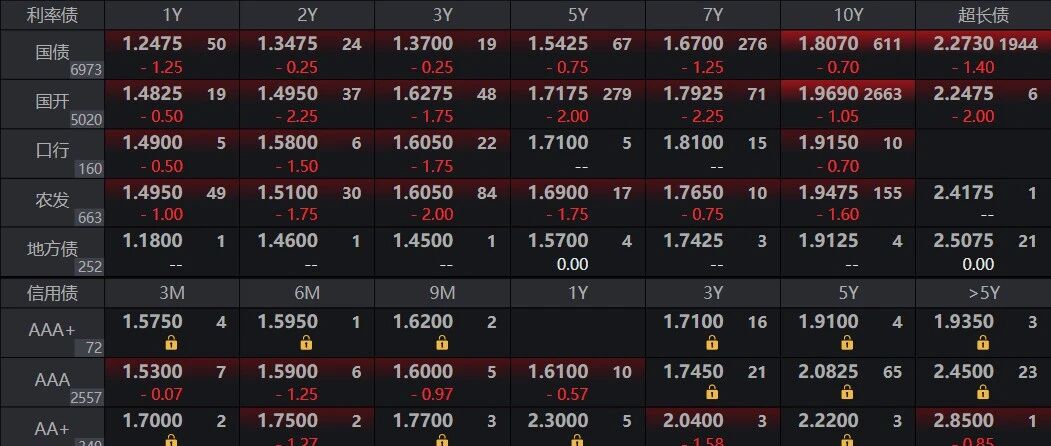
Core Viewpoint - The article emphasizes that the most challenging aspect of investing is not predicting the market but controlling one's emotions, highlighting that greed and fear are the biggest enemies of investors, while discipline and patience are the best tools [1]. Financial Market Overview - The interbank funding market is experiencing a balanced and slightly loose liquidity environment, with the central bank conducting a 245 billion yuan reverse repurchase operation, resulting in a net injection of 15 billion yuan after 230 billion yuan of reverse repos matured [3]. - The overnight funding rates have slightly decreased, with DR001 around 1.33% and DR007 around 1.47% [3]. - The stock market has seen a slight decline, influenced by ongoing geopolitical conflicts and news of a potential reduction in interbank deposit rates, which has led to some deposit rates hitting historical lows [5]. Bond Market Insights - The 10-year government bond yield opened at 1.814% and fluctuated, eventually settling at 1.807% [5]. - The bond market sentiment remained stable in the morning, with a slight decrease in yields following the news of lower deposit rates [5]. - Recent fundamental data has broken a year-long period of stagnation, with inflation data and high oil prices contributing to short-term inflation expectations remaining unproven [5]. Market Data Summary - The weighted rates for various repo codes are as follows: R001 at 1.40%, R007 at 1.51%, and R014 at 1.53%, with respective changes of -1 bp, 0 bp, and -1 bp [4]. - The trading volume for R001 was 77,204.47 million yuan, while R007 had a volume of 6,803.47 million yuan, indicating a decrease of 522.82 million yuan [4].
大类资产早报-20260311
Yong An Qi Huo· 2026-03-11 02:16
Report Industry Investment Rating - Not mentioned in the provided content Core Viewpoints - Not mentioned in the provided content Summary by Directory Global Asset Market Performance - **10 - year Treasury Bonds**: Latest yields for major economies include 4.158% in the US, 4.552% in the UK, 3.443% in France, 2.834% in Germany, 3.524% in Italy, 3.290% in Spain, 0.351% in Switzerland, 3.514% in Greece, 2.171% in Japan, 6.076% in Brazil, 1.817% in China, and 4.847% in Australia [1] - **2 - year Treasury Bonds**: Latest yields are 3.593% in the US, 3.860% in the UK, 2.248% in Germany, 1.245% in Japan, 2.426% in Italy, 1.271% in China (1Y yield), and 4.433% in Australia [1] - **Dollar - Emerging Economy Currency Exchange Rates**: Latest rates are 5.159 for the dollar against the Brazilian real, 16.291 against the South African rand, 1466.050 against the South Korean won, 31.615 against the Thai baht, and 3.924 against the Malaysian ringgit. The on - shore RMB is 6.869, the off - shore RMB is 6.879, the RMB central parity rate is 6.898, and the RMB 12 - month NDF is 6.748 [1] - **Major Economies' Stock Indices**: Latest values are 6781.480 for the S&P 500, 47706.510 for the Dow Jones Industrial Average, 22697.100 for the Nasdaq, 67397.940 for the Mexican index, 10412.240 for the UK index, 8057.360 for the French CAC, 23968.630 for the German DAX, 17445.000 for the Spanish index, 54248.390 for the Nikkei, 25959.900 for the Hang Seng Index, 4123.138 for the Shanghai Composite Index, 32771.870 for the Taiwan index, 5532.590 for the South Korean index, 7440.913 for the Indian index, 1405.760 for the Thai index, 1701.680 for the Malaysian index, 8924.227 for the Australian index, and 1504.330 for the emerging economies' index [1] - **Credit Bond Indices**: Latest values are 3561.750 for the US investment - grade credit bond index, 266.918 for the euro - zone investment - grade credit bond index, 290.890 for the emerging economies' investment - grade credit bond index, 2928.260 for the US high - yield credit bond index, 410.440 for the euro - zone high - yield credit bond index, and 1842.996 for the emerging economies' high - yield credit bond index [1] Stock Index Futures Trading Data - **Index Performance**: Closing prices are 4123.14 for A - shares, 4674.76 for the CSI 300, 2981.84 for the SSE 50, 3306.14 for the ChiNext, and 8410.30 for the CSI 500. The percentage changes are 0.65%, 1.28%, 0.64%, 3.04%, and 1.58% respectively [2] - **Valuation**: PE (TTM) values are 14.15 for the CSI 300, 11.48 for the SSE 50, 37.76 for the CSI 500, 26.51 for the S&P 500, and 17.90 for the German DAX. The环比 changes are 0.00, - 0.06, 0.58, - 0.06, and 0.33 respectively [2] - **Risk Premium**: The 1/PE - 10 - year interest rate is - 0.39 for the S&P 500 and 2.75 for the German DAX. The环比 changes are - 0.06 and - 0.09 respectively [2] - **Fund Flows**: The latest values are 349.57 for A - shares, 3.60 for the main board, 216.78 for the ChiNext, and 93.77 for the CSI 300. The 5 - day average values are - 119.52 for A - shares, - 182.70 for the main board, 44.93 for the ChiNext, and - 11.84 for the CSI 300 [2] Other Trading Data - **Transaction Amount**: The latest transaction amount for the Shanghai and Shenzhen stock markets is 23978.88, with a环比 change of - 2496.57. For the CSI 300, it is 1217.62 with a环比 change of - 495.95; for the SSE 50, it is 4641.20 with a环比 change of - 423.03; for the small - and medium - sized board, it is 6449.02 with a环比 change of - 52.77 [3] - **Main Contract Basis**: The basis for IF is - 10.76 with a basis amplitude of - 0.23%, for IH it is - 0.44 with a basis amplitude of - 0.01%, and for IC it is - 16.70 with a basis amplitude of - 0.20% [3] - **Treasury Bond Futures**: Closing prices are 108.34 for T2303, 105.93 for TF2303, 108.31 for T2306, and 105.98 for TF2306. The percentage changes are - 0.02%, - 0.04%, - 0.01%, and - 0.00% respectively [3] - **Funding Rates**: R001 is 1.3917% with a daily change of - 11.00 BP, R007 is 1.5029% with a daily change of 0.00 BP, and SHIBOR - 3M is 1.5492% with a daily change of 0.00 BP [3]
3月10日信用债异常成交跟踪
SINOLINK SECURITIES· 2026-03-10 15:20
Report Industry Investment Rating - Not provided in the given content Core Viewpoints - According to Wind data, among the bonds traded at a discount, "24 Chanrong 08" had a relatively large deviation in bond valuation price. Among the bonds with rising net prices, "H2 Vanke 04" had a relatively high degree of deviation in valuation price. Among the Tier 2 and perpetual bonds with rising net prices, "25 Chongqing Three Gorges Bank Perpetual Bond 01" had a relatively large deviation in valuation price; among the commercial financial bonds with rising net prices, "25 Xiamen International Bank Bond 02" had a relatively high degree of deviation in valuation price. Among the bonds with a trading yield higher than 5%, real estate bonds ranked high. The changes in credit bond valuation yields were mainly distributed in the [-5,0) range. The trading terms of non-financial credit bonds were mainly distributed between 2 and 3 years, with the 3 - 4 year term variety having the highest proportion of discounted trades; the trading terms of Tier 2 and perpetual bonds were mainly distributed between 4 and 5 years, with the variety with a term of less than 1 year having the highest proportion of discounted trades. By industry, the bonds in the commercial and retail industry had the largest average deviation in valuation price [3]. Summary by Relevant Catalogs 1. Discounted Bond Trading Tracking - Bonds such as "24 Chanrong 08", "24 Chanrong 06", "24 Chanrong 04" in the non - banking financial industry and "24 Puzhi 03", "26 Puzhi 01" in the urban investment industry had relatively large deviations in valuation price and were traded at a discount. The trading scale of "23 AVIC Chanrong MTN001 (Sci - tech Innovation Note)" was 64.08 million yuan, which was relatively large among the discounted bonds [5]. 2. Tracking of Bonds with Rising Net Prices - "H2 Vanke 04", "H2 Vanke 06", "H2 Vanke 02" in the real estate industry and "26 Runtou V1" in the commercial and retail industry had relatively large positive deviations in valuation price and rising net prices. The trading scale of "26 Runtou V1" was 362.83 million yuan, which was relatively large among the bonds with rising net prices [6]. 3. Tracking of Tier 2 and Perpetual Bond Trading - "25 Chongqing Three Gorges Bank Perpetual Bond 01", "25 Luzhou Bank Perpetual Bond", "25 Beibu Gulf Bank Perpetual Bond 01" and other Tier 2 and perpetual bonds had a certain degree of deviation in valuation price. The trading scale of "25 Zhonghang Secondary Capital Bond 03A(BC)" was 433.483 million yuan, which was relatively large among the Tier 2 and perpetual bonds [7]. 4. Tracking of Commercial Financial Bond Trading - "25 Xiamen International Bank Bond 02", "25 CITIC Bank Green Bond 01BC", "25 Zheshang Bank Green Bond 01BC" and other commercial financial bonds had a certain degree of deviation in valuation price. The trading scale of "24 Nanjing Bank 02" was 613.72 million yuan, which was relatively large among the commercial financial bonds [8]. 5. Tracking of Bonds with a Trading Yield Higher than 5% - Bonds such as "H2 Vanke 04", "H2 Vanke 06", "H2 Vanke 02" in the real estate industry and "24 Chanrong 05", "23 Chanrong 10" in the non - banking financial industry had a trading yield higher than 5%. The trading scale of "23 AVIC Chanrong MTN001 (Sci - tech Innovation Note)" was 64.08 million yuan, which was relatively large among the high - yield bonds [9]. 6. Distribution of Credit Bond Valuation Deviations - The changes in credit bond valuation yields were mainly distributed in the [-5,0) range [3]. 7. Distribution of Non - financial Credit Bond Trading Terms - The trading terms of non - financial credit bonds were mainly distributed between 2 and 3 years, with the 3 - 4 year term variety having the highest proportion of discounted trades [3]. 8. Distribution of Tier 2 and Perpetual Bond Trading Terms - The trading terms of Tier 2 and perpetual bonds were mainly distributed between 4 and 5 years, with the variety with a term of less than 1 year having the highest proportion of discounted trades [3]. 9. Discounted Trading Proportion and Trading Scale of Non - financial Credit Bonds by Industry - The bonds in the commercial and retail industry had the largest average deviation in valuation price [3].