
资本市场

Search documents
“十五五”规划建议全文发布 资本市场五年发展重点明确
Di Yi Cai Jing· 2025-10-28 10:59
Core Points - The "15th Five-Year Plan" emphasizes the establishment of a well-functioning capital market, focusing on enhancing inclusivity and adaptability of market systems, and promoting direct financing through equity and bonds [1] - The China Securities Regulatory Commission (CSRC) outlined four key areas for implementing the capital market reforms during the 2025 Financial Street Forum [1][3] Group 1: Capital Market Development - The plan aims to deepen sector reforms and enhance the inclusivity and coverage of the multi-tiered market system, with specific initiatives for the Sci-Tech Innovation Board and the Growth Enterprise Market [1][2] - The CSRC will implement reforms in the Growth Enterprise Market to better align listing standards with the characteristics of emerging industries and innovative enterprises [2] Group 2: Market Stability - High-quality listed companies are identified as the cornerstone for stable market operations, with plans to introduce a refinancing framework and broaden support channels for mergers and acquisitions [3] - The CSRC will encourage listed companies to improve governance and increase shareholder returns through dividends and buybacks, thereby solidifying their value foundation [3] Group 3: Opening Up the Market - The introduction of the optimized Qualified Foreign Institutional Investor (QFII) scheme aims to enhance investment efficiency and expand investment scope, with measures already implemented for efficient approval and access [4] - The CSRC plans to improve the mutual market access mechanisms and deepen cooperation between mainland and Hong Kong markets [4] Group 4: Risk Management and Investor Protection - The CSRC has released guidelines to strengthen the protection of small and medium investors, focusing on enhancing fairness in trading and improving service levels of industry institutions [5] - The first batch of newly registered companies on the Sci-Tech Innovation Board was listed, marking a significant step in the implementation of the "15th Five-Year Plan" [5]
中国证监会:完善资本市场涉外法治体系 营造良好涉外法治环境
Xin Hua Cai Jing· 2025-10-28 09:00
Core Viewpoint - Strengthening foreign-related legal construction is essential for advancing deep reforms and high-level opening-up, as well as for maintaining security and addressing external risks [1] Group 1: Legislative Initiatives - Emphasis on legislative primacy as a prerequisite for good governance, with a focus on enhancing the legal framework for capital markets, particularly in light of complex international changes [2] - The China Securities Regulatory Commission (CSRC) plans to advance foreign-related legislation systematically, prioritizing urgent needs and establishing a transparent and comprehensive legal system for capital markets [2] Group 2: Cross-Border Regulatory Cooperation - The rapid development of overseas financing and capital flows necessitates improved cross-border regulatory collaboration, ensuring that domestic regulatory bodies do not underperform or overreach [3] - The CSRC aims to strengthen communication and cooperation between domestic and foreign regulatory bodies, holding issuers and intermediaries accountable while maintaining a zero-tolerance policy for cross-border violations [3] Group 3: Judicial Support - The long-term stability and healthy development of capital markets rely on judicial support, with a focus on optimizing foreign-related trial mechanisms and enhancing the efficiency of foreign-related judicial work [4] - The recent decisions from the 20th Central Committee highlight the importance of foreign-related legal construction within the broader context of the socialist legal system with Chinese characteristics [4] Group 4: Current Regulatory Framework - The CSRC has established foundational regulations for overseas listings and cross-border transactions, creating a more transparent and predictable institutional environment for domestic enterprises [5] - As of now, the CSRC has signed cooperation memorandums with 67 countries and regions, enhancing collaboration with foreign enforcement agencies to facilitate overseas law enforcement [5]
证监会:将进一步研究完善资本市场的涉外立法工作
Sou Hu Cai Jing· 2025-10-28 04:25
Group 1 - The core viewpoint emphasizes the need for a better legal framework to support the high-level opening of the capital market, focusing on the role of law in guiding, regulating, and ensuring a favorable environment for foreign-related legal systems [1][2] - The China Securities Regulatory Commission (CSRC) plans to enhance foreign-related legislation in the capital market, prioritizing the establishment of a transparent and comprehensive legal system to support high-level foreign openness [1] - There is a call for deepening cross-border regulatory collaboration, addressing the challenges posed by rapid overseas financing and capital flow, and ensuring strict enforcement against cross-border illegal activities [1] Group 2 - The judicial system is highlighted as a crucial element in promoting high-level bilateral openness in the capital market, with an emphasis on optimizing foreign-related trial mechanisms and enhancing the efficiency of foreign-related judicial work [2] - The goal is to handle significant foreign-related cases that have substantial rule significance and international impact, thereby advancing the legal process [2]
证监会副主席李超:全面推进实施新一轮资本市场改革 健全投资和融资相协调的资本市场功能
Jing Ji Guan Cha Wang· 2025-10-28 04:20
Core Viewpoint - The China Securities Regulatory Commission (CSRC) is committed to advancing the "14th Five-Year" capital market plan, focusing on deepening reforms in the Sci-Tech Innovation Board and the Growth Enterprise Market to enhance the inclusiveness and adaptability of the capital market [1] Group 1 - The CSRC aims to comprehensively implement a new round of capital market reforms [1] - The reforms will focus on improving the coordination between investment and financing functions within the capital market [1] - The emphasis will be on enhancing the institutional framework to support the growth of innovative enterprises [1]
上海市常务副市长吴伟:全力配合科创板制度改革持续深化
Sou Hu Cai Jing· 2025-10-28 04:14
Core Viewpoint - The establishment of the Sci-Tech Innovation Board (STAR Market) and the pilot registration system is aimed at reforming the capital market and supporting technological self-reliance and strength [1] Group 1: Market Development - Over the past six years, the STAR Market has nurtured a large number of high-growth technology companies and has developed a series of replicable and promotable reform experiences [1] Group 2: Local Government Initiatives - Shanghai, as the birthplace and core hub of the STAR Market, is leveraging its collaboration mechanism with the China Securities Regulatory Commission to accelerate the construction of the "Five Centers" [1] - The city has launched an upgraded version of the "Pudong Light" initiative to enhance its advantages as a global innovation center and modern industrial system, continuously building bridges for "hard technology" companies to connect with the capital market [1]
证监会副主席李超:抓紧研究谋划“十五五”资本市场战略任务和重大举措
Zhong Guo Jing Ying Bao· 2025-10-28 03:30
Core Viewpoint - The China Securities Regulatory Commission (CSRC) aims to deepen the comprehensive reform of the capital market, enhancing its inclusiveness, adaptability, attractiveness, and competitiveness to better serve the 14th Five-Year Plan and the construction of a financial power [1] Group 1: Capital Market Reform - The CSRC will implement a new round of capital market reform and opening-up, focusing on risk prevention, strong regulation, and promoting high-quality development [1] - The CSRC is committed to following the path of financial development with Chinese characteristics [1] Group 2: Science and Technology Innovation Board - The first batch of newly registered companies on the Science and Technology Innovation Board (STAR Market) has been listed, marking a significant step in the capital market's support for technological innovation and new productive forces [1] - The CSRC encourages STAR Market companies to fully utilize reform policies, improve corporate governance, and enhance development quality and investor returns [1] Group 3: Industry and Institutional Support - Industry institutions are urged to enhance their professional capabilities and service quality to better support real enterprises and investors [1] - The Shanghai Stock Exchange is expected to maintain its focus on hard technology positioning for the STAR Market, strengthen regulation, and optimize services [1]
证监会李超最新发声:全面推进实施新一轮资本市场改革
Shang Hai Zheng Quan Bao· 2025-10-28 03:11
Group 1 - The core viewpoint is that the launch of the first batch of newly registered companies on the Sci-Tech Innovation Board marks a significant step in the capital market's support for technological innovation and the development of new productive forces [1] - Since the establishment of the Sci-Tech Innovation Board in November 2018, the China Securities Regulatory Commission (CSRC) has worked with market participants to develop the board from inception to a stable and growing market, enhancing its functions and brand effects [1] - The CSRC has introduced major policy measures such as the "Eight Articles for the Sci-Tech Innovation Board" and "Six Articles for Mergers and Acquisitions" to support high-tech enterprises in fields like integrated circuits and biomedicine [1] Group 2 - The CSRC aims to implement the major deployments from the 20th National Congress of the Communist Party, focusing on risk prevention, strong regulation, and promoting high-quality development in the capital market [2] - The strategy for the 14th Five-Year Plan period will emphasize deepening comprehensive reforms in capital market investment and financing, enhancing the inclusiveness, adaptability, attractiveness, and competitiveness of China's capital market [2]


证监会副主席李超:抓紧研究谋划“十五五”时期资本市场战略任务和重大举措
证券时报· 2025-10-28 02:28
Group 1 - The core viewpoint emphasizes the need for the China Securities Regulatory Commission (CSRC) to promptly research and plan the strategic tasks and major initiatives for the capital market during the 14th Five-Year Plan period, focusing on risk prevention, strong regulation, and promoting high-quality development [1] - The CSRC encourages companies listed on the Sci-Tech Innovation Board to fully utilize reform policies, improve corporate governance, and enhance development quality and investor returns [2] - The implementation of the "1+6" reform on the Sci-Tech Innovation Board has progressed smoothly, with the establishment of the Sci-Tech Innovation Board's growth tier and the introduction of experienced professional institutional investors [3] Group 2 - The reform of the Sci-Tech Innovation Board is increasingly demonstrating its role as a "testing ground," leading to continuous improvement of the foundational systems across the entire market and effectively supporting high-tech enterprises in fields such as integrated circuits and biomedicine [4]

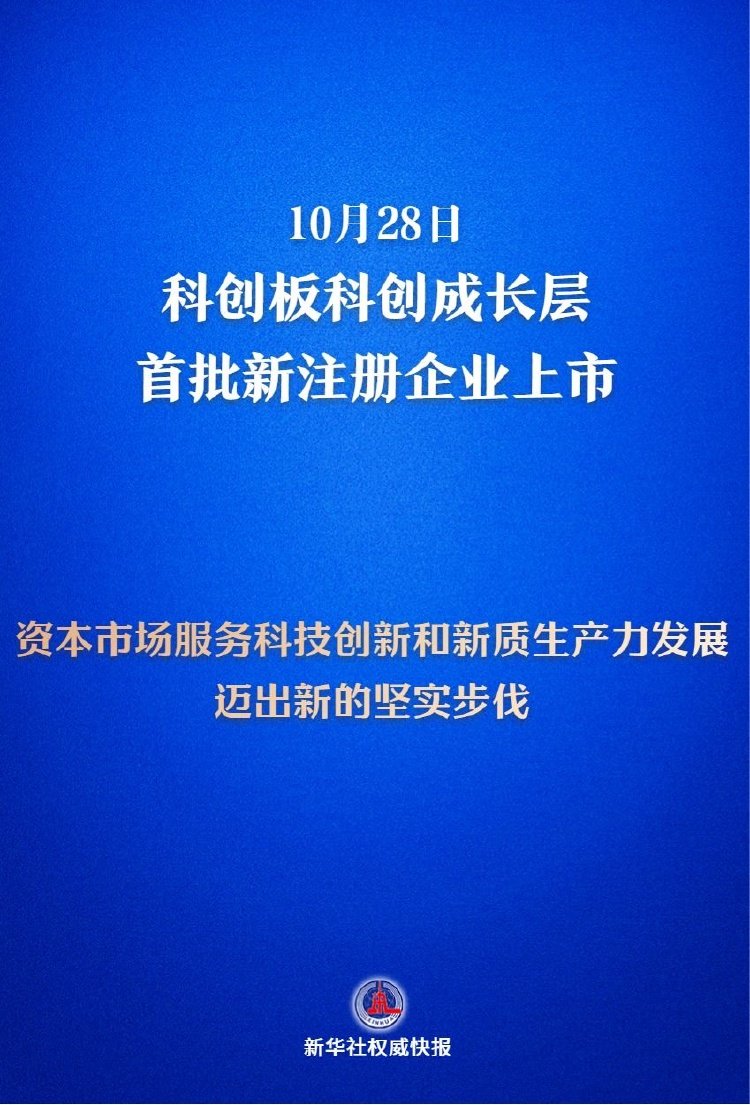
科创板科创成长层首批新注册企业上市
Xin Hua She· 2025-10-28 01:40
Group 1 - The first batch of newly registered companies on the Sci-Tech Innovation Board's growth tier was listed on October 28 [1][4] - The Vice Chairman of the China Securities Regulatory Commission, Li Chao, stated that this marks a significant step forward in the capital market's support for technological innovation and the development of new productive forces [4] - The "1+6" reform implemented in June this year has progressed smoothly, with the establishment of the growth tier and the introduction of experienced professional institutional investors and pre-review systems being piloted effectively [4]
吴清系统阐述四大关键举措 资本市场下一步改革路线图明晰
2 1 Shi Ji Jing Ji Bao Dao· 2025-10-27 23:13
Core Viewpoint - The 2025 Financial Street Forum emphasizes the deepening reform of China's capital market, focusing on four key measures to drive high-quality development through comprehensive investment and financing reforms, signaling a commitment to institutional openness and enhanced investor protection [1][2]. Group 1: Capital Market Reforms - The China Securities Regulatory Commission (CSRC) has introduced two significant documents aimed at optimizing the Qualified Foreign Institutional Investor (QFII) system and enhancing protections for small and medium investors [1][6]. - The upcoming reforms include the launch of the Growth Enterprise Market (GEM) and improvements to the Beijing Stock Exchange (BSE), with the first batch of new registered companies set to list on October 28 [1][2]. - The reforms aim to create a modern capital market system that supports the entire lifecycle of enterprises and aligns with the national innovation-driven strategy [3]. Group 2: Multi-Layered Market System - The CSRC plans to deepen the reform of various market segments to enhance the inclusiveness and adaptability of the multi-layered market system for different types of enterprises [2]. - The Sci-Tech Innovation Board (STAR Market) has shown significant progress, with the introduction of the "1+6" policy and the listing of new registered companies, marking a breakthrough in supporting early-stage technology firms [2][4]. - The BSE will also focus on high-quality development and improve its listing standards to better serve innovative and emerging industries [2]. Group 3: Foreign Investment Environment - The newly launched QFII optimization plan aims to create a more transparent, convenient, and efficient environment for foreign investors, addressing long-standing concerns [5][6]. - Key measures include streamlining the approval and account opening processes for foreign institutional investors, which will shorten the market entry cycle and reduce operational costs [6][7]. - The plan also includes enhancements to short-term trading rules and allows domestic institutions to provide investment advisory services to foreign investors, fostering a more interactive and competitive environment [6][7]. Group 4: Investor Protection Measures - The CSRC has introduced 23 practical measures to strengthen the protection of small and medium investors, focusing on enhancing the quality and effectiveness of investor rights protection [7][8]. - The measures include stricter regulations against financial fraud and market manipulation, aiming to boost investor confidence [7][8]. - A multi-faceted dispute resolution mechanism has been emphasized, showcasing innovative approaches to collective investor rights protection [9].