
建材

Search documents
ETF日报:建材ETF的投资标的包含水泥、玻璃、陶瓷、新型建材等领域的上市公司
Xin Lang Cai Jing· 2026-01-20 11:44
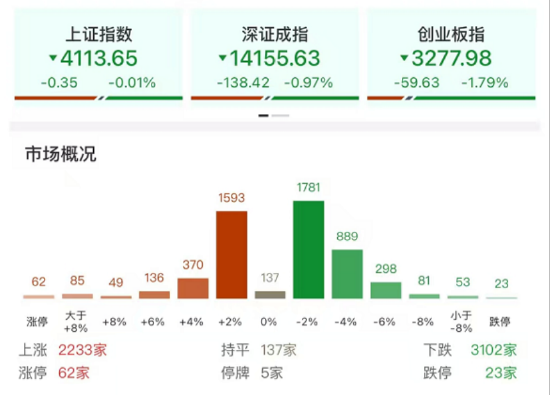
Market Overview - The three major indices collectively declined, with the ChiNext Index dropping over 2% at one point. The Shanghai Composite Index fell by 0.01%, the Shenzhen Component Index by 0.97%, and the ChiNext Index by 1.79% [1][14] - The total trading volume in the Shanghai and Shenzhen markets reached 2.78 trillion yuan, an increase of 69.4 billion yuan compared to the previous trading day [1][14] Gold Market - Gold-related ETFs saw gains, with the Gold Stock ETF rising by 2.45% and the Gold Fund ETF by 0.72%. The spot price of gold in London surpassed $4,700 per ounce, driven by geopolitical tensions [6][19] - The ongoing liquidity easing and de-dollarization trends are expected to provide stable support for gold prices. A recent report indicated that global central bank gold reserves have surpassed U.S. Treasury holdings for the first time since 1996 [7][20] Real Estate and Building Materials - The building materials sector performed well, with the Building Materials ETF increasing by 3.88%. The second-hand housing market is showing signs of recovery, with significant week-on-week increases in transaction prices in key cities [8][22] - Policies aimed at stabilizing the real estate market, such as lowering loan rates and adjusting down payment ratios, are expected to support the building materials sector. The total transaction volume for new and second-hand homes is projected to remain strong at 1.2 to 1.3 billion square meters [8][22] Communication Sector - The communication sector experienced a pullback, with the Communication ETF declining by 3.14%. This was attributed to recent fund outflows and disappointing earnings forecasts from some companies [10][23] - Looking ahead, demand for optical modules is expected to surge, driven by major tech companies. The supply side is anticipated to face shortages, particularly in laser components, which could enhance profitability in the sector [12][24][25]

兴业证券:A股业绩预告即将进入披露高峰 关注哪些方向?
智通财经网· 2026-01-20 10:56
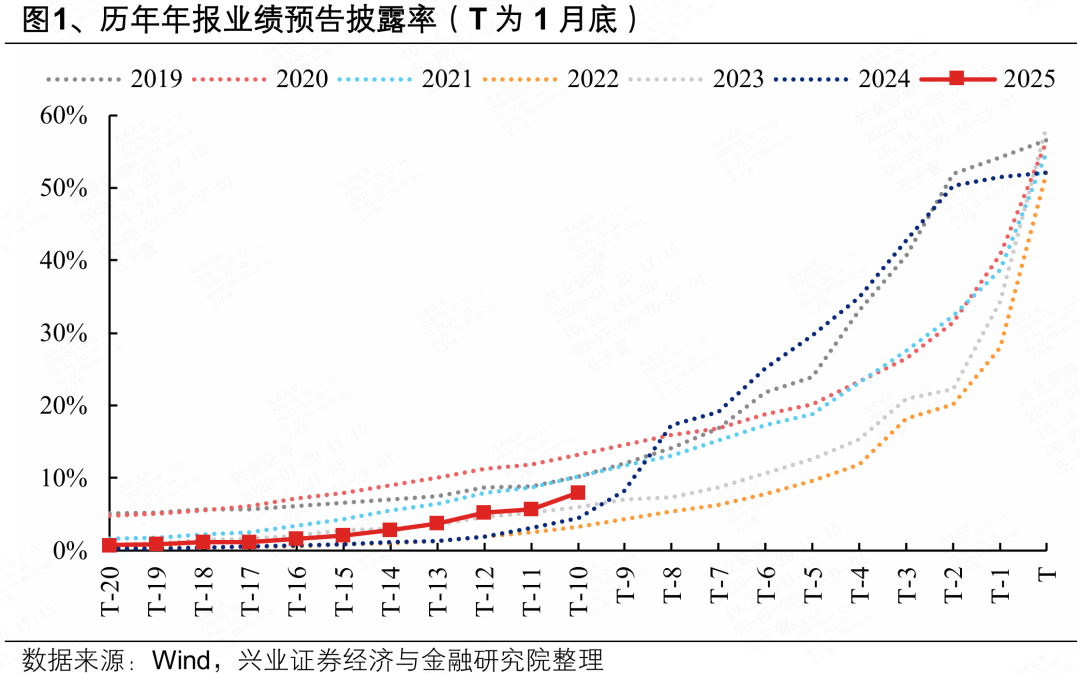
Core Viewpoint - As of January 19, the disclosure rate of annual performance forecasts for A-shares is 7.98%, with a peak expected in late January, where the final disclosure rate may reach around 55% [2][5]. Group 1: Performance Forecasts - The performance forecasts indicate that companies with significant net profit growth are primarily in sectors such as computing power, new energy, chemicals, pharmaceuticals, non-ferrous metals, and computers [6][10]. - By January 19, 447 A-share companies have released annual performance forecasts, with 144 companies expecting net profit growth exceeding 50%, mainly in computing power (semiconductors, communication equipment), new energy (batteries, photovoltaics), and chemicals [6][10]. Group 2: Market Reactions - As the performance forecasts enter their peak disclosure period, the correlation between stock prices and performance is expected to increase significantly in the latter half of January, with market sentiment returning to rationality [5]. - The market is likely to undergo a structural adjustment based on fundamentals, with previous hot sectors facing performance validation, while some low-performing but high-quality sectors may attract new capital inflows [5]. Group 3: Industry Insights - The sectors with upward revisions in profit forecasts since November include technology (especially in upstream computing hardware and downstream applications like consumer electronics and software), advanced manufacturing (new energy, military, automotive), and cyclical industries (building materials, non-ferrous metals, coal, steel) [12][13]. - The industries with lower performance growth since the last market rally include AI computing power, new energy, pharmaceuticals, and cyclical sectors like steel and glass fiber [14].

循“碳”渐进:转型金融校准高碳行业减排路径
Xin Lang Cai Jing· 2026-01-20 10:39
Group 1 - The article emphasizes the urgent need for high-carbon industries to transition towards low-carbon practices due to increasing climate risks and regulatory pressures, particularly in light of global agreements like the Paris Accord and China's carbon neutrality goals [1][2] - High-carbon industries are significant contributors to greenhouse gas emissions and face mounting compliance and cost pressures in international markets, necessitating technological upgrades and process improvements to enhance competitiveness [2][3] - The transition is capital-intensive, with projected funding needs of approximately 25.2 trillion yuan (around 3.5 trillion USD) from 2024 to 2030 and about 243 trillion yuan (around 34 trillion USD) from 2031 to 2060, highlighting the financial challenges these industries face [3] Group 2 - Transition finance is proposed as a crucial complement to green finance, aimed at supporting high-carbon industries that are committed to transitioning, thereby facilitating a gradual and orderly shift towards lower emissions [4][5] - The calibration mechanism of transition finance is essential to prevent greenwashing and ensure that genuine transition efforts are not excluded from financing opportunities, emphasizing the need for clear boundaries and measurable goals [5] - China's central bank is initiating research on transition finance to create a framework that aligns domestic practices with international standards, focusing on quantifiable standards, innovative financial products, and enhanced information disclosure [6][7] Group 3 - Jiangsu province is piloting a "1+N+N" transition finance support system, which includes evaluation standards for financing entities and a directory of supported economic activities, aimed at facilitating the green transition of traditional high-carbon industries [7] - The system involves dynamic management and regular verification of carbon emissions and reduction performance, ensuring that financial resources are effectively allocated to projects that meet established criteria [7] - The article concludes that a systematic approach involving policy, market, and technology collaboration is necessary for the successful transition of high-carbon industries, with a focus on creating verifiable progress in emissions reduction [8]
两头堵 | 谈股论金
水皮More· 2026-01-20 08:49
Market Overview - The A-share market showed a mixed performance today, with the Shanghai Composite Index slightly down by 0.01% closing at 4113.65 points, while the Shenzhen Component Index fell by 0.97% to 14155.63 points, and the ChiNext Index dropped by 1.79% to 3277.98 points [2][6] - The total trading volume in the Shanghai, Shenzhen, and Beijing markets reached 280.44 billion, an increase of 72 billion compared to the previous day [2] Market Dynamics - The market is experiencing a cooling trend, which can occur through either active or passive means. Currently, the market is responding rationally to regulatory signals, with state-owned entities playing a significant role in guiding market trends [4] - The broad-based ETFs, particularly the CSI 1000 ETF, have taken a leading role in market movements, indicating a shift in investment focus towards low-valuation sectors [4] Sector Performance - Significant outflows were observed in sectors such as CPU-related stocks, with NewEase ranked first in capital outflow. The photovoltaic sector also saw over 7 billion in outflows, affecting major stocks like Longi Green Energy and Tongwei Co. [5] - In contrast, sectors related to real estate, such as building materials and construction, showed relative stability, suggesting a migration of funds towards undervalued sectors [5] Regulatory Impact - The current regulatory approach aims to suppress excessive speculation in individual stocks by allowing indices to adjust moderately, which is intended to maintain a stable market environment leading up to the Spring Festival [6] - The overall market sentiment reflects a clear cooling trend, with a net outflow of nearly 100 billion in major funds, indicating the core objective of regulatory measures [6]

股评两头堵 | 谈股论金
Xin Lang Cai Jing· 2026-01-20 08:39
Group 1 - The market is experiencing a cooling trend, which can occur through either active or passive means, with the current situation reflecting a relatively rational market response to regulatory signals [1] - The China Securities 1000 ETF played a leading role in the market today, influencing the overall market trend alongside other major ETFs [1] - Structural differences in the market are notable, with major state-owned enterprises and financial stocks maintaining positive performance, while broad-based ETFs exerted downward pressure on speculative stocks [1] Group 2 - Significant capital outflows were observed in sectors such as CPU-related stocks and the photovoltaic sector, with over 7 billion yuan flowing out of the latter [2] - In contrast, sectors related to real estate, such as building materials and construction, showed relative stability, indicating a shift of funds towards undervalued sectors [2] - The regulatory goal is to suppress excessive speculation in individual stocks by gradually adjusting major indices to influence market sentiment [2] Group 3 - The market indices showed a clear cooling trend, with the Shanghai Composite Index down 0.01%, the Shenzhen Component down 0.97%, and the ChiNext Index down 1.79% [3] - The total trading volume reached 2.77 trillion yuan, with a net outflow of nearly 100 billion yuan, reflecting the core objective of regulatory cooling [3] - The current adjustment aims to maintain a stable market outlook before the Spring Festival while avoiding excessive market bubbles [3]
——金属周期品高频数据周报(2026.1.12-2026.1.18):M1 M2增速差已连续三个月回落-20260120
EBSCN· 2026-01-20 07:47
Investment Rating - The report maintains an "Accumulate" rating for the steel and non-ferrous metals sector [5] Core Insights - The M1 and M2 growth rate difference has been declining for three consecutive months, reaching -4.7 percentage points in December 2025, indicating a tightening liquidity environment [10][18] - The average daily crude steel production of key steel enterprises in early January has rebounded to levels close to mid-October 2025 [21][42] - The report highlights that the prices of titanium dioxide and glass are at low levels, with titanium dioxide priced at 13,200 CNY/ton and glass at 1,124 CNY/ton [79] Summary by Sections Liquidity - The M1 and M2 growth rate difference is -4.7 percentage points as of December 2025, a decrease of 1.60 percentage points month-on-month [10][18] - The BCI small and medium enterprise financing environment index was 47.15 in December 2025, down 10.19% from the previous month [10][18] - The current price of London gold is 4,599 USD/ounce, reflecting a 2.00% increase [10] Infrastructure and Real Estate Chain - The average daily crude steel production for key steel companies in early January is approximately 1.903 million tons, a 21.55% increase compared to the previous month [42] - The national high furnace capacity utilization rate is 85.48%, down 0.56 percentage points [42] - The price changes for various materials include rebar up 1.22%, cement price index down 0.94%, and rubber down 1.26% [21] Industrial Chain - The operating rate of semi-steel tires is at 73.44%, an increase of 7.55 percentage points [2] - Copper spot prices have reached a historical high, while tungsten concentrate prices have also hit a new high since 2012 [2] - The price of electrolytic aluminum is 24,000 CNY/ton, with a profit margin of 6,787 CNY/ton [2] Price Relationships - The price ratio of London spot gold to silver has reached a new low since 2013 [3] - The price difference between rebar and iron ore is currently 3.99 [3] - The price difference between small rebar (used in real estate) and large rebar (used in infrastructure) is 200 CNY/ton, a 31.03% decrease from the previous week [3] Export Chain - The new export orders PMI for China in December was 49.00%, an increase of 1.4 percentage points [3] - The CCFI composite index for container shipping rates is 1,209.85 points, up 1.25% [3] - The capacity utilization rate for U.S. crude steel is 75.70%, an increase of 1.30 percentage points [3] Valuation Percentiles - The CSI 300 index decreased by 0.57%, while the industrial metals sector performed best with a 2.81% increase [4] - The PB ratio of the steel sector relative to the CSI 300 is currently at 0.50, with a historical high of 0.82 [4] - The report suggests that the supply of steel may be reasonably constrained, leading to a potential recovery in sector profitability to historical average levels [4]
中国明确三个阶段梯度培养零碳工厂
Chang Jiang Shang Bao· 2026-01-20 06:47
Core Viewpoint - The construction of zero-carbon factories is receiving policy support, aimed at enhancing energy efficiency and promoting green low-carbon transformation in key industries [1][2]. Group 1: Policy Guidance - The Ministry of Industry and Information Technology and four other departments issued the "Guiding Opinions on Zero-Carbon Factory Construction," focusing on energy-saving and carbon reduction potential in the industrial sector [1]. - The guidance outlines a three-phase approach to cultivate zero-carbon factories, prioritizing industries with urgent decarbonization needs and lower difficulty in achieving carbon reduction [2]. Group 2: Goals and Timeline - By 2026, a selection of zero-carbon factories will be established as benchmarks, with a focus on sectors such as automotive, lithium batteries, photovoltaics, electronics, light industry, machinery, and computing facilities [2]. - By 2030, the initiative will expand to include high-energy-consuming industries like steel, non-ferrous metals, petrochemicals, building materials, and textiles, exploring new decarbonization pathways [2]. Group 3: Construction Pathways - The construction of zero-carbon factories involves improving carbon emission accounting, transitioning to green energy structures, enhancing energy efficiency, analyzing carbon footprints, and increasing digital intelligence for carbon control [3]. - The Ministry emphasizes that building zero-carbon factories is a complex and systematic project, requiring unified evaluation standards and verification of key technologies [3]. Group 4: Implementation Support - The Ministry will coordinate with relevant departments to implement the guiding opinions, ensuring high-quality advancement of zero-carbon factory construction and supporting industrial green low-carbon transformation [3].
基建需求回暖,带动建材板块集体走强,建材ETF(516750)盘中涨超3%
Mei Ri Jing Ji Xin Wen· 2026-01-20 06:26
Group 1 - The core viewpoint of the article highlights the recovery in the construction materials sector driven by increased infrastructure investment and the issuance of local special bonds, leading to a positive sentiment in the market [1] Group 2 - Since the beginning of 2026, the construction materials sector has shown signs of improvement, with the construction materials ETF (516750) rising over 3% during trading on January 20, 2026, and nearly 80% of the stocks in the sector experiencing gains [1] - Research institutions indicate that the construction materials sector benefits from both policy support and marginal demand improvement, with infrastructure investment providing support for traditional materials like cement and waterproofing materials [1] - The supply-side constraints in the industry remain, allowing for potential price and profit recovery, which has attracted increased attention from funds towards cyclical sectors amid low valuation [1] - The construction materials ETF (516750) covers various sub-sectors including cement, waterproofing, glass, and pipes, focusing on leading companies in the industry, providing investors with a convenient tool to capitalize on the recovery in the construction chain [1]
亏损16-23亿元!这家上市公司建材、地产业务全亏损!
Sou Hu Cai Jing· 2026-01-20 03:58
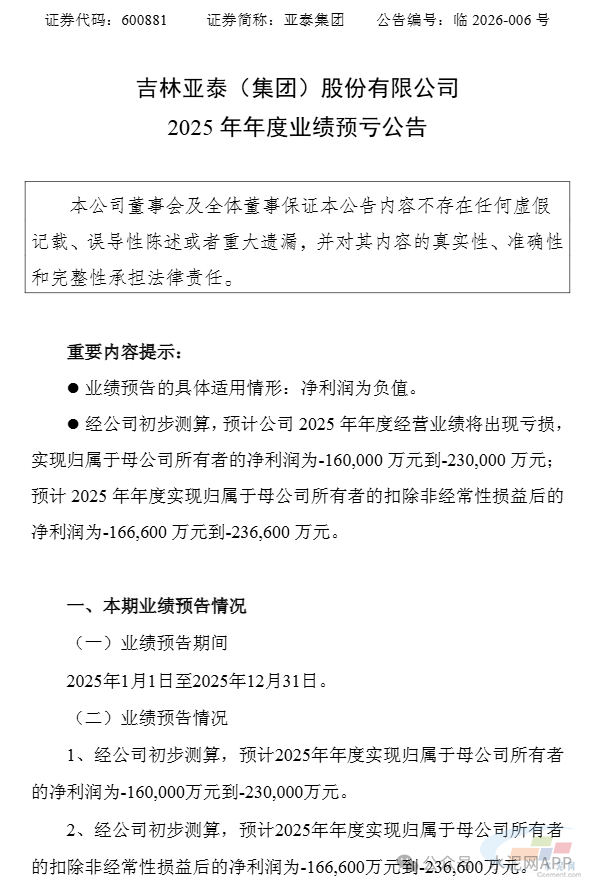
Core Viewpoint - The company, Yatai Group, anticipates a net loss for the fiscal year 2025, with projected losses narrowing compared to the previous year [1][4]. Group 1: Financial Performance - The estimated net profit attributable to the parent company for 2025 is projected to be between -1.6 billion and -2.3 billion yuan, compared to a net profit of -2.918 billion yuan in 2024, indicating a year-on-year improvement of 21.18% to 45.17% [1][4][6]. - The estimated net profit attributable to the parent company, excluding non-recurring gains and losses, is expected to be between -1.666 billion and -2.366 billion yuan [1][4][6]. Group 2: Reasons for Performance - The primary reasons for the anticipated losses include a recovery in prices for cement and clinker, which led to a reduction in losses for the building materials sector, but insufficient market demand continues to keep the company in a loss position [1]. - The real estate sector is facing challenges due to pressure on both volume and price in the commodity housing market, prompting the company to adjust its sales strategy and increase efforts to reduce inventory, resulting in lower gross margins on project transfers [1]. Group 3: Business Overview - The building materials segment possesses unique resource advantages and scale, with limestone reserves of 3 billion tons, aggregate resources of 220 million cubic meters, and production capacities of 50 million tons per year for clinker and cement, 5 million cubic meters per year for concrete, and 500,000 cubic meters per year for prefabricated components and bridges [1].

1Q26均衡布局新兴成长与传统红利
HTSC· 2026-01-20 02:45
Investment Rating - The report maintains an "Overweight" rating for the construction and building materials sectors [6]. Core Insights - The report highlights a focus on balancing investments in emerging growth sectors and traditional dividend-paying sectors, anticipating a recovery in investment in early 2026, particularly in infrastructure and real estate [1]. - It emphasizes the potential for a spring rally in the market, driven by supportive real estate policies and opportunities in technology and overseas markets, particularly in AI applications and related materials [1]. - The report suggests that the construction and building materials sectors are under pressure, with significant declines in real estate sales and new construction, but sees potential in segments like building coatings and pipe materials due to a shift towards renovation in the existing housing market [2]. Summary by Sections Infrastructure and Real Estate Investment - In 2025, cumulative year-on-year investment in infrastructure (excluding power, heat, gas, and water supply) decreased by 2.2%, real estate by 17.2%, and manufacturing by 0.6% [1]. - The report notes a continued decline in real estate transactions, with a year-on-year decrease of 8.7% in sales area and a 20.4% drop in new construction area [2]. Cement Industry - The cement production in 2025 was 1.693 billion tons, down 6.9% year-on-year, with an average price of 360 RMB per ton in December, reflecting a 15.6% decrease year-on-year [3]. - The report indicates that the pressure on costs is easing due to increased efforts in staggered kiln shutdowns, leading to a slowdown in price declines [3]. Glass Industry - The flat glass production in 2025 was 976 million weight cases, down 3.0% year-on-year, with a significant price drop of 20.9% year-on-year [4]. - The report notes an acceleration in cold repairs in the glass industry, which is expected to stabilize prices [4]. Stock Recommendations - The report recommends several stocks with "Buy" ratings, including: - Yaxiang Integration (603929 CH) with a target price of 235.62 RMB - China National Materials (600970 CH) with a target price of 14.64 RMB - Sichuan Road and Bridge (600039 CH) with a target price of 13.48 RMB - Precision Steel Structure (600496 CH) with a target price of 5.75 RMB - Oriental Yuhong (002271 CH) with a target price of 17.19 RMB - Kaisheng Technology (600552 CH) with a target price of 16.94 RMB - China Jushi (600176 CH) with a target price of 20.80 RMB - Huaxin Cement (600801 CH) with a target price of 26.70 RMB - China Nuclear Engineering (601611 CH) with a target price of 18.21 RMB [8][29].


