企业软件

Search documents
996 工作制席卷硅谷!招聘启事惊现“加班警告”:接受就是年薪翻倍+股权暴增,不接受就滚蛋
AI前线· 2025-07-25 12:40
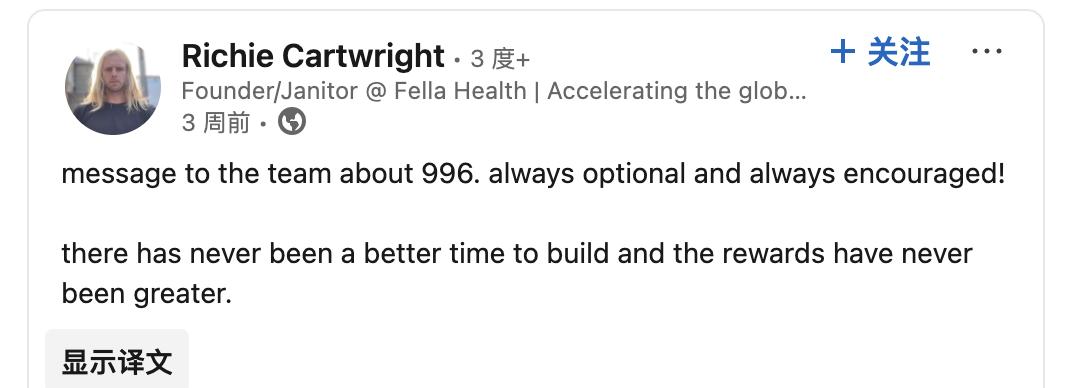
Core Viewpoint - The 996 work culture, characterized by working six days a week from 9 AM to 9 PM, is increasingly being adopted by startups in the AI sector in the West, despite its controversial reputation as a form of modern slavery [1][3][15]. Group 1: Adoption of 996 Work Culture - The number of U.S. startups explicitly requiring employees to adhere to the 996 work schedule has at least doubled in the past year, particularly in fast-evolving fields like AI and enterprise software [3][9]. - This shift contrasts sharply with the pre-pandemic focus on work-life balance and combating burnout, as companies now prioritize speed and high-intensity work [3][4]. Group 2: Case Studies of Startups - Rilla, an AI startup, achieved revenue growth from $0 to $40 million in three and a half years, with a net revenue retention rate exceeding 170%, by maintaining a work culture where employees often work over 70 hours a week [6][7]. - Rilla's hiring practices openly state the expectation of long hours, warning potential candidates that those who prioritize work-life balance need not apply [8][9]. Group 3: Perspectives from Founders and Investors - Founders like Amrita Bhasin of Sotira acknowledge the necessity of high-intensity work for startup founders but argue that imposing such demands on all employees is neither fair nor sustainable [9][10]. - Ritchie Cartwright of Fella & Delilah is experimenting with a "tiered approach" to work intensity, offering significant compensation increases for those willing to adopt a 996 schedule, indicating a trend towards incentivizing high-intensity work rather than mandating it [10][14]. Group 4: Cultural and Legal Implications - The debate around 996 has intensified, with some investors suggesting that even more extreme work schedules may be necessary to achieve significant business growth, highlighting a cultural divide between American and European attitudes towards work [15][16]. - Legal risks are emerging as many startups adopting 996 fail to properly classify employees under U.S. labor laws, potentially exposing themselves to significant liabilities [16]. Group 5: Public Reactions and Criticism - Public sentiment reflects skepticism towards the 996 culture, with many arguing that productivity should not be equated with long hours, and that smarter work practices can yield better results [18][20]. - European entrepreneurs express strong resistance to the 996 model, emphasizing that successful companies thrive on sustainable innovation rather than excessive work hours [19][20].


996 工作制席卷硅谷,招聘启事惊现“加班警告”:接受就是年薪翻倍+股权暴增,不接受就滚蛋
3 6 Ke· 2025-07-25 07:49
Group 1 - The "996" work schedule, which entails working six days a week from 9 AM to 9 PM, is becoming a standard requirement in AI startups, particularly in the U.S. and Europe, as competition intensifies in the industry [1][2][3] - The number of U.S. startups mandating a "996" work schedule has reportedly doubled in the past year, with a significant concentration in AI and enterprise software sectors [2] - This shift contrasts sharply with the work culture discussions during the early COVID-19 pandemic, which focused on combating burnout and promoting work-life balance [2] Group 2 - Rilla, an AI startup, has achieved rapid growth, reaching $40 million in revenue within three and a half years, with a net revenue retention rate exceeding 170% [4][5] - Rilla's team works an average of over 70 hours per week, with no fixed end time for the workday, emphasizing a culture of high intensity and rapid feedback loops [5][6] - The company actively seeks employees who are willing to embrace this demanding work culture, explicitly stating the expectations in job postings [6][7] Group 3 - Many startups are adopting the "996" model as a means to filter candidates who are genuinely committed to success, believing that short-term intense effort can lead to exponential growth [7] - Some founders, like Amrita Bhasin of Sotira, acknowledge the necessity of high intensity in the early years of a startup but do not impose the same expectations on their teams [7][8] - Fella & Delilah is experimenting with a tiered approach, offering significant compensation increases for employees who opt into a "996" work schedule [8][9] Group 4 - The debate around the "996" work culture has intensified, with some investors suggesting that even more extreme work hours may be necessary for significant success [14] - There is a notable cultural divide, with American employees showing more acceptance of "996" compared to their European counterparts, who often resist such demands [14][18] - Critics argue that the push for longer hours can lead to burnout and high turnover rates, as seen in companies like Revolut, which faced challenges partly due to its intense work culture [16][18]
抱着“不做就会死”的决心,才能真正做好全球化 | 42章经
42章经· 2025-06-15 13:57
Core Viewpoint - The article emphasizes the importance of a mindset shift for founders when entering overseas markets, treating globalization as a critical strategy rather than a secondary option [2][4]. Group 1: Globalization Strategy - Founders must view overseas expansion as a "do or die" situation to succeed in global markets [2][4]. - The distinction between "going overseas" and "globalization" is significant; the former lacks focus and direction [6][8]. - Initial focus should be on specific regions that can drive value to other markets, with Southeast Asia and Japan identified as initial targets [9][10]. Group 2: Market Insights - Success in the U.S. market can provide credibility in other regions, as American clients value proven case studies [12]. - The U.S. market has a higher ceiling for revenue potential compared to other regions [13]. - Japan's market is predictable, but the pace of business is slower, requiring patience and understanding of local practices [15][17]. Group 3: Operational Challenges - A "business trip mentality" is insufficient for establishing long-term relationships in overseas markets; physical presence is crucial [19]. - Local hiring is essential for roles that require deep market understanding, while some technical roles can be filled by domestic teams initially [21][23]. - Language barriers are minimal compared to the challenge of starting from scratch in a new market [23]. Group 4: Competitive Advantages - Chinese teams possess unique advantages in technology, supply chain, and service responsiveness, which can be leveraged in the U.S. market [24][27]. - Focusing on customer success rather than just product performance is vital for building strong client relationships [36]. Group 5: Commercialization Strategies - Selecting clients carefully is crucial; targeting large enterprises can yield higher lifetime value (LTV) [39][42]. - Understanding and defining what constitutes a "big client" is essential for strategic growth [41][44]. - The importance of storytelling and marketing should not overshadow product development and customer engagement [47][48]. Group 6: Organizational Culture - Establishing an English-speaking work environment and using international tools are key milestones for assessing a team's readiness for globalization [49]. - A commitment to global expansion should be unwavering, even if domestic revenue is present [50][51].

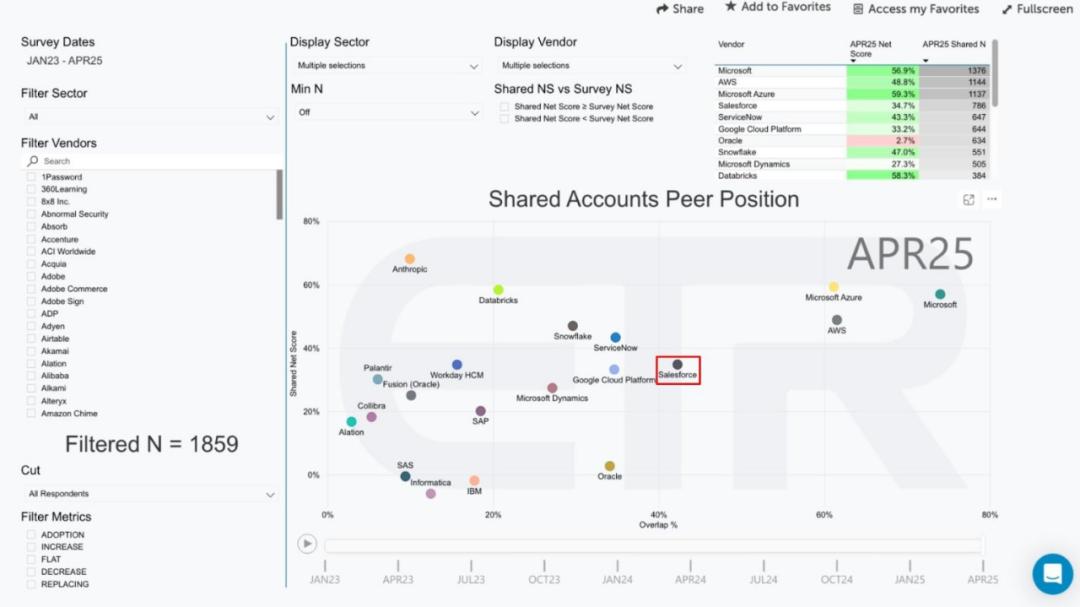
SaaS 的下一站是 Agentforce ?Salesforce 押注 AI 工作流革命
3 6 Ke· 2025-05-23 02:28
Group 1 - Marc Benioff, CEO of Salesforce, envisions a transformative era for enterprise software driven by AI agents and unified data architecture, transitioning from Software as a Service (SaaS) to Service as Software [1][2] - The "digital workforce" revolution is expected to be more disruptive than the cloud and mobile waves of 15 years ago, fundamentally redefining application functionalities [2] - Salesforce's Agentforce and Data Cloud strategies are central to its agentic vision, positioning the company as a potential "pure software hyperscaler" [2] Group 2 - Agentforce is a new AI-driven enterprise agent platform that integrates autonomous or semi-autonomous software assistants into all Salesforce applications, aiming to enhance human productivity [3][4] - Benioff claims that embedding these agents into workflows could lead to a 50% productivity increase across departments, a significant rise from a previously stated 30% [4] - Early customer deployments, such as Disney's use of AI agents for optimizing theme park operations, demonstrate the practical viability of this vision [4] Group 3 - The concept of "agent fluidity" allows AI agents to seamlessly operate across datasets and applications, exemplifying the Service as Software model [5] - Salesforce's Data Cloud serves as a unified real-time data platform, aggregating internal and external data sources into a comprehensive business state map [8][9] - The integration of Data Cloud with core applications like Tableau enhances the effectiveness of AI agents by providing unified real-time data and metadata frameworks [10] Group 4 - Salesforce's strategy emphasizes data fluidity, allowing for federated data integration without requiring all data to be migrated to Salesforce's storage [11][12] - Collaborations with third-party data platforms like Snowflake and Databricks enhance the capabilities of Data Cloud, allowing real-time data queries and integration [12][13] - This open integration strategy positions Salesforce as a key player in modern data architecture, avoiding the pitfalls of data silos [30] Group 5 - Salesforce aims to become the first pure software hyperscaler, leveraging its SaaS platform to achieve scale without the capital-intensive model of traditional hyperscalers [19][20] - The company anticipates reaching an annual revenue of approximately $50 billion this fiscal year, with a focus on maintaining healthy free cash flow [20] - By embedding agents, workflows, and federated datasets into daily operations, Salesforce seeks to establish itself as a neutral orchestration layer in heterogeneous environments [20][21] Group 6 - The competitive landscape includes major players like Microsoft, which poses a significant challenge to Salesforce's ambitions in the AI space [23][24] - Salesforce's strategy of integrating rather than competing with data infrastructure providers like Snowflake and AWS allows it to avoid direct confrontations while enhancing its offerings [29][30] - The company is experiencing strong market response to its AI-driven agents, with over 5,000 organizations deploying the technology shortly after its launch [6][32] Group 7 - Salesforce's ambitious goal is to drive overall productivity improvements exceeding 50% through AI agents, with plans to embed AI capabilities across its entire customer base [35][36] - The next 12 to 24 months are critical for validating Salesforce's strategy and its ability to redefine the cloud economy through software alone [35][36] - If successful, Salesforce could reshape the perception of cloud leaders and establish itself as the preferred platform for enterprise-level AI [34][36]