
元宇宙

Search documents
浙江确定96家科技新小龙企业
Zhong Guo Xin Wen Wang· 2025-12-15 17:30
Core Insights - The "Zhejiang Province Technology New Dragon" initiative has identified 96 innovative enterprises in Zhejiang, focusing on various sectors including information technology, renewable energy, and biotechnology [1][2] - The initiative aims to provide comprehensive support for these enterprises through policy assistance, expert guidance, and resource connections, fostering a competitive innovation ecosystem in the region [1] Group 1: Identified Enterprises - 43 enterprises in the new generation information technology sector [1] - 12 enterprises in the renewable energy and environmental protection industry [1] - 18 enterprises in the biotechnology sector [1] - 12 enterprises in the new materials sector [1] - 3 enterprises in aerospace information [1] - 4 enterprises in bionic robotics [1] - 1 enterprise in brain science and brain-like intelligence [1] - 1 enterprise in the metaverse [1] - 2 enterprises in modern services [1] Group 2: Support Mechanisms - The initiative will conduct special matching activities for major provincial technology projects to assist enterprises in participating in significant technological challenges [2] - Enterprises are encouraged to focus on core technology breakthroughs and play a leading role in industrial upgrades and high-quality development [2] - The government emphasizes the need for enhanced services for these innovative enterprises to accelerate the growth of new productive forces in Zhejiang [2]
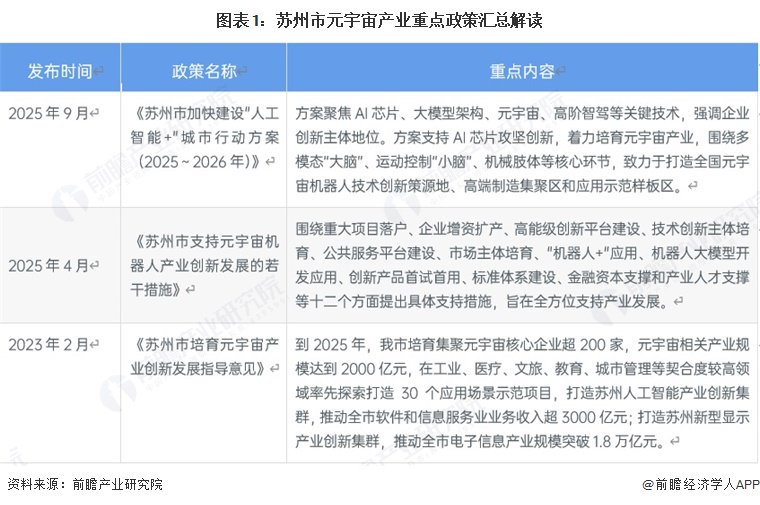
投资苏州丨一文看懂苏州市元宇宙产业发展现状与投资机会前瞻(附元宇宙产业现状、空间布局、投资机会分析等)
Qian Zhan Wang· 2025-12-15 03:17
Group 1: Core Insights - Suzhou aims to establish itself as a national innovation hub for the metaverse and robotics industry by 2025, supported by comprehensive policies covering AI chips, large models, and other key technologies [1][2][4] - The city has outlined specific measures to support the metaverse industry across 12 areas, including project settlement, platform construction, application promotion, and financial talent [2][4] - By 2025, Suzhou plans to cultivate over 200 core metaverse enterprises and achieve an industry scale of 200 billion yuan, with a focus on industrial, medical, cultural tourism, education, and urban management sectors [2][4] Group 2: Regional Policy Overview - Suzhou has established clear regional divisions in the metaverse industry, with the Suzhou Industrial Park as the core innovation source focusing on complete systems and key technologies [4][6] - Wuzhong District emphasizes application ecosystem cultivation through platform construction and funding support, creating a collaborative development framework from technology research to market application [4][6] Group 3: Industry Chain and Development - Suzhou has built a complete metaverse industry chain encompassing upstream technology support, midstream platforms and content, and downstream applications, showcasing strong potential across various sectors [7][9] - By 2025, Kunshan has attracted over 100 metaverse enterprises with a production value exceeding 10 billion yuan, while Wuzhong has gathered 52 core enterprises with a scale of 15.4 billion yuan [11][12] Group 4: Major Application Scenarios - In 2024, Suzhou identified 30 major application scenarios for the metaverse, primarily in the industrial sector, with significant expansions into smart cities, cultural tourism, healthcare, and education [13][16] - The industrial metaverse focuses on digital twin factories and virtual equipment validation, while cultural tourism aims to develop immersive experience projects [13][16] Group 5: Financing Landscape - As of 2025, metaverse financing events in Suzhou are concentrated between 2022 and 2024, with notable activity from companies like Juyou Universe and Haisai Future [21][22] - The financing distribution reflects a concentration in the Gusu District, with Suzhou Industrial Park and Kunshan each having one financed enterprise, aligning with the region's development characteristics [23] Group 6: Investment Opportunities - Suzhou's metaverse industry benefits from a comprehensive policy framework, a complete industry chain, and clear regional divisions, presenting various investment opportunities [29][30] - Key investment areas include strengthening the supply chain in critical segments, integrating metaverse with AI technologies, and focusing on vertical applications that match regional characteristics [29][30]

数字经济周报:OpenAI正式发布GPT-5.2-20251215
GUOTAI HAITONG SECURITIES· 2025-12-15 01:11
Semiconductor Sector Dynamics - AMD officially released the EPYC Embedded 2005 series processors, which can support up to 16 x86 cores and 64MB of shared L3 cache, with a TDP range of 45W to 75W, offering a 28% higher boost frequency and 35% higher base frequency compared to Intel Xeon 6503P-B2 at half the TDP[6] - DapuStor and ZTE are collaborating to build a green and efficient data center using immersion liquid cooling SSDs, marking a significant engineering application breakthrough in enterprise SSDs[8] - ASE Technology has integrated vacuum printing encapsulation and copper pillar transfer technology, significantly reducing product development time by up to 90% and cutting development costs by approximately 30%[10] Automotive Electronics Sector Dynamics - BAIC Group is partnering with Horizon Robotics to develop a full-scene urban NOA system, leveraging the Horizon Journey 6M chip to enhance computational capabilities for smart driving[12] - Innosilicon and United Power announced the successful installation of a new generation 6.6kW OBC system in Changan Automobile, achieving a 30% increase in power density and over 2% improvement in overall efficiency compared to similar products[14] - Ruijia received a development notification from a well-known flying car company, marking a significant milestone in expanding into the low-altitude economy[17] AI Sector Dynamics - OpenAI launched GPT-5.2, which outperformed previous models in professional knowledge tasks, achieving a 70.9% success rate in GDPval tests across 44 job tasks[19] - SenseTime introduced the upgraded "SenseTime Ark" platform, aiming to revolutionize visual AI production methods and enhance algorithm efficiency[22] - Zhiyuan officially launched and open-sourced the GLM-4.6V series multimodal models, reducing prices by 50% compared to the previous version, with API call costs as low as 1 RMB per million tokens[26] Metaverse Sector Dynamics - Cellid released two new AR glasses reference designs, targeting various applications from enterprise digital transformation to everyday consumer use[28] - Beijing Jishuitan Hospital successfully performed China's first "spatial computing + robotics" orthopedic surgery, marking a significant advancement in smart orthopedic technology[30] - Yunglight Technology completed a Series A financing round to accelerate the mass production of AR/VR technologies, with plans for a new 12-inch silicon-based OLED production line[34] Risk Warnings - There are risks of intensified market competition in semiconductor, automotive electronics, AI, and metaverse sectors due to rapid growth in participant numbers and capital investment[38] - Potential risks exist if technological advancements in these sectors do not meet expectations, which could hinder overall development[39] - Market demand growth may fall short of expectations in emerging sectors, impacting overall industry progress[40]
幸福航母重塑发展动能 以创新技术构建内外双循环相互促进新格局
Sou Hu Cai Jing· 2025-12-14 08:07
Core Insights - The article discusses the current economic challenges facing China, emphasizing the structural contradiction of "strong supply but weak demand" and the adverse effects of international trade barriers, particularly from the U.S. [2][10] - It proposes a systemic solution through the "People's Economy" and the "Happiness Aircraft Carrier," which aims to reshape economic dynamics by focusing on internal circulation and enhancing consumer confidence [2][25]. Group 1: Internal Economic Challenges - The internal dilemma of "strong supply but weak demand" is characterized by a disconnect between production capabilities and consumer purchasing power, leading to overcapacity and economic stagnation [2][3]. - The article highlights the need for innovative organizational structures to bridge the gap between large-scale production and local consumer needs [3]. Group 2: Proposed Solutions - The "Neighbor Alliance" is introduced as a community-based economic organization that integrates production, distribution, consumption, and cultural elements to enhance local economic activity [4][5]. - The "Enterprise Commune" is proposed as a collaborative network of companies that can collectively address international market challenges and enhance competitiveness through shared resources and branding [12][14]. - The "Cultural Tourism Metaverse - Chinese Philosophy City" aims to create immersive cultural experiences that stimulate spiritual consumption, thereby enhancing overall economic vitality [20][21]. Group 3: Implementation and Impact - The Neighbor Alliance utilizes digital platforms to aggregate local consumer demand and facilitate direct orders to manufacturers, creating a predictable order flow and reducing excess inventory [5][9]. - The Enterprise Commune enhances member companies' market security and competitiveness, allowing them to navigate geopolitical risks more effectively [16][17]. - The Cultural Tourism Metaverse is designed to meet the growing demand for high-level spiritual and cultural experiences, thus expanding the scope of consumer engagement beyond material goods [23][24]. Group 4: Systemic Integration - The "Happiness Aircraft Carrier" is described as an integrated system where the Neighbor Alliance supports internal demand, the Enterprise Commune expands external markets, and the Cultural Tourism Metaverse elevates the economic focus from material to spiritual [25][27]. - This holistic approach aims to create a new economic development paradigm that aligns with the principles of the People's Economy, addressing both domestic and international challenges [28][30].
事关元宇宙产业!工信部公开征求意见
中国基金报· 2025-12-12 12:33
【导读】事关元宇宙产业创新发展,重磅文件来了! 中国基金报记者 张舟 元宇宙,是数字与物理世界融通作用的沉浸式互联空间,是新一代信息技术集成创新和应用 的未来产业,具有高度沉浸、实时永续、自主创造、开放互联的特征。 12 月 12 日,工信部公开征求《元宇宙产业综合标准化体系建设指南( 2026 版)》(征求 意见稿)意见(以下简称《征求意见稿》)。 《征求意见稿》中提到,元宇宙作为数字经济与实体经济融合的高级形态,对推动制造业高 端化、智能化、绿色化转型升级,完善现代化产业体系具有重要支撑作用。 根据《征求意见稿》总体要求,到 2028 年,制定国家标准和行业标准 20 项以上,初步构 建支撑元宇宙产业创新发展的标准体系。 到 2028 年初步构建支撑 元宇宙产业创新发展的标准体系 1. 基础标准主要包括术语和定义、参考架构、分类与标识、管理、测试评价等标准。 2. 支撑能力标准主要包括基础设施、使能技术等标准。 3. 通用服务标准包括数字主体、数字身份、数字内容、数字资产、数字场景、数实交互等标 准。 到 2030 年,制定国家标准和行业标准 50 项以上,适度超前布局一批支撑未来产业高质量 发展需要的关 ...

工信部就元宇宙产业综合标准化体系建设指南公开征求意见
Zhong Guo Jin Rong Xin Xi Wang· 2025-12-12 11:52
原文链接:关于公开征求《元宇宙产业综合标准化体系建设指南(2026版)》(征求意见稿)意见的公 示 新华财经北京12月12日电 为强化元宇宙产业标准顶层设计,工业和信息化部科技司组织编制形成《元 宇宙产业综合标准化体系建设指南(2026版)》(征求意见稿,以下简称《指南》)。 编辑:幸骊莎 《指南》提出,到2028年,制定国家标准和行业标准20项以上,初步构建支撑元宇宙产业创新发展的标 准体系。到2030年,制定国家标准和行业标准50项以上,适度超前布局一批支撑未来产业高质量发展需 要的关键标准,加快元宇宙国际标准供给,促进元宇宙产业全球化发展。 ...
工信部征求意见:到2030年适度超前布局一批支撑未来产业高质量发展需要的关键标准
Zheng Quan Shi Bao Wang· 2025-12-12 10:56
人民财讯12月12日电,工业和信息化部科技司公开征求《元宇宙产业综合标准化体系建设指南(2026 版)》(征求意见稿)意见,到2028年,制定国家标准和行业标准20项以上,初步构建支撑元宇宙产业 创新发展的标准体系。到2030年,制定国家标准和行业标准50项以上,适度超前布局一批支撑未来产业 高质量发展需要的关键标准,加快元宇宙国际标准供给,促进元宇宙产业全球化发展。 ...
工信部:适度超前布局一批支撑未来产业高质量发展需要的关键标准
Ge Long Hui A P P· 2025-12-12 10:39
格隆汇12月12日|工信部公开征求《元宇宙产业综合标准化体系建设指南(2026版)》(征求意见稿) 意见。意见稿提出,到2028年,制定国家标准和行业标准20项以上,初步构建支撑元宇宙产业创新发展 的标准体系。到2030年,制定国家标准和行业标准50项以上,适度超前布局一批支撑未来产业高质量发 展需要的关键标准,加快元宇宙国际标准供给,促进元宇宙产业全球化发展。 ...
【8点见】湖北竹溪县住建局回应“政府采购评审名单照搬百度人名大全”
Yang Shi Wang· 2025-12-05 00:08
Group 1 - The Ministry of Industry and Information Technology will promote optimization of electric bicycle production companies [1] - The State Administration for Market Regulation has released national standards for food delivery platform service management [1] - New national standards for electric bicycles are planned to be included in next year's supervision and inspection plan [1] Group 2 - The Supreme Court is advancing the cleanup of government agencies and public institutions' arrears to small and medium-sized enterprises, with over 31.14 billion yuan in accounts settled in the first nine months [1] - The Ministry of Commerce is conducting export controls on rare earth-related items in accordance with laws and regulations [1] Group 3 - The number of newly started renovations of old urban communities reached 25,100 in the first ten months of this year [1] - Nearly 220,000 violations of the eight-point regulations were investigated nationwide from January to October this year [1]

【图解】有关应用场景 这22个新领域有新“机”
Zhong Guo Jing Ji Wang· 2025-12-04 07:55
Core Insights - The article discusses the implementation of new opportunities in 22 key areas as outlined by the State Council's recent policy on accelerating scene cultivation and large-scale application of new scenarios [2]. Group 1: New Opportunities in Various Fields - The focus is on exploring application scenarios in areas such as the metaverse, virtual reality, intelligent computing, and robotics within office, social, consumption, and entertainment sectors [4]. - In the artificial intelligence sector, there is an emphasis on strengthening core technology development and promoting high-value application scenarios [4]. - The development of all-space unmanned systems is highlighted, with applications in industrial production, urban planning, public services, and agriculture [4][5]. Group 2: Energy and Marine Development - The clean energy sector is set to innovate in digital and intelligent energy production management, smart grids, and virtual power plants [5]. - Marine development will focus on deep-sea exploration, marine engineering equipment, and marine biomedicine [5]. Group 3: Industrial and Transportation Innovations - The manufacturing sector is encouraged to cultivate application scenarios in industrial design and testing services [6]. - Innovations in transportation include smart traffic management and international air cargo transfer applications [6]. Group 4: Safety and Emergency Response - The emergency rescue system will enhance digital scenarios with intelligent sensing and unmanned rescue technologies [7]. - The mining safety sector aims to develop intelligent applications for real-time condition monitoring and risk prevention [7]. Group 5: Urban and Rural Development - The smart city initiative will focus on comprehensive digital transformation and the opening of key application scenarios [8]. - In rural construction, there will be efforts to improve ecological monitoring and disaster prevention [8]. Group 6: Healthcare and Social Services - The healthcare sector will innovate in remote medical services and health consultations [9]. - In elder care and childcare, there will be advancements in service robots and online healthcare systems [9]. Group 7: Cultural and Consumer Integration - The cultural and tourism sectors will enhance digital experiences and smart management of visitor flows [10]. - Cross-industry consumer integration will focus on merging commerce, culture, and technology, including 5G and virtual reality applications [10].
