Display Panels

Search documents
集邦咨询:12月电视与显示器面板价格预估持稳 笔电面板部分尺寸价格预期下调
智通财经网· 2025-12-06 08:03
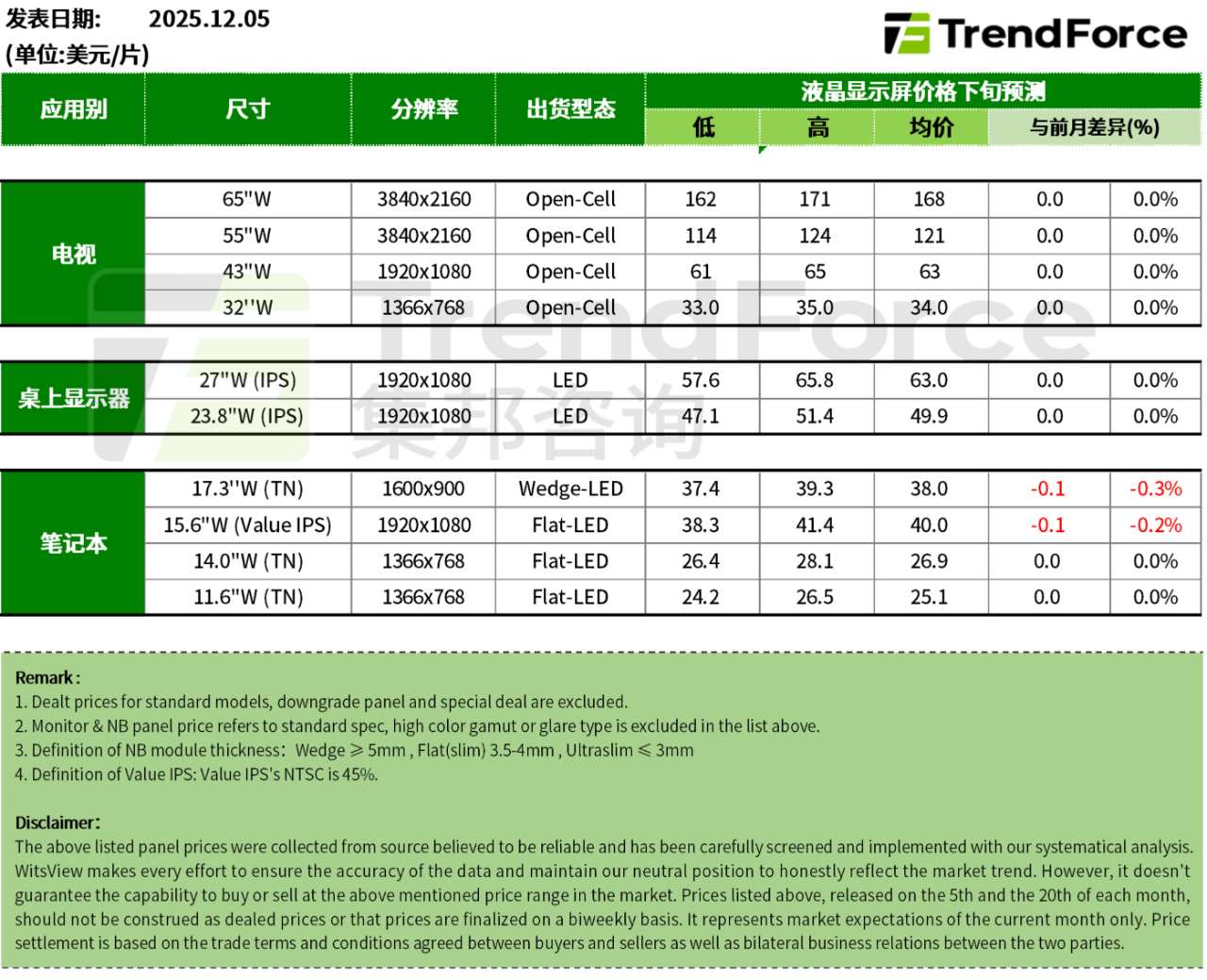
Core Insights - TrendForce forecasts stable prices for TV and monitor panels by December 2025, while laptop panel prices for certain sizes are expected to decline [1][2][3] Group 1: TV Panel Market - Despite entering year-end, demand for TV panels remains robust, driven by brand clients anticipating price stabilization and increasing orders for Q1 2026 [1] - The price trend for December indicates that 32-inch to 65-inch TV panels are likely to stabilize [1] Group 2: Monitor Panel Market - The demand for monitor panels has weakened overall, although some brand clients have increased their orders [2] - December prices for monitor panels are expected to remain stable, with the exception of the 23.8-inch VA Open Cell panel, which is projected to decrease by $0.2 [2] Group 3: Laptop Panel Market - Laptop panel demand is consistent with previous expectations, and shortages in memory have not significantly impacted panel procurement [3] - Some brand clients are pushing for more price concessions from panel manufacturers, indicating that previous discounts are no longer sufficient [3] - For December, prices for IPS laptop panels are expected to decline by $0.1 to $0.2, while low-end TN models are projected to remain stable [3]

价格评论丨12月电视面板价格有望提前止跌
WitsView睿智显示· 2025-12-06 01:03
Core Viewpoint - TrendForce's December panel price forecast indicates stable prices for TV and monitor panels, while laptop panel prices are expected to decline for certain sizes [1][4][5]. Group 1: TV Panels - Demand for TV panels remains stable as some brand clients anticipate that panel prices have reached their bottom, leading to increased orders [4]. - The production and utilization rates of panel manufacturers are expected to remain strong due to this demand, creating a potential atmosphere for price increases [4]. - December's price trend for TV panels in sizes ranging from 32 inches to 65 inches is expected to stabilize [4]. Group 2: Monitor Panels - The demand for LCD monitor panels has weakened overall, despite some brand clients increasing their orders [5]. - Panel manufacturers are reluctant to make significant price concessions, and most brand clients are accepting stable prices [5]. - In December, the price for the 23.8-inch VA Open Cell panel is expected to decline by $0.2, while other sizes are anticipated to remain stable [6]. Group 3: Laptop Panels - The demand for laptop panels is expected to remain as previously anticipated, with memory shortages and price increases not significantly impacting panel procurement [7]. - Some brand clients are actively requesting more price concessions from panel manufacturers, indicating that previous discount strategies are no longer sufficient [7]. - For December, prices for IPS laptop panels are expected to decline by $0.1 to $0.2, while low-end TN models are anticipated to remain stable [7].

12月电视面板行情: 价格走势分化,中小尺寸企稳大尺寸续跌
Xin Lang Cai Jing· 2025-12-04 11:25
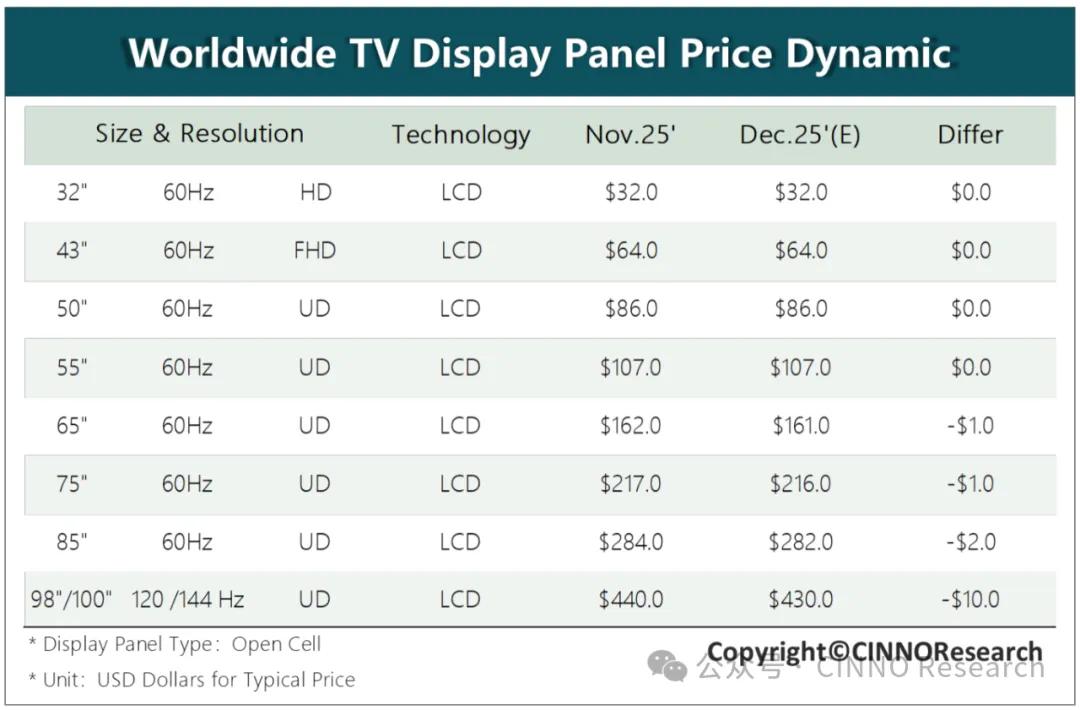
Core Viewpoint - The LCD TV panel market is experiencing a mixed demand environment, with domestic demand slowing down while overseas markets show resilience due to upcoming sports events and year-end purchases by leading brands [2][9]. Demand Side Summary - Since December, domestic market demand has weakened due to the end of seasonal stocking, while overseas demand is supported by anticipated international sports events and brand purchases [2][9]. - In November, overall demand showed signs of fatigue, with prices for most panel sizes continuing to decline, except for 32" and 43" panels which remained stable [2][9]. - For December, mid-sized panel demand is expected to stabilize due to early procurement by brands for upcoming events, while large-sized panels are anticipated to continue their downward price trend due to weak demand [2][9][10]. Supply Side Summary - In November, the industry saw a mixed approach to capacity control among panel manufacturers, leading to an average utilization rate of approximately 80.5%, a year-on-year increase of 2.5 percentage points [2][9]. - The supply environment remains relatively loose, which has further pressured panel prices, with manufacturers expected to maintain high production levels in December to meet North American market orders [2][9]. Price Trends Summary - Price forecasts for December indicate a divergence in trends: 32" and 43" panels are expected to remain at $32 and $64 respectively, while 50" and 55" panels are projected to stabilize at $86 and $107 [3][10]. - Conversely, prices for 65", 75", and 85" panels are expected to decline slightly by $1-2, reaching $161, $216, and $282 respectively, while the price for 98"/100" panels is anticipated to drop by $10 to $430 due to insufficient demand [3][10].
12月电视面板行情: 价格走势分化,中小尺寸企稳大尺寸续跌
CINNO Research· 2025-12-03 23:50
Core Viewpoint - The panel market is experiencing a decline in demand following the end of the peak stocking period, with supply remaining relatively loose, leading to a continued decrease in panel prices [2][5][6]. Demand Analysis - In November, overall demand in the panel market showed signs of fatigue, with prices for most sizes continuing to decline, except for the 32" and 43" panels which remained stable [5][6]. - Entering December, demand for small to medium-sized panels received temporary support due to early procurement by brands in anticipation of international sports events, while large-sized panels continued to face weak demand [5][6]. - The domestic market remains cautious due to unclear policies regarding "national subsidies," leading to conservative stocking expectations for the first quarter of the next year [5][6]. Supply Analysis - In November, the industry saw a rebound in average utilization rates to approximately 80.5%, an increase of 2.5 percentage points year-on-year, as panel manufacturers adjusted production in response to demand fluctuations [6]. - Despite the overall supply environment being relatively loose, major panel manufacturers are expected to maintain high production levels in December to meet orders from the North American market, keeping utilization rates above 80% [6][7]. Price Trends - Price forecasts for December indicate a divergence in the LCD TV panel market, with 32" and 43" panels expected to remain at $32 and $64 respectively, while prices for 50" and 55" panels are projected to stabilize at $86 and $107 [7]. - Larger panels, such as 65", 75", and 85", are anticipated to see slight declines of $1 to $2, with prices expected to reach $161, $216, and $282 respectively; the 98"/100" panels are expected to drop by $10 to $430 due to insufficient demand [7].

机构看好合肥国资入主维信诺 创新推动行业话语权提升
Cai Jing Wang· 2025-12-01 03:05
Group 1 - The company, Visionox (002387), announced a non-public issuance of A-shares to a specific investor, Hefei Jianshu, at a price of 7.01 yuan per share, raising a total of no more than 2,937.4466 million yuan [1] - Following this issuance, Hefei Jianshu will hold a 31.89% stake in the company, making it the controlling shareholder, with the Shushan District People's Government becoming the actual controller [1] - The purpose of this issuance is to enhance the stability of control, demonstrate shareholder confidence in the company's future development, and alleviate working capital pressure [1] Group 2 - Huaxin Securities reported that the entry of Hefei state-owned assets enhances stability and confidence, which could elevate the industry's discourse power [2] - Visionox is a leader in the AMOLED segment, focusing on OLED technology for over 20 years, and is a key player in setting international and national OLED standards [2] - According to CINNO Research, Visionox is projected to capture an 11.2% share of the global smartphone AMOLED panel market in 2024, ranking third globally and second domestically [2] Group 3 - The company invested 769 million yuan in R&D in the first three quarters of 2025, with a research expense ratio of 12.71%, focusing on low power consumption, high performance, and flexible display technologies [2] - The company’s subsidiary, Hefei Visionox, is developing smart pixel technology that offers advantages such as no precision metal mask, independent pixel control, and high precision, which can meet the production needs of full-size AMOLED products [2] - Huaxin Securities forecasts the company's revenues for 2025-2027 to be 8,024.0 million, 8,489.0 million, and 8,979.0 million yuan respectively, maintaining a "buy" investment rating with current price-to-sales ratios of 1.6, 1.5, and 1.4 times [3]

研报掘金丨国信证券:维持京东方A“优于大市”评级,看好公司布局OLED中尺寸应用
Ge Long Hui· 2025-11-27 06:28
Core Viewpoint - The report from Guosen Securities indicates that BOE Technology Group Co., Ltd. (京东方) has achieved year-on-year growth in revenue and net profit attributable to shareholders in Q3 2025, particularly in the OLED sector, where the company has successfully launched mass production of the LTPO project for core clients [1] Company Performance - BOE's OLED shipment volume is expected to achieve double-digit growth for the entire year, driven by the increasing penetration of foldable devices and the expansion of high-end technology routes [1] - The company is well-positioned to optimize the product structure in the industry, which is anticipated to improve overall profitability [1] Industry Outlook - Upcoming sports events, such as the World Cup, are expected to boost demand for TV products in the first quarter of the next year [1] - The replacement cycle and AI integration are projected to drive demand for IT products, alongside the trend towards larger screen sizes, which will further increase industry demand [1] - The industry is expected to reach a supply-demand balance in the future, with a focus on on-demand production in the LCD sector, leading to stable profitability [1] Investment Rating - The company’s strategy in the OLED mid-size application is viewed positively, maintaining an "outperform the market" rating [1]

TrendForce集邦咨询发布2026年十大科技市场趋势预测: 锚定AI驱动下的产业新路径
TrendForce集邦· 2025-11-27 06:07
Group 1 - The core viewpoint of the article is that the technology market is evolving rapidly, particularly in AI, storage, and semiconductor sectors, with significant growth expected in various applications and technologies by 2026 [2][3][4]. Group 2 - AI chip competition is intensifying, with major players like NVIDIA facing challenges from AMD and various Chinese companies enhancing their AI chip development. The demand for AI data centers is expected to grow significantly, with global AI server shipments projected to increase by over 20% annually [3][4]. - Liquid cooling systems are anticipated to penetrate 47% of AI chip applications by 2026, driven by the rising thermal design power (TDP) of chips [3]. Group 3 - HBM and optical communication technologies are becoming critical for overcoming bandwidth limitations in AI computing, with HBM4 expected to support ultra-large-scale computations [4][5]. - The transition to optical communication technologies is seen as essential for improving data transfer efficiency across chips and modules, with a focus on high bandwidth and low power consumption [5]. Group 4 - NAND Flash suppliers are accelerating the development of specialized solutions for AI workloads, including storage-class memory (SCM) and Nearline QLC SSDs, which are expected to capture a 30% market penetration in enterprise SSDs by 2026 [6][7]. Group 5 - Energy storage systems are evolving to become the core energy source for AI data centers, with a projected increase in global AI data center storage capacity from 15.7 GWh in 2024 to 216.8 GWh by 2030, reflecting a compound annual growth rate of 46.1% [8]. Group 6 - The shift to 800V HVDC architecture in data centers is expected to drive demand for third-generation semiconductors (SiC/GaN), with penetration rates projected to rise from 17% in 2026 to over 30% by 2030 [9]. Group 7 - The introduction of 2nm GAAFET technology and advancements in 2.5D/3D packaging are set to enhance transistor density and performance, crucial for high-performance computing and AI applications [10][11]. Group 8 - The humanoid robot market is projected to grow over 700% by 2026, focusing on AI adaptability and application-specific designs, marking a significant shift towards commercial viability [12]. Group 9 - The adoption of OLED displays in laptops is accelerating, with Apple expected to introduce OLED panels in MacBook Pro by 2026, leading to a projected penetration rate of 5% in laptops by 2025 and 9-12% by 2027-2028 [13][14]. Group 10 - The penetration rate of advanced driver assistance systems (L2 and above) is expected to exceed 40% by 2026, with Robotaxi services expanding globally, driven by regulatory changes and advancements in AI models [16].

LG Display四年来有望首次实现扭亏为盈
Shang Wu Bu Wang Zhan· 2025-11-21 10:13
据韩国媒体《Dailian》11月19日报道,LG Display在退出大尺寸LCD业务后全面加速向OLED转型,成 效开始在业绩中集中体现。第三季度OLED销售占比达到历史最高的65%,面板平均售价大幅回升,加 上工厂OLED生产线折旧逐步结束,固定成本显著下降,推动公司三季度销售额和营业利润同比、环比 双双扭亏为盈。若第四季度延续这一势头,公司有望自2021年以来时隔四年再次实现年度盈利。同时业 务结构迅速向大尺寸OLED TV、游戏OLED、车载P-OLED等高附加值产品集中。市场普遍预计LG Display今年营业利润约7700亿韩元,明年有望突破1万亿韩元。 ...
Q4需求不减反增,电视面板价格涨还是跌?
WitsView睿智显示· 2025-11-21 08:00
Core Viewpoint - TrendForce reported a decline in TV panel prices in November, while monitor panel prices remained stable compared to the previous month, and some laptop panel prices decreased for certain sizes [1][3][5]. TV Panels - Despite entering the traditional off-season for TV panel demand in Q4, some brand clients are actively pushing to meet year-end targets, leading to an increase in demand for TV panels [3]. - Panel manufacturers are fulfilling orders but are adopting a low pricing stance to encourage clients to increase orders, with expected price drops of $1 for 32" and 43" panels, $2 for 50" and 55" panels, and $3 for 65" and 75" panels in November [3][4]. Monitor Panels - The demand for monitor panels has shown signs of weakness in Q4, with manufacturers facing ongoing losses on mainstream monitor panels, limiting their ability to lower prices [5]. - In November, only the 23.8" Open Cell panel is expected to see a price drop of $0.2, while other mainstream sizes are anticipated to remain stable [5]. Laptop Panels - In November, despite a significant rise in memory prices, brand clients' purchasing momentum for panels remains in line with expectations, although they continue to request price reductions [6]. - Only TN panels are expected to remain stable in price, while other IPS mainstream sizes are projected to decrease by $0.1 to $0.2 [6].

Omdia:预计2026年平板OLED面板出货量激增39% LCD持平稳增长
智通财经网· 2025-11-21 05:53
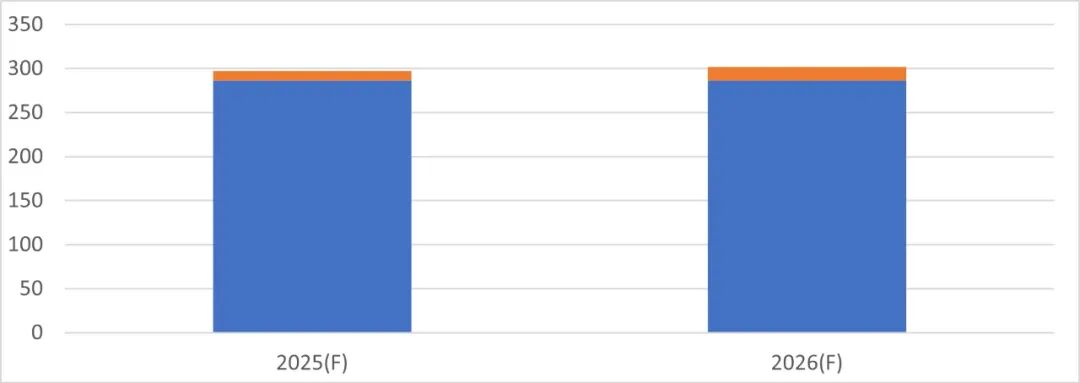
智通财经APP获悉,根据Omdia平板与笔电显示及OEM智能服务的最新分析,OLED平板面板出货量预计将在2026年同比增长39%,达到1,500万片。在多 年增长不及预期之后,这一强劲的OLED目标将成为推动明年整体平板面板出货增长的主要动力。 从2026年整体市场来看,供应链厂商的初步反馈显示,平板面板出货量将同比增长 1.4%,达到3.015亿片。按技术类别分,LCD平板面板出货量预计为 2.864亿片,与去年大致持平。中国面板厂商在国内客户带动下仍预期增长;而主要面向苹果或全球平板品牌的面板供应商,则因2025年出货基数过高,对 2026年预期更加谨慎。 Omdia高级首席分析师林筱茹(Linda Lin)表示:"OLED平板面板出货量终于成为平板面板增长的主要动力。预计到2026年,OLED出货量将同比增长39%, 达到1,500万片,而LCD面板出货量将维持在2025年的水平,因此大部分新增需求将来自 OLED。" 三星显示面板(Samsung Display)预计为苹果iPad Pro和全新iPad mini提供更高出货量这将推动2026年OLED面板的显著增长。同时,中国OLED平板面板供 应 ...