
智能穿戴设备

Search documents
阿里巴巴,即将发布!
中国基金报· 2025-07-23 07:56
Core Viewpoint - Alibaba is set to launch its first self-developed AI glasses this week, entering the competitive "Hundred Glasses War" in the AI glasses market [2]. Group 1: Product Features - The AI glasses will feature a voice assistant, music playback, phone calls, real-time translation, and meeting minutes, integrating functionalities from Alibaba's ecosystem such as maps, payments, and shopping [3]. - Two versions of the product will be available: a non-display AI smart glasses and a display-equipped AI+AR smart glasses, with the latter being prioritized [3]. - The hardware will utilize a dual-chip architecture, incorporating Qualcomm's Snapdragon AR1 and Hengxuan BES2800 chips [3]. Group 2: Development Background - This product is an extension of Alibaba's AI to C strategy, developed collaboratively by the Tmall Genie hardware team and the Quark AI R&D team [4]. - The project for AI smart glasses was officially initiated by Alibaba in April, with the team actively expanding [4]. - The imaging system will feature a Sony IMX681 image sensor with 12 million pixels [4]. Group 3: Market Landscape - Several major tech companies in China are aggressively advancing their AI glasses development, indicating a growing competitive landscape [5]. - Baidu's CEO announced the launch of the world's first native AI glasses equipped with a Chinese large model, set to release in November 2024 [6]. - Xiaomi also announced its first AI glasses during a recent event, directly competing with Meta's popular Ray-Ban, with a starting price of 1999 yuan [6]. - Xiaomi's AI glasses will also use the Qualcomm AR1 processor and feature a 12 million pixel IMX681 sensor [6]. - ByteDance has long been planning its own AI glasses [7]. Group 4: Market Outlook - According to Guojin Securities, the number of players entering the domestic AI glasses market is increasing, marking the beginning of the "Hundred Glasses War" [8]. - The second half of the year is expected to see a surge in product launches and mass production in the AI glasses sector, potentially leading to rapid market expansion [8].



沙利文2025中国AI智能眼镜行业白皮书
2025-07-19 14:57
Summary of the AI Smart Glasses Industry White Paper Industry Overview - The document presents the "China AI Smart Glasses Industry White Paper," analyzing the current state, development trends, competitive landscape, and commercialization prospects of the AI smart glasses industry [4][5]. Key Insights 1. **Market Potential**: The AI smart glasses market is expected to see significant growth, with global sales projected to exceed 10 million units by 2026 and market size surpassing 100 billion yuan by 2029, indicating exponential growth [5][11]. 2. **Pre-Explosion Phase**: The industry is on the verge of a large-scale explosion, driven by technological innovations in hardware and software, which are gradually addressing existing challenges such as interaction experience, privacy concerns, and performance limitations [6][12]. 3. **Shift in Commercialization Path**: Chinese manufacturers are transitioning from a "hardware-centric" approach to an "ecosystem-driven" model, focusing on integrating hardware, software, and services for sustainable business development [7][30]. Development Trends 1. **Evolution Towards AI+AR**: AI smart glasses are evolving towards AI+AR forms, integrating augmented reality capabilities to enhance user interaction and experience [9][18]. 2. **Increasing Intelligence Levels**: The industry is currently at the L2 stage (intelligent assistance) and is expected to progress to L3 (intelligent assistant) and L4 (intelligent collaboration) stages by 2027, with significant improvements in technology integration and user experience [10][26]. 3. **Diverse Consumer Base**: The target consumer base for AI smart glasses is broad, including both vision-corrected and non-corrected users, with significant potential for market growth driven by new user demand and the replacement of traditional eyewear [51][53]. Market Drivers 1. **Technological Advancements**: The adoption of advanced optical solutions like BirdBath and waveguide technologies, along with high-performance display options such as Micro OLED and Micro LED, is driving product functionality and user experience [12][46]. 2. **Domestic Production Growth**: The rapid advancement in domestic production capabilities for key components is expected to lower costs and expand market demand for AI smart glasses [55][60]. 3. **Government Support**: Policies promoting consumer electronics and subsidies for smart glasses purchases are expected to stimulate market growth [34][30]. Competitive Landscape 1. **Diverse Competitive Advantages**: Different categories of manufacturers have varying competitive advantages, with startups focusing on product development, while larger tech companies emphasize ecosystem integration [7][30]. 2. **Emerging Market Leaders**: Companies like Ray-Ban Meta and domestic brands such as 雷鸟 (Thunderbird) are emerging as key players, with competitive pricing and superior features [64][65]. Industry Challenges 1. **Technological Barriers**: Despite advancements, challenges remain in achieving optimal performance in terms of weight, battery life, and user privacy, which need to be addressed for broader market acceptance [6][12]. 2. **Consumer Awareness**: Increasing consumer awareness and understanding of AI smart glasses are crucial for market penetration and growth [5][11]. Conclusion The AI smart glasses industry is poised for significant growth, driven by technological advancements, a diverse consumer base, and supportive government policies. The transition towards an ecosystem-driven approach and the emergence of competitive domestic brands are expected to shape the future landscape of this innovative market.
“中外合璧”强链条(走进链博会)
Ren Min Ri Bao· 2025-07-17 21:44
Group 1: Sustainable Packaging Innovations - The collaboration between Indonesia's Golden Agri-Resources, BASF, and Duobai Cheng has led to the development of "zero plastic" water-based barrier food packaging paper, which is recyclable, biodegradable, and compostable, addressing the environmental concerns of traditional plastic-coated paper cups [1] - The new packaging solution offers excellent performance in terms of water and oil resistance, heat sealing, and microwave heating, making it suitable for coffee, tea, and takeout food industries [1] Group 2: Advancements in Smart Wearable Technology - PICO's new virtual reality headset allows users to experience historical events interactively, showcasing the potential of smart wearable devices in enhancing user engagement [2] - Qualcomm's dedicated chip for spatial computing enables precise motion capture, indicating a significant advancement in interactive technology [2] - Qualcomm aims to deepen collaboration with Chinese partners across various sectors, including smart terminals, smart vehicles, and IoT, to foster a new interconnected future [2] Group 3: Automotive Technology and Localized Development - Bosch has showcased its latest localized achievements in energy power, motion control, and driving assistance at the Chain Expo, emphasizing its commitment to local R&D and manufacturing in China [3] - The strategic partnership between Bosch and Horizon Robotics aims to develop a new generation of multifunctional cameras, highlighting the importance of open collaboration and innovation for sustainable development [3] - Foreign companies like Corning, Sumitomo Electric, and Wacker are establishing comprehensive value chain systems in China, demonstrating the benefits of breaking barriers and fostering collaborative innovation in the global supply chain [3]
影目CEO杨龙昇:小米入局AI眼镜是好事,大家销量翻了两三倍
3 6 Ke· 2025-07-17 00:03
Core Insights - The AI glasses market is experiencing significant growth, with major players entering the field and increasing investment interest, particularly following the success of Meta's collaboration with Ray-Ban in 2024 [3][5][13] - The entry of Xiaomi into the AI glasses market has sparked optimism, leading to a tenfold increase in market traffic and a projected two to three times increase in sales for various manufacturers [5][11][12] - The competition landscape consists of three main types of players: internet giants like Xiaomi and Baidu, established AR glasses manufacturers (referred to as the "AR Four Dragons"), and new entrants without prior experience in glasses manufacturing [7][8] Investment and Market Dynamics - The recent financing round for Yingmu Technology, a key player in the AI glasses sector, raised 150 million yuan (approximately 21.5 million USD) in just two months, indicating strong investor interest [1][13] - The overall market for smart glasses in China is expected to reach 600,000 to 700,000 units this year, representing a growth of 2.5 to 3 times compared to the previous year [22] Competitive Landscape - The competition in the AI glasses sector is characterized by a "hundred glasses battle," with many companies vying for market share, although only a few have achieved product maturity and clear business paths [6][11] - Key competitive factors for AI glasses include hardware miniaturization, optical display quality, and effective integration of AI capabilities to enhance user experience [8][26] Product Development and Technology - The cost structure of AI glasses is heavily influenced by components such as chips and sensors, with the BOM (Bill of Materials) for basic models estimated at around 1,200 yuan (approximately 170 USD) [12] - The industry is witnessing a trend towards domestic production, with Yingmu Technology achieving an 80% localization rate in its supply chain, which helps reduce costs [20] Future Outlook - The long-term competitive barriers in the AI glasses market will focus on miniaturization, optical display advancements, and the development of an integrated OS that leverages AI for enhanced functionality [26][30] - The market is expected to evolve towards more complex applications in entertainment and social interaction, moving beyond basic utility functions [31][32]


雷鸟X3 Pro AR智能眼镜
2025-07-16 06:13
Summary of Conference Call Company and Industry - The conference call focused on the AI eyewear industry, specifically discussing the product lines of the company, which is identified as "雷鸟" (Leiniao) [1][2]. Core Points and Arguments - **Product Lines**: The company has two main product lines centered around BirdBox (BB technology) and color waveguide technology. The first line emphasizes a split design for enhanced viewing experiences, while the second line offers a more convenient all-in-one product, the X series [1]. - **R Series Update**: The R series has introduced the R3s and R3s Pro, which are performance upgrades from the previous R3 model, with a more affordable pricing strategy. The V series did not see significant updates due to the recent product release cycle [2]. - **B Series Launch**: The B series introduced the B340 model aimed at family users. The company has made three major updates to enhance user experience based on feedback [3]. - **Market Dynamics**: The current market for AI eyewear is limited, primarily focusing on split-viewing and gaming experiences. The company anticipates that future large-scale sales will likely come from lighter, longer-lasting products like NEO V3 and MapleMeta [3]. - **Commercial Considerations**: The company is navigating complex commercial considerations, particularly with the X series products, which utilize advanced waveguide technology. The performance of these products is strong, but they face challenges in weight, pricing, and heat dissipation [4]. - **X3 Pro Product Launch**: The X3 Pro is positioned as a showcase of the company's technological capabilities, featuring industry-first technologies and materials. The product's weight has been reduced to 76 grams, a 36% decrease compared to previous models, but it is priced at 8999, indicating a premium positioning [5][6]. - **Strategic Positioning**: The X3 Pro is intended to set a benchmark in the industry, reflecting the company's commitment to innovation and exploration in the AI eyewear space. The Air 3 and Air 3s products focus more on indoor viewing experiences [6]. Other Important Content - **Technological Innovations**: The X3 Pro incorporates various first-time technologies in the industry, including magnesium alloy materials and gentle waveguide materials, highlighting the company's focus on advanced engineering [5]. - **Market Challenges**: The overall industry remains in a low growth state, and the commercial success of new products may lag behind initial expectations due to pricing and market demand constraints [4]. This summary encapsulates the key discussions and insights from the conference call, providing a comprehensive overview of the company's product strategy and market positioning in the AI eyewear industry.
2025年中国智能眼镜行业政策、产业链、出货量、竞争格局及行业发展趋势研判:全球科技巨头与创新企业竞相布局,中国市场呈现出蓬勃发展的态势[图]
Chan Ye Xin Xi Wang· 2025-07-15 01:34
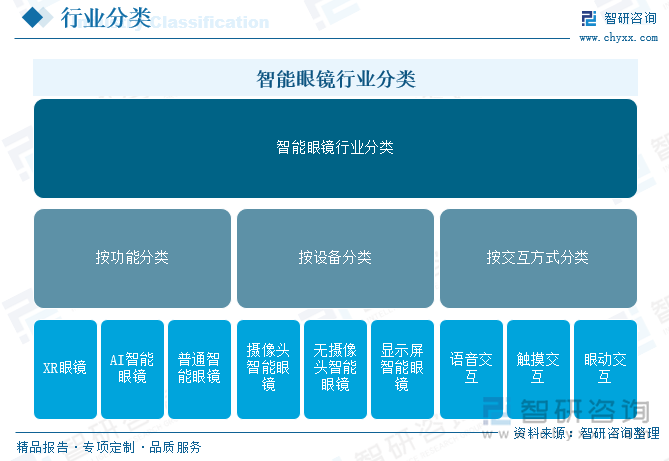
Core Viewpoint - The smart glasses industry is rapidly evolving, with significant growth potential in various applications, including industrial, military, emergency response, and public health monitoring. The global shipment of smart glasses is projected to reach 14.518 million units by 2025, with China showing a particularly promising market growth trajectory [1][4][6]. Industry Definition and Classification - Smart glasses are wearable devices that integrate optical display technology, sensors, computing units, and wireless connectivity, providing information interaction and immersive experiences. They can be classified by function (XR glasses, AI smart glasses, ordinary smart glasses), by device type (camera-equipped, non-camera, display-equipped), and by interaction method (voice, touch, eye movement) [1][10]. Industry Development Status - The smart glasses market is experiencing robust growth, with global shipments expected to reach 14.518 million units by 2025. In China, shipments are projected to rise from approximately 680,000 units in 2023 to 1.307 million units in 2024, and further to 2.907 million units in 2025. Audio and audio-capturing glasses are expected to account for 2.165 million units, while AR/VR devices are projected to reach 742,000 units [4][8]. Industry Value Chain - The smart glasses industry value chain includes upstream components such as lenses, frames, and key electronic parts (optics, chips, displays, sensors, etc.), midstream manufacturing of smart glasses systems and terminals, and downstream sales through traditional optical channels and e-commerce. Applications span various sectors, including media, healthcare, military, and personal use [10]. Industry Policies - The industry is supported by various government policies aimed at enhancing product quality, innovation, and market competitiveness. Recent initiatives include promoting high-value product exports, upgrading consumer electronics standards, and encouraging the development of smart wearable devices in various applications [12][14]. Industry Competitive Landscape - Major players in the smart glasses industry include GoerTek, Jiahe Intelligent, Skyworth Digital, and others. These companies are investing in R&D and production capacity for smart glasses, with GoerTek and Jiahe Intelligent leading in production capabilities. The market is characterized by competition from both domestic and international tech giants [15][18]. Industry Development Trends - The smart glasses market is expected to see advancements in AR/VR technologies, with a focus on enhancing user interaction through AI integration and visual enhancement. The industry is poised for rapid growth, driven by technological innovations and an expanding consumer market [24].
AI眼镜市场火热 产业链公司纷纷抢抓机遇
Zheng Quan Ri Bao· 2025-07-14 16:20
Core Viewpoint - The recent launch of Xiaomi's new AI glasses has significantly boosted the domestic AI glasses market, with sales exceeding 30,000 units on JD.com within just over half a month since its release on June 26 [1] Market Sales Surge - According to IDC, the shipment volume of smart glasses in China reached 494,000 units in Q1 2025, marking a year-on-year increase of 116.1%. The forecast for 2025 predicts a total shipment of 2.907 million units, representing a growth of 121.1% [2] - AI glasses, evolving from traditional eyewear, offer enhanced convenience for information retrieval and interaction, providing a more immersive experience compared to traditional electronic devices [2] - The acceleration of AI model deployment has resolved early issues of functionality and interaction in AI glasses, leading to features like real-time translation, scene recognition, and health monitoring, which are driving sales growth [2] Product Innovations - Xiaomi's new AI glasses feature immersive photography and video recording capabilities, support third-party app video calls and live streaming, and allow real-time sharing of visual experiences [3] - Rokid Glasses, developed by Hangzhou Lingban Technology, launched the world's first smart glasses payment solution in collaboration with Alipay, enhancing user convenience while ensuring security [3] - The surge in new AI glasses products indicates that 2025 is expected to be a significant year for the concentrated release of smart glasses, potentially accelerating technological iteration and reducing product costs [3] Policy Support and Market Dynamics - The rapid increase in AI glasses sales is also attributed to policy support, particularly the "national subsidy" which has effectively boosted domestic consumer market activity [3] - Despite the current growth, long-term widespread adoption of AI glasses will require overcoming challenges related to battery life, interaction, and ecosystem development [4] Concept Stocks and Investor Interest - The AI glasses industry chain includes hardware suppliers, software and system vendors, and sales channels. Recently, 21 AI glasses concept stocks have undergone intensive research by institutional investors [5] - Investor focus is primarily on new product development and application expansion in the second half of the year, with companies actively responding to market inquiries and disclosing progress [5] - Companies like Tianjian Electric Sound and Hisense Vision Technology are reporting increased orders and strategic collaborations aimed at enhancing product offerings in the AI glasses sector [6]
对话 Even Realities 王骁逸:怎么把 599 美元的智能眼镜卖给 CEO 们
晚点LatePost· 2025-07-13 14:22
Core Viewpoint - The company Even Realities emphasizes that smart glasses must first be good glasses, focusing on design, comfort, and optical quality while integrating smart features [3][6][10]. Company Overview - Even Realities was founded by Will Wang, who previously worked on Apple Watch manufacturing design, and aims to innovate in the smart glasses market by prioritizing traditional eyewear qualities [5][6]. - The Even G1 smart glasses are lightweight (around 30 grams) and have a battery life of one and a half days, integrating prescription lenses with display technology [6][8]. Product Features - The Even G1 lacks cameras and speakers, instead featuring a monochrome display that projects images onto the lenses, targeting users who require discreet information access [4][17]. - The glasses are designed for comfort, with a focus on ergonomic weight distribution and aesthetics, ensuring they are appealing to wear [10][11]. Market Positioning - Even Realities positions itself against both high-end eyewear brands like LINDBERG and tech companies like Meta, aiming to create a high-end consumer product that merges design, AI, and manufacturing [8][9][21]. - The pricing strategy for the G1 is set at $599, comparable to high-end brands, reflecting the company's ambition to establish itself as a premium brand in the eyewear market [8][21]. Competitive Landscape - The company believes that many competitors are overselling the capabilities of their products, while Even Realities focuses on delivering a solid initial experience before expanding into more advanced features [15][20]. - The target market includes professionals who need efficient information access without distractions, differentiating from competitors that focus on entertainment or social features [16][20]. Future Vision - The company envisions a two-step approach: first, to attract current glasses wearers to smart glasses, and second, to enhance functionality with AI capabilities over time [14][28]. - The integration of AI is seen as a future necessity, with the potential to transform how users interact with information, positioning smart glasses as a primary device for information access [27][29]. Talent and Team - The team at Even Realities includes experts from both the eyewear and tech industries, ensuring a balanced approach to product development that emphasizes both design and functionality [8][36]. - The company aims to attract top talent by presenting a compelling vision of becoming a leading eyewear brand that could redefine user interaction with information [12][36].

精准到极致,守护更贴心:天悦康康智能指环深度评测
Qi Lu Wan Bao· 2025-07-10 05:27
Core Viewpoint - The Tianyue Kangkang AI smart ring represents an innovative solution in the wearable health monitoring sector, integrating CBT-I (Cognitive Behavioral Therapy for Insomnia) for comprehensive sleep management [1][11]. Group 1: Product Features - The smart ring is designed for comfort, with a thickness of only 2.5mm and a weight of 3 grams, made from aerospace-grade metal, available in three colors [4]. - It offers a "no-sense wear" experience, making it more comfortable for continuous use, especially during sleep, compared to traditional smartwatches [4]. - The product includes a free finger size kit to ensure accurate fitting, enhancing the accuracy of health monitoring [8]. Group 2: Monitoring Capabilities - The smart ring provides real-time monitoring of vital signs such as heart rate, blood oxygen, body temperature, and HRV (Heart Rate Variability), generating a dynamic health baseline through AI algorithms [9][10]. - It boasts high monitoring accuracy, comparable to the well-known Oura Ring, and can capture short naps exceeding 15 minutes [10]. Group 3: Sleep Management - The product incorporates a four-dimensional sleep improvement plan based on the CBT-I framework, offering detailed sleep data recording [11]. - It features an AI-driven sleep aid function that recommends specific sound frequencies to enhance deep and REM sleep quality [11]. Group 4: Elderly Care Features - The smart ring includes a fall detection warning system, analyzing key indicators to predict potential fall risks in elderly users [15]. - It allows family members to remotely monitor the health data of their elderly relatives, facilitating proactive health management [15]. - The integration of a personalized health model enhances its competitive edge in the elderly health sector [15]. Group 5: Market Positioning - The Tianyue Kangkang AI smart ring redefines health management in wearable devices, focusing on both fall prevention and sleep improvement, making it particularly appealing to users concerned about the health of their elderly family members [15].
苹果智能眼镜布局全面加速,Meta/微美全息产业生态协同撬动万亿市场
Zhong Guo Chan Ye Jing Ji Xin Xi Wang· 2025-07-09 03:02
Group 1: Apple’s Smart Glasses Strategy - Apple is preparing to enter the smart glasses market with a roadmap for its Vision product line, planning to release the Vision Pro with M5 processor in Q3 2025 and the Vision Air smart glasses in 2027, which will focus on photography, audio, and AI features [1][2] - The company is also exploring a wired version of Vision Pro that connects to a Mac, indicating a strong ambition in the smart glasses and head-mounted display sector [2] - Apple is employing a brainstorming approach to combine different products, aiming for innovation and strengthening its overall product capabilities in the smart glasses market [2] Group 2: Meta’s Smart Glasses Development - Meta has successfully launched smart glasses in collaboration with Ray-Ban and is increasing investment to introduce more styles, including a high-end version named Hypernova expected to be released by the end of the year [3] - The Hypernova glasses will feature a screen and a controller called Ceres, which allows for gesture recognition, enhancing user interaction [3] - The market for smart glasses is evolving rapidly, with more brands entering the space, positioning head-mounted devices as the next major trend in consumer electronics [3] Group 3: WIMI’s Technological Advancements - WIMI, a leading AR+AI technology company, is strategically positioning itself in the smart glasses sector through technology development and ecosystem collaboration [4] - The company has developed a dynamic real-time rendering engine that lowers the barrier for AR content creation and enhances capabilities like gesture and facial recognition [4] - WIMI's MicroLED optical module and diffraction waveguide technology provide lightweight and high-performance display solutions, enabling features like 3D content overlay and real-time translation in AI smart glasses [4] Group 4: Industry Trends and Future Outlook - The smart glasses market is experiencing explosive growth driven by advancements in AI and XR technologies, with various companies expanding their applications into this field [5] - The competition in the smart glasses sector, referred to as the "battle of a hundred glasses," is intensifying as internet giants, smart hardware manufacturers, and traditional eyewear companies all seek to enter the market [5] - This competitive landscape is expected to empower various sectors, including office work, film, and gaming, as smart glasses become more prevalent [5]


