
软件与服务

Search documents
玄武云委任廉健为主席、授权代表兼执行董事
Zhi Tong Cai Jing· 2026-02-09 11:33
Group 1 - The company Xuanwu Cloud (02392) announced significant changes in its board of directors effective from February 9, 2026 [1] - Mr. Chen Yonghui has resigned from multiple positions including Chairman, CEO, Authorized Representative, Executive Director, and Chairman of the Nomination Committee [1] - Other resignations include Mr. Guo Haiqiu as Executive Director and member of the Compensation Committee, Mr. Du Jianqing as Independent Non-Executive Director and member of the Audit and Nomination Committees, and Ms. Wu Ruifeng as Independent Non-Executive Director and Chair of the Audit Committee [1] Group 2 - New appointments include Mr. Lian Jian as Chairman, Authorized Representative, and Executive Director; Mr. Li Hairong as CEO and member of the Nomination Committee; and Dr. Chen Zhengxu as Executive Director and member of the Compensation Committee [1] - Additional new independent non-executive directors include Mr. Wang Guisheng as Chair of the Audit Committee and member of the Nomination Committee, Dr. Xiao Jingyi as Chair of the Nomination Committee and member of the Audit and Compensation Committees, and Mr. Cao Jianrong as Chair of the Compensation Committee and member of the Audit Committee [1]
AI应用巨头回调30%背后:是估值泡沫破裂,还是产业逻辑的“价值错配”?
3 6 Ke· 2026-02-09 11:23
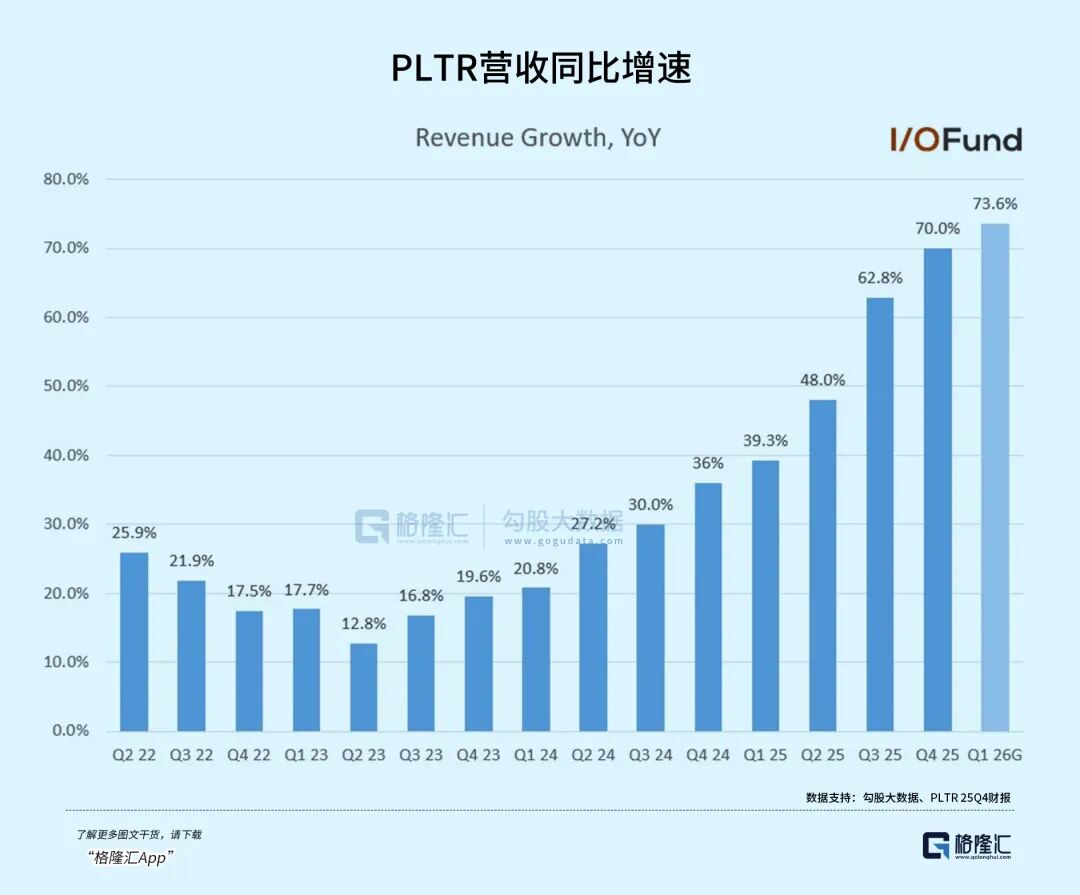
Core Insights - Palantir (PLTR) reported strong earnings in Q4 2025, with revenue growth accelerating to 70% year-over-year, yet its stock price fell over 30% from its peak, raising questions about market valuation and investor sentiment [1][2]. Group 1: Market Review - Palantir's Q4 2025 earnings exceeded expectations, with revenue reaching $1.407 billion, up from 63% growth in Q3 to 70% in Q4 [2]. - Despite strong performance, PLTR's stock price experienced a significant decline post-earnings, suggesting a potential market correction or profit-taking by investors [2][3]. Group 2: Core Data Analysis - PLTR's revenue growth is accelerating, with Q4 showing a 70% year-over-year increase, indicating a rising market penetration rather than a slowdown [3]. - The "Rule of 40" metric, which combines revenue growth and profit margin, reached 127% in Q4, up from 114% in Q3, challenging the notion that high growth must come with high losses [5]. - The US Commercial segment's revenue growth accelerated from 121% in Q3 to 137% in Q4, indicating a strong and ongoing demand for AI decision systems [7]. Group 3: Growth Engine Analysis - PLTR's customer base grew to 954, a 34% increase year-over-year, with significant order sizes, including 180 contracts worth over $1 million each in Q4 [11]. - Existing customers are increasing their spending on PLTR's platform, demonstrating strong product stickiness and expansion potential [13]. Group 4: Business Foundation - PLTR's government and defense business saw a 66% year-over-year revenue increase, reaching $570 million in Q4, reflecting a shift from intelligence analysis to comprehensive defense industry transformation [14]. - The application of technologies like ShipOS and Warp Speed has drastically improved supply chain efficiency, significantly benefiting the US defense sector [15]. Group 5: Competitive Moat - PLTR differentiates itself by focusing on decision-making capabilities rather than just AI chatbots, utilizing an ontology framework that allows for direct business command execution [17]. - The company has developed strong engineering capabilities to address data integration challenges, creating high switching costs for competitors [18]. - PLTR's established presence in the defense sector provides it with unique compliance and security credentials, enhancing its market access [19]. Group 6: Market Outlook - The recent stock price decline may present a buying opportunity, as traditional valuation metrics may not fully capture PLTR's growth potential driven by the "Rule of 40" [20]. - PLTR's business model has been validated through consecutive quarters of strong performance, and the current market correction may have cleared out speculative investors, providing a chance for long-term investors to reassess value [21].


【盈喜】明源云(00909.HK)料年度扭亏为盈 股东应占利润净额2690万至3280万元
Xin Lang Cai Jing· 2026-02-09 10:54
Core Viewpoint - Mingyuan Cloud (00909.HK) is expected to achieve a net profit attributable to shareholders ranging from approximately 26.9 million to 32.8 million RMB for the fiscal year ending December 31, 2025, marking a significant turnaround from a net loss of approximately 190 million RMB in the same period last year, representing a growth of about 114% to 117% [1][2] Financial Performance - The company anticipates a net profit attributable to shareholders between approximately 26.9 million and 32.8 million RMB for the fiscal year ending December 31, 2025 [1][2] - Last year, the company recorded a net loss attributable to shareholders of approximately 190 million RMB, indicating a successful turnaround to profitability [1][2] - The adjusted net profit (non-IFRS measure) for the reporting period is expected to be approximately 97.2 million to 103.2 million RMB, a growth of about 321% to 335% compared to an adjusted net loss of approximately 44 million RMB for the fiscal year ending December 31, 2024 [1][2] Strategic Initiatives - The turnaround to profitability is primarily attributed to the company's focus on core products and key customers, which has led to significant operational cost reductions and improved profitability [1][2] - The implementation of AI technology has greatly enhanced business processes, resulting in increased efficiency and a streamlined approach to development, sales, and operational costs [1][2]
2026年舆情监测系统选型指南与TOP10深度评测报告
Sou Hu Cai Jing· 2026-02-09 10:51
2026年2月的一个周三下午,某跨国快消巨头的高管在一次半公开行业沙龙中的"无心之言",被现场观众录制成15秒短视频并上传至社交平台。在AI自动剪 辑与个性化推荐算法的推波助澜下,该视频在短短2小时内触发了数万次基于AIGC的二次创作,负面情绪通过视频流迅速在全平台蔓延。当公关团队在当晚 收到传统的关键词预警时,品牌市值已在美股盘前蒸发数亿。在全平台视频化与AI生成内容泛滥的今天,传统的文字监测已无法覆盖舆情全貌。舆情管理 已从单纯的信息搜集,演变为一场关于认知速度、算力治理与风险穿透的"高维战争"。 多模态进化让视频流舆情的实时分析成为标配。目前,短视频已占据用户日均在线时长的47%以上,传统的OCR(文字识别)已捉襟见肘。2026年的顶尖系 统通过多模态情感识别技术,能够同时对视频画面中的人物表情、背景音乐的情绪基调、语音中的语气起伏以及弹幕中的隐喻进行综合研判。这种全媒体覆 盖能力,确保了系统能够捕捉到那些隐藏在视觉语言背后的深层风险。 从"搜集"到"研判"的进阶,解决了语义反讽与复杂情绪识别的行业难题。过去,舆情工具在处理"明褒暗贬"或隐喻性表达时常出现误判。而在2026年,以 BERT+BiLSTM ...

——北交所策略周报(20260202-20260208):海外科技股剧烈调整释放风险,关注节前情绪修复可能-20260209
Shenwan Hongyuan Securities· 2026-02-09 10:25
Group 1 - The report indicates that the overseas technology stocks have experienced significant adjustments, which may release risks and suggests a potential recovery in market sentiment before the holiday [1][6][7] - The North Exchange 50 index fell by 0.7%, with trading volume decreasing by 28.7%. The market showed considerable volatility, particularly influenced by the "Wosh trading" on Monday, leading to a notable decline [6][10] - Certain sectors such as food and beverage, beauty care, transportation, and banking performed relatively well due to their low valuation and growth rates, while the power equipment sector was more volatile due to themes related to space photovoltaic [6][10] Group 2 - The report highlights that the North Exchange's PE (TTM) average is 82.05 times, with a median of 39.37 times, indicating a decline in valuation metrics [10][12] - The trading volume for the North Exchange was 4.218 billion shares, a decrease of 29.24% week-on-week, and the total trading amount was 102.42 billion yuan, down 28.70% [10][17] - The report notes that 63 stocks rose while 224 stocks fell, resulting in a rise-to-fall ratio of 0.28, with *ST Yunchuang and Optec leading the gains [26][28] Group 3 - The report mentions that the upcoming week will see the listing of Aide Technology, with no new stocks listed this week. As of February 6, 2026, there are 292 companies listed on the North Exchange [19][39] - The report identifies specific stocks to watch due to potential mispricing from reduced risk appetite, including Liancheng CNC, Gebijia, Kaide Quartz, and others [7][26][39]
甲骨文「暴涨与暴跌」背后:万字解密AI豪赌困局
雷峰网· 2026-02-09 10:15
Core Viewpoint - Oracle's transition to AI infrastructure has shifted from a potential solution to a significant burden, as the company faces financial difficulties and market skepticism regarding its AI strategy [5][6][22]. Group 1: Financial Challenges - Oracle is reportedly considering layoffs of 20,000 to 30,000 employees to release $8 billion to $10 billion in cash flow due to severe funding pressures related to AI data center expansions [5]. - The company's stock price has experienced extreme volatility, peaking at $328.33 on September 10, 2025, before plummeting over 50%, reflecting investor concerns about its financial health and AI strategy [6][21]. - Oracle's total revenue for the fiscal year 2025 is projected to be $57.4 billion, an 8% increase year-over-year, with cloud IaaS revenue surging 50% to $10.3 billion, largely driven by AI infrastructure contracts [15]. Group 2: AI Strategy and Partnerships - Oracle's strategic pivot to AI infrastructure was solidified during a 2024 event where it announced a partnership with OpenAI and Microsoft, aiming to become a leading provider of AI supercomputing resources [11][12]. - The collaboration with OpenAI includes a significant data center project in Texas, designed to support high-performance AI model training, utilizing NVIDIA's H200 GPU chips [14]. - Oracle's RPO (Remaining Performance Obligations) reached $138 billion, with 90% attributed to AI infrastructure contracts, indicating strong demand for its AI services [15]. Group 3: Market Reactions and Stock Performance - Following the announcement of its AI strategy and partnerships, Oracle's stock surged, driven by optimism about its AI capabilities and market position [16]. - However, the stock market's enthusiasm quickly waned, leading to a significant decline in stock price due to concerns over the sustainability of demand from key clients like OpenAI [22][23]. - Oracle's stock price reached a historic high of $345.69 on September 10, 2025, but subsequently fell sharply, reflecting a disconnect between market expectations and actual performance [21]. Group 4: Operational and Delivery Concerns - Oracle faces challenges in delivering on its ambitious AI infrastructure commitments, with reports of delays in data center projects, which could impact its ability to meet client demands [44][46]. - The company has been criticized for its reliance on external partnerships for critical components, such as GPU chips, which limits its control over the supply chain and operational efficiency [51][52]. - Concerns about the sustainability of demand from major clients like OpenAI have led to skepticism regarding Oracle's ability to convert its large order backlog into revenue [31][34]. Group 5: Long-term Viability and Strategic Position - Analysts suggest that Oracle's position in the AI landscape is precarious, as it lacks core competencies in chip development and large model training, relegating it to a secondary role in the AI value chain [49][51]. - The company's historical reliance on software sales and established client relationships may hinder its ability to innovate and compete effectively in the rapidly evolving AI market [53]. - Oracle's future success hinges on its ability to secure financing, deliver on its data center projects, and adapt to changing market dynamics in the AI sector [39][40].

【招银研究】全球制造业共振扩张,国内节前季节性特征凸显——宏观与策略周度前瞻(2026.02.09-02.14)
招商银行研究· 2026-02-09 09:52
Group 1: Global Economic Trends - The capital expenditure plans of major US tech companies are significantly exceeding expectations, with projected spending reaching $610 billion by 2026, a 69.9% increase from 2025, raising concerns about potential shortages in commodities, semiconductors, and electricity [2] - The US job market is showing signs of cooling, with an 80% probability that the Federal Reserve will cut interest rates twice (50 basis points) within the year, and nearly a 50% chance of three cuts (75 basis points) [2] - Global manufacturing is experiencing a synchronized expansion driven by the AI industry, with strong PMI growth in major economies, particularly in the US, India, and ASEAN regions [2] Group 2: Japanese Political Landscape - The Liberal Democratic Party (LDP) achieved a significant victory in the Japanese House of Representatives elections, securing 316 seats, which gives them and their coalition partner, the Japan Innovation Party, a total of 352 seats, allowing them to push major legislation and constitutional amendments [3] - Market sentiment is divided regarding the future direction of Prime Minister Kishi's "responsible active fiscal policy," with close attention needed on the budget framework for the fiscal year 2027 [3] Group 3: US Stock Market Dynamics - The S&P 500 index fell by 0.1%, and the Nasdaq index dropped by 1.8%, primarily due to concerns over the uncertainty of AI investment returns and the potential disruption of the software industry by AI [4] - Despite recent declines, the outlook for US stocks remains positive, supported by strong earnings growth across a broad range of companies, with a shift from valuation expansion to profit improvement as the driving logic [4] Group 4: Currency and Bond Market Insights - The US dollar is expected to experience a downward trend followed by a recovery, influenced by the divergence in monetary policies between the US and Europe, and ongoing uncertainties from former President Trump's policies [5] - The bond market showed strength, with the 10-year government bond yield declining to 1.8%, and expectations for a stable bond market with limited downward yield space due to inflationary pressures [11] Group 5: Chinese Economic Indicators - In the domestic real estate market, transaction volumes for new homes decreased by 29.4%, while second-hand homes saw a smaller decline of 6.8%, indicating a shift in demand towards the second-hand market [8] - Externally, export momentum is showing signs of recovery, with a 9.3% increase in port cargo throughput, although container shipping rates have declined by 4.5% [8] Group 6: A-share Market Outlook - February is anticipated to be a traditional bullish window for the A-share market, with historical data indicating higher performance post-Spring Festival compared to pre-festival [12] - The A-share market is expected to maintain a "slow bull" trend, driven by profit improvements rather than valuation expansions, with sectors like technology manufacturing showing strong performance [12] Group 7: Hong Kong Market Trends - The Hang Seng Index fell by 3.02%, and the Hang Seng Tech Index dropped by 6.51%, reflecting weakened risk appetite influenced by declines in US and A-share tech sectors [13] - Despite recent declines, leading tech companies in Hong Kong are expected to have strong fundamental support, suggesting limited downside potential [13]

航天宏图:2025年预亏10.3亿,主体及债项信用等级下调
Xin Lang Cai Jing· 2026-02-09 09:43
Core Viewpoint - The company announced a significant financial challenge, including a projected net loss for 2025 and a downgrade in credit rating, which may lead to delisting risks for its stock [1] Group 1: Convertible Bonds - The company issued convertible bonds worth 1.009 billion yuan, referred to as "Hongtu Convertible Bonds," with a term of 6 years and a gradually increasing coupon rate starting from 0.4% in the first year to 3% in the sixth year [1] - The initial conversion price was set at 88.91 yuan per share, which has been adjusted to 40.94 yuan per share [1] Group 2: Financial Performance - The company expects a net loss of 1.03 billion yuan for 2025, with a non-recurring loss projected at 1.08 billion yuan [1] - The estimated net asset value at the end of the period is expected to be -280 million yuan, indicating potential financial instability [1] Group 3: Credit Rating - The credit rating agency, China Chengxin International, downgraded the company's credit rating from BBB to BB+, with a negative outlook for the rating [1]

从DeepSeek恐慌到Cowork恐慌
虎嗅APP· 2026-02-09 09:43
Core Viewpoint - The article discusses the recent sell-off in global software stocks, termed "SaaSpocalypse," triggered by the launch of Anthropic's Claude Cowork, which poses a significant challenge to traditional SaaS business models by offering high-level results at lower costs [5][10]. Group 1: Market Reaction - On February 4, major software companies experienced significant stock declines, with Thomson Reuters dropping 15.8%, LegalZoom nearly 20%, and Salesforce and Workday also seeing notable decreases [5]. - The S&P 500 Software and Services Index fell nearly 13% over five trading days, marking a 26% drop from its October peak [5]. - The sell-off is compared to a previous market panic caused by DeepSeek, highlighting the similarities in market reactions to disruptive AI technologies [7][10]. Group 2: Comparison of Two Market Panics - The panic caused by Cowork is expected to be more prolonged than that of DeepSeek, as Cowork represents a novel AI application, while DeepSeek was a cheaper alternative to existing models [10]. - The market's response to both events shows a pattern of overreaction, with analysts suggesting that the fears may be exaggerated [9][10]. - Cowork's impact has spread beyond the U.S. to global markets, affecting stocks in London, Tokyo, and India, indicating a broader concern within the tech industry [11]. Group 3: SaaS Pricing Models and Challenges - Traditional SaaS pricing models are under pressure, with many companies shifting from fixed pricing to usage-based models due to increased efficiency and cost-cutting measures [14][15]. - The average SaaS company in the PricingSaaS 500 index has experienced 3.6 pricing changes per year, with a significant increase in companies adopting usage-based pricing [15]. - Companies like Salesforce have struggled with pricing strategies, leading to a transition from fixed pricing to more flexible models to accommodate rising operational costs [15][17]. Group 4: Emergence of AI-Native Startups - AI-native startups are gaining traction, with their revenue growth rates significantly outpacing traditional SaaS companies, highlighting a shift in enterprise spending towards these new players [18]. - For instance, companies like Harvey and Glean have achieved valuations of $5 billion and $7.25 billion, respectively, indicating strong investor interest in AI-driven solutions [18]. - The article notes that AI-native companies are expected to capture over half of enterprise AI spending, reflecting a fundamental change in the software landscape [18]. Group 5: Vibe Coding and Its Implications - The rise of Vibe Coding could lead enterprises to create their own tools rather than relying on third-party SaaS products, potentially disrupting traditional software markets [20][21]. - If Vibe Coding matures, it may enable employees to develop solutions quickly, reducing reliance on complex software development processes [21]. - The article suggests that traditional software companies may face a "three-step path to extinction" if they fail to adapt to these emerging trends [22].







中远海科:公司将锚定科技创新与产业创新深度融合的核心目标
Zheng Quan Ri Bao Wang· 2026-02-09 09:43
Core Viewpoint - The company emphasizes that 2026 will be a pivotal year for implementing its "14th Five-Year Plan" and deepening transformation and development, focusing on the integration of technological and industrial innovation [1] Group 1: Strategic Goals - The company aims to achieve breakthroughs in technology, expand market reach, enhance management efficiency, and ensure compliance in operations [1] - The core objective is to continuously improve the company's intrinsic value and sustainable development capabilities [1] Group 2: Commitment to Investors - The company is committed to delivering strong operational performance to reward its investors [1]
