
资本市场服务

Search documents
【锋行链盟】香港上市公司配售的核心要点
Sou Hu Cai Jing· 2025-09-28 16:12
Core Concept - Placing is a common and important capital operation method for Hong Kong listed companies, involving the issuance of new shares to specific professional investors to raise funds [2][4]. Basic Concept - Definition: Placing refers to the act of a listed company arranging for an underwriter (usually an investment bank or broker) to issue new shares to selected professional investors [4]. - Key Features: - Non-public: Unlike rights issues, placing targets a selected group of investors [4]. - Institutional Investors: Typically involves funds, asset management companies, private equity funds, and high-net-worth professional investors [4]. - Quick and Efficient: The process is faster compared to public offerings, allowing for rapid fundraising [4]. Regulatory Rules - General Mandate: Companies must obtain shareholder approval at the annual general meeting (AGM) to issue new shares up to 20% of the existing share capital [4]. - Pricing Restrictions: The placing price cannot be lower than 80% of the average closing price over the five trading days prior to the signing of the placing agreement [4]. - Shareholder Approval: If the placing exceeds the general mandate, a shareholder meeting must be convened for independent approval [4]. - Disclosure Obligations: Companies must disclose insider information promptly after signing the agreement, including reasons for the placing, number of shares, pricing basis, and intended use of funds [4]. Typical Placing Process - Decision and Preparation: The board of directors decides to proceed with the placing and appoints an underwriter [5]. - Investor Outreach and Bookbuilding: The underwriter conducts roadshows to gauge investor interest and determine the final issue price [5]. - Agreement Signing: The company signs the placing and subscription agreement with investors [5]. - Announcement: An insider information announcement is made immediately to disclose the details of the placing [5]. Pricing and Discount - Market Practice: Placing prices typically include a discount to attract investors, usually ranging from 5% to 10%, but not exceeding the regulatory cap of 20% [6]. - Pricing Mechanism: The final price is determined dynamically based on feedback from institutional investors during the bookbuilding process [6]. Advantages and Disadvantages - Advantages: - Rapid Fundraising: Placing is one of the fastest ways to raise capital, especially in urgent situations [6]. - Enhanced Shareholder Base: Attracting reputable institutional investors can improve shareholder structure and boost market confidence [6]. - Lower Costs: Compared to public offerings, the process is simpler and typically incurs lower intermediary fees [6]. - High Flexibility: Companies can choose their investors [6]. - Disadvantages: - EPS Dilution: Increased share count may dilute existing shareholders' earnings per share if the funds do not generate immediate profits [6]. - Short-term Price Pressure: Discounts and increased share supply may exert downward pressure on stock prices [6]. - Speculation: The market may speculate on the company's financial health or overvaluation due to the need for discounted financing [6]. Impact on Investors - Existing Shareholders: Their ownership percentage may decrease, and they will be concerned about the intended use of the raised funds [6]. - New Investors: They gain entry at a discounted price but typically face a lock-up period of 90 to 180 days during which they cannot sell their shares [6].


【锋行链盟】港交所上市公司再融资方式
Sou Hu Cai Jing· 2025-09-26 16:12
Group 1 - The core viewpoint of the article is that Hong Kong listed companies have a diverse range of refinancing methods, categorized into equity financing, hybrid financing, and debt financing [2][8] Group 2 - Equity financing involves issuing new shares directly to investors, which dilutes existing shareholders' equity. The methods include placing, rights issue, and private placement [2][3] - Hybrid financing combines debt and equity characteristics, balancing financing costs and equity dilution. It includes convertible bonds, which allow for flexible issuance and can avoid large-scale dilution if the issuance is small [3][5] - Debt financing raises funds in the form of liabilities, with some instruments counting as equity. This includes perpetual bonds and warrants, which can provide long-term funding without affecting control [5][6] Group 3 - The choice of refinancing method in Hong Kong must comply with the Listing Rules and consider the company's financial status, development stage, and shareholder interests [8] - Companies facing urgent funding needs may opt for placing or rights issues for quick access to capital, while those looking to minimize equity dilution might choose convertible bonds or perpetual bonds [9]
今日有1只新股上市,为创业板的昊创瑞通
Mei Ri Jing Ji Xin Wen· 2025-09-25 23:52
Group 1 - No new IPOs were announced on September 26, indicating a pause in the market for new stock offerings [1] - One new stock was listed today, Haocreat Technology (301668), on the ChiNext board, suggesting ongoing activity in the growth sector [1]
A股逼近3900点 专家论道:真牛市还是昙花一现?
Feng Huang Wang Cai Jing· 2025-09-25 09:39
Core Viewpoint - The recent A-share market rally is indicative of a bull market that has already begun, with expectations of the index surpassing 4000 points in the future, despite short-term fluctuations [2][3]. Market Dynamics - The A-share market has shown a strong upward trend, with the Shanghai Composite Index approaching the 3900-point mark, raising questions about the sustainability of this bull market [2][3]. - Historical patterns of short bull and long bear markets have shifted due to structural reforms and improved growth dynamics in the market [3][12]. Factors Driving Market Growth - Key factors contributing to the current market growth include: - Reforms on the asset side and adjustments in the structure of listed companies, leading to long-term growth potential [3][12]. - Improvements in liquidity, supported by the central bank's focus on the capital market and the introduction of structural monetary policy tools [3][4]. - Institutional reforms aimed at transitioning the market from a financing-driven model to a wealth management-oriented investment market [4][12]. Confidence in the Market - The current market rally is characterized as a "confidence economy," where investor confidence plays a crucial role in driving market performance, rather than solely reflecting economic fundamentals [8][9]. - The recent interest rate cuts by the Federal Reserve are seen as a positive external influence, potentially attracting foreign investment to the A-share market [9]. Long-term Outlook - The market is expected to enter a "slow bull" phase, supported by strong policy initiatives and a collaborative effort from various sectors [7][12]. - The recent market performance, including an 800-point increase over four months, is attributed to a combination of policy support and market dynamics [7][12]. Institutional and Structural Reforms - The reforms in market rules and regulations are aimed at enhancing investor confidence and creating reasonable expectations for market performance [4][12]. - The central bank's liquidity support mechanisms, such as the "convenience swap" system, are designed to bolster the financial stability of non-bank institutions [7]. Market Interaction and Humor - The forum featured engaging discussions between experts, highlighting the interplay between stock market performance and consumer spending, with humor adding to the dialogue [16].
深圳市光明国湾中赢创新创业投资基金登记成立 出资额10亿
Sou Hu Cai Jing· 2025-09-25 07:45
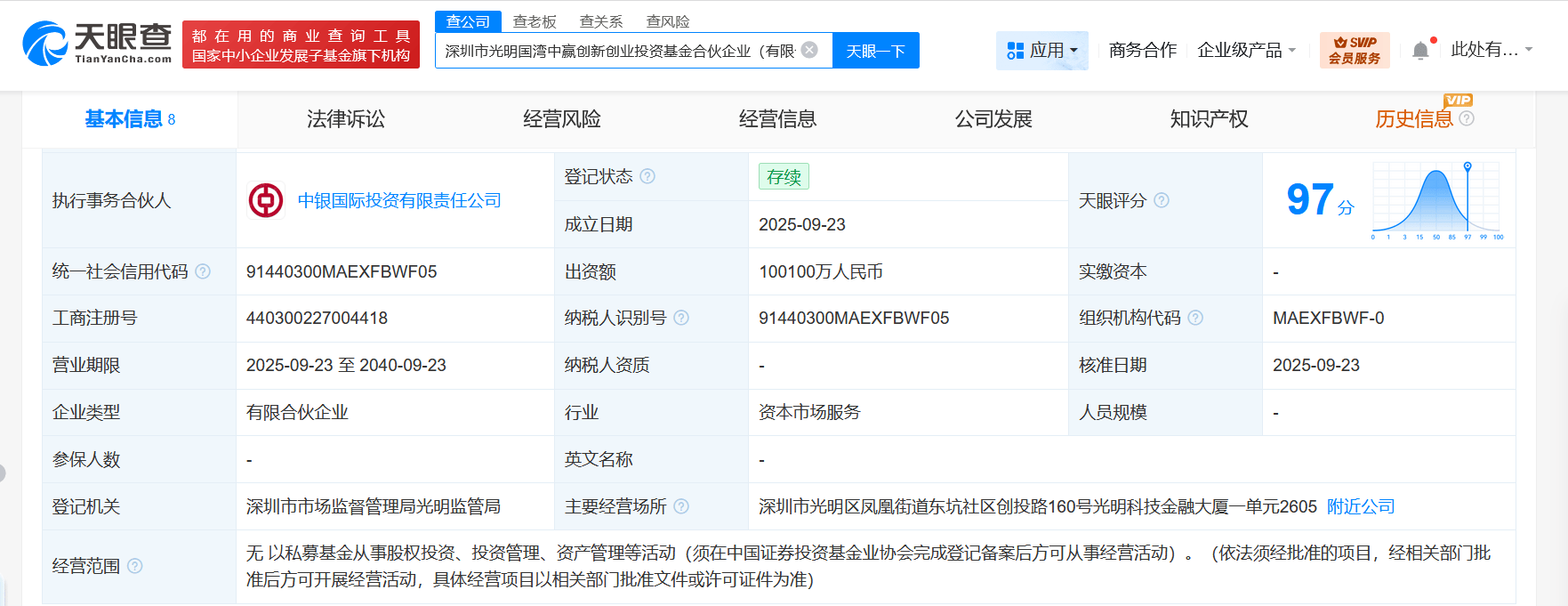
Core Insights - Shenzhen Guangming Guowan Zhongying Innovation and Entrepreneurship Investment Fund Partnership (Limited Partnership) has been established with a capital contribution of 1 billion RMB, focusing on private equity investment, investment management, and asset management [1] - The fund is a collaboration among Shenzhen Angel Investment Guidance Fund Management Co., Ltd., Bank of China International Investment Co., Ltd., Shenzhen Guangming District Guidance Fund Investment Management Co., Ltd., and Shenzhen Guangming Science City Industry Development Group Co., Ltd. [1] - A new comprehensive national science center innovation fund in the Greater Bay Area has been registered, targeting a total scale of 5 billion RMB, with an initial fund size of 1 billion RMB [1] Group 1 - The fund's operational scope includes private equity investment, investment management, and asset management activities [2] - The fund is executed by Bank of China International Investment Co., Ltd. and is registered with the Shenzhen Market Supervision Administration [2] - The fund aims to provide a one-stop nurturing space for new productive forces and will leverage the mother-fund and sub-fund structure to enhance investment capabilities [1][2]

多层次市场体系稳步构建 更好发挥资本市场枢纽功能
Shang Hai Zheng Quan Bao· 2025-09-24 19:48
Core Insights - The capital market in China has shown significant growth during the "14th Five-Year Plan" period, with total financing through stock and bond markets reaching 57.5 trillion yuan, indicating a steady increase in the proportion of direct financing [1] - The development of a multi-tiered market system has been crucial for enhancing the capital market's functionality, with a focus on supporting technological innovation and new productive forces [1][2] Group 1: Market Development - The bond market has seen cumulative issuance exceeding 52.4 trillion yuan, with a low bond default rate of around 1% during the "14th Five-Year Plan" period [2][4] - The North Exchange and the New Third Board have successfully attracted resources towards innovative small and medium-sized enterprises, with 276 companies listed on the North Exchange and over 14,000 companies served by the New Third Board [2] - The introduction of various listing standards, including the "1+6" reform for the Sci-Tech Innovation Board, has expanded the scope for industries such as artificial intelligence and commercial aerospace [1][2] Group 2: Financial Products and Innovation - The market for Sci-Tech Innovation Bonds has rapidly grown, with the first batch of 10 ETFs surpassing 110 billion yuan in total scale, indicating a strong demand for innovative financial products [3] - The futures market has expanded to include 157 products, enhancing its role in price discovery and risk management across key sectors of the economy [3] - The REITs market has also gained momentum, with 79 public REITs registered and nearly 200 billion yuan raised, indicating a growing interest in infrastructure financing [4] Group 3: Future Outlook - The China Securities Regulatory Commission emphasizes the need for a more adaptable multi-tiered market system to better support innovation and the growth of quality enterprises [4] - Continued reforms and innovations in the bond and futures markets are expected to align more closely with the needs of the real economy, enhancing the capital market's effectiveness in supporting high-quality development [4]
“四更”之变让资本市场生态系统性重塑
Jin Rong Shi Bao· 2025-09-24 02:54
Core Insights - The capital market has undergone significant changes over the past year, driven by systematic reforms and enhanced regulations aimed at improving market confidence and stability [1][2][3]. Group 1: Institutional Improvements - A comprehensive reform of the capital market has been initiated since September last year, focusing on optimizing merger and acquisition mechanisms, promoting long-term capital inflows, and enhancing market value management [1]. - The introduction of new monetary policy tools by the People's Bank of China has supported the stable development of the stock market [1]. - The launch of the "1+6" policy combination for the Sci-Tech Innovation Board and the implementation of a third set of standards for the Growth Enterprise Market have improved the market's inclusivity for unprofitable innovative companies [1]. Group 2: Regulatory Enhancements - Regulatory measures have maintained a high-pressure environment, with a comprehensive enforcement system established to combat financial fraud and information disclosure violations [2]. - Over 80 listed companies and related responsible parties have received notices of investigation from the China Securities Regulatory Commission since 2025, with approximately 80% related to information disclosure violations [2]. - The regulatory focus has shifted from "single-point accountability" to "ecological co-governance," increasing the costs of violations and enhancing the deterrent effect on market misconduct [2]. Group 3: Market Dynamics - The improvements in institutional frameworks and regulatory measures have fostered a safer environment for high-quality development of listed companies, shifting their focus from short-term stock price fluctuations to long-term competitiveness and innovation [3]. - The total cash dividends of A-share listed companies reached a historical high of 2.4 trillion yuan for the 2024 fiscal year, with a total of 649.7 billion yuan in cash dividends distributed since 2025 [3]. - The A-share market's total market capitalization surpassed 100 trillion yuan in August, driven by both the increase in the number of listed companies and positive market performance [3]. Group 4: Trading Activity - Since September 2025, the average daily trading volume in the A-share market has increased to approximately 2.5 trillion yuan, compared to 550 billion yuan in the same period last year [4]. - The balance of margin financing has risen from 1.26 trillion yuan to 2.29 trillion yuan, indicating a growing risk appetite among investors [4]. - Despite the overall positive sentiment in the market, there are still disparities in experiences among different market participants, with some feeling restricted by new regulations while others face pressures from increased competition [4].
德勤中国:预计香港新股市场2025年前三季度融资额稳居全球第一
Zhong Zheng Wang· 2025-09-23 15:02
Core Insights - Deloitte China projects that the Hong Kong IPO market will maintain the highest fundraising amount globally in the first three quarters of 2025, with an adjusted annual fundraising range of HKD 250 billion to HKD 280 billion [1][2] Group 1: Market Performance - The Hong Kong IPO market is expected to see 66 new listings raising HKD 182.3 billion in the first three quarters of 2025, representing a 47% increase in the number of new listings and a 228% increase in fundraising compared to the same period last year [1] - The market is anticipated to remain robust, with several large IPOs exceeding HKD 10 billion successfully listed [1] Group 2: Factors Driving Growth - Key factors contributing to the strong performance include regulatory encouragement for mainland leading companies to list in Hong Kong, optimization of the new listing application approval process, and a significant improvement in liquidity due to the return of international capital to the Hong Kong stock market [1] - The expected diversity in the sources of issuers and investment funds will further solidify Hong Kong's role as an international financial center [2] Group 3: Future Outlook - The forecast for the entire year of 2025 includes 80 new IPOs, with the fundraising scale projected to be between HKD 250 billion and HKD 280 billion, highlighting the prominence of pharmaceutical, specialized technology, and consumer companies in the market [1] - The anticipated easing of monetary policy by the Federal Reserve is expected to attract more overseas funds seeking high-growth investment opportunities in Asia, providing liquidity support for several large IPOs in Hong Kong in the fourth quarter of this year [2]
成都未来产业创业投资发展基金成立 出资额40亿
Sou Hu Cai Jing· 2025-09-23 06:09
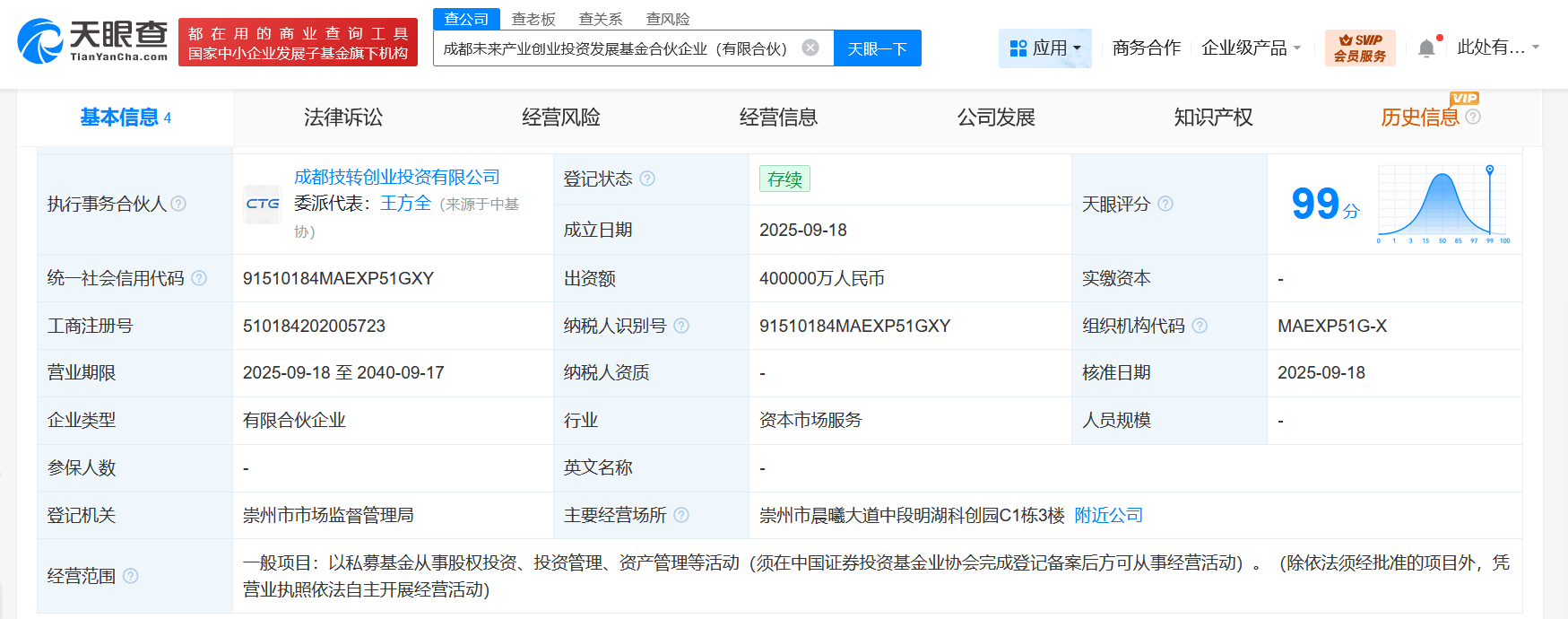
Core Viewpoint - Chengdu Future Industry Venture Capital Development Fund has been established with a total investment of 4 billion RMB, focusing on private equity investment, investment management, and asset management activities [1] Group 1: Fund Information - The fund is a limited partnership, with Chengdu Technology Transfer Venture Capital Co., Ltd. as the executive partner [1] - The fund's establishment date is September 18, 2025, and it will operate until September 17, 2040 [1] - The fund is co-funded by Chengdu Industrial Investment Group Co., Ltd. and Chengdu Technology Transfer Venture Capital Co., Ltd. [1] Group 2: Operational Scope - The fund's business scope includes private equity investment, investment management, and asset management, which must comply with regulations from the Asset Management Association of China [1] - The fund is registered with the Chongzhou Market Supervision Administration [1]
分红回购创新高折射积极信号
Shen Zhen Shang Bao· 2025-09-22 23:13
Core Insights - The awareness of listed companies in China to return profits to investors has significantly increased, with over 10.6 trillion yuan distributed through dividends and buybacks during the "14th Five-Year Plan" period, representing an 80% increase compared to the "13th Five-Year Plan" [1] - In 2023, cash dividends from listed companies reached a historical high of 2.13 trillion yuan, and this is expected to rise to 2.4 trillion yuan in 2024, alongside a buyback amount of 910.3 billion yuan, both setting new records [1] Internal Factors - The improvement in profitability and the heightened awareness of returns among listed companies are key internal drivers. In 2024, 75% of listed companies reported profits, with nearly half showing positive net profit growth, and over 500 companies experiencing net profit increases exceeding 100% [2] - The increase in dividends and buybacks, even amidst a slight decline in total net profit for A-shares last year, indicates a significant enhancement in the companies' commitment to returning value to investors [2] External Factors - Regulatory policies have played a crucial role in this transformation. The new "National Nine Articles" introduced on April 12, 2024, aims to systematically reshape the foundational systems and regulatory logic of the capital market, including strengthening cash dividend regulations for listed companies [3] - The introduction of measures to encourage buybacks and the combination of dividend policies with risk warning systems have effectively increased the willingness and action of listed companies to distribute dividends [3] Investor Confidence - The confidence of investors is largely driven by the profit-making effect, with dividends providing a tangible sense of gain. The trend of buybacks has shifted towards more frequent cancellations of repurchased shares, which directly enhances earnings per share and benefits all shareholders [4] - A robust capital market with significant profit-making effects boosts investor confidence and reinforces the value investment philosophy, thereby enhancing the financing capabilities of listed companies and promoting their growth [4]