再保险

Search documents
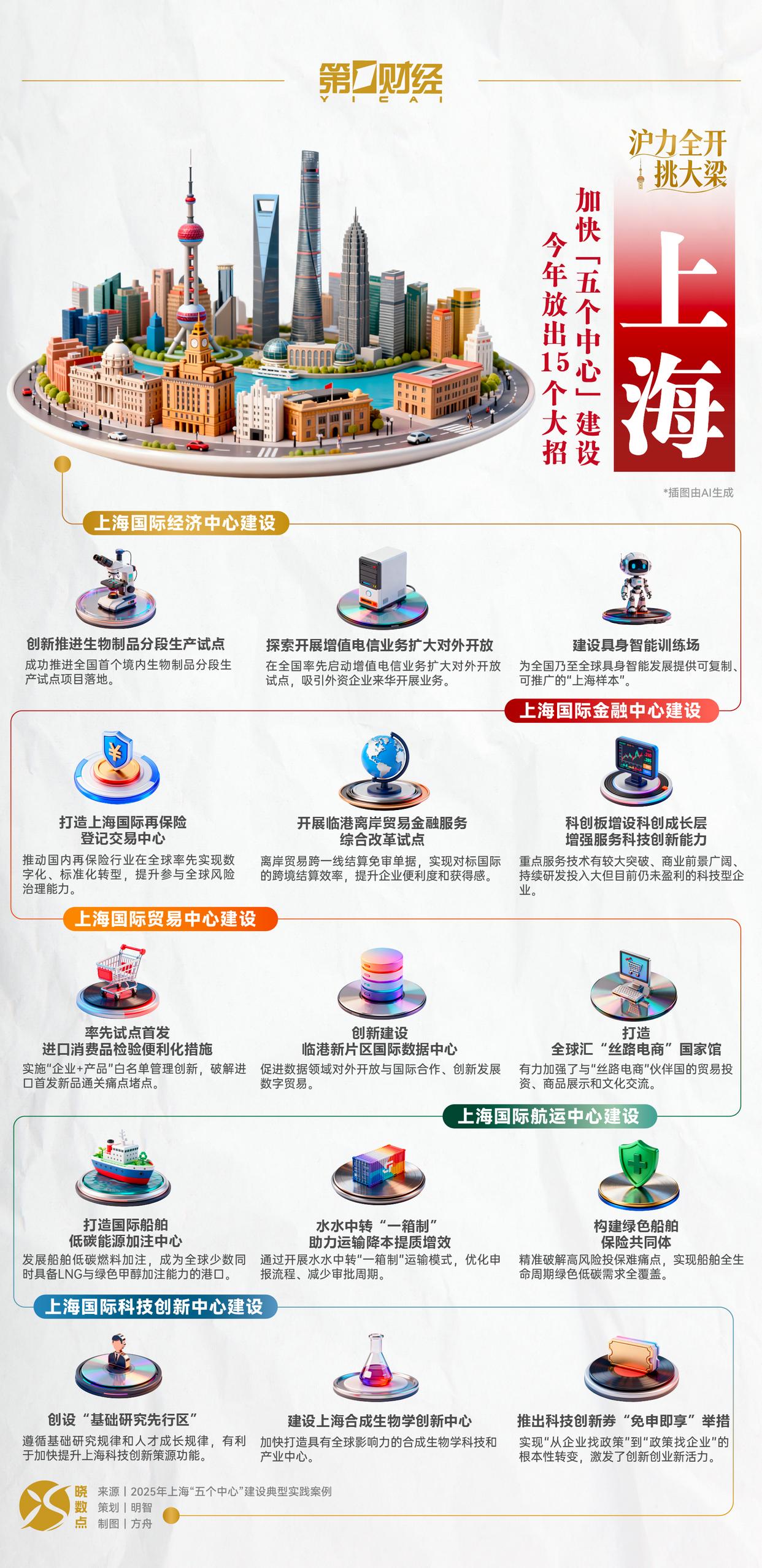
加快“五个中心”建设,上海今年放出15个大招
Di Yi Cai Jing· 2025-12-09 03:19
Group 1: Shanghai International Economic Center Development - The successful launch of China's first domestic segmented production pilot project for biological products [2] - Initiation of a pilot program for expanding value-added telecommunications services to attract foreign investment [2] - Establishment of a digital and standardized transformation in the domestic reinsurance industry to enhance global risk governance capabilities [2] Group 2: Shanghai International Trade Center Development - Implementation of a "white list" management innovation for the inspection of imported consumer goods to streamline customs clearance for new products [4] - Development of an international data center in the Lingang New Area to promote data openness and international cooperation in digital trade [4] - Creation of a low-carbon energy refueling center for ships, positioning Shanghai as one of the few ports capable of LNG and green methanol refueling [4] Group 3: Shanghai International Technology Innovation Center Development - Establishment of a "basic research pilot zone" to enhance Shanghai's technological innovation capabilities [5] - Development of a synthetic biology innovation center to create a globally influential technology and industry hub [5] - Introduction of innovation vouchers that shift the approach from "finding policies from enterprises" to "policies finding enterprises," stimulating innovation and entrepreneurship [5]

中国再保高层调整:朱晓云拟任总裁、田美攀拟任副总裁
2 1 Shi Ji Jing Ji Bao Dao· 2025-12-08 13:29
据了解,田美攀多年深耕寿险再保险专业,曾参与中国偿付能力二代制度体系设计,开创跨境人民币再 保险业务,多次牵头编制生命表、重疾表等重大研究项目,大力推动商业医疗险发展,创新开发特药 险、创新支付、长护失能险等行业标杆产品。 21世纪经济报道记者获悉,中国再保已召开干部会议,宣布原党委委员、副总裁朱晓云任集团公司党委 副书记、拟任总裁,原总裁助理田美攀任集团公司党委委员、拟任副总裁。 中国再保表示,相信其履新后,将充分发挥在精算、保险、金融、风险管理等领域的专业优势,与管理 团队形成合力,立足"十五五"新起点谋篇布局,坚定不移走好中国特色金融发展之路,向着建设"世界 一流"综合性再保险集团目标不断奋进。 公开资料显示,朱晓云,2021年11月起任中国再保副总裁,2025年2月起任执行董事,历任中国再保董 事会办公室副主任、办公室(党委办公室)主任、党委组织部部长、人力资源部总经理、董事会秘书、 中再产险董事长、华泰经纪董事、中国金融传媒董事,兼任首都女金融家协会副会长,亚非保险再保险 联合会(FAIR)执委会代表。 中国再保表示,相信其履新后,凭借丰富的专业知识和实践经验、优秀的领导才能及创新思维,能够与 管理 ...
中国再保迎来首位女性总裁,组建全员“70后”班底
Xin Lang Cai Jing· 2025-12-08 11:28
来源:喻观财经 还有20多天,就要进入2026年了。2026年,是中国再保险(集团)股份有限公司(下称"中国再保", 1508.HK)成立30周年,亦是"十五五"开局之年。 在这个重要的历史节点,中国再保完成了领导班子焕新。 8月29日,中国再保党委书记、董事长和春雷到龄荣休,党委副书记、总裁庄乾志接任党委书记。 9月18日,庄乾志获委任为中国再保第五届董事会董事长,同时辞去总裁之职,即日起代为履行董事长 职务,并作为临时负责人代行公司总裁职权,直至新任总裁正式履职之日止。 庄乾志升任董事长两个多月后,总裁之职的新人选亦已确定。12月8日,中国再保召开干部会议,宣布 中国再保执行董事、副总裁朱晓云任中国再保党委副书记、拟任总裁。 待相关程序完成后,庄乾志和朱晓云将分别出任中国再保董事长和总裁。朱晓云将成为中国再保史上首 位女性总裁。 同批履新的还有田美攀,他将从中国再保总裁助理升为拟任副总裁。 待庄乾志和朱晓云正式履新后,中国再保从董事长、总裁、纪委书记、副总裁到总裁助理,已皆为"70 后"。这是目前中字头国有保险公司中最年轻的一支管理团队。 在这支年轻管理团队的带领下,中国再保这家老牌再保险公司踏上了高质量 ...

中国再保人事调整:朱晓云拟任总裁,田美攀拟任副总裁
Bei Jing Shang Bao· 2025-12-08 11:15
田美攀,毕业于南开大学金融学专业,经济学硕士,具有北美精算师、中国精算师资格。曾任南开大学 保险系教师,中再寿险风险管理部精算处处长、部门副总经理,中再寿险副总精算师、精算责任人、总 精算师、党委委员、副总经理、党委副书记、总经理、党委书记、董事长,现任中国再保总裁助理、总 精算师、财务负责人等。 北京商报讯(记者 李秀梅)12月8日,北京商报记者了解到,中国再保险(集团)股份有限公司(以下 简称"中国再保")召开干部会议,宣布原党委委员、副总裁朱晓云任集团公司党委副书记、拟任总裁, 原总裁助理田美攀任集团公司党委委员、拟任副总裁。 简历显示,朱晓云,2021年11月起任中国再保副总裁,2025年2月起任执行董事,历任中国再保董事会 办公室副主任、办公室(党委办公室)主任、党委组织部部长、人力资源部总经理、董事会秘书、中再 产险董事长、华泰经纪董事、中国金融传媒董事,兼任首都女金融家协会副会长,亚非保险再保险联合 会(FAIR)执委会代表。 ...
晓数点丨加快“五个中心”建设,上海今年放出15个大招
Di Yi Cai Jing· 2025-12-08 07:24
12月7日,上海市加快推进"五个中心"建设领导小组办公室聚焦具有首创性、引领性的重大改革事项和政策创新试点,遴选发布了2025年上海"五个中心"建 设典型实践案例。 离岸贸易跨一线结算免审单据,实现对 的跨境结算效率,提升企业便利度和获得 上海国际贸易中心建设 成功推进全国首个境内生物制品分段生 产试点项目落地。 在全国率先启动增值电信业务扩大对 试点,吸引外资企业来华开展业务。 打造上海国际再保险 登记交易中心 推动国内再保险行业在全球率先实现数 字化、标准化转型,提升参与全球风险 治理能力。 开展临港离岸贸易金融服务 综合改革试点 率先试点首发 进口消费品检验便利化措施 实施"企业+产品"白名单管理创新,破解进 口首发新品通关痛点堵点。 创新建设 临港新片区国际数据中心 促进数据领域对外开放与国际合作、创 数字贸易。 打造国际船舶 水水中转"一箱制" 低碳能源加注中心 助力运输降本提质增效 发展船舶低碳燃料加注,成为全球少数同 通过开展水水中转"一箱制"运输模式, 时具备LNG与绿色甲醇加注能力的港口。 报流程、减少审批周期。 官海国际科技创新中心建设 创设"基础研究先行区" 遵循基础研究规律和人才成长规 ...

15个典型案例出炉!上海“五个中心”建设亮出阶段性“成绩单”
Xin Hua Cai Jing· 2025-12-07 14:11
Core Insights - The seminar held in Shanghai on December 7 focused on accelerating the construction of the "Five Centers" during the 14th Five-Year Plan period, addressing new opportunities and challenges arising from significant changes in domestic and international development [1] Group 1: Innovation in Biopharmaceuticals - Shanghai has initiated a pilot project for segmented production of biopharmaceuticals, successfully launching the first domestic project for innovative drug production, attracting an investment of 3.14 billion yuan from Roche and other companies [2] - The segmented production model has been incorporated into local regulations, enhancing the efficiency of biopharmaceutical resource allocation [2] Group 2: Telecommunications and Digital Services - Shanghai has become the first in the country to pilot the expansion of value-added telecommunications services, allowing foreign companies to operate independently in specific zones, with nine foreign enterprises currently participating [2] - This initiative aims to deepen foreign investment in digital services, including cloud computing and data processing [2] Group 3: Artificial Intelligence Development - The establishment of a large-scale humanoid robot training ground aims to transition embodied intelligence from research to practical applications, achieving a model transfer success rate of over 95% [3] - This initiative supports various sectors, including smart manufacturing and public services, enhancing robots' capabilities in complex environments [3] Group 4: International Financial Center - The Shanghai International Reinsurance Registration and Trading Center has achieved a digital and standardized transformation, with 131 institutions registered and a trading premium of 5.3 billion yuan recorded in the first ten months of 2025 [4] - A pilot reform for offshore trade finance services has been launched, significantly improving cross-border settlement efficiency for offshore trade enterprises [4] Group 5: Technology Innovation and Support - The introduction of a growth tier in the Sci-Tech Innovation Board aims to support technology companies with significant breakthroughs but currently unprofitable, with a total market value of nearly 1.3 trillion yuan for 35 listed companies [5] - The Shanghai government has implemented a "no application required" policy for technology innovation vouchers, benefiting over 30,000 small and medium-sized tech enterprises and increasing voucher orders by 60% from September to November [12] Group 6: International Trade and Data Economy - Shanghai has piloted measures for the facilitation of imported consumer goods inspections, resulting in 1,040 entries and 2,940 batches benefiting from these measures by September 2025 [7] - The construction of an international data center aims to promote data openness and cooperation, establishing a data economy industrial system that supports cross-border data flow [8] Group 7: Shipping and Maritime Innovation - Shanghai has developed a low-carbon fuel supply system for ships, becoming one of the few ports globally capable of supplying both LNG and green methanol, with 1.45 million cubic meters of LNG supplied to 251 vessels by October 2025 [9] - The implementation of a "one-box" water-to-water transfer model has significantly improved logistics efficiency in the Yangtze River Delta region, with increases in cargo declaration numbers and operational efficiency exceeding 30% [9]
太平再保险:将按照再保险合约积极履行赔付责任,为太平香港快速理赔提供全力支持
Xin Lang Cai Jing· 2025-12-01 14:39
11月26日下午,香港新界大埔宏福苑发生严重火灾,造成重大人员伤亡和财产损失。 12月1日,智通财经记者获悉,中国太平旗下子公司太平再保险有限公司参与了中国太平保险(香港) 有限公司承保的宏福苑相关保险。火灾发生后,太平再保险迅速成立应急工作组,全面排查承保业务和 转分保安排,积极与太平香港对接理赔方案。在太平香港定损核赔后,将按照再保险合同约定积极履行 赔付责任,为太平香港快速理赔提供全力支持,助力火灾善后工作。 ...

另类投资简报 | 对冲基金资产规模飙新高5万亿;基金公司为争人才豪掷3千万
彭博Bloomberg· 2025-11-24 06:05
Private Equity Market Review - The article provides an overview of the private equity market, highlighting recent trends and activities in the sector [2]. Hedge Fund Market Overview - The Bloomberg Hedge Fund Index showed a preliminary increase of 1.1% in October, with a year-to-date rise of 11% [4]. - Equity hedge funds performed the best, with a year-to-date increase of 17% [4]. - The total assets in the global hedge fund industry reached a record $5 trillion, driven by strong inflows of nearly $34 billion in the last three months [4]. Industry Highlights - There is a growing competition for talent in the gold trading sector, as trade companies, hedge funds, and banks are actively hiring specialized gold traders, leading to rising compensation in this niche market [4]. - Shareholders of the well-known Chinese condom and sexual wellness brand, Jissbon, are considering selling a minority stake of approximately 20% to 30% of the business, with potential buyers including private equity firms CVC Capital Partners and Advent [4]. Performance Overview - The performance of various hedge fund strategies as of October 31, 2025, includes: - Equity Hedge: 1.28% monthly return, 16.59% year-to-date [5] - Credit Hedge: 0.59% monthly return, 6.58% year-to-date [5] - Event Driven Hedge: 0.62% monthly return, 9.04% year-to-date [5] - Macro Hedge: 1.15% monthly return, 7.28% year-to-date [5] - Relative Value Hedge: 1.27% monthly return, 9.11% year-to-date [5] Notable Transactions - KKR is in negotiations to acquire a minority stake in Hong Kong's Dingrui Reinsurance Company [6].

金融监管总局:同意中国财产再保险有限责任公司发行不超40亿元资本补充债券
Di Yi Cai Jing· 2025-11-21 01:34
Core Viewpoint - The National Financial Regulatory Administration has approved China Property Reinsurance Co., Ltd. to publicly issue up to RMB 4 billion of 10-year redeemable capital supplement bonds in the national interbank bond market [1] Group 1 - The bond issuance is aimed at enhancing the capital structure of China Property Reinsurance Co., Ltd. [1] - The bonds will have a maturity period of 10 years, indicating a long-term financing strategy [1] - The approval reflects regulatory support for the company’s efforts to strengthen its financial position [1]
前海再保险副总经理(主持工作)刘红:中国保险与再保险业的国际化是必答题
Shang Hai Zheng Quan Bao· 2025-11-17 19:14
Core Viewpoint - The insurance and reinsurance industries are facing increasing complexities and demands for risk management due to frequent extreme weather events and global economic uncertainties. Reinsurance serves as a crucial tool for risk diversification and presents development opportunities in this context [3]. Group 1: Development of Reinsurance in China - The Shanghai International Reinsurance Registration and Trading Center has achieved a cumulative trading scale of 4.5 billion and a cumulative registration scale of nearly 110 billion by the end of Q3 this year, indicating steady growth [4]. - The center has improved market efficiency and provided tangible benefits for insurance companies through policy optimization, rule enhancement, and system development [4]. - The establishment of national reinsurance data interaction standards has significantly reduced transaction costs and operational risks, enhancing internal operational efficiency and market transparency [4][5]. Group 2: Addressing Climate Change - Extreme weather events have led to significant losses globally, with meteorological disasters accounting for 88% of total losses and 98% of insurance payouts in the first half of 2025 [7]. - The insurance industry faces both challenges and opportunities due to climate change, necessitating innovative insurance products to address emerging climate risks [7]. - The introduction of AI-driven flood catastrophe models has reduced the development cycle from 2-4 years to 4-12 months, showcasing a shift towards more efficient risk modeling [8]. Group 3: Opportunities for Chinese Enterprises Going Global - The acceleration of Chinese enterprises' international expansion, particularly in the new energy vehicle sector, has created new insurance demands due to various risks such as political and supply chain risks [9]. - The internationalization of the insurance industry is essential for supporting Chinese enterprises abroad and is a key component of the globalization of the Chinese financial system [9]. - The company prioritizes markets where sustainable business relationships can be established with local partners and emphasizes the importance of market familiarity in its overseas strategy [10].