
征信

Search documents
个人征信持牌机构入局可信数据空间建设 钱塘征信“先行先试”
Zhong Guo Jing Ying Bao· 2025-10-21 12:25
Core Insights - Qiantang Credit has recently become a licensed personal credit institution in Zhejiang, aiming to create a trustworthy data space for individuals by integrating public and commercial data [1][2] - The initiative is part of Zhejiang's exploration of a "personal credit economy," which seeks to enhance the value of personal credit through effective management tools [1] - The chairman of Qiantang Credit emphasizes that the personal credit economy will help individuals realize "credit as an asset," fostering a sustainable economic ecosystem [1] Group 1: Company Developments - Qiantang Credit has been authorized as a public data operator in Zhejiang, marking a significant step in the establishment of a personal credit management system [1] - The company plans to implement its services in various sectors, including credit services and flexible employment, by reducing information asymmetry and transaction costs [1][2] - Qiantang Credit has integrated nearly 100 compliant commercial data sources, showcasing a new path for the fusion of public and commercial data in the credit sector [2] Group 2: Industry Context - The model being developed by Qiantang Credit bears similarities to South Korea's MyData service, which empowers individuals to manage and share their data [2][3] - MyData has successfully attracted over 50 million subscribers in South Korea, generating significant revenue and fostering a data-driven ecosystem [2] - Experts suggest that China's higher level of digital governance and public data infrastructure, combined with a larger user base, presents a substantial market demand for personal credit management services [3]
金融教育宣传周|工银瑞信基金:非法金融活动剖析 避开投资“陷阱”
Xin Lang Ji Jin· 2025-09-18 05:53
Group 1 - The article highlights the importance of financial education and consumer protection in the financial industry, particularly during the 2025 Financial Education Promotion Week [1] - It discusses various scams targeting consumers, including fraudulent insurance policy cancellations, illegal loan intermediaries, fake credit repair services, and illegal stock recommendations [3][4] Group 2 - The article warns consumers about the risks of engaging with third-party agents for insurance cancellations, emphasizing the need to contact official insurance company customer service [3] - It outlines the deceptive practices of illegal loan intermediaries that promise easy loans without credit checks but require upfront fees [3] - The article explains the myth of credit repair services that claim to remove negative credit records through special channels, which is not possible according to regulations [4] - It also addresses the dangers of illegal stock recommendations that lure investors with promises of insider information, leading to potential financial losses [4]


八项政策措施助力上海国际金融中心建设
Jin Rong Shi Bao· 2025-08-08 07:59
Core Insights - The People's Bank of China announced eight significant financial opening measures aimed at enhancing the international competitiveness and risk management capabilities of China's financial market, while providing more efficient and diverse support for the real economy and cross-border trade [1][5] Group 1: Financial Infrastructure and Data Governance - The establishment of a trading report repository and personal credit institutions is intended to improve financial infrastructure, enhance information transparency, and provide a data foundation for macro-prudential management and precise regulation, effectively preventing systemic financial risks [2][3] - The trading report repository will aggregate and analyze high-frequency trading data across various financial sub-markets, serving financial institutions and regulatory bodies [2] - The establishment of personal credit institutions aims to optimize the credit market layout and enhance the social credit system, with market-oriented institutions expected to provide over 70 billion credit services in 2024 [3] Group 2: Cross-Border Financial Policies - The policies include optimizing the free trade account functions to facilitate efficient capital flow between quality enterprises and foreign funds, thereby enhancing the liberalization and convenience of cross-border trade and investment [5][6] - The pilot program for offshore trade financial services in the Lingang New Area aims to support the development of offshore trade, with innovations in business rules expected to improve efficiency in cross-border payment settlements and trade financing [6][7] - The "Cross-Border Refinance" pilot program initiated by the Shanghai headquarters of the People's Bank of China focuses on providing refinancing support for cross-border trade financing, alleviating financing difficulties for foreign trade enterprises [7] Group 3: Shanghai as a Financial Reform Pilot - The eight policies are primarily implemented in Shanghai, highlighting its role as a core area for institutional supply and rule experimentation, which is expected to accelerate the nationwide dissemination of successful financial reform outcomes [8][9] - The construction of the Shanghai International Financial Center is emphasized as a critical task, with many significant financial reform policies originating from Shanghai and being replicated in other regions [9]
美国联邦住房金融局局长Pulte:我们正在对所有征信机构进行全面审查。
news flash· 2025-06-27 18:10
Core Viewpoint - The Director of the Federal Housing Finance Agency, Pulte, announced a comprehensive review of all credit reporting agencies [1] Group 1 - The review aims to assess the practices and operations of credit reporting agencies [1] - This initiative is part of a broader effort to enhance the integrity and reliability of credit reporting [1] - The agency is focusing on ensuring that consumers have access to accurate credit information [1]
八项政策措施助力上海国际金融中心建设 高水平金融开放向深向实
Jin Rong Shi Bao· 2025-06-23 01:42
Group 1: Core Financial Policies - The People's Bank of China announced eight significant financial opening measures aimed at enhancing the international competitiveness and risk management capabilities of China's financial market [1][8] - These measures include the establishment of an interbank market transaction reporting database and personal credit institutions to improve financial infrastructure and data governance [2][3] Group 2: Cross-Border Financial Policies - The policies aim to facilitate cross-border trade and investment by optimizing the functions of free trade accounts and launching pilot reforms for offshore trade finance services in the Shanghai Lingang area [5][6] - The "Cross-Trade Refinance" pilot program initiated by the Shanghai headquarters of the People's Bank of China is designed to support cross-border trade financing and alleviate financing difficulties for foreign trade enterprises [7] Group 3: Data Governance and Risk Management - The establishment of a personal credit institution is part of the credit system construction, emphasizing the importance of data governance in the digital economy [3][4] - Enhanced data technology capabilities are crucial for optimizing resource allocation and improving the efficiency and quality of financial services [4] Group 4: Shanghai as a Financial Reform Hub - The eight policies are primarily focused on Shanghai, highlighting its role as a testing ground for financial reforms and the integration of finance, trade, and regulation [8][9] - Shanghai's position as a pioneer in financial reform is underscored by the recent approval of upgrades to free trade account functions and pilot programs for offshore trade finance services [9]
实施八项政策举措 进一步推进上海国际金融中心建设
Sou Hu Cai Jing· 2025-06-18 22:24
Core Viewpoint - The People's Bank of China announced eight policy measures to further advance the construction of Shanghai as an international financial center, emphasizing the need for a diversified and efficient global financial safety net and the consistency and authority of global financial regulatory rules [1][5]. Group 1: Policy Measures - Establishment of an interbank market trading report database to collect and analyze trading data across various financial sub-markets [2]. - Creation of a digital RMB international operation center to promote the internationalization of digital RMB and support financial market innovation [2]. - Establishment of personal credit institutions to provide diversified credit products and enhance the social credit system [3]. - Launch of offshore trade finance service reform pilot in the Lingang New Area to support the development of offshore trade [4]. - Development of offshore bonds in the free trade zone to broaden financing channels for enterprises involved in the Belt and Road Initiative [4]. - Optimization of free trade account functions to enhance the efficiency of cross-border trade and investment [4]. - Implementation of innovative structural monetary policy tools in Shanghai, including blockchain credit refinancing and carbon reduction support tools [4]. - Collaboration with the China Securities Regulatory Commission to promote RMB foreign exchange futures trading to improve the foreign exchange market product series [4]. Group 2: Global Financial Governance - Discussion on the need to reduce reliance on a single sovereign currency and promote a competitive environment among a few strong sovereign currencies to enhance the resilience of the international monetary system [5]. - The potential for Special Drawing Rights (SDR) to serve as a super-sovereign international currency, though facing challenges in political consensus and market depth [5]. - Emphasis on the importance of a diversified global cross-border payment system and the role of emerging technologies in reshaping traditional payment systems [6][7]. - Recognition of the challenges facing the global financial stability framework, including fragmented regulatory frameworks and insufficient regulation of non-bank intermediaries [7]. - The need for a strong IMF to build a diversified and efficient global financial safety net and to adjust the quota shares to reflect member countries' positions in the global economy [7].
重磅!央行宣布8项金融开放举措
证券时报· 2025-06-18 02:14
Core Viewpoint - The article discusses eight significant financial opening measures announced by the People's Bank of China at the 2025 Lujiazui Forum, aimed at enhancing Shanghai's financial market and promoting internationalization of the Renminbi. Group 1: Financial Infrastructure Development - Establishment of an interbank market trading report database to collect and analyze trading data across various financial sub-markets, aiding financial institutions and regulatory bodies [2][3][10] - Creation of a digital Renminbi international operation center to facilitate the internationalization of digital currency and support financial market innovation [2][4][11] - Formation of a personal credit agency to provide diversified credit products and improve the social credit system [2][5][12][13] Group 2: Offshore Trade and Financing - Launch of a comprehensive reform pilot for offshore trade financial services in the Lingang New Area of Shanghai, aimed at innovating business rules to support offshore trade [2][6][14] - Development of free trade offshore bonds, adhering to international standards to expand financing channels for enterprises involved in the Belt and Road Initiative [2][6][15] Group 3: Trade and Investment Facilitation - Optimization and upgrading of free trade account functions to enhance efficient capital flow between quality enterprises and foreign funds, improving the liberalization of cross-border trade and investment [2][6][16] - Implementation of innovative structural monetary policy tools in Shanghai, including pilot projects for blockchain credit refinancing and cross-border trade refinancing [2][7][18] Group 4: Currency Risk Management - Collaboration with the China Securities Regulatory Commission to promote Renminbi foreign exchange futures trading, enhancing the product offerings in the foreign exchange market to better manage exchange rate risks for financial institutions and foreign trade enterprises [2][7][19]

央行宣布八项重磅金融开放举措
财联社· 2025-06-18 01:55
Core Viewpoint - The People's Bank of China announced eight significant financial policies aimed at enhancing the financial market infrastructure, promoting digital currency, and improving credit systems, which are expected to facilitate international trade and investment [1][2]. Group 1: Financial Market Infrastructure - Establishment of an interbank market trading report database to systematically analyze trading data across various financial sub-markets, aiding financial institutions and regulatory bodies [1] - Launch of a digital RMB international operation center to promote the internationalization of digital currency and support financial market development [1] Group 2: Credit and Trade Innovations - Creation of a personal credit institution to provide diversified credit products for financial institutions, enhancing the social credit system [1] - Implementation of comprehensive reform pilot for offshore trade finance services in the Shanghai Lingang New Area to support offshore trade development [1] Group 3: Financing and Investment Channels - Development of offshore bonds following international standards to broaden financing channels for enterprises involved in the Belt and Road Initiative [1] - Optimization of free trade account functions to facilitate efficient capital flow between quality enterprises and foreign funds, enhancing cross-border trade and investment [1] Group 4: Monetary Policy Innovations - Introduction of structural monetary policy tools in Shanghai, including pilot projects for blockchain credit refinancing and cross-border trade refinancing [1] - Collaboration with the China Securities Regulatory Commission to promote RMB foreign exchange futures trading, improving the product offerings in the foreign exchange market [2]

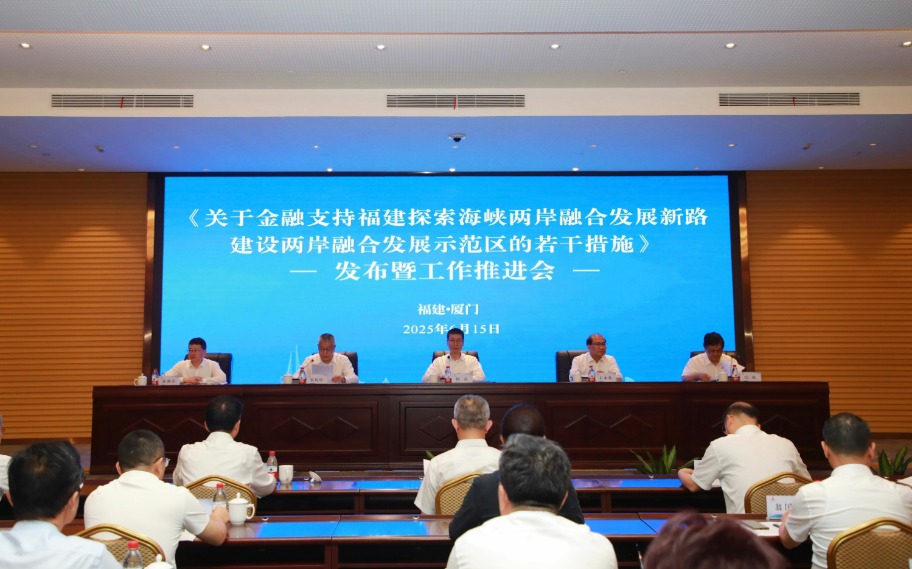
金融支持两岸融合发展示范区建设政策发布会在厦举行 加快建设“台胞台企登陆第一家园”
Xin Hua Cai Jing· 2025-06-15 16:21
Core Viewpoint - The People's Bank of China and the State Administration of Foreign Exchange have jointly issued measures to support the exploration of new paths for cross-strait integration development in Fujian, aiming to enhance financial support for cross-strait exchanges and interactions [1][3]. Financial Support for Cross-Strait Integration - The measures focus on optimizing the financial ecosystem for a shared "living circle" between the two sides, allowing banks in Fujian to handle cross-border RMB transactions for Taiwanese residents involved in legal property transactions [3]. - Banks in Fujian are encouraged to enhance payment services for foreign personnel and improve foreign currency exchange services, including the installation of self-service currency exchange machines [3]. Cross-Border Trade and Investment Facilitation - Fujian will pilot high-level openness in cross-border trade in cities like Fuzhou, Xiamen, and Quanzhou, facilitating foreign exchange payments for qualified enterprises [4]. - The measures allow for net settlement of trade receipts and payments, and streamline the process for special refunds in goods trade without prior registration [4]. Capital Account Cross-Border Financing - Taiwanese enterprises in Fujian can reinvest without registration, and banks will directly handle foreign debt and overseas listing registrations for eligible enterprises [5][6]. - The establishment of integrated currency pools for qualified enterprises is supported, allowing for centralized management of domestic and foreign currency funds [6]. Strengthening Financial Regulation - The measures emphasize the importance of financial regulation to prevent and mitigate risks, with regular monitoring of pilot banks and enterprises to ensure stable cross-border capital flows [7]. - The People's Bank of China and the State Administration of Foreign Exchange will work to implement these measures effectively, providing robust financial support for the development of the cross-strait integration demonstration zone [7].
中国互联网金融协会召开数字征信助力普惠金融发展工作交流会
news flash· 2025-06-12 02:16
Core Viewpoint - The China Internet Finance Association held a conference to promote digital credit standards aimed at supporting the development of inclusive finance, emphasizing the importance of digital credit in enhancing financial services and addressing information asymmetry [1][3]. Group 1: Digital Credit Standards - The association released three key standards: "Digital Credit Scoring Guidelines," "Guidelines for the Application of Public Data in Enterprise Credit," and "Credit Evaluation Guidelines for Small and Micro Enterprises and Individual Business Owners" [1][2]. - The "Digital Credit Scoring Guidelines" aim to provide a unified framework for developing digital credit scores, enhancing accuracy and objectivity in credit assessments [2]. - The "Guidelines for the Application of Public Data in Enterprise Credit" are designed to improve the usability and accuracy of public data in enterprise credit activities, promoting its integration [2]. Group 2: Support for Inclusive Finance - High Ming highlighted the need for a robust social credit system and legal framework to support a credit economy, aligning with the central government's focus on inclusive finance and technological innovation [3]. - The conference featured discussions on how digital credit can alleviate information asymmetry and support high-quality development in inclusive finance, reflecting the central financial meeting's objectives [3]. - The association plans to continue developing standards and guidelines in response to emerging trends in the digital credit industry, contributing to the construction of China's digital economy and social credit system [4].