Funds

Search documents
中邮基金换帅:张涛接棒董事长,毕劲松到龄退休
Nan Fang Du Shi Bao· 2025-12-18 14:33
12月17日,中邮创业基金管理股份有限公司(下称"中邮基金")发布公告称,公司董事长毕劲松因年满 退休,于12月16日正式离任;同日,首创证券党委书记、董事长张涛正式接任中邮基金董事长一职。此 次高管变更与股东方首创证券的人事调整一脉相承,引发市场对中邮基金未来战略布局的关注。 | 基金管理人名称 | 中邮创业基金管理股份有限公司 | | --- | --- | | 公告依据 | 《公开募集证券投资基金信息披露管理办 | | | 法》、《证券基金经营机构董事、监事、高 | | | 级管理人员及从业人员监督管理办法》等 | | | 相关法律法规 | | 高管变更类型 | 新任基金管理公司董事长,离任基金管理 | | | 公司董事长 | 张涛履新: 深耕金融二十余载,证券期货经验丰富 公开资料显示,张涛生于1972年,现年53岁,拥有博士研究生学历,正高级经济师职称。其职业履历横 跨证券、期货及综合金融领域,具备丰富的机构管理经验。 过往从业经历显示,张涛早期任职于华泰证券,从总裁办公室总裁秘书起步,历任投资银行一部业务经 理、福州办事处副主任、上海总部投资银行业务部副总经理(主持工作)、深圳总部副总经理(主持工 ...


黄金基金ETF(518800)近20日资金净流入超7亿元,机构称短期震荡不改长期支撑逻辑
Mei Ri Jing Ji Xin Wen· 2025-12-18 02:18
中长期看,黄金价格中枢仍有望上行,投资者或可考虑后续回调参与、逢低分批布局。关注直接投资实 物黄金,免征增值税的黄金基金ETF(518800),覆盖黄金全产业链股票的黄金股票ETF(517400)。 南京证券指出,黄金具有商品、货币、金融投资三重属性。其货币属性与美元指数关联紧密,金融投资 属性体现为实际利率是黄金的持有成本,同时具备避险和抗通胀特性。美联储降息周期下,美债实际利 率下行将降低黄金投资机会成本,叠加美国经济走软预期增强黄金避险需求,历史复盘显示2019年降息 后黄金价格涨幅超40%,预计本轮降息空间更大,黄金价格震荡向上概率较高。此外,地缘政治冲突推 动黄金避险需求,全球央行持续净购金(中国黄金储备连续13个月增加)支撑黄金中枢价格,当前金价 已站稳4000美元/盎司上方,在避险情绪未平息前易涨难跌。 风险提示:提及个股仅用于行业事件分析,不构成任何个股推荐或投资建议。指数等短期涨跌仅供参 考,不代表其未来表现,亦不构成对基金业绩的承诺或保证。观点可能随市场环境变化而调整,不构成 投资建议或承诺。提及基金风险收益特征各不相同,敬请投资者仔细阅读基金法律文件,充分了解产品 要素、风险等级及收益分 ...
低利率时代,如何解锁财富管理新方式?解码投资新逻辑
Nan Fang Du Shi Bao· 2025-12-18 02:12
Core Viewpoint - The capital market is undergoing significant reforms since 2025, shifting from a "savings-led" to an "asset allocation" approach, driven by low interest rates and increasing demand for wealth management [2] Group 1: Financial Industry Trends - The 14th Annual Financial Industry Evaluation, themed "Innovative Services Benefit the Public, Financial Empowerment Starts Anew," has been launched to highlight inclusive financial innovations in 2025 [2] - The evaluation focuses on five dimensions: product innovation, service model upgrades, digital technology empowerment, precise support for the real economy, and value ecosystem protection [3][4] Group 2: Evaluation Framework - The evaluation framework emphasizes the design and implementation of inclusive financial products, assessing whether institutions lower investment thresholds and optimize product structures to meet diverse investor needs [3] - It also evaluates the effectiveness of institutions transitioning from "sell-side sales" to "buy-side advisory," including the establishment of professional asset allocation research systems and personalized service offerings [3] Group 3: Innovation in Financial Products - The selected cases showcase a trend towards "low thresholds, high adaptability, and favorable rates," with leading ETFs reducing management fees to attract investors and promote industry-wide fee reforms [6] - Institutions are increasingly adopting a "full-cycle companion" service model, enhancing service professionalism and customer loyalty through tailored offerings and intelligent tools [6] Group 4: Empowering the Real Economy - Innovative financial tools like asset-backed securities (ABS) are being used to help specialized small and medium enterprises convert technology patents into financing capital [7] - Selected cases reflect a dual focus on technological advancement and social value, integrating financial products with social welfare initiatives [7] Group 5: Upcoming Event - The awards for the "New Wealth New Investment Pioneer Cases" will be announced at a themed event on December 23, 2025, in Guangzhou, showcasing the achievements of various institutions in exploring inclusive financial pathways [8] - The event aims to gather industry insights and promote a consensus on the future direction of the financial sector, emphasizing the importance of compliance and public trust [8]

110亿资金净流入A500ETF,谁在大举买入?
财联社· 2025-12-18 01:20
以下文章来源于创业板观察 ,作者闫军 创业板观察 . 创业板观察致力于发布深交所创业板的市场发展、政策变化、监管导向、上市企业动态等的及时信息,提供有价值的市场资讯。 A股上演绝地大反攻!12月18日,最新规模数据显示,股票ETF果真获得资金近百亿净流入,其中A500ETF成最大赢家,净流入超110亿 元。 A股震荡一个月后在12月17日午后上演反攻,沪深300ETF异动引发小作文猜想:神秘资金是不是又来了? 这一次大资金进击,放巨量的主角是A500ETF。 截至收盘,5只A500ETF领跑市场,合计成交额合计达452.91亿元,其中,华泰柏瑞 A500ETF成交额达141.18亿元,华夏A500ETF以97.54亿元次之,南方、国泰、易方达旗下A500ETF成交额紧随其后。 华泰柏瑞沪深300ETF排名成交额第六,全天成交50.79亿元,4只头部沪深300ETF合计成交额为80.8亿元,并没有显著放量。 整体来看,全市场A500ETF合计成交额达525.75亿元,是沪深300ETF合计成交额(169.5亿元)的3倍之多。 从资金净流入数据更新,谁被大举买入进一步清晰,规模型股票ETF单日合计净流入96.58 ...

11月香港互认基金月报:资金强劲流入态势持续
Morningstar晨星· 2025-12-18 01:05
Core Insights - The article highlights a strong net inflow of funds into Hong Kong mutual recognition funds in November 2025, with significant contributions from various fund types [1][6]. Fund Performance - The Swiss Pictet Strategy Income Fund led the monthly net inflow with nearly 1.2 billion yuan, focusing on flexible allocation in global equities and fixed income securities [1]. - The Morgan Asian Dividend Fund attracted the most capital among equity funds, aiming to exceed its benchmark, the MSCI All Country Asia Pacific (ex-Japan) Net Total Return Index, by 30 percentage points [1]. - The Amundi Innovation Growth Equity Fund regained investor interest, ranking among the top ten for net inflows, primarily investing in companies benefiting from innovative business models [1]. - In fixed income, the demand for Asian bond funds remained stable, with the Bank of China Hong Kong All-Weather Asian Bond Fund and East Asia Union Asian Strategy Bond Fund ranking second and seventh in net inflows, respectively [1]. - High-yield and global bond products continued to experience outflows, with the HSBC Asian High Yield Bond Fund and Morgan International Bond Fund recording net outflows of 190 million yuan and 411 million yuan, respectively [1]. Company Insights - Swiss Pictet topped the net inflow rankings for November due to strong demand for its only mixed mutual recognition fund, while Bank of China Hong Kong and Morgan also saw significant net inflows exceeding 900 million yuan each [6]. - HSBC, which had recently turned its net inflow positive, faced net outflows again in November, with its multi-asset mutual recognition fund continuing to attract new funds despite overall negative trends [6][7]. - Morgan and HSBC dominate the Hong Kong mutual recognition fund market, with their products totaling 80.6 billion yuan and 34.1 billion yuan in size, respectively, accounting for 60% of the total market [11].
12亿私募资金离奇失踪背后 浙江优策遭顶格重罚
2 1 Shi Ji Jing Ji Bao Dao· 2025-12-17 23:30
Core Viewpoint - The China Securities Regulatory Commission (CSRC) Zhejiang Regulatory Bureau has imposed unprecedented penalties on Zhejiang Youce Investment Management Co., Ltd. for serious violations of private fund laws, including misappropriation of nearly 1 billion yuan in fund assets and falsification of product information [1][11][20]. Group 1: Violations and Penalties - Youce Investment misappropriated nearly 1 billion yuan in fund assets and engaged in systematic fraud, leading to a total fine of 35.25 million yuan, including 21 million yuan for the company and 14.25 million yuan for three responsible individuals [1][20]. - The actual controller, Huang Wei, received a lifetime ban from the securities market and a fine of 9 million yuan, while other responsible individuals were also penalized [1][20]. - The fund industry association revoked Youce Investment's registration as a fund manager, and relevant criminal evidence has been transferred to law enforcement [1][20]. Group 2: Background and Structure - Youce Investment was established in December 2016 and registered as a private securities fund manager in November 2017, managing over 2 billion yuan before its cancellation in December 2025 [2][13]. - The company created a complex product structure involving eight fundraising layer products and three investment layer products, all of which were supposed to invest in bank agreement deposits [2][13][16]. Group 3: Fraudulent Activities - The company engaged in three main fraudulent activities: 1. Providing false information about the actual controller, misreporting Huang Wei as "Li Xiaoqing" until the investigation [6][16]. 2. Misappropriating fund assets, with 9.55 billion yuan still unreturned as of July 2024 [7][17]. 3. Falsifying product information over four years, with discrepancies in asset, income, and net value reporting for 11 fund products [8][18]. Group 4: Regulatory Response and Industry Implications - The CSRC emphasized the need to uphold investor rights and market order, pledging to rigorously enforce regulations against private fund violations [12][22]. - The case reflects a broader trend of increased regulatory scrutiny in the private fund sector, with over 8,000 illegal or inactive institutions eliminated in recent years [10][22]. - The regulatory approach combines punishment with education to promote compliance and high-quality development in the private fund industry [22].
ArrowMark Financial Corp. Releases Month End Estimated Net Asset Value as of November 2025
Globenewswire· 2025-12-17 22:30
Core Viewpoint - ArrowMark Financial Corp. announced an estimated and unaudited Net Asset Value (NAV) of $22.60 as of November 30, 2025 [1] Company Overview - ArrowMark Financial Corp. is a non-diversified, closed-end fund listed on the NASDAQ Global Select Market under the symbol "BANX" [2] - The investment objective of ArrowMark Financial is to provide shareholders with current income by primarily investing in regulatory capital securities of financial institutions [2] - The fund is managed by ArrowMark Asset Management, LLC [2] Financial Information - The NAV reported is an estimate and does not represent a comprehensive statement of the financial condition or results for the month ended November 30, 2025 [1]


公募基金加速出清,年内清盘数增长逾三成 上千只“迷你基”存保壳压力
Sou Hu Cai Jing· 2025-12-17 11:28
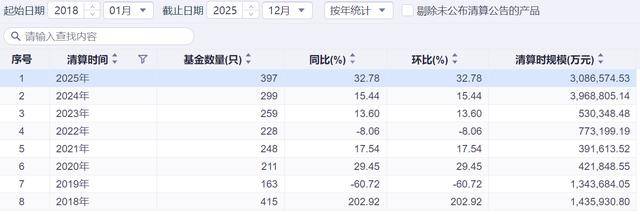
Core Insights - The public fund industry in China is experiencing an accelerated pace of fund liquidations, with nearly 400 funds being liquidated this year, representing a more than 30% increase compared to the entire previous year [1][3]. Group 1: Fund Liquidation Statistics - As of December 17, 2025, a total of 397 funds have been liquidated this year, which is a 32.78% increase from the 299 funds liquidated in the previous year [3]. - This year marks the highest number of liquidations since 2019, approaching the record of 415 funds liquidated in 2018 [3]. - Among the liquidated funds, 99 are initiated funds, accounting for nearly 25% of the total [3]. Group 2: Fund Types and Management Companies - The liquidated funds include 162 mixed funds, 110 bond funds, 52 stock funds, 40 fund of funds (FOF), and nearly 30 money market funds [3]. - Notable fund management companies that have liquidated more than 10 funds this year include CITIC Securities Asset Management, Shanghai Haitong Securities Asset Management, and Shanghai Everbright Securities Asset Management [3]. Group 3: Market Trends and Future Outlook - The presence of "mini" funds is leading to increased liquidation pressures, with over 50 funds issuing liquidation warnings this month alone [4]. - More than 1,000 ordinary open-end funds currently have a scale of less than 50 million yuan, indicating a high risk of liquidation [4]. - Industry experts suggest that the current wave of liquidations is a sign of market maturation, indicating a shift from rapid expansion to a focus on quality and long-term investment value [5].
股债联动 攻守有道丨华商安元债券基金为何值得关注?
Xin Lang Cai Jing· 2025-12-17 04:25
Group 1 - The core product being launched is the "HuaShang AnYuan Bond Fund," which aims for low volatility and long-term stable returns, with a subscription period from December 8 to December 26, 2025 [2][22] - The fund is managed by HuaShang Fund, with Hu Zhongyuan as the proposed fund manager, who has 6.5 years of investment experience [2][22][29] - The fund's investment strategy includes a focus on fixed income assets while also participating in equity assets to enhance returns, with a bond allocation of 80% of the fund's assets [19][36] Group 2 - HuaShang Fund has received AAAA ratings in multiple categories, including three-year comprehensive ratings for fund managers and active bond fund ratings, indicating strong management capabilities [8][30] - The fund's performance in absolute returns has ranked first among similar funds over the past 5 and 7 years, with absolute returns of 57.09% and 90.43% respectively [9][31][32] - The investment strategy emphasizes risk management and long-term asset appreciation through diversified asset allocation and careful credit selection [27][36][38]

浦银安盛稳健双利债券成立 规模20亿元
Zhong Guo Jing Ji Wang· 2025-12-17 03:13
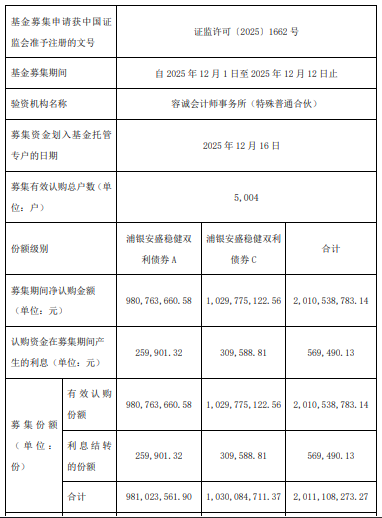
募集期间净认购金额2,010,538,783.14元,认购资金在募集期间产生的利息569,490.13元,募集份额合计 2,011,108,273.27份。 中国经济网北京12月17日讯今日,浦银安盛基金发布浦银安盛稳健双利债券型证券投资基金基金合同生 效公告。 基金经理郑双超2011年7月至2017年12月先后就职于嘉实基金管理有限公司、东吴证券股份有限公司和 天风证券(601162)股份有限公司,从事量化分析、固定收益分析、债券投资等工作。2017年12月14日 加盟浦银安盛基金管理有限公司,曾在固定收益投资部担任固定收益类基金经理助理,2021年12月起任 基金经理。 | 基金募集申请获中国证 | | | 证监许可〔2025〕1662 号 | | | --- | --- | --- | --- | --- | | 监会准予注册的文号 | | | | | | 基金募集期间 | | 自 2025年12月1日至2025年12月12日止 | | | | 验资机构名称 | | 容诚会计师事务所(特殊普通合伙) | | | | 募集资金划入基金托管 | | 2025年12月16日 | | | | 专户的日期 | | ...