
电信运营

Search documents
资费升易降难、合约暗藏玄机……手机套餐套路调查
Ren Min Ri Bao· 2025-12-18 23:17
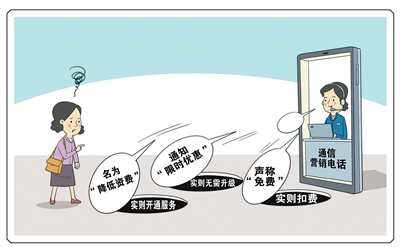
Core Viewpoint - The article highlights the difficulties consumers face when trying to change their mobile communication plans, despite the promotion of "speeding up and reducing costs" in the telecommunications industry. Consumers often encounter obstacles such as high cancellation fees, misleading sales practices, and preferential treatment for new users over existing ones [1][11][12]. Group 1: Consumer Experiences - Consumers like Mr. Huang and Mr. Wang express frustration over the inability to switch to lower-priced plans without incurring additional costs or penalties [1][2]. - Many consumers report being locked into high-priced contracts due to unclear terms and conditions presented at the time of signing [6][8]. - The article notes that customer service representatives often offer limited options for existing users, pushing them towards higher-priced plans or requiring them to open new accounts to access better deals [2][4][9]. Group 2: Sales Practices and Contractual Obligations - The practice of "contract bundling" is identified as a common tactic used by telecom operators to retain high-spending customers, often leading to increased costs for consumers who wish to downgrade their plans [5][8]. - Misleading promotions, such as "free phones" or "exclusive offers," often come with hidden costs and long-term commitments that are not clearly communicated to consumers [8][10]. - The article emphasizes that many consumers are unaware of the penalties associated with early contract termination, which can significantly impact their decision-making [6][9]. Group 3: Regulatory and Industry Response - The article discusses the legal framework protecting consumer rights, including the Consumer Rights Protection Law and the Telecommunications Regulations, which mandate transparency and fair practices from service providers [11][13]. - Regulatory bodies are taking steps to address these issues, including initiatives to simplify service offerings and ensure that consumers are fully informed before making decisions [11][12]. - Experts suggest that ongoing regulatory oversight and consumer education are essential to combat deceptive practices and enhance consumer rights in the telecommunications sector [13][14].
手机套餐 少些套路(民生探针)
Ren Min Ri Bao· 2025-12-18 22:17
Core Viewpoint - The article highlights the difficulties consumers face when trying to change their mobile communication plans, emphasizing that while it is easy to sign up for new plans, switching to more affordable options is often complicated by hidden fees and restrictive contracts [1][6][12]. Group 1: Consumer Experiences - Consumers like Mr. Huang and Mr. Wang express frustration over being unable to switch to lower-priced plans without incurring penalties or being restricted to options that do not meet their needs [1][2]. - Many consumers report being unaware of the existence of early termination fees and other binding clauses when they initially signed up for their plans, leading to dissatisfaction when they attempt to change [6][7][8]. Group 2: Industry Practices - The article reveals that telecom operators employ tactics such as differentiating between new and existing customers, making it easier for new users to access discounts while keeping existing users locked into higher-priced plans [6][10]. - There is a noted trend of "contract bundling," where consumers are tied to long-term agreements that make it difficult to switch plans or cancel services without incurring significant costs [8][9]. Group 3: Regulatory and Legal Framework - The article references the Consumer Rights Protection Law and the Telecommunications Regulations, which state that consumers should have the right to choose their services freely and be informed about all terms and conditions [10][11]. - Experts suggest that regulatory bodies need to enhance oversight and create clearer guidelines to protect consumers from misleading sales practices and ensure transparency in service agreements [12][13]. Group 4: Recommendations for Improvement - The article discusses ongoing initiatives by regulatory authorities to simplify service offerings and improve customer service response times, aiming to ensure that consumers can easily change their plans within a specified timeframe [12][13]. - Legal experts recommend that consumers remain vigilant about promotional offers and be aware of the potential pitfalls associated with long-term contracts, encouraging them to report any violations of their rights [13][14].

解码GCC5G-A商业成功:从技术部署到价值变现的“破壁”
Xin Lang Cai Jing· 2025-12-18 14:30
Core Insights - The GCC region has established itself as a pioneer in the global 5G-Advanced connectivity field, supported by early strategic investments and a strong foundation for smart networks and AI-driven operations [1][13] - The region has over 10,000 deployed 5G-A sites and a commercial user base in the millions, positioning it as a testing ground for 5G-A commercialization [1][13] Group 1: GCC 5G-A Development - The GCC region is leveraging its high-net-worth market and commitment to digital transformation to become a global leader in 5G-A commercialization [1][13] - The region's operators, particularly du and e&, are driving the 5G-A commercial process through innovative technology and scenario development [2][14] Group 2: du's Strategy - Du is transitioning its "5G+ network" focus from customer experience to a vertical-centric approach, targeting industry ecosystem partners rather than end-users [3][15] - The company has completed the deployment of a 3CC indoor network in the Middle East, achieving high bandwidth and low latency through multi-band collaboration [3][15] - Du's monetization strategy includes offering differentiated experience packages tailored to specific customer needs [3][15] Group 3: e&'s Focus - e& is building a "cloud-native + all-scenario" foundation based on 5G-A, achieving a 100Gbps aggregation rate through multi-carrier technology [4][16] - The integration of 5G-A antennas into building facades has enabled seamless coverage and zero roaming switching in urban core areas [4][16] Group 4: Policy and Strategy - GCC countries are prioritizing 5G-A as a key element in their economic diversification strategies, with regulatory bodies acting as ecosystem catalysts [5][17] - The shift from a "traffic pipeline" to an "experience-driven" business model is evident, with operators offering customized experience packages for vertical industries [5][17] Group 5: Ecosystem Collaboration - The commercial boundaries of 5G-A extend beyond telecommunications, integrating deeply into sectors like transportation, healthcare, and manufacturing [5][17] - Operators are breaking down barriers by combining industry knowledge with telecommunications technology, as seen in du's involvement in smart energy projects [5][17] Group 6: Global Comparisons - China has achieved full 5G-A network coverage across 31 provinces within a year, with a user base exceeding 60 million, creating a complete ecosystem [6][18] - Operators in Europe and other Asian markets are adopting similar models to enhance average revenue per user through rate-based packages and scenario services [6][18] Group 7: Huawei's Contributions - Huawei emphasizes the importance of the "3A" infrastructure (5G-A, Always-Online, AI-Driven) to support operators in their transition from Telco to Techco [7][20] - The company aims to facilitate the deployment of 10Gbps networks in the GCC by 2026, enhancing network capabilities for vertical industry scenarios [7][19] Group 8: Value Creation - Experience-driven business models are crucial, as the GCC's practices show that transforming intangible experiences into tangible services is key to breaking the "increase traffic without increasing revenue" dilemma [9][21] - The importance of ecosystem collaboration is highlighted, with successful integration requiring all participants in the value chain to find their place [11][22] - Cost-sharing mechanisms are essential for sustainable development, with GCC countries utilizing national subsidies and industry collaboration to alleviate operator pressures [11][22]
低空经济新场景落地 中国电信助推“空中消费”升级
Sou Hu Cai Jing· 2025-12-18 13:03
Core Insights - The consumer drone market is experiencing explosive growth, driven by innovations and diverse applications in various sectors, including tourism, agriculture, and urban services [3][4][5] - China Telecom is positioning itself as a key player in the low-altitude economy, leveraging its strengths in communication networks, AI, and cloud computing to support the development of consumer drones [2][5][6] Industry Growth - The consumer drone market is maturing, with over 600 drone manufacturing companies in China and a market value in the hundreds of billions [3] - The demand for consumer drones has expanded beyond aerial photography to include services in agriculture, urban governance, and logistics [3][7] Policy Support - Recent government policies, including the implementation of new guidelines for low-altitude economic applications, are providing significant support for the growth of the consumer drone market [4][5] Company Initiatives - China Telecom has established a dedicated subsidiary, China Telecom Drone Technology Co., to focus on the low-altitude economy and has made significant technological advancements in drone networking and intelligent scheduling [5][6] - The company has developed a comprehensive low-altitude economic capability system, introducing innovative products to address industry challenges [5][6] Technological Infrastructure - China Telecom is building a robust 5G-A low-altitude communication network, ensuring stable and real-time connectivity for drone operations across urban and rural areas [6] - The company has implemented a multi-dimensional "air traffic control system" to enhance drone safety and operational efficiency [6] Application Scenarios - China Telecom is actively expanding drone applications in various fields, including public safety, logistics, and agriculture, creating replicable and scalable models [7][8] - Notable projects include a 5G police drone system for smart governance and a low-altitude logistics line in rural areas to address last-mile delivery challenges [7][8] Future Outlook - China Telecom aims to continue collaborating with industry partners to unlock new drone application scenarios, contributing to the high-quality development of the economy and society [8]


安全能力再升级,山东联通智慧光网筑牢政企业务“生命线”
Qi Lu Wan Bao· 2025-12-18 11:19
Core Viewpoint - In the digital economy era, network security is essential for government and enterprise operations, with reliability serving as a cornerstone for service assurance. Shandong Unicom focuses on technological innovation to create a comprehensive OTN network, the Smart Optical Network SD-FAST, which enhances security and reliability across various sectors such as finance, government, and education [1]. Group 1: Three-Dimensional Security Upgrade - The network level employs a security architecture based on physical isolation and partitioned protection to sever risk transmission chains. The Smart Optical Network establishes a dedicated security framework independent of the public network, utilizing specialized optical cable links across all administrative levels and implementing triple security management in core facilities [2]. - The pipeline level relies on OTN technology to create dedicated transmission channels that ensure data transmission security. These channels are completely isolated and do not share any resources, effectively preventing cross-network penetration of public viruses and malicious attacks [3]. - The algorithm level focuses on the final line of defense for data transmission, utilizing international standards and dynamic key management to fortify data security. The Smart Optical Network employs the G.709 encryption algorithm for end-to-end data encryption, with automatic key updates every hour to minimize data leakage risks [4]. Group 2: Full-Link Reliability Upgrade - To provide a stable foundation for the three-dimensional security architecture, the Smart Optical Network optimizes reliability across routing, equipment, and operations, achieving a network availability rate of over 99.99% [5]. - The routing design incorporates a redundancy scheme with dual routing as the primary method and multiple detours as a supplement, ensuring no single point of failure in core cities [5]. - The operations system has been upgraded to an "intelligent early warning + rapid response" model, with a self-developed maintenance platform that monitors over 20 key indicators in real-time, achieving an alarm accuracy rate exceeding 98% [5]. Group 3: Practical Validation of Strength - The three-dimensional security advantages of the Smart Optical Network SD-FAST have been validated in a project involving a university's education and research network, where it provided a dedicated solution that ensured data security and transmission stability [6]. - The network has supported high-demand applications such as remote academic conferences and cross-school research collaborations without any incidents of data leakage or transmission interruptions, earning high praise from faculty and students [6]. Group 4: Future Applications and Innovations - The Smart Optical Network is widely applied in various sectors, including government, finance, and manufacturing, ensuring secure data transmission for social security and healthcare systems, protecting core transaction information for financial institutions, and supporting data collection for industrial internet applications [7]. - Looking ahead, Shandong Unicom plans to deepen innovations in security and reliability technologies, exploring the integration of quantum encryption with OTN networks to provide superior network services for the digital transformation of enterprises in Shandong [7].
江苏省与中国移动签署战略合作协议 信长星刘小涛会见陈忠岳一行
Nan Jing Ri Bao· 2025-12-18 09:33
Core Insights - Jiangsu Province signed a strategic cooperation agreement with China Mobile Communications Group, emphasizing the importance of digital infrastructure and technology in driving the province's development [1] Group 1: Strategic Cooperation - The agreement aims to enhance collaboration in digital infrastructure construction, cutting-edge technology research, industrial transformation, and large-scale application of new scenarios [1] - Jiangsu's leadership expressed gratitude for China Mobile's contributions to the province's development and highlighted the need for smart, green, and integrated growth [1] Group 2: Future Collaboration - China Mobile plans to leverage its strengths to support Jiangsu's technological and industrial innovation, aiming to cultivate new growth points and assist in high-quality development [1]

鹏博士(600804)已和解获赔,4.5万股民索赔
Xin Lang Cai Jing· 2025-12-18 04:01
Core Viewpoint - Peng Bo Shi Telecom Media Group Co., Ltd. has been penalized for violations of information disclosure regulations, including failure to disclose related party transactions and significant omissions in periodic reports, which has harmed investors' rights [1][7]. Group 1: Regulatory Actions - The China Securities Regulatory Commission's Sichuan Regulatory Bureau issued an administrative penalty decision against Peng Bo Shi for failing to disclose non-operating fund transactions with related parties, leading to inaccurate and incomplete annual report disclosures [1][7]. - The violations are considered serious breaches of the Securities Law of the People's Republic of China and related disclosure regulations, infringing on the legitimate rights of investors [1][7]. Group 2: Investor Compensation - Affected investors are entitled to file civil compensation lawsuits due to the company's false statements, as per the revised Securities Law and relevant judicial interpretations [1][7]. - Two categories of investors are preliminarily identified as eligible for compensation: 1. Investors who purchased Peng Bo Shi stock (600804) between April 12, 2013, and July 18, 2023, and sold or continued to hold the stock after July 18, 2023 [2][8]. 2. Investors who bought the stock between April 28, 2022, and April 16, 2024, and sold or continued to hold it after April 16, 2024 [3][8]. Group 3: Required Documentation for Claims - Investors must prepare the following materials to support their claims: 1. Original stock transaction statements, stamped by the brokerage, covering all transactions from the first purchase to the last sale or print date [4][9]. 2. A copy of the investor's ID card, including both sides for individual investors [5][10]. 3. A securities account confirmation letter issued by the brokerage, containing the investor's name, ID number, and account number, also stamped by the brokerage [5][10].

我省与中国移动签署战略合作协议信长星刘小涛会见陈忠岳一行
Xin Hua Ri Bao· 2025-12-17 23:08
Core Insights - Jiangsu Province signed a strategic cooperation agreement with China Mobile Communications Group, emphasizing the importance of digital technology in the province's development [1] - The agreement aims to enhance collaboration in areas such as digital infrastructure, cutting-edge technology research, industrial transformation, and large-scale application of new scenarios [1] - China Mobile has increased its industrial layout and innovation collaboration in Jiangsu, aiming to foster new growth points and support high-quality development in the province [1] Group 1 - Jiangsu is focusing on intelligent, green, and integrated development to build a modern industrial system centered on advanced manufacturing [1] - The provincial leadership expressed gratitude for China Mobile's contributions to Jiangsu's development over the years [1] - The strategic cooperation will involve deepening collaboration in various sectors to better serve national development goals [1] Group 2 - China Mobile's Chairman highlighted the company's commitment to expanding cooperation in technology and industry innovation to meet Jiangsu's needs [1] - The agreement is part of a broader initiative to leverage digital technology for economic growth and modernization in Jiangsu [1] - The collaboration aims to create a significant impact on the province's development trajectory and position it as a leader in high-quality growth [1]
海南封关政策红利全解析
Mei Ri Jing Ji Xin Wen· 2025-12-17 13:58
2025年12月18日,海南自贸港正式启动全岛封关运作。 封关前,海南是海疆前沿的一座岛;封关后,海南更是一扇面向世界的门。这是中国改革开放进程中的 又一重大里程碑,中国将以更高水平开放姿态拥抱世界。 "一线"放开、"二线"管住、岛内自由,"零关税"、低税率、简税制……海南自贸港全岛封关运作带来了 一个又一个政策礼包。 海南自贸港选择封关运作的政策考量是什么?封关之后会给境内外企业带来哪些政策红利?对比其他国 际知名自贸港,海南自贸港与它们的差异又在哪里? 商务部国际贸易经济合作研究院副院长崔卫杰接受《每日经济新闻》记者书面采访时表示,海南自贸港 全岛封关运作不是简单的政策制度调整,而是系统性、制度性的全面升级。这一转变主要体现在"零关 税"水平大幅提升、加工增值免关税政策更加优化、投资环境更加完善、进出海南更加便利四个关键领 域,彰显了海南自贸港开放水平的重大跃升。 封关不是封岛 为什么要封关?封关运作与扩大开放之间是否矛盾? 封关是指将海南岛全岛建成一个海关监管特殊区域,实施以"'一线'放开、'二线'管住、岛内自由"为基 本特征的自由化便利化政策制度。 对外经贸大学中国开放经济理论研究院院长桑百川接受《每 ...
江苏与中国移动签署战略合作协议
Xin Hua Ri Bao· 2025-12-17 12:47
Core Viewpoint - The strategic cooperation agreement signed between Jiangsu Province and China Mobile aims to enhance digital infrastructure, technological innovation, and industrial transformation in the region [1] Group 1: Strategic Cooperation - Jiangsu Province and China Mobile signed a strategic cooperation agreement on December 17 [1] - The agreement focuses on areas such as digital infrastructure construction, cutting-edge technology research, industrial transformation, and large-scale application of new scenarios [1] Group 2: Leadership Statements - Jiangsu leaders expressed gratitude for China Mobile's contributions to the province's development and emphasized the importance of smart, green, and integrated directions for future growth [1] - China Mobile's chairman highlighted the company's commitment to expanding its industrial layout and innovation collaboration in Jiangsu, aiming to foster new growth points and support high-quality development in the province [1]