
贸易

Search documents
连板股追踪丨A股今日共44只个股涨停 这只贸易股4连板
Di Yi Cai Jing· 2025-10-17 08:44
Core Viewpoint - On October 17, the A-share market saw a total of 44 stocks hitting the daily limit up, indicating strong market activity and investor interest in specific sectors [1] Group 1: Stock Performance - The commodity trading sector, represented by Yuanda Holdings, achieved a four-day limit up streak [1] - The coal mining sector also showed significant performance with Dayou Energy recording a four-day limit up [1]


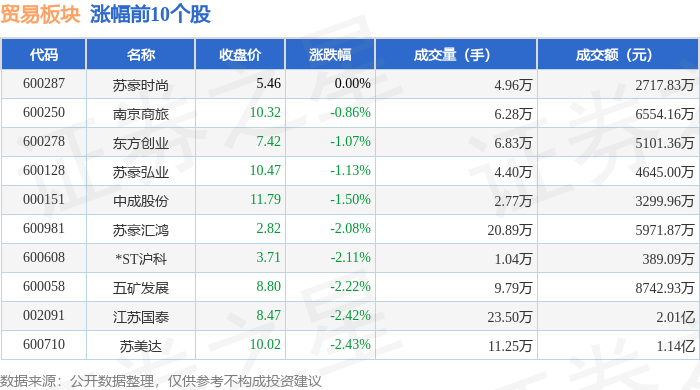
贸易板块10月17日跌2.16%,中信金属领跌,主力资金净流出1.63亿元
Zheng Xing Xing Ye Ri Bao· 2025-10-17 08:35
Market Overview - On October 17, the trade sector declined by 2.16%, with CITIC Metal leading the drop [1] - The Shanghai Composite Index closed at 3839.76, down 1.95%, while the Shenzhen Component Index closed at 12688.94, down 3.04% [1] Stock Performance - Key stocks in the trade sector showed varied performance, with CITIC Metal closing at 10.28, down 3.11%, and Jiangsu Guotai at 8.47, down 2.42% [2] - The trading volume for CITIC Metal was 294,400 shares, contributing to a transaction amount of 308 million yuan [2] Capital Flow - The trade sector experienced a net outflow of 163 million yuan from main funds, while retail investors saw a net inflow of 155 million yuan [2][3] - Jiangsu Guotai had a significant net outflow of 44.53 million yuan from main funds, but a net inflow of 29.99 million yuan from retail investors [3]


广州市山醒茶业有限公司成立 注册资本100万人民币
Sou Hu Cai Jing· 2025-10-17 07:46
Core Viewpoint - Guangzhou Shanxing Tea Industry Co., Ltd. has been established with a registered capital of 1 million RMB, indicating a new player in the tea industry focusing on various related services and products [1] Company Summary - The company is engaged in the sale of tea utensils and tea cultivation, showcasing its commitment to the tea market [1] - It offers marketing planning and brand management services, which may enhance its market presence and competitiveness [1] - The company provides a range of consulting services, excluding licensed information consulting, indicating a focus on general advisory roles [1] Industry Summary - The company is involved in the sale of agricultural and sideline products, reflecting the growing trend of integrating agricultural production with retail [1] - It includes internet sales of pre-packaged food, aligning with the increasing consumer preference for online shopping [1] - The establishment of the company highlights the ongoing development in the tea industry, particularly in areas such as cultural and artistic exchanges, which may attract a diverse customer base [1]
10月17日沪深两市涨停分析
Xin Lang Cai Jing· 2025-10-17 07:33
Group 1 - China COSCO Shipping Group's subsidiary is a leading integrated port and shipping enterprise in Hainan [2] - The company has a new duty-free pickup point, which is part of the duty-free business supply chain [2] Group 2 - Spot gold has risen to $4,330 per ounce, reaching a historical high [3] - Baoding Technology's wholly-owned subsidiary Hexi Gold Mine is engaged in gold mining and sales, with a metal reserve of 4.536 tons [3] - The company has a production capacity of 500 tons of silver annually [3] Group 3 - Tesla will hold a shareholder meeting to showcase new developments in robotics [5] - Pioneering Electronics, through its subsidiary, holds an indirect stake in Benmo Technology, which is rapidly developing in the robotics sector [5] - The company anticipates significant revenue growth in 2024 compared to 2023 [5] Group 4 - Guangdong Mingzhu expects a net profit increase of 858.45%-1071.44% in the first three quarters due to improved operational performance [6] - The actual controller of Cangzhou Mingzhu is set to change to the Guangzhou State-owned Assets Supervision and Administration Commission [6] Group 5 - The company is the first listed firm to produce electronic-grade phosphoric acid [7] - The company is a core supplier for military and armed police procurement, specializing in nuclear pollution prevention technology [7]

潮州市潮安区庵埠镇启财贸易商行(个体工商户)成立 注册资本1万人民币
Sou Hu Cai Jing· 2025-10-17 06:49
天眼查App显示,近日,潮州市潮安区庵埠镇启财贸易商行(个体工商户)成立,注册资本1万人民 币,经营范围为一般项目:日用百货销售;日用品销售;家用电器销售;家居用品销售;厨具卫具及日 用杂品批发;针纺织品销售;塑料制品销售;电子产品销售;互联网销售(除销售需要许可的商品)。 (除依法须经批准的项目外,凭营业执照依法自主开展经营活动)。 ...
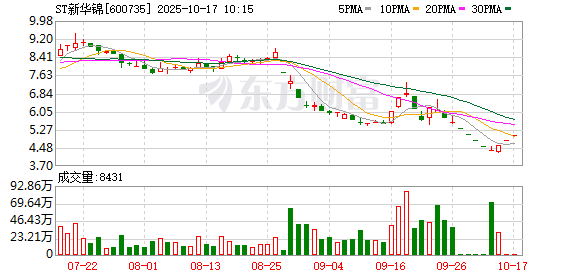
ST新华锦连收3个涨停板
Zheng Quan Shi Bao Wang· 2025-10-17 02:15
Core Viewpoint - ST Xinhua Jin has experienced a significant surge in stock price, achieving three consecutive daily limit increases, indicating strong market interest and potential investor confidence [2] Recent Stock Performance - As of 9:25 AM, the stock price reached 5.04 CNY, with a turnover rate of 0.05% and a trading volume of 213,400 shares, amounting to a transaction value of 1.0755 million CNY [2] - The stock has cumulatively increased by 15.86% during the consecutive limit-up period, with a total turnover rate of 8.12% [2] - The latest total market capitalization of A-shares is 2.161 billion CNY, while the circulating market capitalization stands at 2.144 billion CNY [2] Historical Daily Performance - The stock's daily performance over the past few days shows fluctuations, with notable changes in turnover rates and net capital inflow: - On October 16, 2025, the stock rose by 5.03% with a turnover rate of 0.59% and a net capital inflow of 6.9034 million CNY [2] - On October 15, 2025, it increased by 5.06% with a higher turnover rate of 7.48% and a net inflow of 13.9932 million CNY [2] - The stock faced declines on several previous days, with the most significant drop of 6.05% on September 25, 2025 [2]

苏豪弘业:关于公司及控股子公司资产损失核销的公告
Zheng Quan Ri Bao Zhi Sheng· 2025-10-16 14:09
Core Viewpoint - Suhao Hongye announced the write-off of asset losses amounting to a total of 18.2857 million yuan due to uncollectible receivables and long-term equity investments [1] Group 1: Company Actions - The company will hold the 11th Board of Directors' fourth meeting on October 16, 2025, to review the proposal for asset loss write-offs [1] - The write-off includes seven items of asset losses that are deemed uncollectible [1] Group 2: Financial Impact - The total book value of the assets to be written off is 18.2857 million yuan [1]

申泽(青海)机电设备有限公司成立 注册资本300万人民币
Sou Hu Cai Jing· 2025-10-16 10:59
Core Viewpoint - Recently, Shenze (Qinghai) Electromechanical Equipment Co., Ltd. was established with a registered capital of 3 million RMB, indicating a diversification in the market for electromechanical and related services [1] Company Overview - The legal representative of the newly established company is Zhu Liying [1] - The registered capital of the company is 3 million RMB [1] Business Scope - The company’s business scope includes a wide range of activities such as wholesale of computer software and hardware, sales of mechanical equipment, and various technical services [1] - Additional services offered include sales of medical protective supplies, specialized chemical products, glass instruments, daily necessities, electronic products, and smart instruments [1] - The company also engages in equipment leasing, sales of disinfectants (excluding hazardous chemicals), marketing planning, cultural and artistic exchange activities, and health consulting services [1] - The company is involved in software development and sales, as well as the sale of communication equipment and optical cables [1]
贸易板块10月16日跌1.23%,凯瑞德领跌,主力资金净流出1.26亿元
Zheng Xing Xing Ye Ri Bao· 2025-10-16 08:27
Group 1 - The trade sector experienced a decline of 1.23% on October 16, with Kerryde leading the drop [1] - The Shanghai Composite Index closed at 3916.23, up by 0.1%, while the Shenzhen Component Index closed at 13086.41, down by 0.25% [1] - A detailed table of individual stock performance in the trade sector is provided [1] Group 2 - On the same day, the trade sector saw a net outflow of 126 million yuan from main funds, while retail funds had a net inflow of 108 million yuan [2] - Speculative funds recorded a net inflow of 17.55 million yuan [2] - A detailed table of fund flows for individual stocks in the trade sector is included [2]

小商品城(600415):3Q25净利同增101% 六区招商收入确认&新业务高增
Xin Lang Cai Jing· 2025-10-16 08:26
Core Viewpoint - The company reported strong financial performance for Q3 2025, with significant year-on-year growth in revenue and net profit, indicating resilience in market operations and potential for future growth in trade services and import business [1][2][4]. Financial Performance - Q3 2025 revenue reached 5.348 billion yuan, a year-on-year increase of 39.02%. For the first three quarters of 2025, total revenue was 13.061 billion yuan, up 23.07% [2]. - Q3 2025 net profit attributable to shareholders was 1.766 billion yuan, reflecting a remarkable year-on-year growth of 100.52%. The net profit for the first three quarters was 3.457 billion yuan, an increase of 48.45% [4]. - The company achieved a diluted EPS of 0.32 yuan and a weighted return on equity of 7.93% [1]. Cost and Profitability Metrics - The gross profit margin for Q3 2025 improved by 15.31 percentage points to 45.41%, while the overall gross profit margin for the first three quarters increased by 5.23 percentage points to 37.23% [2]. - The operating expense ratio for Q3 2025 was 4.94%, unchanged year-on-year, with variations in specific expense categories [3]. Business Growth and Market Trends - The company’s cross-border payment service, Yiwu Pay, saw transaction volumes exceed 27 billion yuan in the first nine months of 2025, growing over 35% year-on-year [4]. - The overall import and export value in Yiwu reached 554.26 billion yuan from January to August 2025, marking a year-on-year increase of 24.9% [5]. Future Outlook - The company is expected to continue benefiting from rising market demand and pricing, with projected net profits for 2025-2027 estimated at 4.24 billion yuan, 5.76 billion yuan, and 6.91 billion yuan, respectively, reflecting growth rates of 37.9%, 35.9%, and 20.0% [5].
