数字金融

Search documents
13部门重拳出击虚拟币!美国想用数字美元转嫁债务?中国不答应
Sou Hu Cai Jing· 2025-12-03 14:40
Group 1 - The People's Bank of China has convened a meeting with 13 departments, emphasizing that stablecoins cannot circulate within China and related transactions are deemed illegal financial activities [1][22] - In contrast to the U.S. approach, which aims to promote stablecoins as a new form of "digital dollar," China is taking a firm stance to prevent any potential threats to financial security [1][10] - The global market for stablecoins has surpassed $132 billion, with a significant portion being dollar-pegged assets like USDT and USDC, which are seen as a new shell for "digital dollars" [3][5] Group 2 - The U.S. has been increasing its national debt while global central banks are gradually reducing their dollar assets, leading to a decline in the dollar's share of global foreign exchange reserves to approximately 57.8% [5][10] - Stablecoins are viewed as a means for the U.S. to indirectly export dollars, as they are backed by U.S. Treasury securities, thus creating a new pool of dollar holders globally [5][8] - The GENIUS Act mandates that stablecoin issuers must hold safe dollar assets on a 1:1 basis, resulting in significant holdings of U.S. Treasuries by companies like Circle, which now holds over $120 billion in U.S. debt [7][10] Group 3 - Stablecoins present regulatory challenges due to their pseudonymous nature, making it difficult to trace transactions and identify users, which raises concerns about money laundering and compliance [11][13] - There have been instances of stablecoins being used for illegal activities, such as money laundering and circumventing foreign exchange controls, highlighting systemic risks to the financial system [15][18] - The Chinese government aims to close off these potential loopholes to prevent large-scale capital outflows and maintain currency stability [18][20] Group 4 - China's regulatory stance is clear: virtual currencies are not legal tender and cannot be used as payment tools, reinforcing the prohibition established in 2021 [22][23] - Hong Kong is adopting a dual-track strategy, allowing for stablecoin experimentation under strict regulations while maintaining a clear separation from mainland China's financial system [25][27] - China is focusing on developing its own digital currency, the digital yuan, which is being piloted in various cities and aims to enhance payment efficiency while ensuring compliance [27][29]


OSL集团将于欧洲提供合规数字资产现货与合约交易服务
Zhi Tong Cai Jing· 2025-12-03 05:31
Core Viewpoint - OSL Group, a leading stablecoin trading and payment infrastructure platform in Asia, is expanding its operations into Europe, offering compliant digital asset spot and contract trading services expected to launch in Q1 2026 [1] Group 1: Expansion Strategy - The expansion into Europe represents a significant step in OSL Group's globalization strategy, focusing on both geographic and product diversification [1] - OSL Group aims to provide compliant, efficient, and secure digital asset trading services to European clients through organic growth and partnerships [1] Group 2: Compliance and Market Position - OSL Group's CEO, Huai Song, emphasized the importance of compliance in the European digital asset market, stating the company is proud to operate within local regulatory frameworks [1] - The company is committed to offering more institutional-grade professional services to European clients in the future [1] Group 3: Company Vision and Values - OSL Group is dedicated to building a high-efficiency ecosystem that connects global markets, facilitating seamless and compliant flows of capital between fiat and digital currencies [1] - The core values of OSL Group are rooted in "openness, security, and compliance," aiming to provide a robust digital financial infrastructure service globally [1]
数智联盟打造全球数字资产确权与数字人民币跨境结算重要基础设施
Sou Hu Cai Jing· 2025-12-03 00:27
Core Viewpoint - The establishment of the Digital Intelligence Alliance marks a strategic response to the accelerating global digital economy and the restructuring of the international financial system, positioning itself as a key player in building digital financial infrastructure for the future [1][14]. Group 1: Global Trends in Digital Economy - The global financial technology competition has entered a new phase, with digital currencies becoming a crucial focus for international finance [1]. - Asset tokenization is emerging as a new standard in the financial industry, ensuring data credibility, transparency, and immutability [2]. - Intelligent regulation is evolving as a key direction for global regulatory systems, emphasizing risk warning, cross-border compliance, and data traceability [3]. - These trends are collectively driving a reconstruction window for global digital financial infrastructure [4]. Group 2: Core Positioning of the Digital Intelligence Alliance - The Digital Intelligence Alliance aims to be a participant and builder of global digital asset infrastructure, focusing on four main areas: asset rights confirmation, payment settlement, on-chain governance, and inclusive finance [6][7]. - Key initiatives include the establishment of a unified, trustworthy, and verifiable digital asset custody platform, which will cover asset ownership registration, digital certificate generation, data storage, and cross-border asset recognition [8]. - The alliance will promote a traceable and auditable governance system for digital assets, achieving full data transparency, automated compliance checks, intelligent risk monitoring, and verifiable transaction paths [9]. - The construction of a cross-border payment and settlement system for the digital yuan will expand its application in international trade and supply chain finance [10][11]. - The alliance will assist in the digital upgrade of international trade and supply chain finance, focusing on the digitization of trade certificates and the on-chain confirmation of orders and receivables [12][13]. Group 3: Building International Digital Financial Standards - The Digital Intelligence Alliance will transition from a single platform to a participant in international digital financial standards, focusing on the standardization of international digital asset management rules and the formulation of cross-border usage norms for the digital yuan [6][7]. - Collaboration mechanisms with overseas nodes and international organizations will be established to support the internationalization of the renminbi [13]. Group 4: Contribution to Global Financial Order - The official launch of the Digital Intelligence Alliance represents a significant step in upgrading China's digital financial system and is a product of the new phase of the global digital economy [14]. - By constructing an open, compliant, and sustainable digital financial infrastructure, the alliance aims to provide long-term value for national strategies, international trade, and public users [14].


焕新而立,逐光致远 | PhotonPay光子易香港办公室新址启用
Sou Hu Cai Jing· 2025-12-02 05:45
Core Insights - PhotonPay has officially relocated its Hong Kong office to Taikoo Shing, a strategic move to enhance its presence in the Asia-Pacific region and strengthen its local service capabilities for global clients [1][3]. Group 1: Company Strategy - The new office location in Taikoo Shing is intended to provide a modern business environment that allows PhotonPay to respond more agilely to the global needs of enterprises [3]. - The CEO of PhotonPay emphasized that the new office will facilitate more efficient collaboration among the team and lay a solid foundation for technological innovation, compliance, and international business development [3]. Group 2: Company Growth and Development - Since its establishment in 2015, PhotonPay has been enhancing its global payment network and compliance risk control systems, with the team size exceeding 300 members and branches in over ten major markets [3]. - The new office will serve as the Asia-Pacific business center, strengthening cooperation with international banking networks, card organizations, and financial institutions to improve service quality and depth [3]. Group 3: Future Outlook - With the new office operational, PhotonPay aims to explore breakthroughs in its global business expansion and provide higher standards of digital financial infrastructure to support enterprises going abroad [5]. - The company is committed to a long-term perspective, ready to embrace future growth and opportunities [5].

织密消费者隐私“防护网” 夯实数字金融发展根基
Zheng Quan Ri Bao· 2025-11-30 15:29
Core Viewpoint - Digital finance, leveraging advanced technologies like big data, AI, cloud computing, and blockchain, is enhancing the efficiency, accessibility, and inclusiveness of financial services. However, the collection and utilization of sensitive consumer information pose significant privacy risks, necessitating robust privacy protection measures for sustainable development in the sector [1][2]. Group 1: Privacy Protection Framework - China has established a preliminary legal framework for privacy protection in digital finance, providing institutional compliance for the sector [1]. - To strengthen consumer privacy protection, collaboration among various stakeholders is essential, including regulatory bodies, financial institutions, and technology companies [1][2]. Group 2: Responsibilities of Stakeholders - Financial institutions and tech companies must prioritize consumer privacy while pursuing technological innovation and commercial interests, enhancing internal data governance and employing advanced encryption and anonymization techniques [2]. - Industry associations should promote self-regulation by creating industry agreements and conducting training to elevate privacy protection awareness and capabilities among members [2]. Group 3: Consumer Awareness - Consumers are encouraged to enhance their privacy protection awareness and skills, familiarize themselves with relevant laws, and exercise caution when authorizing personal information [2]. - The emphasis on tightening privacy protection is crucial for ensuring that technological innovations in digital finance operate within compliant frameworks, ultimately benefiting the real economy and meeting the growing needs of the public [2].
北京市已建成近15万个5G基站
Bei Jing Qing Nian Bao· 2025-11-27 01:57
Core Insights - The implementation of the Beijing Digital Economy Promotion Regulation has led to significant advancements in the city's digital economy over the past three years, with recommendations for timely revisions to the regulation to keep pace with rapid developments in the digital economy [1] Group 1: Digital Infrastructure and Smart City Development - Beijing has made steady progress in digital infrastructure and smart city construction, with nearly 150,000 5G base stations built, ranking first in the country; the total computing power has exceeded 42,000 P [2] - The city has enhanced its urban operation command platform capabilities, improving the "one network management" level, and has promoted the use of electronic seals for government services, making public services more convenient [2] Group 2: Data Resource Development and Utilization - The establishment of a national data element comprehensive pilot zone and the first city-level blockchain "directory chain" has facilitated the listing of over 400,000 data items; the Beijing International Big Data Exchange's trading volume in the first three quarters exceeded 1.64 times that of the previous year [2] - The public data open and interconnectivity has improved, with data listing times reduced by over 70%, benefiting over 60 financial institutions and 700,000 market entities [2] Group 3: Artificial Intelligence Industry Growth - The core scale of the artificial intelligence industry in Beijing is expected to exceed 350 billion yuan, with over 2,400 enterprises; Haidian has been approved as the first national advanced manufacturing cluster in the AI field [3] - Approximately one-third of the national registered large models have been filed in Beijing, and 13 open-source projects have been incubated, indicating a growing open-source ecosystem [3] Group 4: Recommendations for Future Development - Suggestions include strengthening overall planning and optimizing digital infrastructure layout, particularly in suburban areas, to enhance disaster response capabilities [3] - The report advocates for increased investment in basic research and the establishment of collaborative innovation mechanisms to support the development of the digital industry [3]
北京全市建设5G基站近15万个,位居全国首位
Xin Jing Bao· 2025-11-26 04:06
Core Insights - The implementation of the "Beijing Digital Economy Promotion Regulations" has shown significant progress over the past three years, with a focus on building a global benchmark city for digital economy and new productivity development [1] Group 1: Digital Infrastructure and Smart City Development - Beijing has made steady progress in digital infrastructure and smart city construction, with nearly 150,000 5G base stations built, ranking first in the country [2] - The total computing power infrastructure has exceeded 42,000 P, and the city has enhanced its urban operation command platform capabilities [2] - The promotion of electronic seals for government services has improved convenience for citizens, with over 1,800 urban operation monitoring indicators integrated into the "Jingzhi" decision-making platform [2] Group 2: Data Resource Development and Utilization - Beijing has established a national data element comprehensive pilot zone and the first city-level blockchain "directory chain," with over 400,000 data items "on-chain" [3] - The Beijing International Big Data Exchange reported a trading volume in the first three quarters exceeding 1.64 times that of the previous year, with nearly 3,500 data products listed [3] - The financial public data zone has served over 60 financial institutions and 700,000 market entities, facilitating financing for small and micro enterprises [3] Group 3: Digital Industry Growth - The core AI industry in Beijing is projected to exceed 350 billion yuan in 2024, with over 2,400 enterprises in the sector [4] - Haidian District has been approved as the first national advanced manufacturing cluster in the AI field, with 162 large models registered, accounting for about one-third of the national total [4] - The city is implementing a three-year action plan for the digital transformation of the manufacturing industry, with over 1,700 digital finance enterprises and continuous digital achievements in education, culture, tourism, and healthcare [4] Group 4: Digital Economy Security - Beijing has enhanced its digital economy security capabilities by establishing a data security coordination mechanism and accelerating the implementation of data classification and management standards [4] - A negative list for data export in the pilot free trade zone has been published, and a compliance policy system for cross-border data flow has been improved [4] Group 5: Recommendations for Further Implementation - The report identifies issues such as the need for better planning of digital infrastructure and increased efforts in data resource development and sharing [5] - Suggestions include leveraging government public data for high-quality sharing, establishing a professional evaluation system for data rights, and improving financial policies to support data asset registration and financing [5][6] - The report also recommends promoting data sharing for smart city construction and utilizing the government cloud platform to streamline data reporting processes [6]
2025中国(北京)数字金融论坛在京举办 一批创新实践集中亮相
Zhong Guo Xin Wen Wang· 2025-11-25 13:39
共策数字金融发展新路径 中新网北京11月25日电 2025中国(北京)数字金融论坛25日在北京丽泽金融商务区国家金融信息大厦举 行。论坛以"智能为核、融合为基、创新为翼、协作为桥、互动为脉"为导向,探讨数字金融与实体经济 深度融合的路径与未来,旨在凝聚行业共识,汇聚发展合力,为构建现代化金融体系、推动经济高质量 发展注入动能。 本次论坛由中国经济信息社、中国财富传媒集团、国金大厦发展有限公司、北京市丰台区人民政府联合 主办,通过1场主论坛、2场分论坛、1场圆桌会和3场配套活动,打造沉浸式数字金融交流平台,构建政 策解读、成果展示、技术交流、产融对接于一体的高端平台。此次论坛既是丰台区践行"五子联动"战 略、深化"法商融合"的实践,也为北京建设全球数字经济标杆城市提供"丰台方案",助力丽泽金融商务 区打造国际数字金融创新高地。 发展数字金融,是推动金融高质量发展、构建中国特色现代金融体系的关键一环,其发展路径与未来前 景备受瞩目。 此外,论坛合作签约成果丰硕,产业集聚效应凸显。在"引企共建"与"伙伴合作"环节,一批金融机构、 科技企业与丰台区签署了战略合作协议,整体合作签约金额超过260亿元。这些项目普遍聚焦于 ...

中国(北京)数字金融论坛举行,丽泽亮出2028发展目标
Xin Jing Bao· 2025-11-25 10:32
新京报讯(记者姜慧梓)11月25日,2025中国(北京)数字金融论坛在北京丽泽金融商务区举行。现场 发布丰台区"1335"数字金融发展矩阵,明确提出到2028年,将丽泽建成金融资源高度汇聚、创新要素持 续集聚、运营管理智慧精细的标杆示范园区。 近年来,丰台区着力打造新兴金融集聚地,现场发布"1335"数字金融发展矩阵。该矩阵通过一套支持政 策、两个"三年行动计划"、五大专项行动形成覆盖数字金融产业全生命周期的支持网络。其中,《北京 丽泽金融商务区高质量发展建设三年行动计划(2026-2028)》明确提出,到2028年建成金融资源高度 汇聚、创新要素持续集聚、运营管理智慧精细的标杆示范园区。 论坛上,北京市丰台区委副书记、区长张艳林表示,作为新兴金融产业集聚区和首都金融改革试验区, 丽泽紧抓"金融+科技"融合机遇,不断壮大数字金融产业规模,积极培育数字金融新技术、新业态、新 模式,日益成为数字金融研发与创新的策源地。下一步,丰台区将全力打造数字金融产业新高地、国际 法商融合新高地、营商服务生态新高地,构建资源共享、优势互补、风险共担、发展共赢的一流数字金 融生态圈。 现场,丰台区与多家企业签署战略合作协议,涵盖 ...
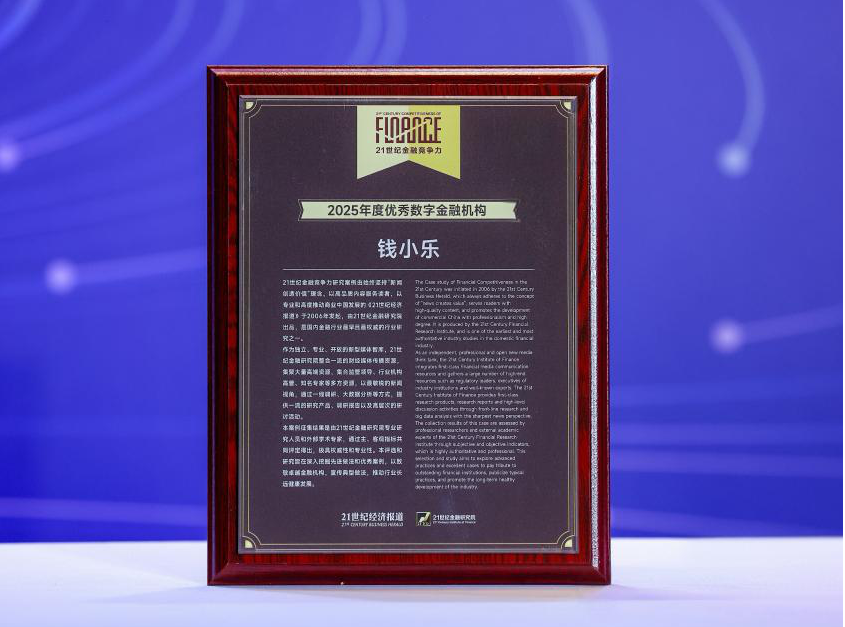
双轮驱动破局新质金融 钱小乐入选2025年度优秀数字金融机构
2 1 Shi Ji Jing Ji Bao Dao· 2025-11-24 04:32
Core Insights - Qianxiaole has been recognized as one of the "Outstanding Digital Financial Institutions of 2025" due to its comprehensive performance in digital financial technology application and inclusive services [1][3] Group 1: Industry Trends - The digital finance sector is evolving from basic capability building to a new stage emphasizing deep integration and systematic advancement, driven by technology to enhance efficiency and data to optimize decision-making [3][4] - The industry is forming a development pattern that ensures stable operations through safety and compliance [3] Group 2: Company Capabilities - Qianxiaole is driven by technological innovation, continuously investing in foundational technology, model training, and scenario connection to enhance its core capabilities in digital financial services [4] - The company has established a robust risk management framework covering user identification, behavior analysis, anti-fraud monitoring, and transaction risk identification, improving the speed and accuracy of risk recognition [4][5] Group 3: Service Expansion - Qianxiaole is optimizing service processes by embedding advanced technologies like artificial intelligence throughout the credit process, enhancing the convenience and accessibility of financial services [5][6] - The company has formed stable partnerships with licensed institutions, creating a scenario-based financial ecosystem that allows financial services to reach users naturally across various contexts [5][6] - The "technology + scenario" model is becoming a significant direction in inclusive finance, allowing for a multi-dimensional service system that extends beyond single touchpoints [6]