网络交易平台

Search documents
新华时评:规范,是为了平台更好发展
news flash· 2025-05-26 10:43
Core Viewpoint - The release of the "Guidelines for Compliance of Charging Behavior of Online Trading Platforms (Draft for Comments)" aims to address the challenges faced by online trading platforms, emphasizing the importance and timeliness of regulation to protect the rights of operators and consumers, and to promote the sustainable and healthy development of the platform economy [1] Group 1 - Strengthening regulation is a major directive from the Central Economic Work Conference to promote the healthy development of the platform economy [1] - The purpose of establishing rules is not to restrict platform development but to further promote fair, legal, and honest charging practices, guiding platforms back to their service essence [1] - The guidelines encourage platforms to adopt flexible and diverse pricing strategies within a legal, reasonable, and mutually beneficial framework to reduce the burden on operators within the platform [1]
新华时评|规范,是为了平台更好发展
news flash· 2025-05-26 10:32
Core Viewpoint - The article highlights the release of the "Guidelines for Compliance of Charging Behavior on Online Trading Platforms (Draft for Comments)" on the 25th, which addresses key issues in the development of online trading platforms, emphasizing the importance and timeliness of regulation to better protect the rights of operators and consumers, and to promote the sustainable and healthy development of the platform economy [1] Group 1 - The guidelines target the hot, difficult, and painful issues faced by online trading platforms [1] - The initiative aims to enhance the protection of rights for both platform operators and consumers [1] - The guidelines are intended to facilitate the continuous and healthy development of the platform economy [1]
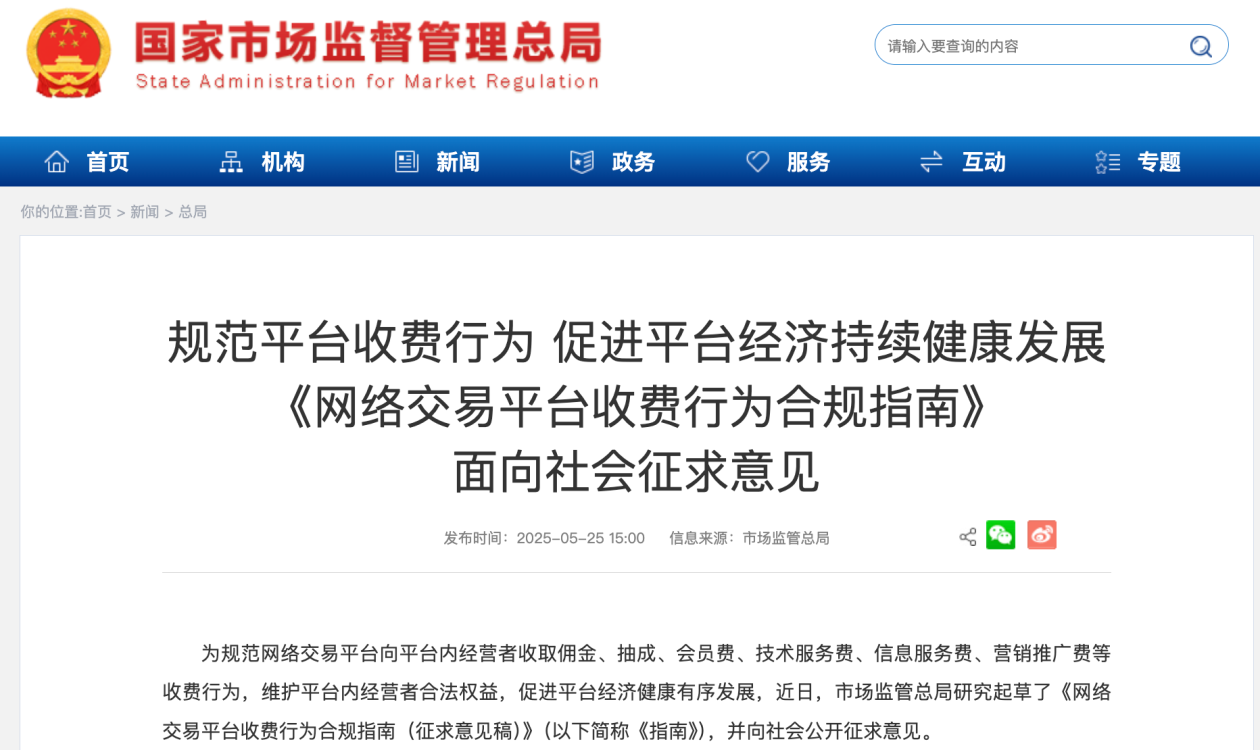
网络交易平台收费行为合规指南征求意见,明确8种不合理收费行为
Huan Qiu Wang· 2025-05-26 02:43
Core Viewpoint - The Market Regulation Administration has drafted the "Compliance Guidelines for Charging Behavior of Online Trading Platforms" to standardize the fees charged by platforms to their operators, aiming to protect their rights and promote healthy development of the platform economy [1][4]. Summary by Relevant Sections Principles of Charging - The guidelines emphasize that platforms must adhere to specific principles when setting fees, including the need for reasonable fee standards and transparent charging rules [4]. Reducing Burden on Operators - The guidelines advocate for lowering the financial burden on platform operators, ensuring that platforms fulfill commitments regarding fee reductions or exemptions [4][5]. Strengthening Compliance and Self-Regulation - Platforms are required to establish compliance management responsibilities and integrate charging compliance into their internal compliance systems, risk control, and training [4]. Standardizing Charging Behavior - The guidelines specify eight types of unreasonable charging behaviors, such as double charging, charging without providing services, and transferring costs that should be borne by the platform itself [4][5]. Enhancing Supervision and Implementation - The guidelines include provisions for the public disclosure of charging rules, the necessity for platforms to solicit public opinions when modifying rules, and the requirement to maintain historical versions of charging rules [4].

推动平台经济规范健康可持续发展
Sou Hu Cai Jing· 2025-05-26 02:05
Core Viewpoint - The article emphasizes the importance of regulating the charging behavior of online transaction platforms to ensure a sustainable and healthy development of the platform economy, which is crucial for high-quality economic and social development [1][2][4]. Summary by Sections Platform Economy Development - The platform economy in China has been rapidly developing, significantly contributing to resource allocation efficiency and technological transformation, involving millions of online operators and over 900 million consumers [1][2]. - The government has been enhancing policy consistency in the platform economy sector to ensure its development is regulated while promoting a healthy ecosystem [2][3]. Issues and Challenges - Despite the positive overall trend, issues such as data manipulation, forced choices, privacy violations, and chaotic capital expansion have emerged, disrupting market order and innovation [2]. - There are complaints from platform merchants regarding the complexity and lack of transparency in platform fees, which poses risks to industry health [2]. Regulatory Measures - The introduction of the "Guidelines for Compliance of Charging Behavior on Online Transaction Platforms" aims to address issues of non-transparent and unreasonable fees, fostering a harmonious ecosystem between platforms and their operators [2][3]. - The guidelines are intended to clarify principles for platform fees, reduce burdens on operators, and enhance compliance management capabilities [3][4]. Future Outlook - The platform economy is seen as a vital component of the digital economy, playing an essential role in daily life and national economic development [3][4]. - Strengthening the guidance for the healthy development of the platform economy is crucial for maximizing its contributions to consumer demand, employment stability, and overall welfare [3].
推动平台企业合规自律的新举措
Jing Ji Ri Bao· 2025-05-25 22:21
Core Viewpoint - The issuance of the "Guidelines for Compliance of Charging Behavior of Online Trading Platforms" aims to standardize and guide the charging behavior of online trading platforms, protect the legitimate rights and interests of operators, and promote the sustainable and healthy development of the platform economy [1][9]. Summary by Sections Section 1: Purpose and Importance of the Guidelines - The guidelines provide clear action guidance for the charging behavior of online trading platforms, aligning with the goals of promoting innovation and establishing a normalized regulatory system for the platform economy [2]. - The guidelines emphasize preventive regulation, shifting the focus from post-event enforcement to proactive compliance, thereby enhancing the precision and effectiveness of regulatory oversight [2][4]. Section 2: Specific Provisions of the Guidelines - The guidelines offer general guidance on charging behavior, addressing operator concerns and promoting compliance management by ensuring transparency in charging practices [3][6]. - Platforms are required to publicly disclose charging items, rules, and standards prominently on their homepage, ensuring operators can easily access and understand this information [3][8]. - The guidelines prohibit unreasonable promotional fees and require platforms to clarify the sharing of subsidy burdens with operators before conducting promotional activities [3][7]. Section 3: Encouragement of Compliance Culture - The guidelines encourage platforms to establish compliance management systems to mitigate potential legal risks and enhance operational integrity [4][5]. - Platforms are urged to adopt measures to reduce the financial burden on operators, including flexible pricing strategies and support during emergencies [7][8]. Section 4: Prohibition of Unreasonable Charging Practices - The guidelines outline specific unreasonable charging behaviors that platforms must avoid, such as duplicate charges, charging without providing services, and price discrimination among operators [8]. - Platforms are required to adhere strictly to relevant laws and regulations, ensuring fair competition and transparency in their charging practices [8][9].
规范网络交易平台向经营者收取佣金等行为(政策解读)
Ren Min Ri Bao· 2025-05-25 21:39
Core Viewpoint - The release of the "Guidelines for Compliance of Platform Charging Behavior (Draft for Comments)" aims to regulate the charging practices of platform enterprises, ensuring fairness, legality, and transparency in their fee structures [1][5]. Summary by Sections Reason for Establishing Guidelines - The rapid development of the platform economy in China involves millions of online operators and over 900 million consumers, making the healthy development of this sector crucial for overall economic prosperity. Issues such as complex fee structures and lack of transparency have been identified, necessitating the creation of these guidelines to enhance compliance and risk management [1]. Requirements for Compliance System - Platforms are required to implement a compliance management system that includes: 1. Establishing a compliance management organization and appointing personnel [2]. 2. Converting relevant laws and regulations into internal compliance systems with a dynamic update mechanism [2]. 3. Creating a mechanism for identifying and assessing unreasonable charging risks [2]. 4. Strengthening pre-approval mechanisms for changes in charging rules [2]. 5. Establishing training mechanisms to enhance compliance awareness among staff [2]. 6. Fostering a culture of compliance within the organization [2]. Transparency in Charging - Platforms must publicly disclose their charging rules, including: 1. Clear presentation of charging items and standards on the homepage [3]. 2. A requirement to solicit public opinion for any modifications to charging rules, with a minimum feedback period of seven days [3]. 3. Maintaining historical versions of charging rules for at least three years [3]. Prohibited Unreasonable Charges - The guidelines specify that platforms cannot impose certain unreasonable fees, including: 1. Duplicate charges or charges without corresponding services [3]. 2. Transferring costs that should be borne by the platform to operators [3]. 3. Forcing operators to purchase services or participate in promotions [3]. 4. Price discrimination among operators under similar conditions [3]. Positive Impact on Platform Economy - The introduction of these guidelines signifies an improvement in the regulatory framework for the platform economy, promoting self-regulation among enterprises and enhancing the protection of operators' rights. The guidelines encourage platforms to reduce operational burdens and ensure timely feedback on charging issues, fostering a harmonious ecosystem between platforms and operators [4][5].
市场监管总局拟规范平台收费行为
Zhong Guo Zheng Quan Bao· 2025-05-25 21:08
Core Viewpoint - The introduction of the "Guidelines for Compliance of Charging Behavior on Online Trading Platforms" aims to standardize the fees charged by platforms to their operators, ensuring their legal rights and promoting healthy development of the platform economy [1][5]. Summary by Sections Principles of Platform Charging - Charging by platforms should adhere to principles of fairness, legality, and good faith, considering service agreements, transaction rules, and the operating conditions of platform operators [2]. Reducing Burdens on Operators - Platforms are encouraged to adopt flexible pricing strategies within legal and reasonable limits, particularly providing discounts or exemptions to small and medium-sized merchants to alleviate their operational burdens [2][5]. Strengthening Compliance and Self-Regulation - Platforms are required to implement compliance management responsibilities, establish compliance management organizations, and enhance their ability to identify and prevent unreasonable charging risks [2][4]. Standardizing Charging Behavior - The guidelines specify that platforms must set reasonable charging standards, improve charging rules, and ensure transparency in fees, while also prohibiting eight types of unreasonable charging behaviors [2][3]. Enhancing Supervision and Implementation - Platforms must actively respond to operators' concerns regarding fees, cooperate with supervision, and strengthen industry self-regulation to ensure fair market competition [2][3]. Risk Assessment Mechanism - Platforms should establish mechanisms to identify and assess risks associated with unreasonable charging behaviors, utilizing data technology for effective monitoring [3][4]. Improvement of Regulatory Framework - The introduction of the guidelines signifies further enhancement of the regulatory framework for platform economies, addressing issues of transparency and fairness in charging practices [5].
细化法规政策 构建长效机制——专家解读《网络交易平台收费行为合规指南(征求意见稿)》
Xin Hua She· 2025-05-25 15:55
Core Viewpoint - The article discusses the release of the "Guidelines for Compliance of Charging Behavior on Online Trading Platforms (Draft for Public Comment)" by the State Administration for Market Regulation, aiming to standardize platform charging behaviors and protect the rights of operators and consumers [1][2]. Group 1: Guidelines Overview - The draft consists of 28 articles focusing on five main areas: principles for platform charging, advocating for reduced burdens on operators, strengthening self-discipline, regulating charging behaviors, and enhancing supervision and implementation [1]. - The draft defines "platform operators" as individuals or organizations selling goods or services through online platforms and outlines various forms of fees that platforms may charge, including commissions, registration fees, and advertising fees [1]. Group 2: Principles and Regulations - The draft emphasizes transparency, standardization, and legality in charging practices, requiring platforms to set fees based on operational costs and service agreements while adhering to principles of fairness and honesty [2]. - It specifies eight types of "unreasonable charges" and provides guidance on the practice of "free first, charge later," mandating platforms to publicly disclose any changes in charging practices [2]. Group 3: Encouragement and Support for Operators - The draft encourages platforms to adopt flexible pricing strategies to reduce the financial burden on operators and to provide discounts or support for small businesses [3]. - It aims to balance the interests of platforms, operators, and consumers, promoting sustainable development within the platform economy [3]. Group 4: Long-term Mechanism and Market Impact - The draft not only addresses immediate issues but also emphasizes the establishment of long-term mechanisms to encourage platforms to innovate and reduce costs for merchants while enhancing consumer services [4]. - Experts believe that the implementation of these guidelines will lead to more transparent charging behaviors, better protection of rights for operators and consumers, and a more equitable market competition environment [4].
给收费行为立规矩,助力平台经济走稳走远 | 新京报社论
Sou Hu Cai Jing· 2025-05-25 15:15
Core Viewpoint - The newly drafted "Guidelines for Compliance of Charging Behavior on Online Trading Platforms" aims to regulate platform charging practices, reduce the burden on operators, and enhance compliance and self-discipline within platforms [2][3]. Summary by Relevant Sections Regulatory Framework - The guidelines signify an improvement in the regulatory policy system for platform economies in China, promoting sustainable and healthy development [2]. - The guidelines address specific issues such as non-transparent and unreasonable charging practices, reflecting the regulatory body's commitment to protecting the legitimate rights of platform operators [2][3]. Focus on Platform Operators - The guidelines emphasize the need for platforms to consider operational costs and the conditions of platform operators when setting charges, encouraging platforms to provide discounts or support for small and medium-sized businesses [3]. - Eight types of unreasonable charging behaviors are identified, including duplicate charges and fees without corresponding services, which platforms are required to avoid [3]. Shift in Regulatory Focus - The guidelines represent a shift in regulatory focus from primarily protecting consumers to also safeguarding the rights of platform operators, addressing the power imbalance between platforms and operators [3][4]. - The guidelines aim to create a fair competitive market environment, responding to the core demands of numerous small and medium-sized businesses [3][4]. Definition of Platform Operators - The term "platform operators" encompasses a wide range of entities, including e-commerce, food delivery, ride-hailing, and various matchmaking platforms, all of which are subject to the new guidelines [4]. - The guidelines do not aim to weaken platforms but rather promote a governance model that combines government regulation with corporate self-discipline, encouraging platforms to enhance internal governance and reduce the operational burden on operators [4]. Long-term Cooperation - The guidelines stress the importance of mutual development between platforms and operators, highlighting that both parties are integral to the same ecosystem and must thrive together for long-term stability [4].

事关网络交易平台收费,最新消息!
新华网财经· 2025-05-25 08:20
Core Viewpoint - The article discusses the draft of the "Compliance Guidelines for Charging Behavior of Online Trading Platforms," which aims to regulate the fees charged by platforms to their operators, ensuring fair practices and promoting healthy development of the platform economy [1][3][10]. Summary by Sections Principles of Charging - Charging by platforms should adhere to principles of fairness, legality, and good faith, considering service agreements, transaction rules, and the operating conditions of platform operators [1][5]. Reducing Burdens on Operators - Platforms are encouraged to adopt flexible pricing strategies within legal and reasonable limits, providing discounts or support to small and medium-sized merchants to alleviate their operational burdens [1][5]. Strengthening Self-Regulation - Platforms are required to implement compliance management responsibilities, establish compliance management organizations, and enhance their ability to manage charging compliance [1][5][7]. Regulating Charging Behavior - Platforms must set reasonable charging standards, maintain clear charging rules, and ensure transparency in their fee structures, while prohibiting eight types of unreasonable charging behaviors [2][5][6]. Enhancing Supervision and Implementation - Platforms are expected to respond to operators' concerns regarding charges, cooperate with supervision, and promote industry self-discipline to ensure fair market competition [2][5][6]. Legal Framework - The guidelines are based on existing laws such as the Price Law and the E-commerce Law, which prohibit unreasonable fees and emphasize fair pricing practices [4][5]. Future Impact - The implementation of these guidelines is anticipated to improve the regulatory framework for the platform economy, enhance self-regulation among platform enterprises, and protect the rights of platform operators [9].