
电池

Search documents
2025年全球动力电池装机
数说新能源· 2026-02-05 04:47
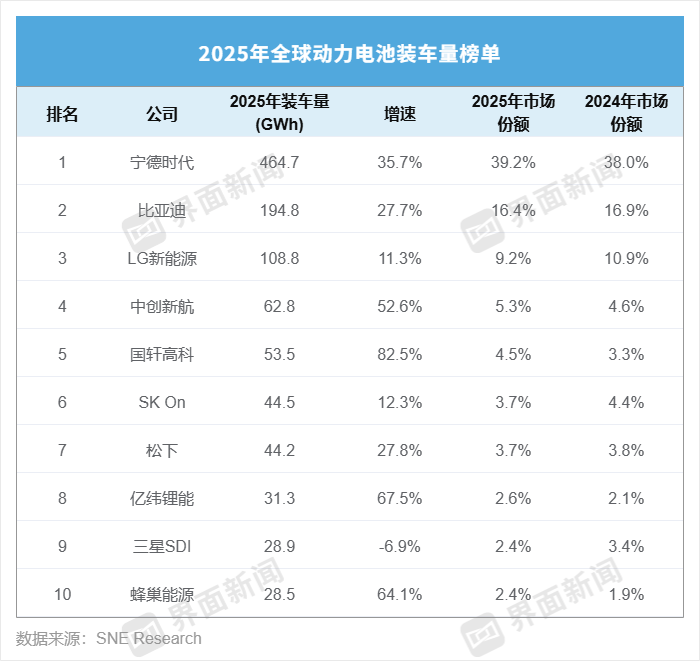
Global Power Battery Installation - The total global power battery installation volume is projected to reach 1187 GWh in 2025, representing a year-on-year increase of 31.7% [1] - CATL is expected to have a global power battery installation volume of 464.7 GWh in 2025, with a year-on-year growth of 35.7%, capturing a global market share of 39.2%, an increase of 1.2 percentage points [1] - Other Chinese companies such as BYD, Zhongchuang Xinhang, Guoxuan High-Tech, Yiwei Lithium Energy, and Honeycomb Energy have market shares of 16.4%, 5.3%, 4.5%, 2.6%, and 2.4% respectively, with year-on-year changes of -0.5, +0.7, +1.2, +0.5, and +0.5 percentage points [1] - In the Japanese and South Korean market, LG Energy Solution is projected to have a power battery installation volume of 108.8 GWh in 2025, with a year-on-year increase of 11.3%, holding a global market share of 9.2%, a decrease of 1.7 percentage points [1] - Other companies like SK On, Panasonic, and Samsung SDI have market shares of 3.7%, 3.7%, and 2.4% respectively, with year-on-year changes of -0.7, -0.1, and -1.0 percentage points [1] Global Energy Storage Battery Shipment - The total global shipment of energy storage lithium batteries is expected to reach 550 GWh in 2025, reflecting a year-on-year increase of 79% [2] - The market sizes for China, North America, Europe, and other regions are projected to be 352 GWh, 88 GWh, 39 GWh, and 72 GWh respectively, with year-on-year growth rates of +117%, +12%, +20%, and +108%, accounting for 64%, 16%, 7%, and 13% of the total market [1] Top 5 Manufacturers in Energy Storage - CATL is expected to ship 167 GWh in 2025, with a year-on-year increase of 80%, holding a market share of 30% [2] - Haicheng Storage is projected to ship 69 GWh, with a year-on-year growth of 200%, capturing a market share of 13% [2] - Yiwei Lithium Energy is expected to ship 66 GWh, with a year-on-year increase of 65%, holding a market share of 12% [2] - BYD is projected to ship 48 GWh, with a year-on-year growth of 78%, capturing a market share of 9% [2] - Ruipu Lanjun is expected to ship 43 GWh, with a year-on-year increase of 34%, holding a market share of 8% [2]



横店东磁股价跌5.04%,广发基金旗下1只基金位居十大流通股东,持有913.45万股浮亏损失940.86万元
Xin Lang Ji Jin· 2026-02-05 03:42
Group 1 - The core point of the news is that Hengdian East Magnetic experienced a decline of 5.04% in stock price, reaching 19.42 yuan per share, with a trading volume of 4.51 billion yuan and a turnover rate of 1.40%, resulting in a total market capitalization of 31.591 billion yuan [1] - Hengdian Group East Magnetic Co., Ltd. was established on March 30, 1999, and listed on August 2, 2006. The company specializes in the production and sales of permanent magnetic ferrite, soft magnetic ferrite, other magnetic materials, batteries, and solar photovoltaic products [1] - The main business revenue composition includes photovoltaic products at 67.47%, magnetic materials at 16.24%, lithium batteries at 10.77%, devices at 3.62%, and others (including other business income) at 1.89% [1] Group 2 - From the perspective of the top ten circulating shareholders, a fund under GF Fund ranks among the top shareholders of Hengdian East Magnetic. The GF Guozhen New Energy Vehicle Battery ETF (159755) entered the top ten circulating shareholders in the third quarter, holding 9.1345 million shares, accounting for 0.56% of the circulating shares [2] - The GF Guozhen New Energy Vehicle Battery ETF (159755) was established on June 15, 2021, with a latest scale of 14.086 billion yuan. It has incurred a loss of 0.48% this year, ranking 5095 out of 5566 in its category; over the past year, it has achieved a return of 65.88%, ranking 450 out of 4285; and since its inception, it has returned 6.41% [2] Group 3 - The fund manager of GF Guozhen New Energy Vehicle Battery ETF (159755) is Luo Guoqing, who has a cumulative tenure of 10 years and 119 days. The current total asset scale of the fund is 116.678 billion yuan, with the best fund return during his tenure being 109.05% and the worst being -48.08% [3]

历史首次,中企狂揽全球动力电池超七成市场 | 动力电池排名②
Xin Lang Cai Jing· 2026-02-05 02:57
智通财经记者 | 高菁 2025年,中国企业贡献了全球超七成的动力电池装车量,以及超八成的储能电池出货量。 2月4日,韩国研究机构SNE Research(下称SNE)发布最新统计数据,去年全球动力电池装车总量达1187 GWh,同比增长31.7%。这一增速较2024年全年有所回升。 同期,共有六家中国企业的动力电池装车量闯进全球前十,分别为宁德时代(300750.SZ)、比亚迪 (002594.SZ)、中创新航(03931.HK)、国轩高科(002074.SZ)、亿纬锂能(300014.SZ)和蜂巢能源。 六家中企的总市场份额达70.4%,较去年全年的提高了3.3个百分点,也是有统计以来中企年度全球动力 电池市占率首次超70%。 | | | | 2025年全球动力电池装车量榜单 | | | | --- | --- | --- | --- | --- | --- | | 排名 | 公司 | 2025年装车量 (GWh) | 増速 | 2025年市场 保题 | 2024年市场 保频 | | 1 | 宁德时代 | 464.7 | 35.7% | 39.2% | 38.0% | | 2 | 比亚迪 | 194.8 ...



隆华科技:公司靶材产品广泛应用于HJT,BC以及钙钛矿电池领域
Ge Long Hui· 2026-02-05 00:57
Group 1 - The core viewpoint of the article is that Longhua Technology (300263.SZ) has indicated that its target material products are widely used in HJT, BC, and perovskite battery fields [1] Group 2 - The company's target materials are essential components in the production of advanced solar cells, indicating a strong position in the renewable energy sector [1] - The mention of HJT (Heterojunction Technology) and perovskite batteries highlights the company's involvement in cutting-edge technologies that are gaining traction in the market [1] - The application of these materials in various battery technologies suggests potential growth opportunities for the company as the demand for renewable energy solutions increases [1]

隆华科技(300263.SZ):公司靶材产品广泛应用于HJT,BC以及钙钛矿电池领域
Ge Long Hui· 2026-02-05 00:57
Group 1 - The core viewpoint of the article is that Longhua Technology (300263.SZ) has indicated that its target material products are widely used in HJT, BC, and perovskite battery fields [1] Group 2 - The company's target materials are essential components in the production of advanced solar cells, indicating a strong position in the renewable energy sector [1] - The mention of HJT (Heterojunction Technology) and BC (Bifacial Cells) highlights the company's involvement in cutting-edge solar technologies [1] - The reference to perovskite batteries suggests potential growth opportunities in emerging battery technologies, which could enhance the company's market prospects [1]
转型升级加快,制造“基石”更稳
Xin Hua Ri Bao· 2026-02-04 21:44
Group 1: Manufacturing Industry Growth - In 2025, the manufacturing sector in the province is expected to achieve a sales revenue growth of 3.8% year-on-year, surpassing the overall provincial sales growth by 2 percentage points [1] - The manufacturing sales scale remains the largest in the country, accounting for 44.4% of the total provincial sales, an increase of 0.9 percentage points from the previous year [1] Group 2: Intelligent Upgrading - The procurement of intelligent equipment by manufacturing enterprises is projected to increase by 5.8% year-on-year in 2025, indicating a faster pace of intelligent transformation and digitalization [2] - Sales revenue for industrial robots and special operation robots is expected to grow by 19.7% and 28.7% year-on-year, respectively [2] Group 3: Green Transformation - In 2025, the sales revenue of high-energy-consuming manufacturing industries is expected to decrease by 1.4 percentage points, reflecting an optimization of the industrial structure [3] - The sales revenue of the lithium-ion battery manufacturing industry is projected to grow by 22.6% year-on-year, highlighting the rapid development of related new energy industries [3] Group 4: Environmental Investment - Jiangsu Longjiang Steel Co., Ltd. has increased its green production line renovation investment by 220% year-on-year, achieving a water recycling rate of 99.5% [4] - XuGong Fudi Battery Technology Co., Ltd. anticipates a revenue of approximately 900 million yuan in 2025, representing an 800% year-on-year increase, driven by innovation and technology empowerment [4] Group 5: Digital Integration - The manufacturing sector's procurement of digital technology is expected to grow by 10.3% year-on-year in 2025, with an acceleration of 4.7 percentage points compared to the previous year [5] - Companies are increasingly focusing on integrating advanced technologies such as AI and industrial internet to enhance their core competitiveness and drive smart manufacturing [5]
科力远:部分电池材料和电池产品涉及出口业务
Zheng Quan Ri Bao· 2026-02-04 13:39
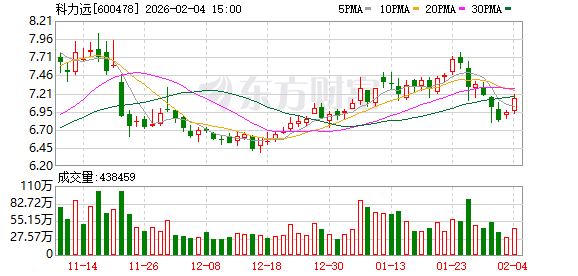
Core Viewpoint - The company, Kolyuan, is actively expanding its overseas energy storage market to achieve growth in revenue and profits, with a notable portion of its battery materials and products involved in export business [2] Group 1: Export Business - Kolyuan's export business model primarily involves direct exports from domestic entities to overseas customers, supplemented by third-party traders and agents [2] - In 2024, the company's export revenue is projected to account for 6.63% of its total annual revenue [2] Group 2: Future Outlook - Detailed data regarding the company's export performance for 2025 will be provided in the upcoming annual report [2] - The company is focused on expanding its presence in the overseas energy storage market to drive revenue and profit growth [2]

科力远:公司部分电池材料和电池产品涉及出口业务,业务模式以境内主体直接向海外客户出口为主
Mei Ri Jing Ji Xin Wen· 2026-02-04 13:05
Core Viewpoint - The company, Kolyuan (600478.SH), is actively expanding its export business and overseas energy storage market to drive revenue and profit growth, with a projected export revenue accounting for 6.63% of total annual revenue in 2024 [2] Group 1 - The company’s export business primarily involves direct sales from domestic entities to overseas customers, supplemented by third-party traders and agents [2] - The company is focusing on the overseas energy storage market as a strategy for increasing its revenue and profits [2] - Detailed export data for 2025 will be provided in the company's upcoming annual report [2]
未来10年,这18个赛道将带来48万亿美元收入
创业家· 2026-02-04 10:35
Core Insights - McKinsey's report identifies 18 industry sectors likely to reshape the global business landscape, predicting revenues of $29 trillion to $48 trillion by 2040, contributing 18-34% to global GDP growth [2] E-commerce - By 2040, e-commerce's share of global retail revenue is expected to rise to 27%-38% from approximately 20% currently [3] - Growth drivers include market expansion in developing countries and new product categories in developed markets, such as healthcare and emotionally valuable products [4] - Significant investments are anticipated in customer acquisition and last-mile delivery across e-commerce platforms [5] Electric Vehicles - Electric vehicles (EVs) are projected to exceed 50% of global passenger car sales by 2040 [6] - Breakthroughs in battery technology and smart algorithms will significantly influence this sector, prompting increased R&D investments from both EV manufacturers and traditional automakers [7] Cloud Services - The demand for higher storage and computing capabilities is driven by a more interconnected world and the need for AI products requiring substantial computational power [9] - The cloud services industry experienced a 17% compound annual growth rate from 2005 to 2020, with similar growth expected in the coming decades [10] Semiconductors - The semiconductor industry is forecasted to grow at a compound annual growth rate of 6%-8% over the next decade, driven by demand in computing, data storage, automotive, communication, and industrial electronics [11] AI Software Services - The rapid development of AI has led to its classification as a distinct sector, with increasing usage of AI assistants [12] - Companies in the AI space are engaged in a competitive race to develop advanced foundational models and applications [13] Digital Advertising - Digital advertising is expanding in value globally, fueled by an increasing number of internet users and more time spent online [14] - Continuous algorithm improvements enhance platforms' abilities to target customers and track advertising costs, although competition for user attention necessitates higher investments in engaging content [15] Streaming Video - Investment in customer acquisition and content production is rising, prompting streaming platforms to seek new revenue models [17] - Developing countries are expected to contribute to growth in subscription and advertising revenues, with projections indicating over 1 billion households subscribing to long-form video services by 2040 [18] Shared Autonomous Vehicles - The advent of autonomous driving technology may reduce the necessity for personal vehicle ownership [19] - By 2040, shared autonomous vehicles could account for 25%-51% of shared mobility revenue [20] Space Economy - The world is on the brink of entering a space economy era, with advancements in reusable rocket technology [21][22] Cybersecurity - Cybercrime caused approximately $950 billion in direct economic losses in 2020, with indirect losses potentially reaching $4-6 trillion [24] - Increasing awareness of cybersecurity has led companies to enhance their investments in this area [25] Batteries - Significant advancements in battery technology have tripled energy density over the past few decades [26] - The global energy transition is driving demand for batteries, particularly in electric vehicles, energy storage, and consumer electronics, with EVs expected to represent over 80% of the battery market by 2040 [28] Video Games - By 2030, an estimated 40% of the global population may become video game players [30] - New gaming models, such as mobile and cloud gaming, are accelerating market growth, with free-to-play games generating substantial revenue [32] Robotics - The integration of AI with robotics is creating significant expectations for humanoid robots as "ultimate intelligent agents" [33] Industrial and Consumer Biotechnology - Breakthroughs in gene editing and other technologies are accelerating the application of biotechnology in agriculture, alternative proteins, consumer products, and bio-materials [37] Modular Construction - Modular construction methods can significantly enhance building efficiency, addressing global housing shortages and high costs [38] Nuclear Fission Power - Safer, smaller modular reactors may supplement renewable energy sources, with commitments from over 20 countries to double nuclear energy output by 2050 [40] Air Traffic - Electric vertical takeoff and landing vehicles and delivery drones represent major technological shifts in air traffic [41] Obesity Treatment Drugs - The prevalence of obesity is projected to rise from 15% in 2020 to 24% by 2035, indicating a potential market for effective weight loss products [43]

2.4犀牛财经晚报:多家中小银行宣布上调存款利率
Xi Niu Cai Jing· 2026-02-04 10:24
Group 1: Banking Sector - Several small and medium-sized banks have announced an increase in deposit rates ahead of the Spring Festival, with banks like Hunan Xinhang Rural Commercial Bank and Shanxi Lin County Rural Commercial Bank raising rates for certain term deposits [1] - Despite some banks raising rates, others have chosen to lower their deposit rates amid a declining market interest rate environment, indicating a mixed trend in the banking sector [1] - Industry insiders suggest that due to low net interest margins and ongoing downward pressure, banks may stabilize deposit rates at low levels or even slightly reduce them in the future [1] Group 2: Gold Market - Fidelity International's fund manager has indicated plans to buy significantly if gold prices drop by 5% to 7%, citing a structural upward trend in the gold market despite current price corrections [2] - The Shui Bei market has seen a surge in consumer interest in gold, with a shift from traditional gold bars to high craftsmanship, low weight "emotional gold" jewelry, reflecting changing consumer preferences [2] - Analysts believe that while gold prices may consolidate at high levels in the short term, the long-term investment logic remains solid due to factors like structural depreciation of the dollar and geopolitical risks [2] Group 3: Solar Industry - Elon Musk's team has been exploring the Chinese photovoltaic supply chain, with orders already placed with heterojunction equipment manufacturers, indicating potential collaboration in the solar sector [2] - The price of polysilicon has increased, with N-type polysilicon quoted at 48-59 yuan per kilogram, driven by market confidence following recent industry meetings [2] - Silicon wafer prices have remained stable, with companies adopting a wait-and-see approach due to significant fluctuations in metal prices affecting battery components [2] Group 4: Semiconductor Industry - Yangtze Memory Technologies' third-phase project is set to be completed and put into production this year, expected to attract around 200 upstream and downstream enterprises [3] Group 5: IPO and Corporate Actions - Tianyi Space Technology has completed its IPO counseling filing, marking a significant step for China's first commercial SAR remote sensing satellite company [4] - Guosheng Technology has clarified that it is not involved in space photovoltaic business, addressing market speculation [4] - Fuguang Co., Ltd. announced plans for major shareholder reductions, indicating potential changes in ownership structure [5] Group 6: Construction and Engineering - Beixin Road and Bridge has won an engineering project worth 1.145 billion yuan, showcasing its capabilities in large-scale infrastructure projects [6] - Palm Holdings has been awarded a project with a total investment of approximately 2.29 billion yuan, reflecting ongoing opportunities in agricultural infrastructure development [7] Group 7: Battery and Materials - Sileck's subsidiary has received project designation from a South Korean battery client, indicating a growing partnership in the battery materials sector [8] - Yinbang Co., Ltd. has secured a sales order worth approximately 280 million yuan from HOLTEC ASIA, highlighting its role in the composite materials market [9][10] Group 8: Logistics and Shipping - Zhonggu Logistics plans to invest in the construction of two 6000 TEU container ships, aiming to optimize its fleet structure [11] Group 9: Beverage Industry - Chongqing Beer reported a 10.43% increase in net profit for 2025, reflecting positive growth in the beverage sector [12] - Huanxu Electronics achieved a 12.16% increase in net profit despite a slight decline in total revenue, indicating resilience in the electronics market [13] Group 10: Mining and Resource Acquisition - Hainan Mining is planning to acquire control of Fengrui Fluorine Industry, with ongoing discussions and stock suspension indicating strategic moves in the mining sector [14] Group 11: Market Overview - The Shanghai Composite Index rose by 0.85%, with strong performances in coal and photovoltaic sectors, while AI applications and precious metals faced declines [15]