私募基金

Search documents
百亿私募基金红筹投资存8项违规 被限网下打新6个月
Zhong Guo Jing Ji Wang· 2025-09-15 08:05
Core Viewpoint - Shenzhen Red Chip Investment Co., Ltd. has been placed on a restricted list for offline investors for six months due to multiple compliance failures in its pricing evaluation and decision-making processes [1][6]. Group 1: Compliance Issues - The company failed to follow pricing evaluation and decision-making procedures, with a single researcher determining the final price without collective decision-making [6]. - There was insufficient basis for pricing, as the suggested price range lacked logical reasoning and was determined subjectively by the researcher [6]. - The research report writing mechanism was inadequate, lacking detailed regulations for using the lead underwriter's pricing report and approval processes [6]. Group 2: Internal Control Deficiencies - The company did not establish a necessary investment decision-making mechanism, leading to compliance issues in the pricing decision process [6]. - There was a lack of a comprehensive compliance management system, with inadequate execution of compliance checks [6]. - The company failed to implement a pricing review mechanism, with no written records of the final pricing review [6]. Group 3: Communication and Accountability - The control of communication devices was poorly executed, with no management of devices used by personnel aware of pricing during the inquiry period [6]. - The company did not establish an internal accountability mechanism or performance assessment indicators for pricing risks, failing to verify the objectivity and prudence of pricing retrospectively [6]. Group 4: Regulatory Framework - The violations were found to be in breach of several articles of the "Management Rules for Offline Investors in Initial Public Offerings," including Articles 18, 25, 26, 42, and 43 [1][4][5].
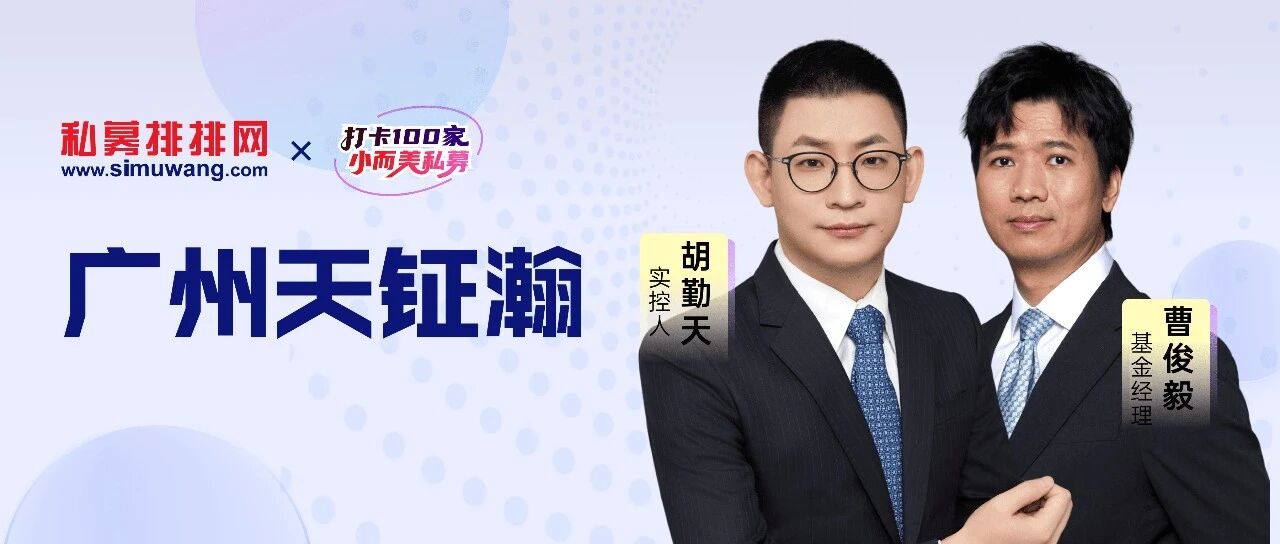
广州天钲瀚:量化择时策略,捕捉个股机遇 | 打卡100家小而美私募
私募排排网· 2025-09-15 07:00
Core Viewpoint - The article highlights the significance of small to medium-sized private equity firms in the industry, focusing on Guangzhou Tianzhanhan as a representative example of a successful quantitative investment firm [3][4]. Company Overview - Guangzhou Tianzhanhan Private Fund Management Co., Ltd. was established in March 2017 and is located in Tianhe District, Guangzhou. The firm specializes in quantitative investment, particularly in timing strategies for selected targets, aiming for absolute returns through low buying and high selling [4][6]. - As of August 2025, Tianzhanhan's products achieved an average return of ***% from January to August, ranking in the top 10 among quantitative private equity firms in Guangdong [4]. Investment Model - The firm operates with a management scale of 0-5 billion and focuses on quantitative strategies [6]. - The development timeline includes key milestones such as the issuance of representative products and securing seed investments from major financial institutions [6]. Core Team - The core team at Guangzhou Tianzhanhan has extensive experience in quantitative investment, with expertise in computer science, mathematics, and finance. The team has been stable and cohesive for over 10 years, ensuring strong continuity in product strategies [8][20]. Investment Philosophy & Representative Strategies - The core investment philosophy revolves around exploiting market volatility driven by human emotions, using mathematical models to identify price imbalances. The goal is to achieve absolute returns through strategic timing in buying and selling [11][24]. - The firm employs two main strategies: quantitative individual stock timing and quantitative index timing, utilizing proprietary models to predict future trends [12][16]. Strategy Logic - The investment decision-making process combines macro and micro timing analyses, focusing solely on the target assets rather than market indices. This approach aims to maximize profits through precise timing in buying low and selling high [13][21]. Core Advantages - The company has a clear ownership structure and stable operations since its inception in 2017. The focus on individual stock timing rather than market exposure allows for lower correlation with mainstream strategies, reducing competition [20][22]. - The firm emphasizes direct analysis of timing effectiveness, aiming for high win rates and strategy validity, which is relatively rare in the market [23][25].

今年来基金经理十强都有谁?陆航、殷陶、王琛等领衔百亿!童驯、李佳佳等夺冠!
私募排排网· 2025-09-15 03:17
Core Insights - The article emphasizes that "buying a fund means buying the fund manager," highlighting the critical role of fund managers in determining fund performance [2] - As of the end of August, there are 2,831 fund managers with performance data, managing a total of 5,276 private fund products, with a combined management scale of approximately 465.47 billion yuan and an average return of 22.64% this year, significantly outperforming the market [2][3] Summary by Categories Fund Manager Education and Experience - Nearly 50% of the fund managers hold a master's degree, while 221 have a doctoral degree and 8 are postdoctoral [2] - 244 fund managers have over 20 years of experience, accounting for 38.1%, and only 62 have over 30 years of experience, representing 9.7% [2] Fund Size and Performance - Fund managers from private funds with a scale of 10-20 billion yuan have an average return of 24.99%, leading the performance [3] - Fund managers from private funds with over 100 billion yuan have an average return of 24.78%, while those managing between 50-100 billion yuan have an average return of 20.16% [3] Top Performing Fund Managers - The top three fund managers in the over 100 billion yuan category are Lu Hang from Fusheng Asset, Jiang Yunfei from Duration Investment, and Yin Tao from Stable Investment [6][10] - Lu Hang has 20 years of experience and focuses on growth stocks, with significant returns from new consumer stocks [10] - Yin Tao, with 12 years of experience, utilizes a self-created high-frequency trading method and artificial intelligence in his investment strategy [10] Performance Rankings by Fund Size - In the 50-100 billion yuan category, the top three fund managers are Tong Xun from Tongben Investment, Ni Fei from Kaishi Private Equity, and Zhang Xiangfang from Mingxi Capital [12] - In the 20-50 billion yuan category, Li Jiajia from Haokun Shengfa Asset leads, followed by Shi En from Yunqi Quantitative and Xu Shuang from Zige Investment [17] - In the 10-20 billion yuan category, He Zhenquan from Liangli Private Equity ranks first, with a focus on emerging industry trends [22] - In the 5-10 billion yuan category, Liu Xianglong from Fuyuan Capital tops the list, emphasizing value investment [27]
两天,倒计时!
Zhong Guo Ji Jin Bao· 2025-09-14 06:03
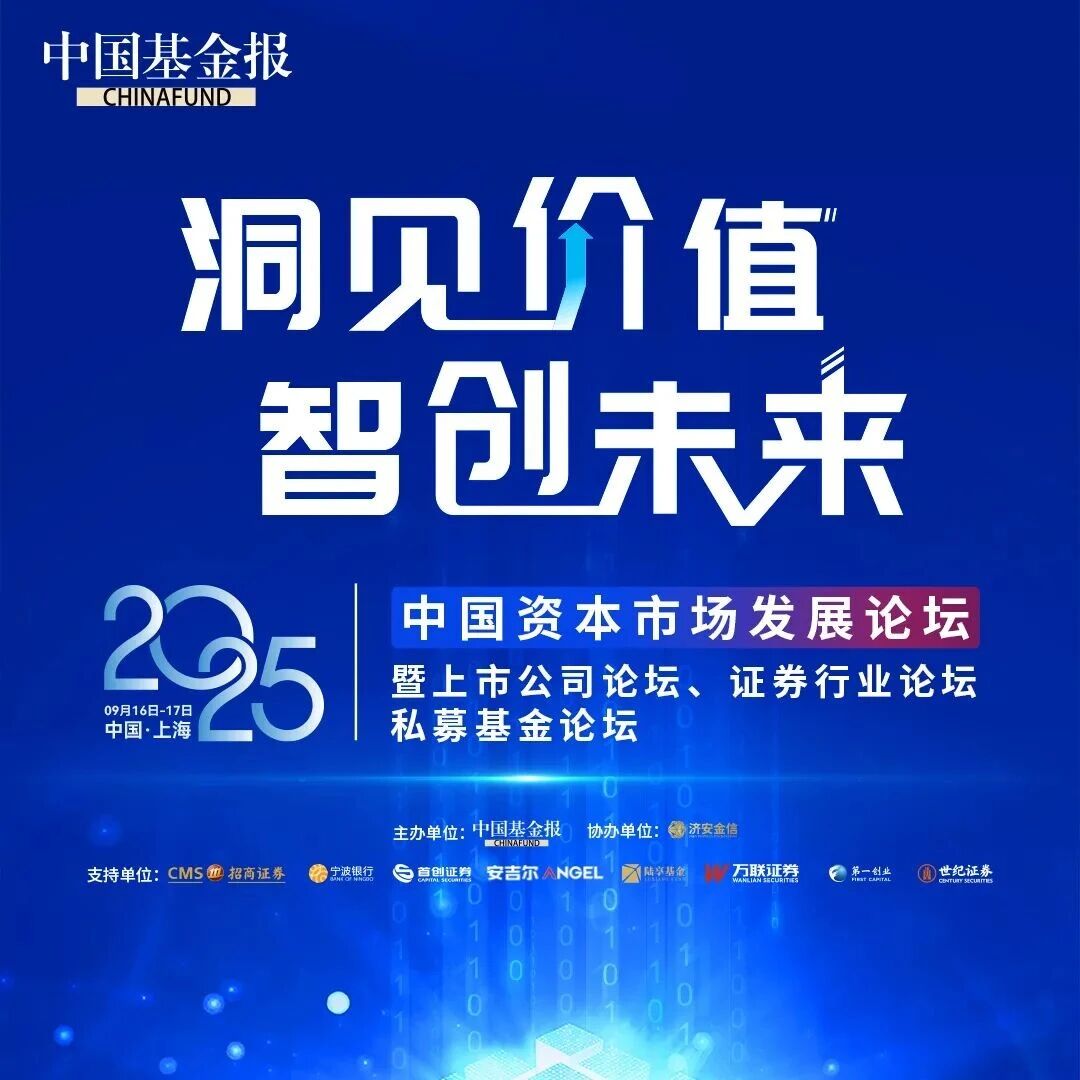
Core Insights - The 2025 China Capital Market Development Forum will be held in Shanghai from September 16 to 17, focusing on the theme "Insight into Value, Intelligent Creation of the Future" [1] - The forum aims to explore new paths for the high-quality development of China's capital market, emphasizing the service to the real economy, empowerment of technological innovation, and leading industrial transformation [1] Group 1: Forum Objectives - The forum will gather nearly a thousand representatives from regulatory bodies, industry, and investment sectors for in-depth discussions [1] - It will focus on three main areas: listed companies, the securities industry, and private equity funds [1] - The event aims to build a high-end dialogue platform to enhance the capital market's role in supporting the real economy [1] Group 2: Key Deliverables - The forum will release the "2025 Listed Company Value Management White Paper" and showcase the latest applications of AI technology in the industry [1] - It will highlight outstanding cases in the fields of listed companies, securities industry, and private equity funds [1] Group 3: Event Support and Collaboration - The forum is organized by China Fund News and supported by various institutions including China Merchants Securities, Ningbo Bank, and others [1][2] - It serves as a platform for resource linking and ecological co-construction within the capital market [2]
百亿私募独家揭秘投资策略|投资人说
Di Yi Cai Jing Zi Xun· 2025-09-13 12:09
Core Viewpoint - The recent market has shown significant activity, with the Shanghai Composite Index reaching a three-year high and margin trading balances hitting historical peaks, yet many investors struggle to outperform the index due to rapid sector rotations and concentrated hot spots [3][4]. Investment Strategy - The company has maintained its investment strategy and methodology despite market fluctuations, focusing on stock selection in various industries rather than over-participating in trending sectors like AI [3][4]. - A notable investment was made in a Hong Kong-listed blind box company, where strong revenue growth in North America was observed, leading to a successful position build-up based on performance tracking [4][5]. Market Trends and Shifts - The company has shifted its investment focus over the years, moving from consumer sectors to new energy, then to dividend assets, and currently to a combination of technology and consumption, driven by the need to align with market trends and growth opportunities [5][6]. - The investment philosophy emphasizes the importance of aligning with growth-oriented assets that reflect societal consumption habits and industry structures [6][7]. Performance Metrics - The company sets a growth threshold of 20% over the next two to three years as a benchmark for evaluating potential investments, ensuring a unified valuation standard across different sectors [10][11]. - The core investment philosophy is termed "performance-driven investment," which posits that the growth trend of earnings is the primary driver of stock prices [12][13]. Risk Management - The company adopts a "weaker" mindset in its investment approach, focusing on realistic assessments rather than predictions, which helps in identifying performance inflection points more accurately [14][15]. - The company emphasizes the importance of liquidity and does not rely heavily on trading, instead focusing on fundamental analysis and performance tracking [16][17]. Future Outlook - The current market valuation is perceived as not overheated, presenting a favorable environment for identifying quality investment opportunities [18]. - The company plans to focus on "growth-oriented dividends" in the fourth quarter, seeking companies that demonstrate strong earnings growth while also providing shareholder returns [19].
将私募基金财产用于借贷!海南卓戴私募收警示函
Sou Hu Cai Jing· 2025-09-13 06:51
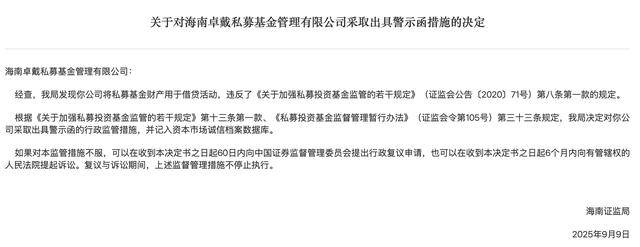
海南证监局日前披露,对海南卓戴私募基金管理有限公司出具警示函。 经查,海南证监局发现公司将私募基金财产用于借贷活动,违反了相关规定。 根据规定,海南证监局决定对公司采取出具警示函的行政监管措施,并记入资本市场诚信档案数据库。 资料显示,海南卓戴私募基金管理有限公司是一家专注于智能制造、信息技术、生物医药等产业领域, 以私募股权投资为主业的投资机构,也是国企金融机构参股的投资平台。公司成立于2016年,总部位于 上海陆家嘴。 来源:读创财经 ...
河南神火煤电股份有限公司 关于与专业机构共同出资设立基金的进展公告
Zhong Guo Zheng Quan Bao - Zhong Zheng Wang· 2025-09-13 03:54
Group 1 - The company, Henan Shenhua Coal and Electricity Co., Ltd., has approved the establishment of a partnership fund with a total investment of 1.512 billion yuan, with the company contributing 1.2 billion yuan as a limited partner [2][3] - The partnership fund aims to invest in key mineral resources, new materials, intelligent manufacturing, new energy, and smart connected vehicles, aligning with national strategic emerging industries [4][5] - The partnership agreement stipulates a ten-year duration for the fund, with an initial six-year investment period followed by a four-year exit period [4][5] Group 2 - The fund will be managed by two general partners, Jiangkong Chuangfu Private Fund Management Co., Ltd. and Henan Asset Fund Management Co., Ltd., with specific rights and responsibilities outlined for each [11][13] - The fund's management fee is capped at 1.8% per year during the investment period, and 1% per year during the exit period after achieving a 6% threshold return [24][25] - The fund's investment decisions will be overseen by an investment committee composed of seven members, ensuring a collaborative decision-making process [18][20] Group 3 - The company has reported a reduction in shareholding by a major shareholder, Puyuan Industrial Co., Ltd., which has decreased its stake from 8.52% to 7.96% after selling 12.6 million shares [36][37] - The share reduction was executed through centralized bidding, and the shareholder plans to continue reducing its stake within the specified timeframe [36][37]

重磅来了,就在下周
中国基金报· 2025-09-13 00:27
Core Viewpoint - The 2025 China Capital Market Development Forum will be held in Shanghai from September 16 to 17, focusing on the theme "Insight into Value, Intelligent Creation of the Future" [3][4]. Group 1: Forum Overview - The forum will gather nearly a thousand representatives from regulatory bodies, industry, and investment sectors to discuss new paths for high-quality development of China's capital market [4]. - Key areas of focus include listed companies, the securities industry, and private equity funds, aiming to enhance the capital market's service to the real economy, empower technological innovation, and lead industrial transformation [4]. Group 2: Key Events and Agenda - The forum will feature the release of the "2025 Listed Company Value Management White Paper" and showcase the latest applications of AI technology in the industry [4]. - The agenda includes opening speeches, thematic presentations, and roundtable discussions on topics such as new growth logic in bull markets and opportunities in China's intelligent manufacturing [6][7][10][14]. Group 3: Supporting Organizations - The forum is organized by China Fund News, with support from various institutions including China Merchants Securities, Ningbo Bank, and others [4][18].
五年蛰伏终落地,逸行团队携手Thoma Bravo资本启动QFLP中国基金
Sou Hu Cai Jing· 2025-09-12 11:46
Group 1 - Thoma Bravo Capital has completed regulatory filings for its QFLP private equity fund targeting the Chinese market, expected to launch within two months [1][3] - The fund's establishment involved extensive preparation over five years, including multiple trips by executives to understand China's private fund regulations and foreign exchange requirements [3] - The fund will allocate 60% of its capital to new energy and intelligent manufacturing, 30% to the digital economy, and 10% to life and health sectors, aligning with China's 14th Five-Year Plan [4] Group 2 - The fund will utilize a dual-currency structure, with USD entering through the QFLP channel and RMB being raised simultaneously, and has over 20 Pre-IPO projects in reserve [4] - The partnership with Yixing Team, which specializes in internet, new energy, and AI sectors, reflects a strategic move towards localized investment management in China [6] - The five-year strategy includes initial fundraising and project investments in the first year, followed by efforts to list portfolio companies on the Sci-Tech Innovation Board or the ChiNext in the subsequent years [4][6]

天承科技拟以不超5000万元认购产业基金份额
Sou Hu Cai Jing· 2025-09-12 09:57
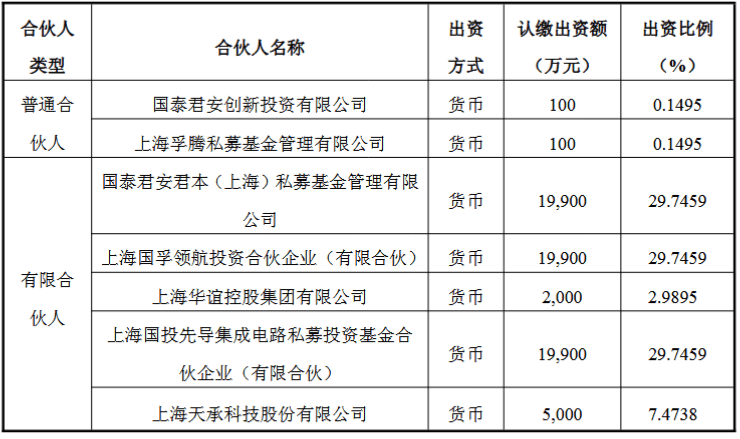
Core Viewpoint - Tiancheng Technology (688603) plans to invest up to 50 million yuan in the Shanghai Junhua Fu Chuang Electronic Materials Industry Development Private Investment Fund Partnership, acquiring a 7.4738% stake [1] Investment Details - The company will contribute 5 million yuan, representing 7.4738% of the total fund [1] - Other partners in the fund include: - Guotai Junan Innovation Investment Co., Ltd. with 100 million yuan (0.1495%) - Shanghai Futeng Private Fund Management Co., Ltd. with 100 million yuan (0.1495%) - Guotai Junan Junben (Shanghai) Private Fund Management Co., Ltd. with 19.9 million yuan (29.7459%) - Shanghai Guofu Linghang Investment Partnership (Limited Partnership) with 19.9 million yuan (29.7459%) - Shanghai Huayi Holding Group Co., Ltd. with 2,000 million yuan (2.9895%) - Shanghai Guotou Xiandao Integrated Circuit Private Investment Fund Partnership (Limited Partnership) with 19.9 million yuan (29.7459%) [1] Financial Performance - In mid-2025, Tiancheng Technology reported revenue of 213 million yuan and a net profit attributable to shareholders of 36.73 million yuan [1]