光伏设备

Search documents
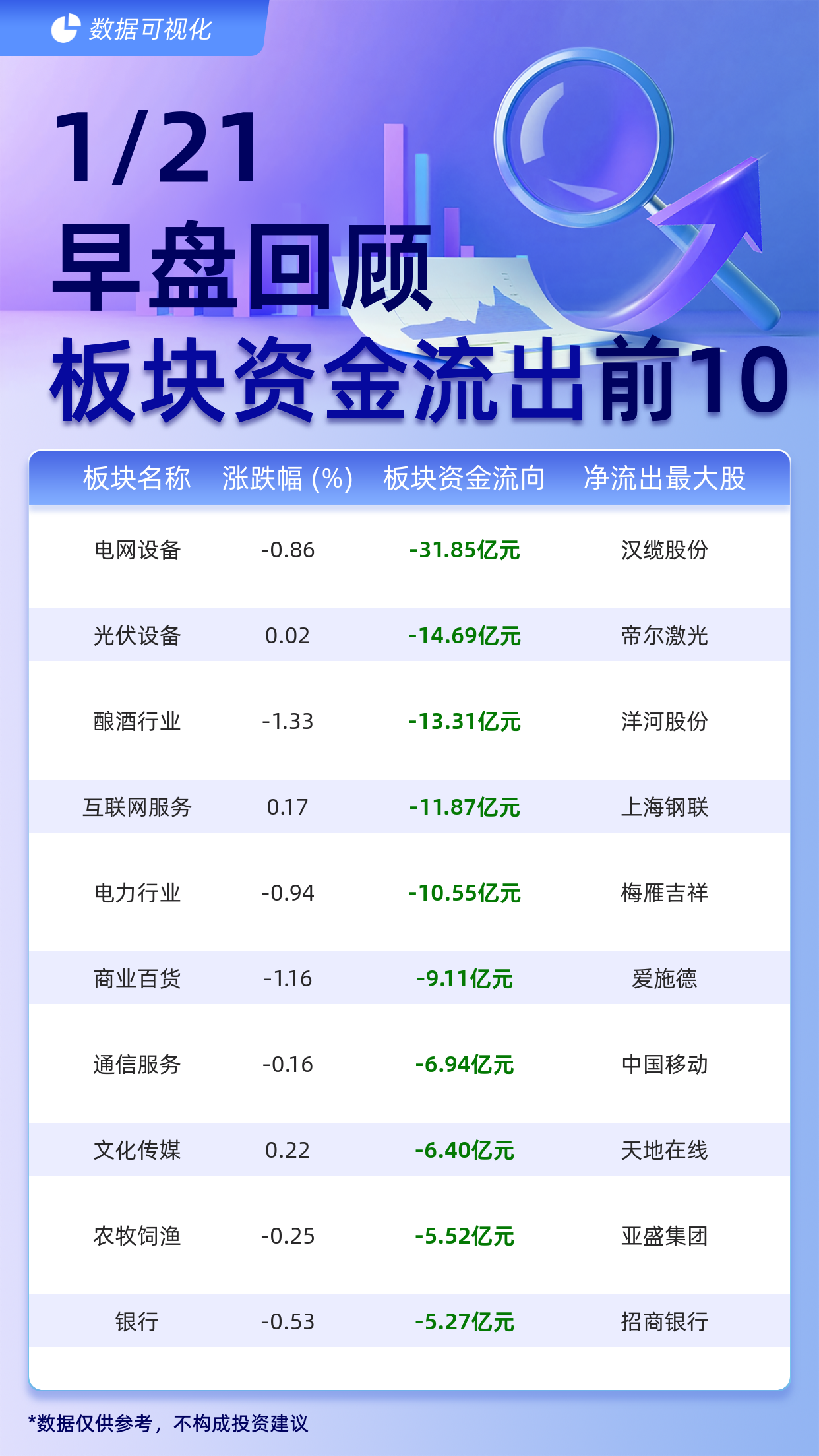
主力板块资金流出前10:电网设备流出31.85亿元、光伏设备流出14.69亿元
Jin Rong Jie· 2026-01-21 04:04
Core Viewpoint - As of January 21, the main market saw a net inflow of 7.765 billion yuan in major funds, indicating a mixed sentiment among investors across various sectors [1]. Fund Flow Summary - The top ten sectors with the largest fund outflows included: - Power Grid Equipment: net outflow of 3.185 billion yuan, with a decline of 0.86% [2] - Photovoltaic Equipment: net outflow of 1.469 billion yuan, with a slight increase of 0.02% [2] - Alcohol Industry: net outflow of 1.331 billion yuan, with a decrease of 1.33% [2] - Internet Services: net outflow of 1.187 billion yuan, with a rise of 0.17% [2] - Electric Power Industry: net outflow of 1.055 billion yuan, with a decline of 0.94% [2] - Commercial Retail: net outflow of 911 million yuan, with a decrease of 1.16% [2] - Communication Services: net outflow of 694 million yuan, with a decline of 0.16% [3] - Cultural Media: net outflow of 640 million yuan, with an increase of 0.22% [3] - Agriculture, Animal Husbandry, and Fishery: net outflow of 552 million yuan, with a decrease of 0.25% [3] - Banking: net outflow of 527 million yuan, with a decline of 0.53% [3]

钧达股份(002865):业绩阶段性亏损,加快布局新增长点
Soochow Securities· 2026-01-21 03:58
Investment Rating - The investment rating for the company is "Buy" (maintained) [1] Core Views - The company is expected to experience a phase of losses in 2025, with a projected net profit loss of 12 to 15 billion RMB, representing a year-on-year decline of 153.76% to 103.01% [8] - The company is actively investing in new growth points, including a partnership with Xingyi Xinneng to develop space photovoltaic materials, which is expected to enhance its competitive edge in the market [8] - The company’s overseas business revenue has surpassed 50%, positioning it as a core supplier in the overseas battery market, with plans for localized production in Turkey expected to commence in Q1 2026 [8] Financial Summary - Total revenue for 2023 is projected at 18.657 billion RMB, with a significant decline to 9.952 billion RMB in 2024, followed by a slight decrease to 9.318 billion RMB in 2025, and a recovery to 14.627 billion RMB in 2026 [1] - The net profit attributable to shareholders is forecasted to be 815.64 million RMB in 2023, dropping to a loss of 591.11 million RMB in 2024, and further to a loss of 1.272 billion RMB in 2025, before recovering to a profit of 471.07 million RMB in 2026 [1] - The earnings per share (EPS) is expected to decline from 2.79 RMB in 2023 to a loss of 4.35 RMB in 2025, with a recovery to 1.61 RMB in 2026 [1]

固德威股价涨5.46%,嘉实基金旗下1只基金重仓,持有1.76万股浮盈赚取6.99万元
Xin Lang Cai Jing· 2026-01-21 03:20
Group 1 - The core viewpoint of the news is that GCL-Poly Energy Holdings Limited (固德威) has seen a stock price increase of 5.46%, reaching 76.51 CNY per share, with a trading volume of 416 million CNY and a turnover rate of 2.31%, resulting in a total market capitalization of 18.592 billion CNY [1] - GCL-Poly Energy Holdings Limited, established on November 5, 2010, and listed on September 4, 2020, specializes in the research, production, and sales of photovoltaic inverters and related products [1] - The revenue composition of GCL-Poly includes 45.41% from household systems, 32.91% from grid-connected inverters, 7.05% from other products, 7.02% from energy storage batteries, 6.85% from photovoltaic energy storage inverters, and 0.76% from other sources [1] Group 2 - From the perspective of major fund holdings, one fund under Harvest Fund Management holds GCL-Poly as a significant investment, with the Harvest Low Carbon Selected Mixed Fund A (嘉实低碳精选混合发起式A) holding 17,600 shares, accounting for 3.62% of the fund's net value, ranking as the ninth largest holding [2] - The Harvest Low Carbon Selected Mixed Fund A was established on December 13, 2022, with a latest scale of 13.426 million CNY, achieving a year-to-date return of 5.2% and a one-year return of 48.39% [2] - The fund manager, Song Yang, has been in position for 3 years and 20 days, with the fund's total assets amounting to 285 million CNY, achieving a best return of 51.5% and a worst return of 14.32% during his tenure [3]

未知机构:再度call帝尔激光单GW价值量持续提升拓主业深度半导体设备太空光伏造成长-20260121
未知机构· 2026-01-21 02:05
Summary of Conference Call on Company and Industry Insights Industry and Company Overview - The conference call focused on the laser equipment industry, particularly the advancements in photovoltaic (PV) technology and semiconductor equipment, with a specific emphasis on the company 帝尔激光 (Dier Laser) [1][2]. Key Points and Arguments - **Increase in Single GW Value**: The single GW value has increased from 50 million/GW to at least 70-80 million/GW. This enhancement is attributed to: 1. New crystallization equipment contributing over 10 million per GW. 2. Anticipated bulk orders for metallization processes, including electroplating and copper paste sintering this year. 3. Layout of two welding routes for full plate welding and conductive backplane interconnection, with mass production orders expected to materialize by the first half of 2026 [1]. - **Space Photovoltaics**: 1. HJT (Heterojunction Technology) is being developed with laser transfer printing, induced repair, and sintering, all of which are mature mass production processes. The single GW value can reach 50 million/GW. 2. Perovskite technology is being explored with laser grooving and slicing, achieving a single GW value in the tens of millions [1]. - **Innovative Equipment and Multi-functional Devices**: The company is set to receive orders from leading customers in Jiangsu and is also in discussions with clients in Beijing regarding innovative equipment and processes [2]. - **Adaptation to Thin Silicon and Flexible Components**: Full plate welding and conductive backplane interconnection are naturally suited for ultra-thin silicon wafers and flexible components. Laser technology remains the core of all battery technology routes, with a high upper limit for single GW value this year marking a year of new laser technologies [3]. - **Semiconductor Product Layout**: The company aims for non-PV orders to reach 1 billion in 2026. The target for TGV (Through Glass Via) orders this year is over a hundred units. PCB (Printed Circuit Board) prototypes are expected to be delivered in February for validation [3]. - **Advanced Semiconductor Packaging**: The use of laser technology for advanced packaging, such as laser transfer printing for ball placement (tin ball dot printing) and laser drilling for optical fiber arrays in AFU (Active Fiber Unit) modules, is highlighted [4]. - **Dual-Drive Strategy**: The combination of photovoltaic and semiconductor sectors is driving growth, with space photovoltaics opening new opportunities for the company [4]. Other Important Insights - The emphasis on laser technology across various applications indicates a strategic focus on innovation and efficiency in production processes. - The anticipated growth in both the photovoltaic and semiconductor sectors suggests a robust market outlook for the company, positioning it well for future developments and potential investment opportunities [1][3][4].

中泰证券:卫星太阳翼市场持续扩容 钙钛矿电池有望成为主流技术路线
智通财经网· 2026-01-21 02:04
Core Insights - The demand for satellite internet construction is urgent, driven by the rigid application needs in communication, navigation, and remote sensing, with a low completion rate of satellite constellations in China [1] - Space computing is leading to new growth opportunities in satellite demand, with significant advancements in satellite-based computing systems [2] - Solar wings are the only efficient and long-term energy supply solution for near-Earth commercial space, constituting about 12%-24% of satellite value [3] Group 1: Satellite Internet Demand - There is a strong subjective and objective demand for satellite internet construction, with advantages such as wide coverage, strong disaster resistance, and rapid deployment [1] - The International Telecommunication Union (ITU) has established principles for satellite frequency and orbit usage, emphasizing the urgency of satellite internet development in China due to limited low-Earth orbit resources [1] Group 2: Space Computing Advancements - The traditional "ground computing" model is evolving to a "space computing" model to address issues of data latency and processing cycles, with significant projects like Starcloud-1 and SpaceX's Starlink V3 planned for future deployment [2] Group 3: Solar Wing Technology - Solar wings are critical components of satellite energy systems, with increasing surface areas leading to enhanced power supply capabilities [3] - The transition from rigid to flexible solar wings allows for larger deployment areas and improved power output, making them suitable for high-power and multi-satellite launch scenarios [4] Group 4: Technological Differences Between China and the US - The US favors low-cost silicon solutions due to its rocket capabilities, while China is exploring perovskite batteries for higher power-to-weight ratios, aiming to maximize payload space in single launches [5] - Perovskite batteries are expected to become the next mainstream technology for solar wings in China, offering lower costs and higher efficiency [5]

IPO雷达| IPO前减员超五成,江松科技订单缩水仍逆势扩产
Xin Lang Cai Jing· 2026-01-20 23:07
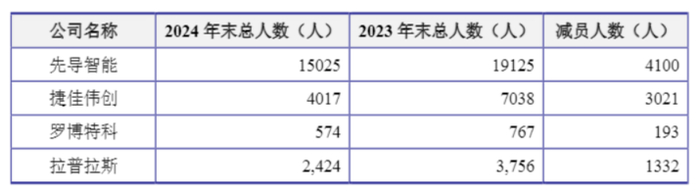
Core Viewpoint - Jiangsong Technology's IPO journey is under scrutiny due to significant risks highlighted by its financial performance and operational decisions amidst a supply-demand imbalance in the photovoltaic industry [1][2]. Financial Performance Concerns - Jiangsong Technology's revenue is projected to grow from 807 million to 2.019 billion from 2022 to 2024, with net profit increasing from 88 million to 187 million, indicating over 100% growth in both revenue and profit [2]. - However, the company faces a significant decline in orders, with its order backlog dropping from 3.613 billion at the end of 2024 to 2.491 billion in the first half of 2025, a decrease of 1.122 billion or over 31% [2][3]. - The company's profit forecast methodology has been criticized for lacking rationality, as it assumes a stable net profit margin despite a drastic reduction in orders, which could lead to a more significant profit decline than revenue drop [3]. Workforce Reduction - Jiangsong Technology plans to reduce its workforce from 1,976 employees in 2023 to 887 in 2024, a reduction of 1,089 employees or 55.1%, which is significantly higher than its peers [4][5]. - The company justifies this reduction as a cost-cutting measure due to decreased demand in the photovoltaic sector, but this approach raises concerns about losing key technical and business personnel [6]. Research and Development Investment - The company's R&D expenditure is projected to decrease by 11.35% in 2024, with an R&D expense ratio of only 2.86%, significantly lower than the industry average of 7.58% [7][8]. - This reduction in R&D investment raises concerns about the company's ability to maintain its competitive edge in a rapidly evolving technology landscape [7][8]. Accounts Receivable Issues - Jiangsong Technology's accounts receivable aging shows a declining trend in the proportion of receivables under one year, from 76.93% in 2023 to 65.83% in the first half of 2025, indicating potential cash flow issues [11][12]. - The company reported a significant increase in bad debt losses, amounting to 89.0053 million in 2024, which is 26 times that of 2023, suggesting serious risks in accounts receivable management [14]. Investment Project Viability - Jiangsong Technology plans to raise 1.053 billion for projects including a photovoltaic intelligent equipment production base, despite the current industry facing a supply-demand imbalance and reduced customer demand [1][20]. - The proposed investment in production capacity expansion raises questions about its feasibility, as the market for its core products is nearing saturation, and existing capacity is underutilized [18][19].
禾迈股份:截至2025年第三季度欧洲地区营业收入约占公司整体营业收入的35%
Zheng Quan Ri Bao Wang· 2026-01-20 14:14
证券日报网讯1月20日,禾迈股份在互动平台回答投资者提问时表示,截至2025年第三季度,欧洲地区 营业收入约占公司整体营业收入的35%,欧洲境外销售主要通过"集成商-安装商"等方式销售至终端客 户。 ...

ETF收评 | 内需板块全线上扬,建材ETF涨近4%
Ge Long Hui· 2026-01-20 13:02
Market Performance - The A-share market experienced a collective decline, with the Shanghai Composite Index down 0.01%, the Shenzhen Component Index down 0.97%, the ChiNext Index down 1.79%, and the Beijing Stock Exchange 50 Index down 2% [1] - The total trading volume across the three markets reached 28,041 billion yuan, an increase of 720 billion yuan compared to the previous day, with over 3,100 stocks in the three markets showing losses [1] Sector Performance - The top-performing sectors included epoxy propylene, precious metals, glyphosate, cultivated diamonds, real estate, construction materials, banking, and airport shipping [1] - Conversely, the sectors that saw the largest declines were commercial aerospace, military equipment, CPO, copper cable high-speed connections, and photovoltaic equipment [1] ETF Performance - Domestic demand sectors saw a broad increase, with the real estate industry chain leading the gains; notable ETFs included: - Fuguo Fund Construction Materials ETF up 3.96% - Guotai Fund Construction Materials ETF up 3.88% - E Fund Construction Materials ETF up 3.39% - Huabao Fund Real Estate ETF up 3.22% - Yinhua Fund Real Estate ETF up 2.87% [1] - Gold prices reached a new historical high, with Ping An Fund Gold Stock ETF rising by 3.24% [1] - Hong Kong consumer stocks also rose, with the Huitianfu Fund Hong Kong Stock Connect Consumer 50 ETF increasing by 2.8% [1] Declining ETFs - The commercial aerospace sector led the declines, with satellite ETFs such as Satellite ETF, Satellite ETF Penghua, and Satellite ETF Guangfa falling by 4.69%, 4.63%, and 4.58% respectively [1] - The photovoltaic sector experienced a pullback, with the Kexin New Energy ETF down 3.94% [1] - The CPO sector also declined, with the communication equipment ETF down 3.76% [1]
上市房企,批量亏损!
Sou Hu Cai Jing· 2026-01-20 11:20
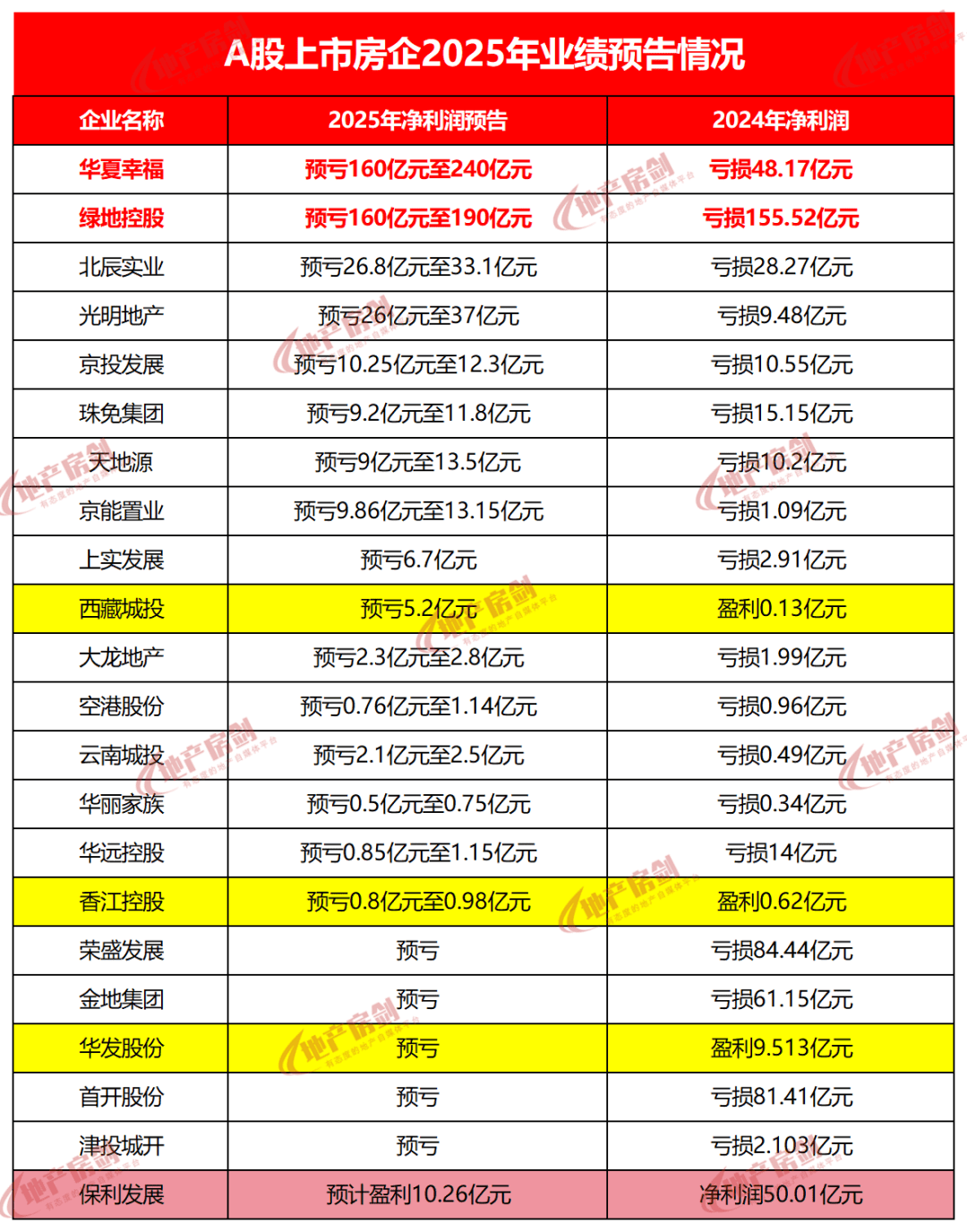
Core Viewpoint - The photovoltaic and real estate industries are experiencing significant losses, with the real estate sector facing even more severe challenges as many companies, including state-owned enterprises, are projected to report substantial losses in 2025 [1][5]. Summary by Sections Photovoltaic Industry Losses - Tongwei Co. is expected to report a loss of 9 to 10 billion yuan, TCL Zhonghuan is projected to lose 9.2 to 9.6 billion yuan, LONGi Green Energy is expected to lose 6 to 6.5 billion yuan, and JA Solar is projected to lose 4.5 to 4.8 billion yuan in 2025 [1]. Real Estate Industry Losses - As of January 19, 2026, 22 A-share listed real estate companies have released their 2025 performance forecasts, with only Poly Development expected to be profitable, while the other 21 companies are projected to incur losses [1][3]. - Poly Development anticipates a net profit of 1.026 billion yuan in 2025, a significant decrease of 79.49% compared to 2024, despite a slight revenue decline of 1.09% [4]. Major Losses Among Real Estate Companies - China Fortune Land Development and Greenland Holdings are expected to report losses exceeding 10 billion yuan, with China Fortune Land Development projected to lose between 16 to 24 billion yuan and Greenland Holdings expected to lose between 16 to 19 billion yuan [6][7]. - Other companies such as Beichen Industrial, Guangming Real Estate, and Jingtou Development are also expected to report losses exceeding 1 billion yuan [7]. Shift from Profit to Loss - Companies like Huafa Holdings and Tibet Urban Investment, which were profitable in 2024, are projected to report losses in 2025, marking a significant shift in their financial performance [8]. - The overall trend indicates that many companies are facing unprecedented challenges, with some experiencing their first losses in decades [1][8]. Market Conditions and Profitability - The decline in profitability across the real estate sector is attributed to a prolonged downturn in housing prices, leading to asset impairment and reduced profit margins [15][16]. - The average gross margin for major real estate companies has decreased significantly, with some companies reporting net profit margins as low as 2.27% [16]. Broader Implications - The losses are not confined to private enterprises; state-owned and central enterprises are also affected, indicating a systemic issue within the real estate market [17]. - The perception of the real estate industry as a high-profit sector is changing, as many companies are now struggling to maintain profitability amid challenging market conditions [16][17].


兴业证券:A股业绩预告即将进入披露高峰 关注哪些方向?
智通财经网· 2026-01-20 10:56
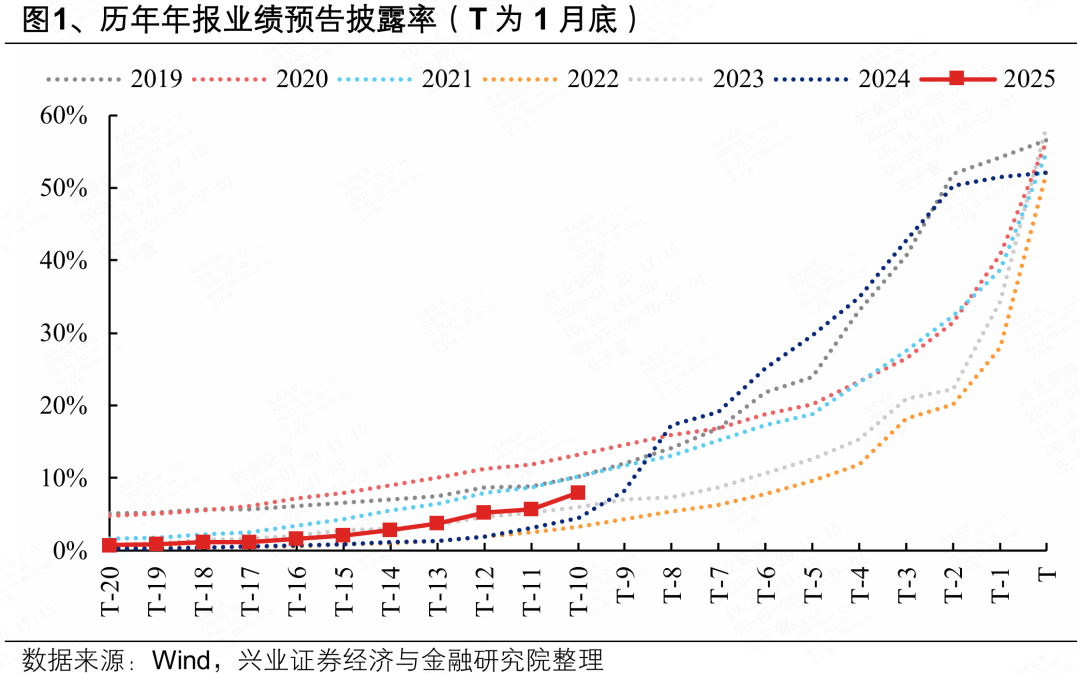
Core Viewpoint - As of January 19, the disclosure rate of annual performance forecasts for A-shares is 7.98%, with a peak expected in late January, where the final disclosure rate may reach around 55% [2][5]. Group 1: Performance Forecasts - The performance forecasts indicate that companies with significant net profit growth are primarily in sectors such as computing power, new energy, chemicals, pharmaceuticals, non-ferrous metals, and computers [6][10]. - By January 19, 447 A-share companies have released annual performance forecasts, with 144 companies expecting net profit growth exceeding 50%, mainly in computing power (semiconductors, communication equipment), new energy (batteries, photovoltaics), and chemicals [6][10]. Group 2: Market Reactions - As the performance forecasts enter their peak disclosure period, the correlation between stock prices and performance is expected to increase significantly in the latter half of January, with market sentiment returning to rationality [5]. - The market is likely to undergo a structural adjustment based on fundamentals, with previous hot sectors facing performance validation, while some low-performing but high-quality sectors may attract new capital inflows [5]. Group 3: Industry Insights - The sectors with upward revisions in profit forecasts since November include technology (especially in upstream computing hardware and downstream applications like consumer electronics and software), advanced manufacturing (new energy, military, automotive), and cyclical industries (building materials, non-ferrous metals, coal, steel) [12][13]. - The industries with lower performance growth since the last market rally include AI computing power, new energy, pharmaceuticals, and cyclical sectors like steel and glass fiber [14].