农村电商

Search documents
农村电商是帮助之手抑或攫取之手
经济观察报· 2026-03-31 13:37
Core Viewpoint - Rural e-commerce serves as both a "helping hand" and a "grabbing hand," providing opportunities for growth while also posing risks and challenges to rural communities [3][9][13]. Group 1: Helping Hand - E-commerce has transformed rural shopping habits, allowing farmers to access a wider range of products and increasing the value of agricultural goods, which can now reach national and global markets [4][5]. - The rise of rural e-commerce has improved living conditions and consumer choices, enabling farmers to purchase goods comparable to those available in urban areas, thus enhancing their quality of life [5][6]. - E-commerce has created job opportunities and encouraged entrepreneurship among the youth, leading to the emergence of new agricultural entrepreneurs who contribute to local economies [6][7]. Group 2: Grabbing Hand - Despite the benefits, rural e-commerce often leads to "consumption outflow," where money earned by farmers is spent on urban products, limiting local economic growth and exacerbating urban-rural disparities [9][10]. - The pressure to meet e-commerce demands has resulted in monoculture practices, which can harm land sustainability and lead to economic vulnerability for farmers [9][10]. - The digital divide remains a concern, as many farmers lack the skills to effectively engage in e-commerce, leading to a situation where they are often sidelined in the value chain [9][10]. Group 3: New Agricultural Entrepreneurs - The emergence of "returning new farmers" has the potential to shift the balance towards the positive aspects of rural e-commerce, as they bring education and urban experience to rural entrepreneurship [13][14]. - These new farmers are adept at resource integration, helping to create cooperative models that enhance local agricultural production and market presence [14][15]. - To sustain the positive impact of new farmers, there is a need for targeted policies, collaborative platforms, and community support to foster a more equitable and thriving rural economy [15][16].


【甘快看】新春走基层丨乡村巩大厨的烟火人生
Xin Lang Cai Jing· 2026-02-15 13:49
Core Insights - The article highlights the entrepreneurial journey of Gong Yaojun, a chef from a rural village in Ningxia, who transformed his culinary skills into a successful catering business, benefiting both himself and the local community [1][9]. Group 1: Business Development - Gong Yaojun started his catering business after returning to his hometown in 2015, leveraging the rise of rural e-commerce to establish a mobile catering service [1][9]. - Initially, he offered free services to relatives and neighbors to build a reputation, which led to increased demand and a shift from charging a service fee of 20 yuan per table to a comprehensive package that includes food and service [9][17]. - The business has grown from one mobile catering vehicle to two, and the team expanded from two to over thirty employees, generating an annual income of 7 to 8 million yuan [9][17]. Group 2: Service Offerings - The catering service includes a variety of dishes, with a standard banquet featuring 16 dishes, including both cold and hot options, reflecting an upgrade in the quality of ingredients over the years [3][4]. - The pricing for a banquet has increased from around 400-500 yuan a decade ago to 780 yuan per table for current events, indicating a shift towards higher-end offerings [4][12]. Group 3: Community Impact - The business not only provides employment for local villagers but also contributes to the local economy by sourcing ingredients from nearby suppliers and engaging in community events [7][17]. - Gong Yaojun's success has inspired other villagers, and the establishment of a new comprehensive service center is planned to further capitalize on the growing local economy due to new industrial projects [17].
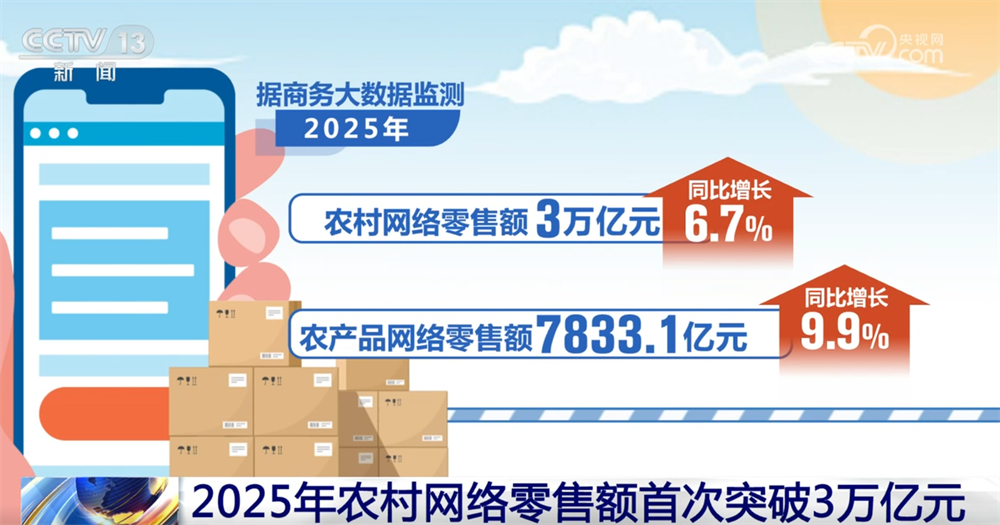
2025年我国农村网络零售额首破3万亿元
Yang Shi Wang· 2026-02-10 12:15
Core Viewpoint - The development of county economies and the continuous growth of farmers' income are driving a steady increase in rural consumption, with rural online retail expected to exceed 3 trillion yuan by 2025, marking a year-on-year growth of 6.7% [1] Group 1: Rural Online Retail Growth - By 2025, China's rural online retail sales are projected to surpass 3 trillion yuan, reflecting a 6.7% year-on-year increase [1] - During the 14th Five-Year Plan period, the scale of rural online retail will continue to expand, and its structure will further optimize [1] Group 2: Rural Logistics Development - The rural logistics distribution network is becoming increasingly完善, supported by policies such as the county commercial construction action and modern commercial circulation system pilot projects [1] - By 2025, 348 county-level logistics distribution centers are planned for construction and renovation, with the current coverage rate of county-level logistics distribution centers reaching 100% [1] - The gradual improvement of the "last mile" in rural logistics is leading to a steady decrease in commodity circulation costs [1]
视线|希望田野更有活力
Ren Min Ri Bao· 2026-02-08 06:09
Core Insights - The rapid development of rural e-commerce in China has established a three-tier electronic commerce service and logistics distribution system at the county, township, and village levels, significantly contributing to farmers' income and rural consumption [1] Group 1: Rural E-commerce Development - By 2025, the national rural online retail sales are expected to grow by 6.7% year-on-year, while agricultural product online retail sales are projected to increase by 9.9% year-on-year [1] - The integration of logistics and e-commerce has made rural life more convenient, allowing for better quality of life and increased economic activity in rural areas [1] Group 2: Case Study - Inner Mongolia - In Inner Mongolia, a new model combining passenger and freight transport has been implemented, allowing rural residents to receive packages directly in their villages, thus reducing the need for long-distance travel [3] - The collaboration between postal services and local bus companies has led to a significant increase in delivery efficiency, with an average of 4,000 packages being transported daily across seven townships and 94 villages by the end of 2025 [4] Group 3: Case Study - Liaoning - In Liaoning, rural supermarkets have become package collection points, enhancing the convenience of e-commerce for local residents and increasing the number of elderly individuals engaging in online shopping [5][6] - The integration of package delivery services with local businesses has resulted in a 30% increase in revenue for rural supermarkets [6] Group 4: Case Study - Shanxi - In Shanxi, live-streaming e-commerce has significantly boosted the income of local fruit farmers, with one farmer reporting sales exceeding 30,000 yuan in a single day through live broadcasts [7][8] - The county has developed over 1,000 e-commerce enterprises, creating employment for over 60,000 people, and has implemented logistics subsidies to reduce shipping costs for local farmers [9][10] - By 2025, the e-commerce sales of agricultural products in Shanxi are expected to reach 2.5 billion yuan, with live-streaming sales accounting for 25% of this figure [10]

农村电商加快发展—— 希望田野更有活力
Ren Min Ri Bao· 2026-02-08 02:54
Core Viewpoint - The rapid development of rural e-commerce in China is significantly enhancing farmers' income and promoting rural consumption, with projected growth rates of 6.7% for overall rural online retail and 9.9% for agricultural products by 2025 [2] Group 1: E-commerce Development - Rural e-commerce has established a three-tier service and logistics system at the county, township, and village levels, facilitating better access to goods and services for rural residents [2] - The integration of logistics and e-commerce is creating new opportunities for rural areas, making products more accessible and enhancing the quality of life for residents [2] Group 2: Logistics Innovations - A new model combining passenger and freight transport is being piloted in the Inner Mongolia region, allowing public transport to carry parcels, thus reducing delivery costs for courier companies [4] - The collaboration between public transport and postal services is leading to a win-win situation, where costs are lowered for courier companies while providing additional income for bus drivers [4][5] Group 3: Impact on Local Businesses - Rural supermarkets are evolving into package collection points, increasing foot traffic and sales as more residents engage in online shopping [6][7] - Local farmers are benefiting from improved logistics, allowing them to sell their products directly to consumers, thus increasing their profit margins [7] Group 4: E-commerce and Livestreaming - Livestreaming e-commerce is thriving, with local farmers using platforms to sell their products directly to consumers, significantly boosting their sales [8][9] - The county of Linyi has seen a substantial increase in e-commerce activity, with over 1,000 companies contributing to local employment and economic growth [10][11] Group 5: Government Support - Local governments are providing financial support for logistics costs, which is crucial for the sustainability of e-commerce businesses in rural areas [10][11] - Training programs for e-commerce skills are being implemented, enhancing the capabilities of local entrepreneurs and contributing to the growth of the sector [11]
希望田野更有活力(视线)
Ren Min Ri Bao· 2026-02-07 01:34
Core Viewpoint - The rapid development of rural e-commerce in China has established a three-tier electronic commerce service and logistics distribution system at the county, township, and village levels, significantly contributing to farmers' income and rural consumption. By 2025, the national rural online retail sales are expected to grow by 6.7% year-on-year, with agricultural product online retail sales increasing by 9.9% [7]. Group 1: Integration of Delivery and Public Transport - The integration of public transport and delivery services addresses the challenges faced by both sectors, with rural public transport companies like Xiangyu Bus Company in Inner Mongolia collaborating with private courier companies to deliver packages to remote areas [8][10]. - The new model allows for cost savings in delivery for courier companies and provides additional revenue streams for public transport, creating a win-win situation for all parties involved [10]. - By the end of 2025, the new delivery model is expected to handle an average of 4,000 packages daily across seven townships and 94 villages in the region [11]. Group 2: Rural E-commerce and Consumer Behavior - The establishment of village-level courier stations has made it easier for residents to receive and send packages, leading to an increase in online shopping among older villagers [12][13]. - Local farmers are benefiting from improved logistics, allowing them to sell their products directly to consumers, which increases their profit margins significantly [13][14]. - The integration of e-commerce with local businesses has resulted in a 30% increase in revenue for village supermarkets that also serve as courier stations [14]. Group 3: Agricultural E-commerce Growth - The rise of live-streaming e-commerce has significantly boosted sales for local farmers, with one farm reporting over 30,000 yuan in sales within half a day of live streaming [15][16]. - The county of Linyi has seen a transformation in its agricultural sector, with e-commerce contributing to a substantial increase in farmer incomes and attracting young entrepreneurs back to rural areas [16][17]. - By 2025, Linyi County aims to achieve 2.5 billion yuan in agricultural e-commerce sales, with live-streaming sales accounting for a quarter of that total [17].

农村电商加快发展——希望田野更有活力(视线)
Ren Min Ri Bao· 2026-02-07 00:44
Core Insights - The rapid development of rural e-commerce in China has established a three-tier electronic commerce service and logistics distribution system at the county, township, and village levels, significantly contributing to farmers' income and rural consumption growth. By 2025, the national rural online retail sales are expected to grow by 6.7%, with agricultural product online retail sales increasing by 9.9% [1]. Group 1: Rural E-commerce Development - Rural e-commerce has transformed the accessibility of goods, allowing for direct delivery to villages, enhancing the quality of life for residents [1][4]. - The integration of logistics services, such as the collaboration between public transport and courier services, has improved delivery efficiency and reduced costs for both courier companies and local transport services [3][6]. Group 2: Case Studies in Rural Areas - In Inner Mongolia, a new model combining passenger and freight services has been implemented, allowing for the delivery of parcels to remote areas, which has increased the income of local postal workers [3][4]. - In Liaoning, the establishment of village-level courier stations has facilitated the last-mile delivery of goods, encouraging more residents, including the elderly, to engage in online shopping [6][7]. - In Shanxi, the rise of live-streaming e-commerce has significantly boosted local farmers' incomes, with one farmer reporting sales exceeding 30,000 yuan in a single day through live broadcasts [8][9]. Group 3: Economic Impact and Future Prospects - The e-commerce sector in Shanxi has evolved, with over 1,000 e-commerce companies established, creating employment for over 60,000 people, and contributing to a projected 25 billion yuan in agricultural e-commerce sales by 2025 [10][11]. - Policies supporting logistics cost reductions, such as subsidies for local shipments, have been instrumental in enhancing the competitiveness of local agricultural products in broader markets [10][11].
金观平:千方百计促进农民增收
Xin Lang Cai Jing· 2026-02-06 21:01
Core Viewpoint - The central government emphasizes increasing farmers' income as a key task, with a focus on promoting agricultural development and improving living conditions for farmers, despite facing challenges such as low agricultural prices and employment pressures [1][2]. Group 1: Income Growth Strategies - The average disposable income for farmers is projected to reach 24,456 yuan by 2025, reflecting a 6% increase from the previous year, while the income gap between urban and rural residents continues to narrow [1]. - The government has introduced a policy package aimed at stabilizing agricultural production, boosting industries, expanding employment, and activating resources to address new challenges in income growth [1]. Group 2: Industrial Development - County economies are identified as crucial for fostering industries that benefit farmers, with a need to develop unique local products and avoid homogenization in rural industries [2]. - The establishment of a marketing service system for agricultural products is essential, leveraging the growth of rural e-commerce and live-streaming sales to enhance market access for farmers [2]. Group 3: Labor Income Stability - Wage income constitutes a significant portion of farmers' earnings, but challenges such as job stability and skill deficiencies hinder income growth [2]. - Strategies to enhance labor income include targeted training for migrant workers, improving job security, and supporting returnee entrepreneurs to create local employment opportunities [2]. Group 4: Resource Utilization - Issues such as abandoned land and idle housing in rural areas limit the potential for farmers' property income growth [3]. - Encouraging farmers to invest land use rights in cooperatives and repurposing idle houses for commercial use can broaden income channels, while ensuring legal protections for farmers' property rights [3].
奔赴“春天的约定”,在希望的田野上描摹“三农”壮美画卷
Xin Lang Cai Jing· 2026-02-06 08:35
Core Viewpoint - The central document outlines a clear roadmap for agricultural and rural development in China, emphasizing the modernization of agriculture, improvement of rural living conditions, and enhancement of farmers' livelihoods as key objectives for the new journey ahead [1][2]. Group 1: Agricultural Production and Food Security - The document sets a target to stabilize grain production at approximately 1.4 trillion jin (around 700 million tons) and emphasizes the implementation of a new round of actions to increase grain production capacity by 100 billion jin [2][3]. - It highlights the importance of maintaining arable land and promoting integrated practices for high-yield crops, thereby ensuring food security and enhancing agricultural productivity [2][3]. Group 2: Farmers' Income and Economic Development - A dedicated section focuses on promoting stable income growth for farmers, with a strong emphasis on developing local industries to create job opportunities [3][4]. - The document encourages the integration of technology, green practices, and quality agriculture to enhance the value of agricultural products, as well as the development of rural e-commerce and small enterprises [3][4]. Group 3: Rural Living Conditions and Community Development - New requirements for building livable and workable beautiful villages are outlined, aiming to transform rural areas into attractive destinations for tourism and entrepreneurship [4]. - The document stresses the need for tailored approaches that respect local conditions and farmers' wishes, avoiding one-size-fits-all policies, and addressing critical issues in education, healthcare, and elder care to improve the quality of life in rural areas [4].
2025年农村网络零售额首次突破3万亿元 消费活力激发乡村振兴“新引擎”
Yang Shi Wang· 2026-02-06 02:50
Group 1 - The core viewpoint is that by 2025, rural online retail sales will exceed 3 trillion yuan, indicating a significant acceleration in consumer spending in rural areas [1] - Rural online retail sales are projected to reach 3 trillion yuan, with agricultural product online retail sales at 783.31 billion yuan, reflecting year-on-year growth of 6.7% and 9.9% respectively [1] Group 2 - The effectiveness of the trade-in program is notable, with 48.23 million units sold and sales revenue of 158.6 billion yuan from the replacement of home appliances and mobile phones in county areas by 2025 [3] - Service consumption in county areas is expected to reach 9.1 trillion yuan, showing a year-on-year increase of 5.9% [3] Group 3 - The rural e-commerce supply chain is rapidly developing, with 1,428 facilities for agricultural product commercialization being supported for construction by 2025 [6] - Live-streaming e-commerce has significantly boosted direct supply from sources, with over 4 million live-streaming events conducted by leading e-commerce platforms, resulting in agricultural specialty product sales exceeding 10 billion units [6] Group 4 - The logistics and distribution network is becoming increasingly comprehensive, with support for the construction of 348 county-level logistics distribution centers and 562 township express logistics stations by 2025 [9] - Currently, the coverage rate of county-level logistics distribution centers has reached 100%, with over 7 billion express deliveries made to villages under the postal universal service network [9]