Semiconductor

Search documents
Tech stock shakeout clouds market ahead of economic data deluge
Yahoo Finance· 2026-02-06 11:05
By Lewis Krauskopf NEW YORK, Feb 6 (Reuters) - An artificial intelligence-driven shakeout in the heavyweight technology sector is set to keep stock investors on edge in the coming week while a barrage of data could shift focus to the health of the economy. A deepening rout among software stocks commanded Wall Street's attention this week, as investors worried about the extent to which AI would upend business models throughout the industry. Further weakness in the tech sector, which holds massive weight ...
科创芯片设计ETF易方达(589030)成交额超4000万元,近1周规模实现显著增长
Xin Lang Cai Jing· 2026-02-06 08:16
Core Viewpoint - The performance of the Sci-Tech Innovation Board Chip Design Theme Index has shown a decline, with notable fluctuations among constituent stocks, indicating a mixed sentiment in the chip design sector [1][2]. Group 1: Index Performance - As of February 6, 2026, the Sci-Tech Innovation Board Chip Design Theme Index (950162) decreased by 1.48% [1] - Among constituent stocks, Yingji Chip led with a rise of 3.87%, while Chip Origin fell by 6.28%, highlighting the volatility within the sector [1] Group 2: ETF Performance - The E Fund Sci-Tech Chip Design ETF (589030) dropped by 1.51%, with the latest price at 0.98 yuan [1] - The ETF experienced a turnover rate of 9.32% during the trading session, with a total transaction volume of 47.85 million yuan [1] - Over the past week, the ETF's average daily trading volume reached 81.80 million yuan, indicating significant trading activity [1] Group 3: Fund Flows and Scale - The E Fund Sci-Tech Chip Design ETF saw a net inflow of 5.94 million yuan, with four out of the last five trading days recording net inflows totaling 98.03 million yuan [1] - The ETF's latest share count reached 523 million, marking a new high since its inception [1] Group 4: Valuation Metrics - The latest price-to-earnings ratio (PE-TTM) for the index is 238.66, which is in the 19.92 percentile over the past year, indicating that the valuation is lower than 80.08% of the time in the last year [1]
概伦电子:拟购两公司股权,申请延期回复审核问询函
Xin Lang Cai Jing· 2026-02-06 07:46
Core Viewpoint - The company plans to issue shares and pay cash to acquire 100% equity of Chengdu Ruicheng Chip Micro and 45.64% equity of Nengneng Microelectronics, constituting a significant related party restructuring [1] Group 1 - The company received an inquiry letter from the Shanghai Stock Exchange on January 9, 2026, with a total response time not exceeding one month [1] - If the company cannot respond on time, it can apply for a one-month extension [1] - Due to the need for further implementation of certain matters, the company has applied for an extension of no more than one month to submit the response documents from the expiration of the response period [1] Group 2 - The transaction is subject to multiple approvals, indicating uncertainty in the process [1]

Open AI发新模型;千问App推30亿免单丨科技风向标
2 1 Shi Ji Jing Ji Bao Dao· 2026-02-06 03:28
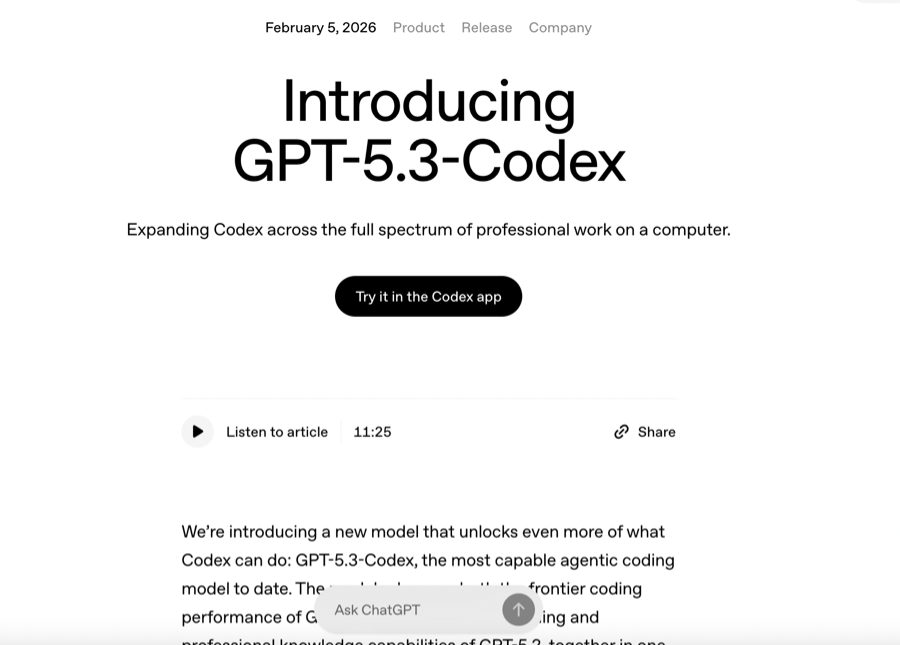
Group 1: Open AI Developments - Open AI has launched a new model, GPT-5.3-Codex, which enhances coding performance and reasoning capabilities, integrating the strengths of previous models and improving speed by 25% [2] Group 2: Xiaomi Automotive Updates - Xiaomi Automotive clarified rumors regarding the dissolution of the SU7 Ultra professional team, stating that sales strategies have been adjusted to improve customer service [4] - The company has reduced the safety mileage threshold for its assisted driving feature from 1000 km to 300 km to help users gradually familiarize themselves with the technology [5] Group 3: Meituan Acquisition - Meituan announced plans to acquire DINGDONG FRESH HOLDING LIMITED for an initial cost of $717 million (approximately 5 billion RMB), with certain conditions regarding cash extraction from the target group [6][7] Group 4: AI and Technology Innovations - Qianwen App launched a "Spring Festival 3 billion free order" campaign, allowing users to receive a 25 RMB no-threshold coupon for use in over 300,000 beverage stores [8] - Xiaoma Zhixing and Moer Thread have formed a strategic partnership to focus on L4 autonomous driving technology, utilizing domestic AI computing power for training and optimization [9] - The International Olympic Committee announced the creation of the first official Olympic large model based on Alibaba's Qianwen, aimed at enhancing service and information delivery during the Milan Winter Olympics [10] - Kuaishou's Keling AI has globally launched the 3.0 series model, which integrates video generation and editing into a unified workflow [11] Group 5: Aerospace and Semiconductor Developments - Fengfei Aviation successfully completed the conversion flight of its 5-ton eVTOL, marking a significant milestone in the eVTOL industry [12] - Intel and SoftBank's SAIMEMORY are collaborating to develop a new type of DRAM storage technology, aiming for prototype release by 2027 and commercialization by 2030 [13] - Texas Instruments announced the acquisition of Silicon Labs for approximately $7.5 billion, aiming to create a leading company in embedded wireless connectivity solutions [14] - Infineon announced a price increase for power switches and related chips starting April 1, 2026, due to rising demand and supply constraints [16] Group 6: Capital Market Activities - Kaide Quartz announced that Jiangfeng Electronics will become the controlling shareholder following a share transfer agreement [17] - Runze Technology is planning to issue convertible bonds to acquire minority stakes in Guangdong Runhui Technology [18] - Guoxuan High-Tech plans to raise no more than 5 billion RMB through a private placement to fund various battery projects [19] - Jinfeng Technology intends to acquire 51% stakes in Zhuohui Metal and Lianyi Thermal for a total consideration of up to 714 million RMB [20]

小马智行与摩尔线程达成战略合作,以国产AI算力加速中国自动驾驶规模化落地
IPO早知道· 2026-02-06 02:12
Core Viewpoint - The strategic collaboration between Pony.ai and Moore Threads represents a significant demonstration of collaborative innovation in China's artificial intelligence industry, focusing on the application and optimization of L4 autonomous driving technology [2][3]. Group 1: Strategic Collaboration - Pony.ai and Moore Threads will focus on the implementation and scaling of L4 autonomous driving technology, leveraging Pony.ai's core technology, including world models and virtual driver systems [2]. - This partnership marks the first large-scale application of domestic AI computing power in critical training and simulation processes for autonomous driving [2]. - The collaboration aims to create a comprehensive ecosystem for autonomous driving capabilities, enhancing the synergy across algorithms, data, computing power, and applications [2]. Group 2: Technological Advancements - Pony.ai's world model, based on reinforcement learning, generates over 10 billion kilometers of testing data weekly, allowing the virtual driver to evolve through repeated training [3]. - The collaboration will utilize Moore Threads' MTT S5000 training and inference integrated computing card and the Kuangya computing cluster to support the training and validation of Pony.ai's models [2][4]. - Moore Threads has rapidly iterated four generations of GPU architecture, achieving international advanced levels in training large models with hundreds of billions to trillions of parameters [4]. Group 3: Market Position and Goals - Pony.ai has become the first company in China to operate fully autonomous Robotaxi services in four major cities, with a fleet size of 1,159 vehicles as of December 31 last year, exceeding its annual target [4]. - The seventh-generation Robotaxi system has achieved a positive unit economic model in Guangzhou, indicating significant progress in commercial viability [4]. - The goal is to scale the Robotaxi fleet to over 3,000 vehicles by the end of 2026, with the collaboration expected to enhance training efficiency and overall system performance [4].
核心应用用户量破四千万,鸿蒙软件生态进化再度提速
Xuan Gu Bao· 2026-02-05 23:19
Group 1 - The installation of the WeChat HarmonyOS version App has officially surpassed 40 million, marking significant growth from 30 million in December last year, 20 million in October, and 10 million in July [1] - Huawei's hardware updates, including the Mate80 series and MateX7, are seen as a milestone in the evolution of the HarmonyOS ecosystem, which has grown rapidly over the past year with over 300,000 applications and services, achieving over 95% compatibility [1] - The HarmonyOS ecosystem has completed adaptation with major internet applications, and mid-tail applications are accelerating their launch across various sectors such as government services, finance, transportation, and entertainment [1] Group 2 - Huawei's open-source HarmonyOS products have exceeded 1,200 types, with a total of over 1.19 billion devices and more than 7.2 million developers contributing to the ecosystem [1] - The system-level intelligent agent, Xiaoyi, has been developed to achieve full-scene access through various entry points, with over 50 pioneering HarmonyOS intelligent agents currently in development [1][2] - Guokai Micro has completed the iteration of its smart vision, commercial display, and audio-visual solutions from OpenHarmony 3.1 to OpenHarmony 5.1, with eight open-source HarmonyOS chip platforms now in mass production across various industries [3] - Chipsea Technology is innovating in "Harmonyization" products through a full-link approach combining chips, algorithms, and systems [4]


音频 | 格隆汇2.6盘前要点—港A美股你需要关注的大事都在这
Ge Long Hui A P P· 2026-02-05 23:12
Group 1 - U.S. stock indices fell over 1.2%, with AMD and Qualcomm dropping more than 8%, while the Chinese concept index rose by 0.9% [1] - Bitcoin dropped below $65,000 [1] - Silver prices plummeted by 19.5%, and gold fell by 4% [1] - U.S. crude oil futures closed down over 2.8%, at $63.29 per barrel [1] - UBS and Goldman Sachs warned about volatility and liquidity issues in the silver market [1] - HP and Dell are reportedly researching the use of mainland China's memory chips [1] - South Korean stocks fell by 3.86%, with foreign investors recording a record high net sell-off [1] - JPMorgan stated that strong demand from central banks could push gold prices to $6,300 per ounce by the end of 2026 [1] - In January, the number of layoffs by Challenger companies in the U.S. rose to 108,000, the highest for the same period since 2009 [1] - Nvidia delayed the release of new gaming chips due to a shortage of memory chips [1] - Amazon's stock dropped by 11% after hours, with expected annual capital expenditures of approximately $200 billion [1] Group 2 - Meituan plans to acquire Dingdong for $717 million [2] - Multiple foreign institutions continue to increase their investment willingness in China [2] - China Telecom and China Unicom have initiated trial commercial use of Beidou SMS [2] - AUX announced a price increase of 6%-10% for all central air conditioning products starting March 1 [2] - Hong Kong Stock Exchange reported that the amount raised from IPOs in January was HKD 39.3 billion, a year-on-year increase of 555% [2] - The silicon industry association indicated that the silicon wafer market is expected to remain stable due to adjustments in battery production and expectations of declining silicon prices [2] - NIO expects adjusted operating profit to be between 700 million and 1.2 billion yuan in Q4 2025 [2] - The Bank of England maintained its current policy as expected [2] - Muyuan Foods saw a 1.9% increase in dark trading, earning HKD 74 per lot [2] - Dazhu CNC experienced a 21.71% increase in dark trading, earning HKD 2,080 per lot [2] Group 3 - Hong Kong stocks of Zhuozheng Medical, Dazhu CNC, and Muyuan Foods were listed [3] - Significant accumulation of Tencent shares occurred, with southbound funds net buying a total of HKD 11 billion over four consecutive days [3] - Announcement highlights include Revotek planning a 1 billion yuan investment in a synthetic biology manufacturing project in Xinjiang, and GCL-Poly has not yet received relevant orders in the "space photovoltaic" sector [3] - In A-shares, Beiliang's major shareholder Ma Xuejun is under investigation by the CSRC for alleged market manipulation [3]




深圳市节辰半导体有限公司成立,注册资本500万人民币
Sou Hu Cai Jing· 2026-02-05 23:10
天眼查显示,近日,深圳市节辰半导体有限公司成立,法定代表人为李贵平,注册资本500万人民币, 由深圳市鑫自来投资有限公司全资持股。 序号股东名称持股比例1深圳市鑫自来投资有限公司100% 经营范围含一般经营项目是:集成电路芯片设计及服务;集成电路芯片及产品销售;半导体分立器件制 造;半导体分立器件销售;半导体器件专用设备销售;电子产品销售;计算机软硬件及辅助设备批发; 计算机软硬件及辅助设备零售;技术服务、技术开发、技术咨询、技术交流、技术转让、技术推广;技 术进出口;货物进出口。(除依法须经批准的项目外,凭营业执照依法自主开展经营活动),许可经营 项目是:无 企业名称深圳市节辰半导体有限公司法定代表人李贵平注册资本500万人民币国标行业制造业>计算 机、通信和其他电子设备制造业>电子器件制造地址深圳市龙华区民治街道白石龙社区白石龙二区皇嘉 商务中心A1603-A1606企业类型有限责任公司(法人独资)营业期限2026-2-5至无固定期限 来源:市场资讯 ...
AOS(AOSL) - 2026 Q2 - Earnings Call Transcript
2026-02-05 23:00
Financial Data and Key Metrics Changes - Total revenue for Q2 2026 was $162.3 million, down 6.3% year-over-year and down 11.1% sequentially [4][18] - Non-GAAP gross margin was 22.2%, compared to 24.1% last quarter and 24.2% a year ago [18] - Non-GAAP EPS was a loss of $0.16 per share, compared to a profit of $0.13 last quarter and $0.09 a year ago [18] - Operating cash flow was negative $8.1 million, down from positive $10.2 million in the prior quarter [19] Business Line Data and Key Metrics Changes - Computing segment revenue was $80.5 million, representing 49.6% of total revenue, down 17.1% sequentially but up 5.9% year-over-year [10][12] - Consumer segment revenue was down 14.9% year-over-year and down 18.3% sequentially, accounting for 11.8% of total revenue [12][14] - Communication segment revenue was flat year-over-year and increased 1.1% sequentially, representing 20.4% of total revenue [15] - Power supply and industrial segment revenue was down 22.5% year-over-year and down 3% sequentially, accounting for 16.7% of total revenue [16] Market Data and Key Metrics Changes - Demand for PCs is expected to be constrained due to memory shortages, but data center investments are providing an offset [11][55] - The smartphone market is seeing uneven demand from China, while the U.S. market is experiencing growth due to higher charging currents [15][56] - Advanced computing, particularly in AI data centers, is becoming a core growth area, with increased demand for medium-voltage solutions [10][12] Company Strategy and Development Direction - The company is transitioning from a component supplier to a provider of application-specific total solutions, focusing on higher performance markets [5][6] - Increased R&D investments are being made in areas with clear differentiation and strong customer engagement [7][40] - The company is monetizing a portion of its equity interests in the Chongqing joint venture to support strategic investments [8] Management's Comments on Operating Environment and Future Outlook - Management expects the March quarter to be a near-term low point for revenue and margin, with growth anticipated beginning in the June quarter [17] - The application-specific total solution strategy is yielding results, with expectations for stronger growth in 2027 and beyond [17][40] - Visibility into the PC market remains limited, but the company is confident in its ability to penetrate further with its total solution strategy [55] Other Important Information - The company repurchased approximately $13.9 million of shares during the December quarter, with $16 million remaining in the share repurchase program [5] - CapEx for the quarter was $15 million, with expectations for the March quarter to range from $15 million to $18 million [20] Q&A Session Summary Question: AI opportunities and GPU track - Management noted that while AI opportunities are less than original expectations, they are expanding into medium-voltage MOSFETs for power conversions [24] Question: Operating expenses normalization - Management indicated that operating expenses are expected to increase by about $4 million in the March quarter, primarily due to R&D investments [25] Question: Capacity and gross margin - Management confirmed that CapEx is being invested to prepare for growth in 2026, with ongoing capacity building [28] Question: Gross margin expectations - Management explained that the March quarter's gross margin guidance is lower due to reduced utilization during the lunar new year, with expectations for a rebound in June [34] Question: R&D investment specifics - Management clarified that increased R&D is focused on areas with competitive leverage, including AI applications and smartphone battery solutions [39] Question: Revenue return on investment - Management anticipates that AI-related revenue could grow to 50% of the computing segment, depending on successful penetration of opportunities [50]

Coherent Shines at Q2 Earnings: Should Investors Buy the Stock Now?
ZACKS· 2026-02-05 18:31
Core Insights - Coherent Corp. (COHR) achieved a record revenue of $1.7 billion in Q2 FY26, exceeding the Zacks Consensus Estimate by 3% and reflecting a 17.5% year-over-year growth [1][9] - The company reported an EPS of $1.29, marking a 35.8% increase year-over-year and surpassing consensus estimates by 5.7% [2][9] Revenue Growth - The datacenter & communications segment saw a significant 33.5% year-over-year revenue increase, contributing 72% to the total revenue, up from 63% in the previous year [3][9] - The industrial business also showed signs of recovery, with a 4% sequential revenue increase, although it remained flat year-over-year on a pro forma basis [6] Margin and Financial Health - Coherent's operating income rose by 8.8% sequentially and 26.8% year-over-year, leading to a margin expansion of 40 basis points from the previous quarter and 147 basis points from the same quarter last year [7][9] - The company maintained a strong cash position of $863.7 million, up from $852.8 million in the previous quarter, with long-term debt remaining stable at $3.2 billion and a reduced debt leverage ratio of 1.7X compared to 2.3X a year ago [8][9] Competitive Position - Coherent's stock has increased by 110% over the past year, significantly outperforming the industry average growth of 3.8% [9] - The company is well-positioned in the market with a strong product portfolio and vertical integration, focusing on high-speed data transmission technologies [14][15] Investment Recommendation - Given the impressive fiscal discipline, deleveraged balance sheet, and robust fundamentals, Coherent is recommended as a buy for investors [15][16]