
金属制品

Search documents
佛山市南海区志振景包装制品经营部(个体工商户)成立 注册资本1万人民币
Sou Hu Cai Jing· 2025-11-22 08:28
Core Insights - A new individual business named "Zhizhenjing Packaging Products Operation Department" has been established in Nanhai District, Foshan City with a registered capital of 10,000 RMB [1] Company Overview - The business operates in various sectors including the sale of packaging materials and products, plastic products, and internet sales (excluding items requiring permits) [1] - It also engages in sales agency, domestic trade agency, and the sale of food-grade plastic packaging containers and tools [1] Business Activities - The company is involved in wholesale of daily necessities, retail and wholesale of hardware products, and sales of metal products, paper products, and cork products [1] - The business is authorized to conduct operations independently based on its business license, except for projects that require legal approval [1]
云南翔鹏科技有限公司成立 注册资本300万人民币
Sou Hu Cai Jing· 2025-11-22 08:22
Group 1 - Yunnan Xiangpeng Technology Co., Ltd. has been established with a registered capital of 3 million RMB [1] - The legal representative of the company is Li Chengyi [1] - The business scope includes technology services, development, consulting, and various sales related to metal structures and materials [1] Group 2 - The company is involved in the manufacturing and sales of high-quality special steel materials and new metal functional materials [1] - It also engages in the processing of non-ferrous metals and the manufacturing of metal processing machinery [1] - Additional activities include the sale and manufacturing of hardware products and construction metal accessories [1]
浙江钲辰科技有限公司成立 注册资本1000万人民币
Sou Hu Cai Jing· 2025-11-22 02:20
Core Insights - Zhejiang Zhengchen Technology Co., Ltd. has been established with a registered capital of 10 million RMB [1] - The company is engaged in a wide range of activities including research and development of metal products, household appliances, and new materials [1] Company Overview - The legal representative of the company is Tang Xiaoyu [1] - The business scope includes manufacturing and sales of metal daily necessities, glass insulation containers, plastic products, and daily ceramics [1] - The company also engages in the wholesale and retail of sports goods and equipment, as well as internet sales [1] Operational Scope - The company is involved in import and export activities, as well as technology import and export, excluding projects that require approval [1] - The operational activities are conducted independently based on the business license [1]
前10个月山东经济运行稳中有进 规模以上工业增加值增长7.7%
Da Zhong Ri Bao· 2025-11-22 00:34
Economic Overview - The province's economy has maintained overall stability and progress, with a focus on releasing domestic demand potential, strengthening industrial support, promoting service industry development, and stabilizing foreign trade [1][2] Industrial Performance - The industrial added value for the first ten months increased by 7.7%, with 36 out of 41 industries experiencing growth, resulting in a growth rate of 87.8% [1] - Key industries such as automotive, electronics, and railway shipbuilding saw significant increases in added value, with growth rates of 17.8%, 14.7%, and 14.3% respectively [1][2] - The added value of the equipment manufacturing industry grew by 11.9%, surpassing the overall industrial growth rate by 4.2 percentage points [2] Service Sector Development - The revenue of the service industry increased by 5.1% in the first three quarters, with nine out of ten major sectors showing growth [1][2] - Notable growth was observed in leasing and business services, water and environmental management, and cultural and entertainment services, with revenue growth rates of 16.0%, 10.7%, and 10.5% respectively [1] Consumer Market Trends - The total retail sales of consumer goods grew by 5.4%, with retail sales above a certain threshold increasing by 6.2% [2] - Online retail sales through public networks reached 195.9 billion yuan, growing by 16.9%, which is 10.7 percentage points higher than the overall retail sales growth [2] Investment Insights - Fixed asset investment saw a structural optimization with a growth rate of 6.0%, supported by strong industrial investment [2] - Significant increases in investment were noted in the metal products industry (19.8%), general equipment manufacturing (28.3%), and automotive manufacturing (33.2%) [2] Foreign Trade Performance - The total import and export volume reached 2.88778 trillion yuan, growing by 4.7%, with exports increasing by 4.0% and imports by 5.7% [2] - Trade with countries involved in the "Belt and Road" initiative amounted to 1.85 trillion yuan, marking an 8.4% increase and accounting for 64.2% of the province's total trade [2] Private Sector Dynamics - The added value of private industrial enterprises grew by 9.3%, exceeding the overall industrial growth rate by 1.6 percentage points [3] - Retail sales from private commercial units increased by 7.4%, outpacing the overall retail sales growth by 1.2 percentage points [3] - Private enterprises accounted for 75.8% of the province's total import and export volume, amounting to 2.19 trillion yuan, with a growth rate of 6.4% [3] Social Welfare Investments - Investments in the social welfare sector increased significantly, with production and supply of electricity, heat, gas, and water growing by 21.6%, and investments in residential services and repairs rising by 13.2% [3]
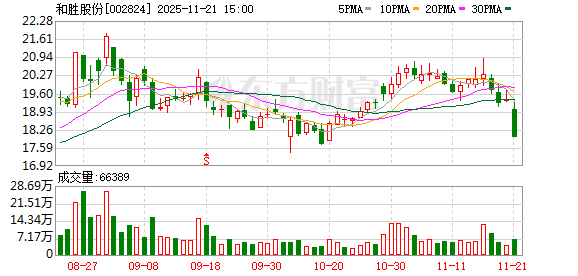
和胜股份:截至2025年11月20日,公司股东人数为24701户
Zheng Quan Ri Bao· 2025-11-21 10:19
Core Points - The company, He Sheng Co., stated on November 21 that as of November 20, 2025, the number of shareholders will be 24,701 [2]

博盈特焊:公司已在海外深耕多年
Zheng Quan Ri Bao Wang· 2025-11-21 09:43
Core Viewpoint - The company has established a joint venture with Wilham to expand its oil and gas market presence, particularly in the Middle East, leveraging its extensive overseas experience and strong cash flow to support project development [1] Group 1: Joint Venture and Market Expansion - The joint venture is controlled by the company, with Wilham holding a minority stake [1] - The partnership aims to actively explore both domestic and overseas markets, with a focus on establishing manufacturing bases abroad [1] - The company has accumulated rich experience in connecting with overseas clients over many years [1] Group 2: Technological Development and Product Advantage - The company has invested in research and development in the field of metal composite pipes for several years, with ongoing technical validation [1] - The joint venture is expected to leverage both parties' strengths in technology, funding, and market resources for a synergistic effect [1] - The subsidiary's products have a cost advantage in the Middle East due to improved production efficiency [1] Group 3: Financial Position - The company has a strong cash flow, which provides robust support for project advancement [1]
邓州市琛创建材有限公司成立 注册资本100万人民币
Sou Hu Cai Jing· 2025-11-21 05:13
Group 1 - The company Chengchuang Material Co., Ltd. has been established in Dengzhou City with a registered capital of 1 million RMB [1] - The legal representative of the company is Yu Yongyang [1] - The business scope includes sales of construction materials, metal ores, non-metallic minerals and products, and various automotive-related services and products [1] Group 2 - The company is involved in the sales of new energy vehicles and their components, as well as battery sales and recycling [1] - Additional services include supply chain management and parking lot services [1] - The company also engages in the processing of non-metallic waste and scrap, and the manufacturing and retail of hardware products [1]
亚星锚链股价涨5%,南方基金旗下1只基金位居十大流通股东,持有614.23万股浮盈赚取325.54万元
Xin Lang Cai Jing· 2025-11-21 03:37
Group 1 - The core viewpoint of the news is that Jiangsu Yaxing Anchor Chain Co., Ltd. has seen a 5% increase in stock price, reaching 11.12 CNY per share, with a trading volume of 1.319 billion CNY and a turnover rate of 12.81%, resulting in a total market capitalization of 10.669 billion CNY [1] - Jiangsu Yaxing Anchor Chain Co., Ltd. was established on March 16, 2000, and listed on December 28, 2010. The company specializes in the production of marine anchor chains, mooring chains, and mining chains [1] - The main business revenue composition of the company includes 62.37% from ship chains and accessories, 35.76% from mooring chains, and 1.86% from other sources [1] Group 2 - From the perspective of the top ten circulating shareholders, a fund under Southern Fund ranks among the top shareholders of Yaxing Anchor Chain. The Southern CSI 1000 ETF (512100) reduced its holdings by 63,100 shares in the third quarter, holding 6.1423 million shares, which accounts for 0.64% of the circulating shares [2] - The Southern CSI 1000 ETF (512100) was established on September 29, 2016, with a latest scale of 76.63 billion CNY. Year-to-date returns are 24.71%, ranking 1906 out of 4208 in its category; the one-year return is 18.97%, ranking 2143 out of 3972; and since inception, the return is 10.36% [2] - The fund manager of Southern CSI 1000 ETF (512100) is Cui Lei, who has a cumulative tenure of 7 years and 16 days, managing total fund assets of 122.76 billion CNY, with the best fund return during the tenure being 180.57% and the worst being -15.93% [2]

赛福天股价跌5.12%,鹏华基金旗下1只基金重仓,持有8.47万股浮亏损失3.47万元
Xin Lang Cai Jing· 2025-11-21 02:46
Group 1 - The core point of the news is that Saifutian's stock price has been declining for four consecutive days, with a total drop of 7.72% during this period, currently trading at 7.60 CNY per share [1] - As of the report, Saifutian's market capitalization is 2.182 billion CNY, with a trading volume of 37.981 million CNY and a turnover rate of 1.71% [1] - The company's main business involves the research, production, and sales of special steel wire ropes and accessories, with revenue composition being 71.21% from photovoltaic cell slices, 28.21% from steel wire ropes and accessories, and minor contributions from other segments [1] Group 2 - According to data, Penghua Fund has one fund heavily invested in Saifutian, specifically the Penghua Smart Investment Digital Economy Mixed A fund, which holds 84,700 shares, accounting for 0.6% of the fund's net value [2] - The fund has experienced a floating loss of approximately 34,700 CNY today and a total floating loss of 56,700 CNY during the four-day decline [2] - The Penghua Smart Investment Digital Economy Mixed A fund has achieved a year-to-date return of 38.39% and ranks 1,577 out of 8,136 in its category [2]

东睦股份跌2.03%,成交额1.35亿元,主力资金净流出1233.86万元
Xin Lang Zheng Quan· 2025-11-21 02:43
Core Viewpoint - Dongmu Co., Ltd. has experienced a stock price increase of 64.15% year-to-date, but has seen a decline in recent trading sessions, indicating potential volatility in its stock performance [1][2]. Financial Performance - For the period from January to September 2025, Dongmu Co., Ltd. achieved a revenue of 4.417 billion yuan, representing a year-on-year growth of 22.32%. The net profit attributable to shareholders was 415 million yuan, reflecting a significant increase of 50.10% year-on-year [2]. - Cumulative cash dividends since the company's A-share listing amount to 1.56 billion yuan, with 370 million yuan distributed over the past three years [3]. Shareholder Information - As of September 30, 2025, the number of shareholders for Dongmu Co., Ltd. reached 57,000, an increase of 56.29% compared to the previous period. The average number of circulating shares per shareholder decreased by 36.02% to 10,812 shares [2]. - Among the top ten circulating shareholders, Hong Kong Central Clearing Limited holds 31.2923 million shares, an increase of 3.6932 million shares from the previous period [3]. Stock Performance - As of November 21, Dongmu Co., Ltd.'s stock price was 26.05 yuan per share, with a market capitalization of 16.448 billion yuan. The stock has seen a recent decline of 4.93% over the last five trading days and 13.91% over the last twenty days [1].
