Software and Services

Search documents
鸿蒙政企应用,开始回答「价值」问题
36氪· 2025-12-29 13:45
过去很长一段时间,数字化被等同为"上云用数"。业务系统被迁移至云端,数据被用于驱动局部流程的效率提升。这一路径在早期成效显著,帮助大量组织 完成了从线下到线上的关键跃迁。 但随着数字化转型的深入,这一模式逐渐遇到瓶颈,数据与业务"合而不通",各类系统林立导致数据无法有效汇聚、形成整体价值;在移动化办公需求之 下,安全与便捷"难以两全";智能能力更多停留在功能层或工具层,难以真正进入业务运行的核心。 尤其在政企领域,这种"天花板效应"被进一步放大。政务系统与企业核心应用往往运行周期长、参与角色多、容错空间极小,对底层稳定性的要求高于消费 级场景。当数字化进入全新阶段,核心问题便转为系统能否长期、稳定运行。 在关键技术必须自主可控成为共识的背景下,底层能力的角色被重新审视。市场意识到,如果缺乏统一、可信、可持续演进的数字底座,云与数据所释放的 价值终将受限。 鸿蒙,正是在这一过程中被推向政企数字化核心场景的代表性方案之一。 从覆盖到深耕,鸿蒙开启政企2.0时代。 从"规模构建"到"价值深化" 鸿蒙开启政企2.0时代 当"数字中国"的进程行至深水区,一个更根本的问题逐渐浮出水面——继算力与数据之后,什么才是支撑政企 ...


IBM告别传奇拯救者,前CEO郭士纳逝世
Sou Hu Cai Jing· 2025-12-29 09:56
Core Insights - Lou Gerstner, former CEO of IBM, passed away, leaving a significant legacy in transforming the company during a critical period [1][3] Group 1: Leadership and Transformation - Gerstner took over as IBM's first external CEO in 1993 when the company was facing severe challenges, including record losses and potential disintegration into independent units [3][4] - He implemented drastic reforms, including cutting 35,000 jobs, selling non-core assets, and restructuring the compensation system to align employee pay with overall company performance [3][4] - One of his most impactful decisions was to maintain IBM's corporate integrity instead of pursuing a breakup, focusing on integrated solutions rather than fragmented technologies [4][5] Group 2: Business Performance - Under Gerstner's leadership from 1992 to 2001, IBM's services revenue grew from $7.4 billion to $30 billion, and the stock price increased from $13 to $80, raising the market capitalization from $29 billion to approximately $168 billion [5] - Gerstner shifted the company's focus from the OS/2 operating system to middleware solutions, establishing IBM as a key integrator in the network and systems space [4][5] Group 3: Legacy and Influence - Gerstner maintained a long-term relationship with IBM after his tenure, providing advice and insights while remaining engaged with the company's developments [5] - He authored a book detailing his leadership journey at IBM, emphasizing the importance of creating a truly integrated entity, which he considered his most significant legacy [5]


Repurchase of Truecaller B shares in week 52, 2025
Prnewswire· 2025-12-29 07:43
Core Insights - Truecaller AB has repurchased a total of 240,000 B shares during week 52, representing 0.07% of outstanding capital, and has bought back 6,641,053 shares since the start of the current buyback program, which is 1.88% of outstanding capital [1][5] Buyback Program Details - The share buyback program was announced on May 30, 2025, and will continue until the 2026 Annual General Meeting (AGM) [1] - The Board was authorized to buy back B-shares until the AGM in 2026, with a limit that the company's shareholding does not exceed 10% of the total number of outstanding shares [2] Transaction Data - The aggregated daily volume for the buybacks during week 52 included 120,000 shares on both December 22 and December 23, with a weighted average share price of SEK 19.12 and SEK 19.19 respectively, totaling SEK 4,596,926 for the week [3] - The total accumulated transaction value during the buyback program is SEK 192,243,655, with an average share price of SEK 28.95 [3] Current Shareholding - As of December 26, 2025, Truecaller holds 10,586,385 B shares and 5,013,786 C shares, amounting to 4.41% of the outstanding capital [4] - The total number of shares in Truecaller, including own shares, is now 353,790,721, while the number of outstanding shares, excluding own shares, is 338,190,550 [4] Historical Buyback Summary - Truecaller's historical buyback programs have accumulated a total of 39,193,900 shares, with a total transaction value of SEK 1,275,398,738 and an average share price of SEK 32.54 [5]

云赛智联股价涨5.28%,汇添富基金旗下1只基金位居十大流通股东,持有462.4万股浮盈赚取439.28万元
Xin Lang Cai Jing· 2025-12-29 03:52
Group 1 - The core viewpoint of the news is that YunSai ZhiLian's stock price has increased by 5.28% to 18.93 CNY per share, with a total market capitalization of 25.89 billion CNY, and the stock has seen a cumulative increase of 2.45% over the last three days [1] - YunSai ZhiLian specializes in providing core hardware and software products and comprehensive solutions for smart cities, with revenue composition being 53.32% from cloud computing and big data, 42.35% from industry solutions, 7.33% from smart products, and 0.12% from other products [1] - The company is located in Xuhui District, Shanghai, and was established on May 28, 1993, with its listing date on December 19, 1990 [1] Group 2 - Among the top circulating shareholders of YunSai ZhiLian, a fund under Huatai-PineBridge is noted, with the China Securities Shanghai State-Owned Enterprises ETF (510810) reducing its holdings by 594,600 shares, now holding 4.624 million shares, which is 0.34% of the circulating shares [2] - The China Securities Shanghai State-Owned Enterprises ETF (510810) has a current scale of 7.994 billion CNY and has achieved a return of 8.67% this year, ranking 3608 out of 4197 in its category [2] - The fund manager of the China Securities Shanghai State-Owned Enterprises ETF is Wu Zhenxiang, who has a total tenure of 15 years and 331 days, with the best fund return during his tenure being 202.04% [3]

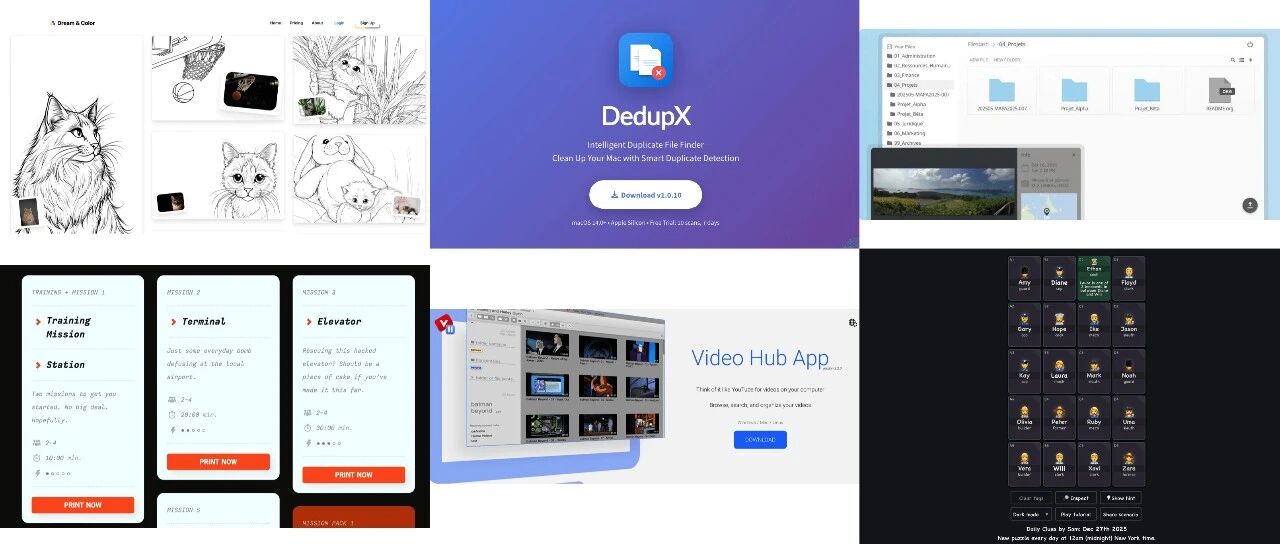
2025 看看月入 500+ 刀的独立开发者都做了什么?打磨别人嫌麻烦的需求,做极简项目就够了~
菜鸟教程· 2025-12-29 03:30
Core Insights - The article discusses various small-scale side projects that individuals are pursuing to earn an additional income of $500 per month by 2025, emphasizing simplicity and addressing real pain points without heavy advertising reliance [1][52]. Group 1: Project Summaries - **JustFax Online**: A minimalistic online fax service that charges a one-time fee per use, targeting industries like healthcare and legal that still utilize faxing. It generates over €500 monthly through SEO and payment processing via Stripe [2]. - **NotebookLM Web Importer**: A Chrome extension that allows users to import web content into Google’s NotebookLM. After launching a paid feature in July, it has over 100,000 users and earns more than $500 monthly [6][7]. - **Dream and Color**: An AI tool that transforms photos into printable coloring pages, targeting parents and teachers. It has shown a monthly growth rate of 10-20% and is profitable with minimal marketing [9][10]. - **DedupX**: A macOS application that helps photographers find duplicate and visually similar photos, charging an annual fee of $5.99 or a lifetime fee of $16.99. It has over 100 paying users [14][15]. - **Clues by Sam**: A daily logic puzzle game that generates puzzles algorithmically and manually, ensuring unique solutions. It relies on word-of-mouth for growth [18][19]. - **Filestash**: An open-source web file manager that allows users to mount various backend storage as a web disk, monetizing through custom development and paid plugins [22][25]. - **Video Hub App**: A local video library manager that allows users to browse and manage videos, available as a one-time purchase for $5 [28]. - **OnlineOrNot**: A monitoring service for websites and APIs that generates over $500 monthly since 2022, requiring only two hours of daily development [32][33]. - **Cold Call Gym**: An AI sales training platform that helps users practice sales calls, offering a free trial and a paid subscription for extended features [35][36]. - **Escape Team**: A printable escape room game designed for tabletop enthusiasts, with each task priced at $2.99 for permanent access [41][42]. - **Unli.xyz Series**: A price tracking service for storage devices on eBay, utilizing regex to parse product listings and earning commissions through affiliate links [46][48]. Group 2: Common Themes - The projects highlighted share a common theme of addressing overlooked needs with simple yet effective solutions, demonstrating that focusing on niche markets can yield significant returns [52].
Phillip Securities Raises Oracle 2026 Capex Forecast to $50B Highlighting Confidence in OCI and Full-Stack AI Leadership
Yahoo Finance· 2025-12-28 17:46
Core Insights - Analysts view Oracle Corporation (NYSE:ORCL) as one of the most active US stocks to buy, with Phillip Securities lowering its price target to $344 while maintaining a Buy rating [1] - RBC Capital also reduced its price target to $250, keeping a Sector Perform rating, following mixed FQ2 2026 results [2] Financial Performance - Oracle reported a 13% year-over-year increase in total revenue to $16.1 billion, driven primarily by a 33% surge in cloud revenue to $8 billion, which now constitutes half of Oracle's total business [3] - Within the cloud segment, OCI revenue increased by 66% to $4.1 billion, significantly boosted by a 177% rise in GPU-related revenue [3] - Other notable revenue increases included Autonomous Database revenue, which rose by 43%, and Cloud Applications revenue, which reached $3.9 billion, up 11% [3] Future Projections - For FQ3, Oracle anticipates total cloud revenue growth between 37% and 41%, and total revenue growth between 16% and 18% in constant currency [4] Capital Expenditure Outlook - Phillip Securities raised its 2026 capital expenditure forecast for Oracle from $35 billion to $50 billion, reflecting confidence in Oracle's dual role as a specialized cloud provider and a leader in full-stack AI [1][3]

鸿蒙押注新未来:用AI重写数字世界交互逻辑
量子位· 2025-12-27 07:08
Core Viewpoint - The year 2025 is anticipated to be a pivotal moment for the explosion of terminal AI, marking a significant transition in the industry akin to the shift from feature phones to smartphones. This transition represents a fundamental restructuring of business models and interaction logic, moving from a passive service model centered around apps to an active service model centered around AI agents [1]. Group 1: Industry Transition - The challenge of reconstructing the connection between humans and devices is a common issue faced by all manufacturers in this transition [2]. - There are two main factions in the industry: one that seeks to improve existing app ecosystems and another that advocates for a fundamental restructuring at the operating system level [3]. - Huawei, as a representative of the "reconstruction faction," has anchored its strategy at the foundational level, aiming to integrate AI capabilities into the native genes of the operating system [4]. Group 2: AI Terminal Classification - Huawei's terminal intelligence classification standard, developed in collaboration with Tsinghua University, categorizes AI terminals into levels L1 to L5, emphasizing the need for terminals to evolve beyond mere tools to achieve autonomous planning capabilities at L3 [5][10]. - Most current products remain trapped in outdated architectures, failing to progress beyond L1 and L2 stages, which are characterized by human-led, AI-assisted functionalities [8][16]. Group 3: Path Dependency in AI Applications - The industry exhibits three typical path dependencies that hinder true generational leaps in AI applications: 1. Major model vendors focus on B to C products, leading to "floating intelligence" that lacks integration with device-level operations [9]. 2. Internet giants with super apps tend to create "segmented intelligence," confining AI capabilities within their ecosystems and exacerbating data silos [11][13]. 3. Traditional terminal manufacturers adopt a "patchwork intelligence" approach, integrating AI features in a fragmented manner without a cohesive system-level strategy [14][15]. Group 4: System-Level Reconstruction - Huawei's HarmonyOS is pursuing a challenging path of system-level reconstruction, breaking down the rigid boundaries between applications and systems [21][22]. - The foundation of this reconstruction is the Harmony Intelligent Agent Framework (HMAF), which establishes a unique intent framework and user data map, transforming the operating system into a proactive service provider [25]. Group 5: User Experience Transformation - The bottom-level reconstruction allows for a shift from cumbersome operations to a dialogue-based interaction, where the system can autonomously identify user intentions and execute tasks seamlessly [27][28]. - This transformation enables a proactive response from services, exemplified by the Shenzhen Airlines intelligent agent that can handle complex booking processes through simple voice commands [29]. Group 6: Developer Ecosystem and Flow Distribution - HarmonyOS provides a platform for developers to create intelligent agents that can be easily integrated across various devices, enhancing the overall user experience [31][32]. - The new service distribution mechanism shifts the focus from app downloads to real-time user needs, allowing smaller developers to gain visibility and opportunities in the market [37]. Group 7: Market Growth and Developer Opportunities - Currently, over 32 million devices equipped with HarmonyOS 5/6 have been deployed, creating a robust foundation for the new flow of services [38][40]. - As the L3 intelligent experience is realized and the intent-service commercial loop is established, the Harmony AI ecosystem is entering a phase of substantial benefit release, presenting a prime opportunity for developers to engage with the next generation of service distribution [41][42].

F5 Shareholder Alert: ClaimsFiler Reminds Investors With Losses In Excess Of $100,000 Of Lead Plaintiff Deadline In Class Action Lawsuits Against F5, Inc. - FFIV
Prnewswire· 2025-12-27 03:48
Core Viewpoint - A securities class action lawsuit has been filed against F5, Inc. for failing to disclose material information during the class period, which has led to significant financial repercussions for investors [3]. Group 1: Lawsuit Details - Investors have until February 17, 2026, to file lead plaintiff applications if they purchased F5 securities between October 28, 2024, and October 27, 2025 [1]. - The lawsuit is pending in the United States District Court for the Western District of Washington [1]. - The case is identified as Smith v. F5, Inc., et al., No. 25-cv-02619 [5]. Group 2: Company Performance - On October 27, 2025, F5 announced its fourth quarter fiscal year 2025 results, revealing below-market growth expectations for fiscal 2026, including anticipated reductions in sales and renewals, elongated sales cycles, and increased expenses due to a security breach involving its highest revenue product, BIG-IP [4]. - Following the announcement, F5's share price dropped from $290.41 to $258.76, marking a decline of 10.9% within two days [5]. Group 3: Investor Support - ClaimsFiler provides a free service to help retail investors recover funds from securities class action settlements, offering resources for timely claim submissions and legal evaluations [6].


Oracle shares heading for worst quarter since 2001 following AI investment concerns
New York Post· 2025-12-26 15:37
Core Viewpoint - Oracle's stock has experienced a significant decline, dropping 30% in the current quarter, marking its worst performance since the dot-com crash in 2001 [1][8]. Financial Performance - Oracle reported weaker-than-expected quarterly revenue and free cash flow earlier this month, prompting the new finance chief to announce a capital expenditure plan of $50 billion for fiscal 2026, which is 43% higher than the previous plan and double the amount from the previous year [4]. - The company is also planning $248 billion in leases to enhance cloud capacity, alongside building new data centers, indicating a substantial financial commitment [4]. Debt and Investment Concerns - In September, Oracle raised $18 billion through a bond sale, one of the largest in the tech sector, but investor confidence is waning, leading to increased costs for insuring Oracle's debt [5]. - Analysts express concerns about Oracle's ability to meet its financial obligations without restructuring its contract with OpenAI, especially given its precarious investment-grade rating [6]. Market Reaction and Future Outlook - Following the announcement of a significant revenue backlog tied to OpenAI, Oracle's stock initially surged nearly 36%, reaching an intraday high of $345.72 per share [9]. - However, the stock later fell 43%, closing at $197.49, despite a brief recovery after TikTok's agreement to sell part of its US business to Oracle [12]. - Wall Street analysts are divided on Oracle's long-term growth prospects, with some expressing skepticism about the company's heavy reliance on OpenAI and the timeline for projected growth [15][16].

Quantum International Corp. (QUAN) Expands GhostLine Platform with the Launch of GhostDrop and GhostSignal
TMX Newsfile· 2025-12-26 12:00
Core Viewpoint - Quantum International Corporation is expanding its privacy and security product portfolio with the introduction of GhostDrop and GhostSignal, enhancing its existing GhostLine platform into a comprehensive security suite [1][5]. Product Overview - GhostLine is a browser-based, serverless messaging application that facilitates private, temporary communication through end-to-end encryption without user accounts or stored message histories, catering to the rising demand for privacy-focused communication tools [2]. - GhostDrop is a one-time encrypted file and message delivery tool that allows secure, non-persistent sharing. It encrypts content client-side and delivers it via a single-use link, automatically destroying files and messages after access to minimize data exposure [3]. - GhostSignal is a personal safety and check-in application designed for situations where users may be unable to respond. It allows users to set scheduled check-ins, notifying trusted contacts if a check-in is missed, along with the user's last known location and device status [4]. Strategic Direction - The addition of GhostDrop and GhostSignal to the GhostLine platform reflects a design philosophy focused on minimal data retention, user control, and practical privacy. The company is also exploring distribution, integration, and monetization strategies for the GhostLine security suite as part of its broader technology roadmap [5][7].