
电池制造

Search documents
“宁王”大动作!拟发行百亿债券
Zhong Guo Zheng Quan Bao· 2025-12-10 14:25
Group 1 - The core point of the article is that Ningde Times plans to issue bonds not exceeding 10 billion yuan to optimize its debt structure and reduce financing costs [1][4] - The funds raised will be primarily used for project construction, supplementing working capital, and repaying interest-bearing liabilities [4] - The bond issuance will target investors in the national interbank bond market or exchange market, with a maturity of no more than 5 years [4] Group 2 - In the third quarter, the company achieved revenue of 104.19 billion yuan, a year-on-year increase of 12.9%, and a net profit attributable to shareholders of 18.55 billion yuan, up 41.21% [4] - For the first three quarters of the year, the company reported revenue of 283.07 billion yuan, a 9.28% increase year-on-year, and a net profit of 49.03 billion yuan, growing by 36.2% [4] - As of November 30, the company has spent approximately 4.386 billion yuan on share repurchases, completing 54.82% of its previously disclosed repurchase plan limit of 8 billion yuan [5] Group 3 - Ningde Times has launched a "ship-shore-cloud" zero-carbon shipping and smart port integrated solution, promoting electrification from land to water [6][7] - The company has delivered nearly 900 electric ships, maintaining its position as the global leader in electric ship battery supply [8] - New products such as the Shenxing and Kirin batteries account for about 60% of total shipments, with sodium batteries being piloted in commercial vehicles and expected to expand into passenger vehicles [8]


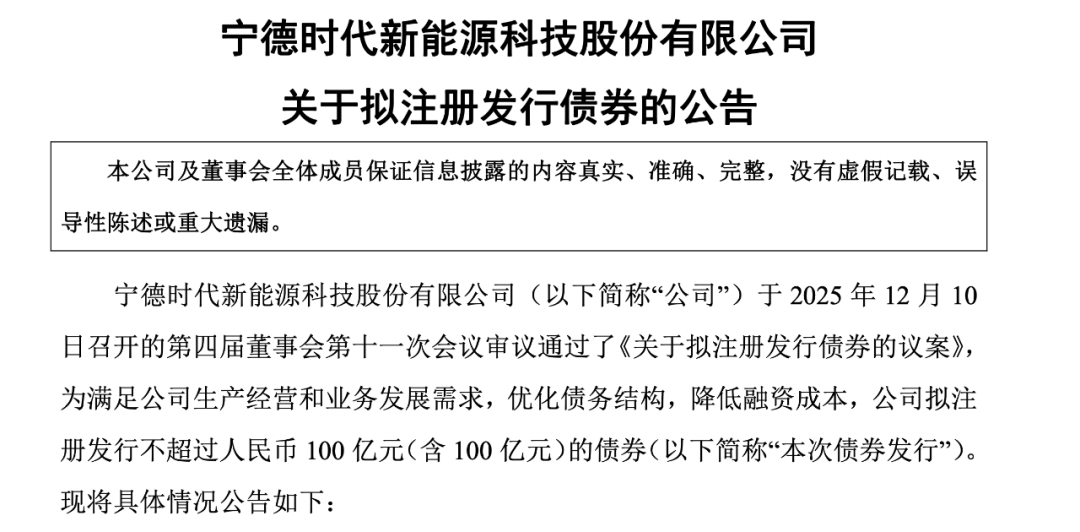
宁德时代(03750.HK)拟注册发行不超100亿元债券
Ge Long Hui· 2025-12-10 12:32
Core Viewpoint - The company plans to register and issue bonds up to RMB 10 billion to meet operational and business development needs, optimize debt structure, and reduce financing costs [1] Group 1 - The company announced the decision during the 11th meeting of the 4th Board of Directors held on December 10, 2025 [1] - The bond issuance is aimed at supporting the company's production and business development [1] - The total amount of bonds to be issued is capped at RMB 10 billion, including the full amount [1]
宁德时代(03750)拟注册发行不超过100 亿元的债券
智通财经网· 2025-12-10 12:26
智通财经APP讯,宁德时代(03750)公布,为满足公司生产经营和业务发展需求,优化债务结构,降低融 资成本,董事会同意公司注册发行不超过人民币 100 亿元(含 100 亿元)的债券,并提请股东会授权公司 总经理或其授权人士负责全权办理与本次债券注册发行工作的相关事宜。 ...
宁德时代拟注册发行不超过人民币100亿元的债券,用于项目建设等
Xin Lang Cai Jing· 2025-12-10 11:53
Core Viewpoint - Contemporary Amperex Technology Co., Limited (CATL) plans to issue bonds up to RMB 10 billion to optimize its debt structure and reduce financing costs [1] Group 1: Bond Issuance Details - The company intends to register and issue bonds not exceeding RMB 10 billion, including the full amount [1] - The bond issuance will have a maturity period of no more than 5 years [1] - The target investors for the bond issuance are participants in the national interbank bond market or exchange market [1] Group 2: Use of Proceeds - The funds raised will primarily be used for project construction, supplementing working capital, and repaying interest-bearing liabilities [1] - The usage of proceeds will comply with regulatory and legal requirements as stipulated in the issuance documents [1]
【ESG真心话】施义:ESG不是“评分游戏”
Jing Ji Guan Cha Wang· 2025-12-10 11:44
Core Insights - The article emphasizes the growing importance of ESG (Environmental, Social, and Governance) factors in corporate competitiveness, moving beyond traditional financial metrics [2][3] - It highlights the late development of the ESG framework in China, with many companies still questioning the necessity of ESG practices [2] - The Chinese government is set to implement a unified sustainable disclosure framework by 2030, indicating a significant shift towards ESG compliance [2] Group 1: ESG Development in China - The Chinese ESG framework is evolving, with various government departments releasing new policies and guidelines to promote ESG practices [2] - By 2027, the Ministry of Finance and other national ministries will introduce basic guidelines for sustainable disclosures and climate-related disclosures for domestic companies [2] - The number of companies rated by MSCI has increased significantly, from 2 at the end of the 13th Five-Year Plan to 54, indicating a shift towards proactive ESG engagement [4] Group 2: ESG as a Value Creation Tool - ESG is viewed as a means to manage non-financial risks and create measurable, positive impacts rather than merely a compliance exercise [3][4] - Companies are beginning to focus on the actual carbon footprint of their products and the social impact of their investments, moving from superficial compliance to substantive value creation [4] - The distinction between traditional ESG investment and impact investment is crucial, with the latter requiring a deeper analysis of a company's positive contributions to society and the environment [8] Group 3: Governance and Corporate Engagement - Effective governance is foundational for successful ESG implementation, with a need for boards to possess diverse skills and effectively oversee company strategy and risk [12] - There is a call for improved communication between companies and investors, particularly regarding timely disclosures related to shareholder meetings [17] - Companies are encouraged to adopt a "double materiality" approach, assessing both the financial impact of external sustainability factors and the company's operational impact on the environment and society [17] Group 4: Future Trends and Strategies - The article notes a divergence in ESG sentiment globally, with some regions experiencing backlash against ESG, while China continues to strengthen its ESG policies and practices [15] - The focus on long-term structural trends in green and low-carbon transitions in China is seen as a more stable driver for ESG adoption compared to external pressures [15] - Companies are advised to set quantifiable impact goals for their key ESG issues, moving beyond mere compliance to achieve long-term value creation [17]
宁德时代拟发债百亿用于项目建设偿债
Cai Jing Wang· 2025-12-10 11:38
Core Viewpoint - Ningde Times plans to register and issue bonds not exceeding 10 billion yuan for project construction, working capital supplementation, and repayment of interest-bearing liabilities [1] Group 1 - The bond issuance will have a term of no more than 5 years [1] - The issuance method will be public offering, with underwriting conducted by institutions on a balance underwriting basis [1] - The company's board of directors will propose to authorize the general manager or their authorized personnel to handle all matters related to the bond issuance [1]
宁德时代(300750.SZ)拟注册发行不超100亿元债券
智通财经网· 2025-12-10 11:12
智通财经APP讯,宁德时代(300750.SZ)公告,公司董事会审议通过了《关于拟注册发行债券的议案》, 公司拟注册发行不超过100亿元(含100亿元)的债券。本次发行的债券的期限不超过5年(含5年)。 ...
东莞市锐能电源有限公司成立 注册资本100万人民币
Sou Hu Cai Jing· 2025-12-10 07:28
天眼查App显示,近日,东莞市锐能电源有限公司成立,注册资本100万人民币,经营范围为一般项 目:电池制造;电池销售;电池零配件生产;电池零配件销售;新兴能源技术研发;新能源汽车电附件 销售;汽车零部件及配件制造;电子专用材料研发;电子专用材料制造;电子专用材料销售;移动通信 设备制造;移动通信设备销售;通信设备制造;通信设备销售;家用电器销售;塑料制品制造;塑料制 品销售;合成材料制造(不含危险化学品);合成材料销售;五金产品研发;五金产品制造;五金产品 批发;五金产品零售;机械电气设备制造;机械电气设备销售;电气设备销售;电子元器件制造;电子 元器件与机电组件设备销售;光伏设备及元器件制造;光伏设备及元器件销售;软件开发;软件销售; 货物进出口;技术进出口。(除依法须经批准的项目外,凭营业执照依法自主开展经营活动)。 ...
三星SDI获美国13.6亿美元磷酸铁锂电池订单,股价大涨6%
Jin Rong Jie· 2025-12-10 05:51
声明:市场有风险,投资需谨慎。本文为AI基于第三方数据生成,仅供参考,不构成个人投资建议。 12月10日,三星SDI发布公告表示,其美国子公司已与一家美国能源基础设施开发运营公司达成合作协 议。该协议涉及磷酸铁锂电池的供应业务,合同总价值超过2万亿韩元,折合约13.6亿美元。 本文源自:市场资讯 协议约定的交付时间将从2027年开始,持续三年时间。这一大规模订单显示出美国市场对磷酸铁锂电池 需求的强劲增长。三星SDI在公告中确认了这一重要商业合作的具体细节。 作者:观察君 受此消息影响,三星SDI股价当日上涨6%。市场对这一重大订单表现出积极反应,认为这将对公司未来 业绩产生正面影响。 磷酸铁锂电池作为储能系统的重要组成部分,在能源基础设施建设中发挥关键作用。该类型电池具有安 全性高、循环寿命长等特点,适合大规模储能应用场景。 三星SDI近年来在磷酸铁锂电池领域持续加大投入。公司已在韩国蔚山工厂建设了首条磷酸铁锂电池生 产线,这是韩国国内首条此类生产线。与此同时,公司还计划在美国印第安纳州的合资工厂导入磷酸铁 锂电池生产线,预计2027年投产。 该协议的签署标志着三星SDI在美国储能市场的重要突破。公司通过本 ...
瑞浦兰钧(00666.HK)附属与福建青拓订立建设工程施工合同
Jin Rong Jie· 2025-12-09 15:18
Core Viewpoint - The announcement indicates that Jiaxing Lanjun, a subsidiary of Ruipu Lanjun (00666.HK), has entered into a construction contract with Fujian Qingtuo for a project involving the renovation of a factory area dedicated to lithium-ion battery cell and module production, with an annual capacity of 45GWh [1] Group 1 - The construction contract is set to be executed on December 9, 2025 [1] - The project involves the renovation of the steel structure portion of the factory, specifically the 1 plant's 10-axis to 16-axis and A-axis to ES-axis areas [1] - The project aims to enhance production capabilities in the lithium-ion battery sector, which is critical for the growing electric vehicle and renewable energy markets [1]