
半导体制造

Search documents
中方表态:荷方应承担全部责任
中国基金报· 2025-11-04 07:21
来源:商务部网站 据商务部网站11月4日消息,商务部新闻发言人就安世半导体相关问题应询答记者问。 问: 近期,各界高度关注安世半导体问题磋商进展,请问商务部对此有何评论? 答: 此前,中方已就安世半导体相关问题回应了有关记者的评论。我愿再次强调,荷兰政府9月 30日发布行政令,不当干预安世半导体企业内部事务,之后荷企业法庭作出剥夺中国企业股权的 错误裁决,严重侵害中国企业合法权益。此后,荷政府不顾中方多次在磋商中提出的合理诉求, 没有展示出建设性态度和行动且升级全球供应链危机。安世(荷兰)10月26日宣布停止向安世 (中国)供应晶圆,导致后者无法正常生产,造成了全球半导体产供链的动荡和混乱。对此,荷 方应承担全部责任。 中方本着对全球半导体产供链稳定与安全的负责任态度,于11月1日宣布将对符合条件的出口予 以豁免,并努力促进安世(中国)恢复供货。但荷方继续一意孤行,且无解决问题实际行动,这 必将加深对全球半导体供应链的不良影响。这是中方和全球业界不愿看到的。 中方希望,荷方从维护中荷、中欧经贸关系大局和产供链稳定与安全的角度出发,以负责任的态 度与中方相向而行,停止干涉企业内部事务,为安世半导体问题找到建设性 ...

商务部发声,事关安世半导体
Zhong Guo Zheng Quan Bao· 2025-11-04 06:59
Core Viewpoint - The Chinese government emphasizes that the Dutch government's recent actions regarding ASML have severely infringed upon the legitimate rights of Chinese enterprises and have escalated the global supply chain crisis [1] Group 1: Government Actions and Responses - The Dutch government issued an administrative order on September 30, which improperly intervened in the internal affairs of ASML, leading to a court ruling that stripped Chinese companies of their equity [1] - On October 26, ASML (Netherlands) announced the cessation of wafer supply to ASML (China), disrupting normal production and causing turmoil in the global semiconductor supply chain [1] - The Chinese government announced on November 1 that it would exempt qualified exports to promote the resumption of supply from ASML (China) [1] Group 2: Call for Constructive Solutions - The Chinese government urges the Dutch side to adopt a responsible attitude and cease interference in corporate internal affairs to find constructive solutions to the ASML issue [1] - The Chinese government expresses a commitment to safeguarding the legitimate rights of enterprises and stabilizing the global semiconductor supply chain [1]
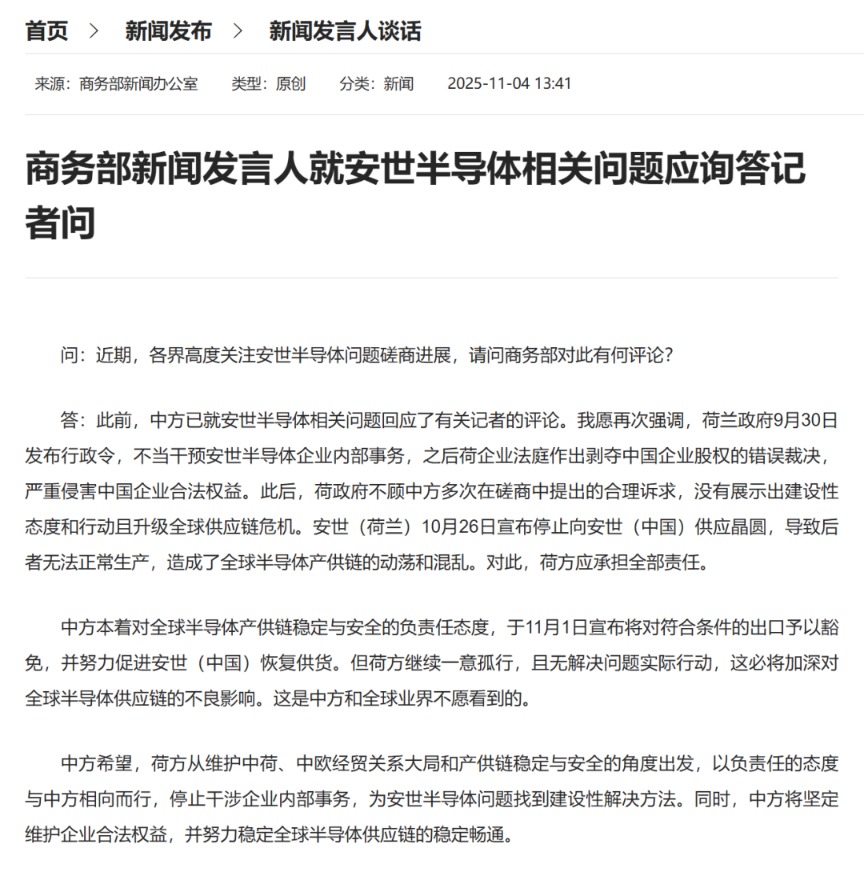
商务部:安世(荷兰)10月26日宣布停止向安世(中国)供应晶圆,造成全球半导体产供链动荡和混乱,荷方应承担全部责任
Ge Long Hui· 2025-11-04 06:45
(责任编辑:宋政 HN002) 【免责声明】本文仅代表作者本人观点,与和讯网无关。和讯网站对文中陈述、观点判断保持中立,不对所包含内容 的准确性、可靠性或完整性提供任何明示或暗示的保证。请读者仅作参考,并请自行承担全部责任。邮箱: news_center@staff.hexun.com 中方本着对全球半导体产供链稳定与安全的负责任态度,于11月1日宣布将对符合条件的出口予以豁 免,并努力促进安世(中国)恢复供货。但荷方继续一意孤行,且无解决问题实际行动,这必将加深对全 球半导体供应链的不良影响。这是中方和全球业界不愿看到的。 中方希望,荷方从维护中荷、中欧经贸关系大局和产供链稳定与安全的角度出发,以负责任的态度与中 方相向而行,停止干涉企业内部事务,为安世半导体问题找到建设性解决方法。同时,中方将坚定维护 企业合法权益,并努力稳定全球半导体供应链的稳定畅通。 格隆汇11月4日丨商务部新闻发言人就安世半导体相关问题应询答记者问。问:近期,各界高度关注安 世半导体问题磋商进展,请问商务部对此有何评论? 答:此前,中方已就安世半导体相关问题回应了有关记者的评论。我愿再次强调,荷兰政府9月30日发 布行政令,不当干预 ...
商务部:荷兰政府不当干预安世半导体企业内部事务,中方将维护企业合法权益
Zheng Quan Shi Bao Wang· 2025-11-04 06:36
中方本着对全球半导体产供链稳定与安全的负责任态度,于11月1日宣布将对符合条件的出口予以豁 免,并努力促进安世(中国)恢复供货。但荷方继续一意孤行,且无解决问题实际行动,这必将加深对 全球半导体供应链的不良影响。这是中方和全球业界不愿看到的。 中方希望,荷方从维护中荷、中欧经贸关系大局和产供链稳定与安全的角度出发,以负责任的态度与中 方相向而行,停止干涉企业内部事务,为安世半导体问题找到建设性解决方法。同时,中方将坚定维护 企业合法权益,并努力稳定全球半导体供应链的稳定畅通。 问:近期,各界高度关注安世半导体问题磋商进展,请问商务部对此有何评论? 答:此前,中方已就安世半导体相关问题回应了有关记者的评论。我愿再次强调,荷兰政府9月30日发 布行政令,不当干预安世半导体企业内部事务,之后荷企业法庭作出剥夺中国企业股权的错误裁决,严 重侵害中国企业合法权益。此后,荷政府不顾中方多次在磋商中提出的合理诉求,没有展示出建设性态 度和行动且升级全球供应链危机。安世(荷兰)10月26日宣布停止向安世(中国)供应晶圆,导致后者 无法正常生产,造成了全球半导体产供链的动荡和混乱。对此,荷方应承担全部责任。 (原标题:商务部: ...
为确保晶圆供应,安世中国已有应对之策
Guan Cha Zhe Wang· 2025-11-04 06:34
Core Viewpoint - The Chinese Ministry of Commerce has criticized Nexperia (Netherlands) for halting wafer supply to Nexperia (China), causing disruptions in the global semiconductor supply chain, and has called for responsible actions from the Dutch side to stabilize the situation [1][6]. Group 1: Supply Chain Impact - Nexperia (Netherlands) announced on October 26 that it would stop supplying wafers to Nexperia (China), leading to production disruptions [1]. - The Chinese government has stated that it will exempt eligible exports to facilitate the recovery of Nexperia (China) and stabilize the global semiconductor supply chain [1][6]. - Despite potential disruptions from European wafer supply, Nexperia (China) is expected to continue delivering products to domestic semiconductor clients [2]. Group 2: Alternative Suppliers - Several Chinese wafer manufacturers, including Wuxi Xin Jie Neng and Hangzhou Silan Microelectronics, are capable of supplying wafers to Nexperia (China) [2]. - Shanghai Ding Tai Jiang Xin Technology, part of Wingtech Technology, is also likely to provide wafers to Nexperia (China), with a significant investment of 12 billion yuan in a 12-inch wafer production facility [4]. Group 3: Production and Certification Challenges - Nexperia (China) may require 6 to 12 months to certify new wafer suppliers due to strict safety requirements, complicating the production scheduling process [4]. - Most Chinese wafer manufacturers primarily produce medium and low-voltage products, while foreign companies like Infineon and STMicroelectronics can produce high-voltage products, potentially limiting Nexperia (China)'s options [5]. Group 4: Market Reactions - Following positive news regarding the potential resumption of chip shipments from Nexperia (China), stock prices of European automakers such as Volkswagen, Mercedes-Benz, and Volvo rose by at least 3% [6]. - Nexperia (Netherlands) welcomed recent statements from China and the U.S. that removed obstacles to chip shipments but refrained from commenting on Nexperia (China)'s plans to accelerate its independence [6]. Group 5: Company Statements and Legal Issues - Nexperia (China) has assured customers of sufficient inventory to meet demand until the end of the year and is actively validating new wafer production capacities [7]. - Nexperia (China) refuted claims of contract violations, stating that Nexperia (Netherlands) owes 1 billion yuan to its packaging and testing factory in Dongguan [7].
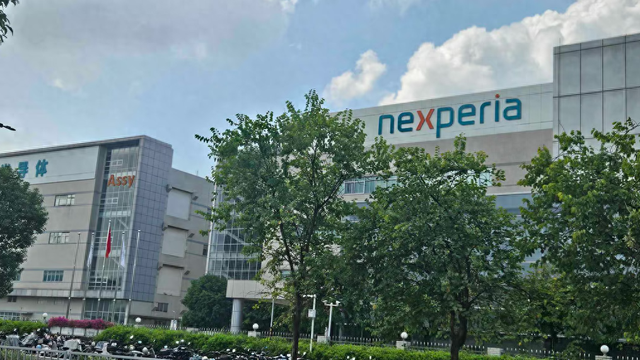
商务部最新发声:荷方应承担全部责任!
Shang Hai Zheng Quan Bao· 2025-11-04 06:29
Group 1 - The core issue revolves around ASML's semiconductor supply chain disruptions due to the Dutch government's intervention and court rulings affecting Chinese companies' equity rights [1][2] - The Dutch government issued an administrative order on September 30, which was seen as an improper interference in ASML's internal affairs, leading to a court ruling that stripped Chinese companies of their equity [1] - ASML (Netherlands) announced on October 26 that it would stop supplying wafers to ASML (China), causing production disruptions and chaos in the global semiconductor supply chain [1] Group 2 - China has expressed its commitment to maintaining the stability and security of the global semiconductor supply chain and has announced exemptions for eligible exports to facilitate ASML (China) in resuming supply [1][2] - The Chinese side has urged the Dutch government to adopt a responsible attitude and cease interference in corporate affairs to find constructive solutions to the ASML semiconductor issue [2]
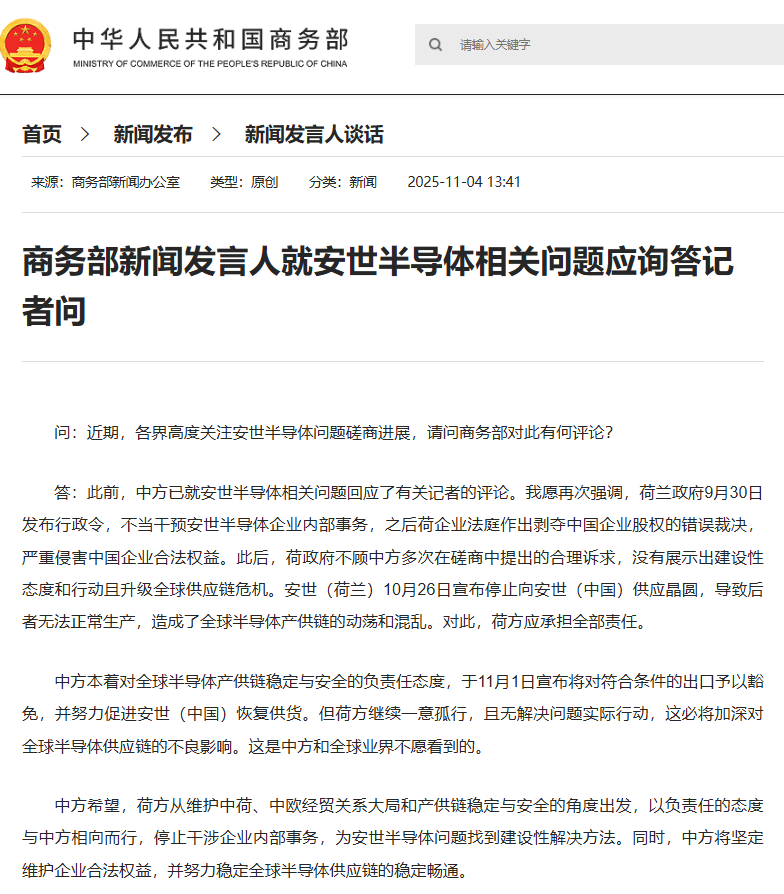
商务部再回应安世半导体问题
是说芯语· 2025-11-04 06:21
Core Viewpoint - The article discusses the ongoing issues surrounding ASML Semiconductor, emphasizing the negative impact of the Dutch government's actions on the global semiconductor supply chain and the need for constructive dialogue to resolve the situation [1]. Group 1: Government Actions and Responses - The Dutch government issued an administrative order on September 30, which improperly intervened in ASML's internal affairs, leading to a court ruling that stripped Chinese companies of their equity rights, severely infringing on their legitimate interests [1]. - Following the Dutch government's actions, ASML announced on October 26 that it would stop supplying wafers to ASML (China), disrupting normal production and causing turmoil in the global semiconductor supply chain [1]. Group 2: China's Position and Actions - China has expressed a responsible attitude towards the stability and security of the global semiconductor supply chain, announcing on November 1 that it would exempt qualified exports from restrictions and work to restore supply to ASML (China) [1]. - Despite China's efforts and reasonable requests during negotiations, the Dutch side has shown a lack of constructive attitude and actions, which could exacerbate the negative impact on the global semiconductor supply chain [1]. Group 3: Call for Constructive Solutions - China urges the Dutch government to consider the broader context of Sino-Dutch and Sino-European economic relations and the stability of the supply chain, advocating for a responsible approach to find constructive solutions to the ASML semiconductor issue [1]. - The Chinese side remains committed to safeguarding the legitimate rights and interests of enterprises and ensuring the smooth operation of the global semiconductor supply chain [1].
商务部新闻发言人就安世半导体相关问题应询答记者问
21世纪经济报道· 2025-11-04 06:14
Core Viewpoint - The Chinese government emphasizes that the Dutch government's interference in ASML's internal affairs and the subsequent court ruling that stripped Chinese companies of their equity rights have severely violated the legitimate rights and interests of Chinese enterprises, escalating the global supply chain crisis [1][2]. Group 1: Government Actions and Responses - The Dutch government issued an administrative order on September 30, which was deemed an improper intervention in ASML's internal affairs [1][2]. - On October 26, ASML (Netherlands) announced the cessation of wafer supply to ASML (China), leading to production disruptions and chaos in the global semiconductor supply chain [1][2]. - On November 1, the Chinese government announced exemptions for eligible exports to promote the resumption of supply from ASML (China) [1][2]. Group 2: Expectations and Future Actions - The Chinese government hopes that the Dutch side will adopt a responsible attitude and cease interference in corporate internal matters, aiming for a constructive resolution to the ASML issue [3]. - The Chinese government is committed to safeguarding the legitimate rights of enterprises and ensuring the stability and smooth operation of the global semiconductor supply chain [3].
商务部回应安世半导体相关问题
财联社· 2025-11-04 06:06
Core Viewpoint - The Chinese government emphasizes the negative impact of the Dutch government's intervention in ASML's internal affairs, which has led to a crisis in the global semiconductor supply chain [2]. Group 1: Government Response - The Dutch government issued an administrative order on September 30, which was seen as an improper intervention in ASML's internal matters [2]. - A Dutch court's decision to strip Chinese companies of their equity in ASML is viewed as a serious infringement of Chinese enterprises' legitimate rights [2]. - The Chinese government has expressed its disappointment over the lack of constructive actions from the Dutch side despite multiple reasonable requests made during negotiations [2]. Group 2: Supply Chain Impact - ASML (Netherlands) announced on October 26 that it would stop supplying wafers to ASML (China), disrupting normal production and causing turmoil in the global semiconductor supply chain [2]. - The Chinese government has taken steps to stabilize the semiconductor supply chain by announcing exemptions for eligible exports on November 1 [2]. - The ongoing situation is expected to worsen the negative effects on the global semiconductor supply chain if the Dutch side continues its current approach [2]. Group 3: Call for Cooperation - The Chinese government urges the Dutch side to adopt a responsible attitude and cease interference in corporate affairs to find constructive solutions to the ASML issue [2]. - There is a call for both sides to work together to maintain the stability and security of the China-Netherlands and China-Europe economic and trade relations [2]. - The Chinese government remains committed to protecting the legitimate rights of enterprises and ensuring the smooth operation of the global semiconductor supply chain [2].

一场控制权争夺,撕裂全球半导体命脉
Tai Mei Ti A P P· 2025-11-04 02:25
Core Viewpoint - The control struggle over Nexperia, a semiconductor company, has led to a significant supply chain crisis affecting global automotive production, highlighting the geopolitical tensions between the Netherlands and China [1][10]. Group 1: Supply Chain Impact - Nexperia's production capacity has been severely disrupted, with a 30% reduction in parking space and one-third of packaging equipment idle due to wafer supply interruptions from its Dutch headquarters [1]. - Major automotive manufacturers, including Volkswagen and BMW, have halted production lines due to critical chip shortages, with the European automotive industry warning of a potential 15% reduction in production capacity if the crisis continues [7][11]. - The crisis has led to a tenfold increase in the price of basic chips, with costs exceeding 3 yuan per unit, directly impacting global automotive production plans [5][7]. Group 2: Historical Context and Acquisition - Nexperia's origins trace back to the 1920s, evolving through various ownerships, including a significant acquisition by a Chinese consortium in 2016 for $2.75 billion, which was seen as a strategic move to fill gaps in China's automotive semiconductor market [2][3]. - The acquisition by Wingtech Technology in 2019 for 34 billion yuan transformed Nexperia into a key player in the automotive semiconductor sector, significantly increasing its revenue and market share [3][4]. Group 3: Legal and Political Dynamics - The Dutch government invoked a 1952 law to freeze Nexperia's assets and remove its Chinese CEO, citing concerns over financial resource misuse and technology transfer risks [4][5]. - The legality of the Dutch court's decision has been questioned, with Wingtech asserting its rights as the 100% controlling shareholder, while the timing of the Dutch intervention aligns with U.S. pressures on Chinese management [5][6]. - The geopolitical context reveals that the Netherlands is aligning with U.S. semiconductor restrictions, reflecting broader strategic concerns about China's technological advancements [10][11]. Group 4: Future Implications and Lessons - The crisis underscores the vulnerabilities of global supply chains, particularly the reliance on a single region for critical components, prompting discussions about regional redundancy in production [13][14]. - The situation serves as a cautionary tale for Chinese companies regarding the importance of political risk assessment in overseas acquisitions, emphasizing the need for a more integrated operational approach to mitigate geopolitical risks [14][16]. - The ongoing conflict illustrates the potential for political actions to disrupt established business contracts, raising concerns about the future of international investments and the sanctity of contracts [14][15].
