Footwear

Search documents
84岁大佬疑自曝遭儿子儿媳逼宫,深埋80后记忆中的品牌塌房了?
凤凰网财经· 2025-05-06 10:33
Core Viewpoint - The article discusses the internal family conflict within the long-established Chinese shoe company, Double Star Celebrity Group, highlighting the power struggle between the founder and his family members, which has led to significant operational disruptions and legal actions [1][2]. Group 1: Company Background - Double Star Celebrity Group was founded from the state-owned Qingdao No. 9 Rubber Factory in 1921 and became a leading brand in the Chinese footwear industry under the leadership of founder Wang Hai [3]. - Wang Hai, known as the "Shoe King," has seen his personal shareholding in the company decrease to approximately 21.88%, while Qingdao Xingmaida Trading Co., Ltd. has become the largest shareholder with a 56.96% stake [2]. Group 2: Recent Developments - An open letter from 84-year-old founder Wang Hai accused his son, daughter-in-law, and grandson of attempting to seize control of the company, including allegations of physical intimidation and property damage [1]. - The company has temporarily suspended all external authorization activities due to the ongoing family dispute, which has raised concerns about its operational stability [1]. Group 3: Financial and Operational Challenges - In recent years, Double Star has shifted its focus from mainstream sports markets to lower-tier markets and elderly footwear, relying on low-price strategies to survive, but faces significant transformation challenges [6]. - The company has been linked to financial distress, with its subsidiary, Qingdao Double Star Group Hanhai Footwear Co., Ltd., being listed as a dishonest executor in April 2025 [6].


Skechers Shareholders Unhappy with Merger Should Contact Shareholder Rights Firm Regarding Potential Legal Claims
Prnewswire· 2025-05-05 19:26
Core Viewpoint - Julie & Holleman LLP is investigating the acquisition of Skechers U.S.A., Inc. by 3G Capital, citing potential conflicts of interest and concerns that the deal price is undervalued [1][4]. Company Overview - Skechers is a footwear company controlled by the Greenberg family, which collectively owns over 60% of the company's stock and voting power [2]. Acquisition Details - On May 5, 2025, Skechers announced its sale to 3G Capital, transitioning to a private company. Stockholders may receive either $63 per share in cash or $57 per share in cash plus a share in the post-close private entity, which has trading restrictions [3]. Legal Concerns - Julie & Holleman is pursuing legal claims regarding the fairness of the acquisition deal, particularly focusing on the Greenbergs' conflicts of interest and the perceived undervaluation of Skechers [4].


Skechers shares jump 25% after striking $9.4B deal to go private
New York Post· 2025-05-05 16:04
Core Viewpoint - Skechers has agreed to be taken private by 3G Capital in a $9.4 billion deal amid challenges from US tariffs and trade policies [1][2][3] Group 1: Deal Details - The acquisition price is set at $63 per share, which represents a 28% premium over Skechers' stock price prior to the announcement [1] - Following the announcement, Skechers' shares increased by 25% to $61.61 [1] - The deal is expected to close in the third quarter of 2025 and will be financed through cash from 3G Capital and debt financing from JPMorgan Chase Bank [4] Group 2: Market Context - Skechers withdrew its annual results forecast last month due to the impact of the Trump administration's trade policies on the global economy and consumer sentiment [2][5] - The Trump administration has increased import tariffs on Chinese goods to 145%, significantly affecting Skechers as China constitutes a major source of imports for its US business [2]
Wall Street Analysts Predict a 32.43% Upside in Birkenstock (BIRK): Here's What You Should Know
ZACKS· 2025-05-05 15:01
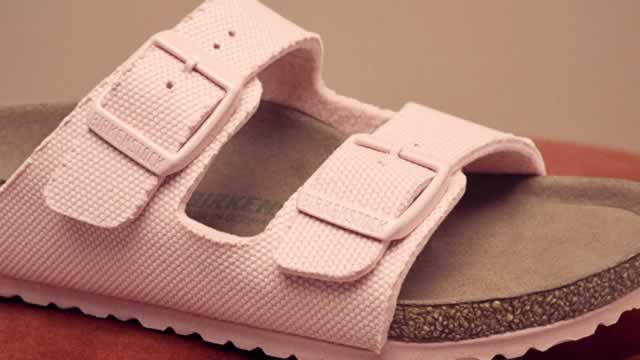
Group 1 - Birkenstock (BIRK) shares have increased by 17.3% over the past four weeks, closing at $51.46, with a mean price target of $68.15 indicating a potential upside of 32.4% [1] - The average of 17 short-term price targets ranges from a low of $57 to a high of $95, with a standard deviation of $9.66, suggesting a variability in analyst estimates [2] - Analysts have shown a strong agreement in revising earnings estimates higher, which correlates with potential stock price movements [11][12] Group 2 - The Zacks Consensus Estimate for the current year has increased by 1.8% over the past month, with three estimates going higher and no negative revisions [12] - Birkenstock currently holds a Zacks Rank 2 (Buy), placing it in the top 20% of over 4,000 ranked stocks based on earnings estimates [13] - While the consensus price target may not be a reliable indicator of the extent of potential gains, it does provide a directional guide for price movement [13]

Skechers to be acquired by 3G Capital in take-private deal, shares soar 25%
CNBC· 2025-05-05 13:10
The entrance of the Sketchers retail store at the Barton Creek Square Mall on July 16, 2024 in Austin, Texas.Footwear giant Skechers has agreed to be acquired by private equity firm 3G Capital, the companies announced on Monday. The firm will pay $63 per share in cash for Skechers, a 30% premium to the company's current valuation on the public markets. Once the deal is closed, Skechers will become a privately held company. "With a proven track-record, Skechers is entering its next chapter in partnership wit ...
Footwear giants Nike, Adidas and others ask Trump for tariff exemption
CNBC· 2025-05-02 19:08
Core Viewpoint - The Footwear Distributors and Retailers of America is requesting a tariff exemption from President Trump, citing the tariffs as an "existential threat" to the footwear industry, with 76 brands including Nike and Adidas signing the letter [1][2]. Industry Impact - Many companies producing affordable footwear for lower and middle-income families are unable to absorb high tariff rates or pass costs to consumers, risking business closures and low inventory for U.S. consumers [2]. - The footwear industry is already facing significant duties on products like children's shoes, with tariffs expected to range from 150% to about 220% for U.S. footwear companies [5]. Tariff Details - Trump's tariffs, announced on April 2, included high levies on key footwear supplier countries such as China, Vietnam, and Cambodia, with effective rates of 145% on Chinese imports and initial rates of over 45% for Vietnam and Cambodia reduced to 10% for a limited period [3]. - The higher tariffs on various trade partners are set to resume in early July, exacerbating the situation for the footwear industry [3]. Business Sentiment - Adidas has warned that tariffs will lead to increased prices for American consumers, while Nike's finance chief indicated that global levies and economic uncertainty would negatively impact current-quarter sales [4]. - The footwear association emphasized the urgency of the situation, stating that the industry cannot afford months to adjust to the new tariff regime, which undermines the certainty needed for investment in sourcing changes [6].


Deckers Outdoor Corporation Is An Interesting Value Play That Might Get A Boost By A US-Vietnam Trade Deal
Seeking Alpha· 2025-05-02 14:16
Company Overview - Deckers Outdoor Corporation (NYSE: DECK) is a US company that specializes in marketing and distributing footwear for casual use, ultra-runners, and outdoor activities [1] - The company is known for its prominent brands, including UGG, HOKA, and AHNU [1] Financial Performance - The company has experienced fluctuations in portfolio performance, with a yield of 17.5% at the end of 2020, a near flat performance in 2022 with a loss of only 0.16%, and a disappointing gain of 0.8% during a market surge [1] - Recently, the company has improved its risk strategy, achieving a yield of 12.84% last year with a beta of less than 0.6 [1] Investment Strategy - The company is focusing on algorithmic trading and trading strategies, with an interest in macroeconomic topics, particularly in relation to China [1] - There is a plan to initiate a beneficial long position in DECK through stock purchases or call options within the next 72 hours [2]

德训鞋,正成为运动爱好者的百搭单品
新消费智库· 2025-05-02 12:38
Core Viewpoint - The article discusses the rise of modern training shoes, particularly the German Army Trainer (德训鞋), highlighting their dual appeal in both fitness and fashion markets, and their evolution from military origins to trendy footwear [4][15][22]. Group 1: Market Trends - Modern training shoes are gaining popularity among both office workers seeking comfort and fitness enthusiasts prioritizing functionality [4]. - The sales trend of training shoes is increasing, driven by their stylish design and versatility for both casual wear and workouts [5][7]. - The emergence of various brands reinterpreting the traditional training shoe has created a "despise chain" in the market, where certain high-end brands are favored over others [7][9]. Group 2: Historical Background - The German Army Trainer was first produced in the 1930s for soldiers, with its design attributed to the Dassler brothers, who later founded Adidas and Puma [15][16]. - The shoe gained fame when worn by Jesse Owens during the 1936 Olympics, marking its significance in sports history [15]. - Post-World War II, the shoe transitioned into the vintage market, becoming popular in Europe due to its durability and unique design [16]. Group 3: Product Features - Modern training shoes retain the hard sole characteristic, providing necessary support for weight training and preventing injuries [11][35]. - They are designed to be versatile, suitable for various sports activities, including running and jumping, while ensuring comfort and stability [30][33]. - The shoes are made with high-quality materials, such as suede and leather, ensuring breathability and durability [28][35]. Group 4: Brand Landscape - A wide range of brands offers training shoes at different price points, from affordable options like Li Ning and Feiyue to high-end brands like Maison Margiela and Dior Homme [43][40]. - The market includes both international brands and emerging domestic brands, catering to diverse consumer preferences [21][38]. - The article emphasizes that there is no "despise chain" in training shoes; various brands meet different consumer needs and price ranges [41].
2 Growth Stocks Down 45% or More to Buy in May
The Motley Fool· 2025-05-01 08:25
Group 1: Cava Group - Cava Group is experiencing significant growth, with a full-year revenue increase of 33% and same-restaurant sales up 13%, accelerating to 21% in Q4 [3][4] - The company has a profit margin of 13%, comparable to Chipotle Mexican Grill, indicating strong earnings growth potential as it expands [4] - Cava opened 15 new restaurants in Q4, ending the year with 367 locations, and plans to open 62 to 66 new locations in 2025, aiming for over 1,000 by 2032 in the U.S. [5] - The stock is currently trading 45% off its highs, with a more reasonable valuation of 11 times sales compared to 19 times at its peak [5][6] Group 2: Deckers Brands - Deckers Brands, known for Hoka and UGG, has shown remarkable performance, with a $10,000 investment in 2002 now worth $6 million [7] - The company is projected to achieve approximately 15% sales growth for fiscal 2025, gaining market share from competitors like Nike [8] - UGG sales grew 16% year-over-year during the holiday quarter, while Hoka sales surged 24%, positioning Deckers for its fifth consecutive year of double-digit sales growth [8] - Hoka is generating over $2 billion in annualized sales, with significant growth opportunities remaining in the footwear market [9] - International sales grew 28% year-over-year in fiscal Q3, indicating potential for further expansion [10] - Despite challenges from tariffs and higher import costs, the stock is trading at 17 times this year's earnings estimate, down 51% from previous highs, suggesting it may be undervalued [11][12]


Adidas says tariffs are going to make your sneakers more expensive
Business Insider· 2025-04-30 10:28
Add sneakers to the growing list of things that tariffs will make more expensive. Adidas warned Tuesday that President Donald Trump's sweeping tariffs could drive up the costs of all its products in the US, as the company remains reliant on imports to stock American shelves."Since we currently cannot produce almost any of our products in the US, these higher tariffs will eventually cause higher costs for all our products for the US market," CEO Bjørn Gulden said. The warning came alongside Adidas's first- ...