Funds

Search documents
银行ETF涨幅居前,机构:行业增速有所回升丨ETF基金日报
2 1 Shi Ji Jing Ji Bao Dao· 2025-10-23 02:51
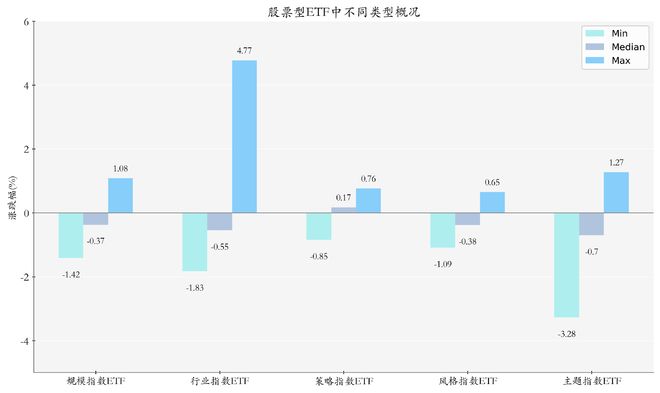
Market Overview - The Shanghai Composite Index fell by 0.07% to close at 3913.76 points, with a high of 3918.59 points during the day [1] - The Shenzhen Component Index decreased by 0.62% to 12996.61 points, reaching a peak of 13078.64 points [1] - The ChiNext Index dropped by 0.79% to 3059.32 points, with a maximum of 3089.76 points [1] ETF Market Performance - The median return of stock ETFs was -0.43% [2] - The highest performing scale index ETF was Ping An MSCI China A-Shares International ETF with a return of 1.08% [2] - The highest performing industry index ETF was GF National Index Communication ETF with a return of 4.77% [2] - The highest performing strategy index ETF was Yongying CSI Dividend Low Volatility ETF with a return of 0.76% [2] - The highest performing theme index ETF was Yinhua CSI Oil and Gas Resources ETF with a return of 1.27% [2] ETF Performance Rankings - The top three ETFs by return were: 1. GF National Index Communication ETF: 4.77% [4] 2. Yinhua CSI Oil and Gas Resources ETF: 1.27% [4] 3. Huaxia CSI Banking ETF: 1.21% [4] - The top three ETFs by decline were: 1. Guotai CSI Hong Kong Gold Industry ETF: -3.28% [5] 2. Huaan CSI Hong Kong Gold Industry ETF: -3.26% [5] 3. ICBC Credit Suisse CSI Hong Kong Gold Industry ETF: -3.17% [5] ETF Fund Flows - The top three ETFs by fund inflow were: 1. Huabao CSI All-Index Securities Company ETF: 345 million yuan [6] 2. Guotai CSI All-Index Securities Company ETF: 331 million yuan [6] 3. Ping An CSI A50 ETF: 315 million yuan [6] - The top three ETFs by fund outflow were: 1. Huatai-PB CSI 300 ETF: 760 million yuan [7] 2. Southern CSI 500 ETF: 654 million yuan [7] 3. Huaxia CSI Sci-Tech 50 ETF: 636 million yuan [7] ETF Margin Trading Overview - The top three ETFs by margin buying were: 1. Huaxia CSI Sci-Tech 50 ETF: 488 million yuan [8] 2. Guotai CSI All-Index Securities Company ETF: 417 million yuan [8] 3. Jiashi CSI Sci-Tech Chip ETF: 290 million yuan [8] - The top three ETFs by margin selling were: 1. Yifanda CSI Sci-Tech 50 ETF: 21.72 million yuan [9] 2. Huatai-PB CSI 300 ETF: 14.18 million yuan [9] 3. Huaxia CSI 50 ETF: 13.81 million yuan [9] Institutional Insights - Guotai Haitong Securities expects a recovery in the growth rate of listed banks' performance in the first three quarters of 2025, with revenue and net profit projected to grow by 0.4% and 1.1% year-on-year, respectively [10] - CITIC Securities indicates that the fourth quarter of 2025 may be a key time for bottom-fishing in dividend stocks, with historical data suggesting potential for excess returns [10]

SPXX: Attractive Valuation On This Steady Income Fund (NYSE:SPXX)
Seeking Alpha· 2025-10-23 02:30
Core Insights - Markets are trending near all-time highs, prompting investors to seek security amid uncertainties [1] - The Nuveen S&P 500 Dynamic Overwrite Fund (NYSE: SPXX) is highlighted as a valuable investment option [1] - A hybrid investment strategy combining classic dividend growth stocks, Business Development Companies, REITs, and Closed End Funds is suggested for boosting investment income while achieving total returns comparable to traditional index funds [1] Investment Strategy - The approach focuses on uncovering high-quality dividend stocks and assets with long-term growth potential [1] - The strategy aims to create a balance between growth and income, allowing for efficient investment income generation [1] - The total return achieved is reported to be on par with the S&P 500 index [1]

SPXX: Attractive Valuation On This Steady Income Fund
Seeking Alpha· 2025-10-23 02:30
Core Insights - Markets are trending near all-time highs, prompting investors to seek security amid uncertainties [1] - Funds like Nuveen S&P 500 Dynamic Overwrite Fund (NYSE: SPXX) are highlighted as valuable investment options [1] - A hybrid investment strategy combining classic dividend growth stocks, Business Development Companies, REITs, and Closed End Funds is suggested for boosting investment income while achieving total returns comparable to traditional index funds [1] Investment Strategy - The approach focuses on uncovering high-quality dividend stocks and assets with long-term growth potential [1] - The strategy aims to create a balance between growth and income, allowing for efficient investment income generation [1] - The total return achieved is reported to be on par with the S&P 500 index [1]

基金投顾试点六周年 :零到近两千亿元跨越式增长
2 1 Shi Ji Jing Ji Bao Dao· 2025-10-22 13:01
Core Insights - The public fund advisory business in China has experienced significant growth since its pilot launch in October 2019, evolving from a focus on quantity to a qualitative leap in service offerings [1][4][11] - The industry is projected to reach a scale of over 10 trillion yuan by 2030, driven by policy changes, fee reforms, and the increasing financial assets of residents [1][4] - AI technology is becoming a core driver of competition in the fund advisory sector, enhancing service personalization and efficiency [2][8][9] Industry Growth and Performance - The fund advisory business has grown from zero to nearly 200 billion yuan in assets under management over six years, with significant contributions from leading brokerage firms [3][4] - As of mid-2025, Huatai Securities reported a fund advisory business scale of 21.037 billion yuan, a 16.36% increase from the previous year [3] - Yimi Fund's advisory service assets exceeded 51 billion yuan by September 30, 2025, with over 460,000 clients [3] User Experience and Investment Behavior - Fund advisory services have shown a significant positive impact on user profitability and investment experience, with advisory accounts outperforming non-advisory accounts by approximately 27.1% over the past year [6][7] - The use of AI in services like "Help You Invest" has led to over 90% profitability among clients, with those utilizing signal services achieving a 97% profitability rate [7][8] Future Outlook and Challenges - The industry is transitioning from a scale-oriented approach to one focused on investor returns, emphasizing the need for improved service quality and client trust [10][11] - There is a recognized need for enhanced investor education to increase awareness and understanding of fund advisory services [11][12] - The competitive landscape is expected to evolve towards a model of professional division and ecological win-win, with different institutions leveraging their strengths in various market segments [12]
21独家|公募基金业绩比较基准规则征求意见稿即将发布
2 1 Shi Ji Jing Ji Bao Dao· 2025-10-22 08:45
Core Viewpoint - The upcoming release of the public fund performance benchmark rules is a significant step in the reform of the public fund industry in China, aimed at enhancing the quality and accountability of fund management [2][3]. Group 1: Regulatory Developments - The China Securities Investment Fund Industry Association is set to publish a draft for public consultation regarding the performance benchmark rules for public funds [2]. - The performance benchmark rules are part of the "Action Plan for Promoting High-Quality Development of Public Funds," which outlines 25 measures for reforming various aspects of fund management [3]. - The rules will establish a performance benchmark library, allowing fund managers to select benchmarks that align with their product characteristics, thereby enhancing the evaluation of fund managers' performance [3][4]. Group 2: Industry Impact - The introduction of performance benchmarks will tie fund managers' compensation and industry awards to their ability to generate excess returns, creating a more accountable environment [4]. - The rules are expected to impose effective constraints on fund performance evaluation, fee structures, and compensation mechanisms, pushing the industry towards higher quality development [4]. - There has been a notable increase in the adjustment of performance benchmarks among public funds, with 136 funds changing their benchmarks this year, indicating a shift towards more relevant indices [6]. Group 3: Market Trends - The public fund industry has seen a trend of misalignment between performance benchmarks and actual investment portfolios, leading to issues such as management laxity and product homogeneity [5]. - As the market matures and investor awareness increases, the demand for more precise evaluation standards and scientifically set performance benchmarks is becoming a prevailing trend in the public fund industry [5]. - The regulatory body is taking a cautious approach to the number of indices included in the benchmark library to avoid unnecessary operational costs and market disruptions [6].
平安公司债ETF:你的未来你做主
Sou Hu Cai Jing· 2025-10-22 05:54
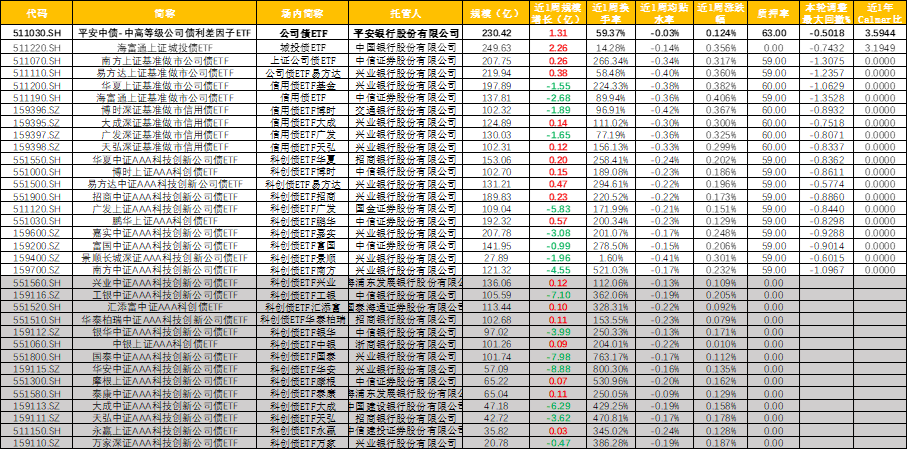
Core Insights - The total scale of credit bond ETFs is 476.9 billion yuan, with a daily decrease of 500 million yuan, indicating a trend of capital outflow from credit bond ETFs [1] - The Ping An Company Bond ETF (511030) has seen a contrary growth of 131 million yuan, attributed to its short duration of 1.95 years, static high yield of 1.97%, and minimal discount of -0.03% [1] - The average yield of credit bond ETFs is 1.92%, with a median discount rate of -13.5 basis points [1] Liquidity - The overall transaction amount reached 194.3 billion yuan, with an average single transaction amount of 4.88 million yuan [1] - The median turnover rate stands at 46.7%, reflecting active trading in the market [1] Valuation - The median yield is reported at 1.92%, while the median discount rate is -13.5 basis points, with the benchmark market-making ETF at -26.6 basis points [1] - The Ping An Company Bond ETF has the best performance in terms of drawdown control since the bond market adjustment, with a year-to-date drawdown of only -0.50% [1] Competitive Positioning - The Ping An Company Bond ETF differentiates itself from other credit bond ETFs through its unique positioning, which includes a shorter duration and lower drawdown, providing a competitive edge in the current market environment [1]
国开债券ETF(159651):精挑细选,债筑未来
Sou Hu Cai Jing· 2025-10-22 02:48
Group 1 - The research team from Caitong Fixed Income indicates that the Ping An 0-3 National Development Bank Bond ETF (159651) serves as a passive index fund tracking short-duration policy bank bonds, positioned as a "money+" short-term cash management tool, balancing liquidity management and leveraged interest rate arbitrage [1] - Current market sentiment suggests a moderately strong bond market, with potential for interest rate declines depending on trade tensions and rate cut expectations, leading to a recommendation for small adjustments and buying during dips while focusing on high yield spread positions [1] - The 10-year National Development Bank bond to treasury bond spread has narrowed to around 14-15 basis points, with expectations that this trend may be influenced by new redemption fee regulations [1] Group 2 - The issuance of special bonds has shown three characteristics: initiation in the second quarter, tight renewal intervals, and no cross-year renewals, indicating that the 25-year ultra-long special bond may not be renewed until at least March 2026 [2] - The 25-year T6 bond is expected to maintain a yield spread of 4-6 basis points over the 25-year T5 bond, with current spreads at 2.5 basis points, suggesting potential for further yield compression in a favorable bond market [3] - The National Development Bank Bond ETF has shown a 1.55% increase over the past year, with a trading volume of 163.92 million yuan and a turnover rate of 0.33% as of October 21, 2025 [3][4] Group 3 - The National Development Bank Bond ETF ranks 68th out of 490 in terms of performance among index bond funds, with a historical maximum drawdown of 0.12% and a recovery time of 8 days [4] - The management fee for the National Development Bank Bond ETF is 0.15%, and the custody fee is 0.05%, making it one of the lowest in its category [5] - The ETF closely tracks the China Bond 0-3 Year National Development Bank Bond Index, which includes policy bank bonds with a maturity of up to 3 years, serving as a benchmark for this type of investment [5][6]
基金风险等级大量上调
21世纪经济报道· 2025-10-22 01:19
Core Viewpoint - A significant wave of risk level reassessment has swept through the public fund industry, with nearly 20 fund companies issuing over 20 adjustment announcements since September, affecting hundreds of products. The adjustments primarily involve raising risk levels, with many previously considered "stable" bond funds and "fixed income+" products being upgraded from R2 (medium-low risk) to R3 (medium risk), and some high-volatility equity funds being raised to R4 (medium-high risk) [1][5][6]. Summary by Sections Adjustment Trends - Since September 2025, the frequency of risk level adjustment announcements in public funds has significantly increased, with major fund companies like Huazhang Fund and Fuguo Fund announcing adjustments for multiple products, primarily raising risk levels [3][5]. - For instance, Huazhang Fund announced on October 20 that 17 of its funds would have their risk levels raised, with bond funds moving from R2 to R3 and several equity funds from R3 to R4 [3][5]. - Fuguo Fund also reported on October 9 that 28 out of 31 funds would see their risk levels increased, with 20 funds moving from R2 to R3 and 8 from R3 to R4 [3][5]. Involvement of Sales Channels - The adjustments are not limited to fund companies; banks and third-party sales channels are also involved. For example, CITIC Bank adjusted the risk ratings of 17 asset management products, with some being downgraded and others upgraded [5][6]. - Other banks, such as Agricultural Bank and Construction Bank, have also made similar adjustments to their sold public fund products [6]. Regulatory and Market Drivers - The core drivers of these risk level adjustments are regulatory requirements and market changes. The implementation of the "Commercial Bank Agency Sales Business Management Measures" in October 2025 has been a direct catalyst for banks to adjust risk levels [7][8]. - Market volatility has also played a role, with some thematic funds showing significant performance but increased net value volatility, prompting a reassessment of risk levels [8]. Dynamic Risk Assessment Process - The process for adjusting risk levels involves a combination of third-party evaluations and the fund managers' assessments, with a tendency to adopt the higher of the two ratings. This dynamic assessment is crucial for accurately reflecting the risk characteristics of the funds [9]. - The adjustments are characterized by a "higher not lower" principle, driven by regulatory mandates, with banks, fund companies, and third-party sales channels working in coordination [9]. Impact on Investors - The adjustments have direct implications for fund investors, who will receive notifications about changes in risk levels. Investors are encouraged to reassess their risk tolerance in light of these changes [11][12]. - New investors may face restrictions on purchasing funds if the adjusted risk level exceeds their assessed risk tolerance, serving as a protective measure against taking on excessive risk [11][12].

Income-Covered Closed-End Fund Report, October 2025
Seeking Alpha· 2025-10-21 19:58
Core Insights - The service offers managed income portfolios targeting safe and reliable yields of approximately 8% through high-yield opportunities in closed-end funds (CEFs) and exchange-traded funds (ETFs) [2][3] - The majority of holdings in the CEF/ETF Income Laboratory are monthly-payers, which facilitates faster compounding and provides steady income streams for investors [3] - The service is designed for both active and passive investors of all experience levels, providing features such as 24/7 chat and trade alerts [3][4] Company Overview - The CEF/ETF Income Laboratory is led by a scientific researcher with a decade of experience in analyzing and generating profitable investments using CEFs and ETFs [4] - The service aims to simplify income investing by focusing on reliable yield opportunities, catering to a diverse range of investors [2][3]


基金公司和代销机构风险重估潮来袭:基金风险等级大量上调
2 1 Shi Ji Jing Ji Bao Dao· 2025-10-21 13:34
Core Viewpoint - A significant wave of risk level reassessment has swept through the public fund industry, with nearly 20 fund companies adjusting the risk levels of hundreds of products since September, primarily increasing risk ratings for previously considered "stable" bond funds and "fixed income+" products [1][4][10] Summary by Sections Risk Level Adjustments - Since September, nearly 20 fund companies have issued over 20 adjustment announcements, a sharp increase compared to previous months [4] - Major fund companies like Huazhang Fund and Fuguo Fund have announced risk level adjustments for multiple products, with many bond funds moving from R2 (medium-low risk) to R3 (medium risk) and several equity funds moving from R3 to R4 (medium-high risk) [3][4] Sales Channels Involvement - Adjustments are not limited to fund companies; banks and third-party sales channels have also participated in the risk level reassessment [5][6] - For instance, CITIC Bank has made multiple adjustments to the risk ratings of its sold asset management products, with a significant number of products seeing their risk ratings increased [5] Regulatory and Market Drivers - The core drivers behind the risk level adjustments are regulatory requirements and market changes, particularly the implementation of the new regulations by the National Financial Regulatory Administration [8][9] - The new regulations emphasize the need for sales institutions to ensure that product risks align with customer risk tolerance, leading to a more rigorous assessment process [8] Dynamic Risk Assessment - The adjustments reflect a broader trend towards dynamic risk assessment, where fund managers and sales institutions regularly evaluate and adjust risk ratings based on market conditions and product performance [9][10] - This dynamic approach requires investors to stay informed about changes in risk levels, especially when products are deemed to have increased risk [12][13] Impact on Investors - The adjustments have direct implications for investors, who will receive notifications about changes in risk levels and may need to reassess their investment strategies accordingly [11][12] - New subscription and investment plans may be restricted if the adjusted risk levels exceed the investor's risk tolerance, serving as a protective measure [12]