海富通上证城投债ETF

Search documents
ETF规模速报 | 创业板ETF易方达净流入超10亿元,A500ETF南方净流出超6亿元
Mei Ri Jing Ji Xin Wen· 2026-02-12 01:42
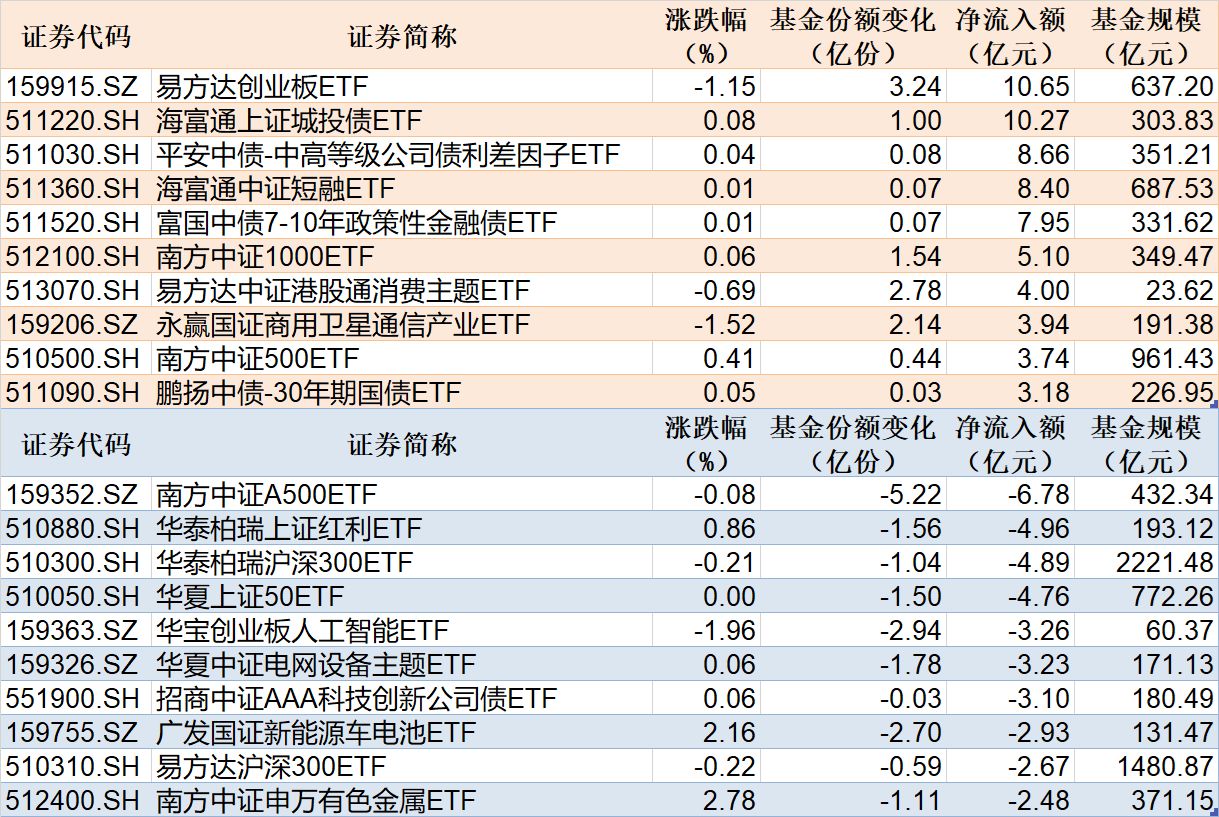
Market Overview - The three major indices showed mixed performance, with the ChiNext Index and the STAR 50 Index both declining over 1% [1] - The chemical sector has recently shown strength, particularly in the fiberglass concept, while the film and cinema sector experienced a collective decline [1] ETF Market Activity - On February 11, the non-monetary ETF market saw significant inflows, with the E Fund ChiNext ETF increasing by 324 million shares and a net inflow of 1.065 billion yuan [1] - The Hai Fu Tong Shanghai City Investment Bond ETF also saw an increase of 100 million shares with a net inflow of 1.027 billion yuan [1] - The Ping An Zhongdai High-Grade Corporate Bond Spread Factor ETF had an increase of 8 million shares and a net inflow of 866 million yuan [1] Fund Performance - The E Fund ChiNext ETF had a decline of 1.15%, despite the increase in shares and net inflow [2] - The Hai Fu Tong Shanghai City Investment Bond ETF had a slight increase of 0.08% with a net inflow of 1.027 billion yuan [2] - The Ping An Zhongdai High-Grade Corporate Bond Spread Factor ETF increased by 0.04% with a net inflow of 866 million yuan [2] Fund Outflows - The Southern CSI A500 ETF saw a reduction of 522 million shares and a net outflow of 678 million yuan [2] - The Huatai-PB Shanghai Dividend ETF experienced a decrease of 156 million shares with a net outflow of 496 million yuan [2] - The Huatai-PB CSI 300 ETF had a reduction of 104 million shares and a net outflow of 489 million yuan [2] Top ETF Inflows - The top 20 ETFs by net inflow for the month include the Huatai-PB Hang Seng Technology ETF with 3.885 billion yuan and the Hai Fu Tong CSI Short-term Bond ETF with 3.852 billion yuan [4] - Other notable inflows include the Huatai-PB Hang Seng Internet Technology ETF with 2.872 billion yuan and the E Fund ChiNext ETF with 1.772 billion yuan [4] Overall Market Statistics - As of February 11, the total ETF shares in the market reached 33,335.10 billion shares, with a total scale of 54,141.40 billion yuan [4] - The information sector saw the largest increase in shares, with four funds tracking it, while the largest thematic increase was in the CSI Robotics Index, tracked by nine funds [4]




城投债配置需求升温,城投债ETF海富通连续四日获资金净流入
Mei Ri Jing Ji Xin Wen· 2026-02-12 01:37
Group 1 - The core viewpoint of the articles highlights the increasing investor interest in urban investment bonds (城投债) as the Spring Festival approaches, with significant net inflows into the Hai Fu Tong Shanghai Urban Investment Bond ETF, totaling over 1.7 billion yuan in the last four days, bringing its total size to 30.383 billion yuan [1] - The market is favoring stable yield assets before the holiday, with a general decline in yields across various ratings and maturities of urban investment bonds, indicating a shift in positive sentiment towards medium to long-term products [1] - The support from a comprehensive debt restructuring policy enhances the safety margin of urban investment bonds, making them a valuable core investment option [1] Group 2 - The Hai Fu Tong Shanghai Urban Investment Bond ETF, established in November 2014, is one of the earliest bond ETF products in the market, providing an effective tool for investors to access a basket of urban investment bonds [2] - The fund received a five-star rating from Guotai Junan Securities in January 2026, reflecting its outstanding performance based on multiple indicators such as tracking error and information ratio [2] - Hai Fu Tong Fund is a leader in the bond ETF sector, offering a diverse range of products that cater to various investor needs, including short-term, medium-term, and long-term bond ETFs [2]
债券ETF资金持续流出 | 债券ETF跟踪
Xin Lang Cai Jing· 2026-01-20 06:39
Fund Flow - As of January 16, 2026, bond ETFs experienced a net outflow of 16.512 billion yuan over the past week, with interest rate, credit, and convertible bond ETFs seeing net outflows of 5.307 billion yuan, 14.018 billion yuan, and a net inflow of 2.814 billion yuan respectively [21][24] - Since 2025, cumulative net inflows for interest rate, credit, and convertible bond ETFs have reached 60.615 billion yuan, 487.023 billion yuan, and 25.964 billion yuan respectively, totaling 573.603 billion yuan [21][24] Index Performance - The China Bond New Comprehensive Index rose by 0.18% over the past week, while short-term pure bond and medium-to-long-term pure bond funds increased by 0.02% and 0.05% respectively [19][24] - The CSI AAA Sci-Tech Bond Index and the Shanghai Benchmark Market Company Bond Index both increased by 0.11% [19][24] Net Value Performance - Various types of bond ETFs generally saw an increase in net value, with the 30-year government bond ETF from Bosera rising by 0.37%, and the government bond ETF from Huaxia increasing by 0.31% [23][24] - Convertible bond ETFs and the Shanghai Convertible Bond ETF rose by 1.05% and 0.68% respectively [23][24] Credit Bond ETF and Sci-Tech Bond ETF Performance - As of January 16, 2026, the median unit net value for credit bond ETFs and sci-tech bond ETFs was 1.0128 and 1.0010, with increases of 0.09% and 0.07% respectively [25][32] - The Dachen credit bond ETF performed relatively well, increasing by 0.10% [25][32] Duration Tracking of Credit Bond ETFs - As of January 16, 2026, the holding durations for short-term bond ETFs, corporate bond ETFs, and urban investment bond ETFs were 0.34 years, 1.56 years, and 2.13 years respectively [32][34] - For market-making credit bond ETFs, the median holding durations for products tracking the Shanghai and Shenzhen market-making corporate bonds were 3.58 years and 2.80 years respectively [32][34]

大额买入与资金流向跟踪(20251215-20251219)
GUOTAI HAITONG SECURITIES· 2025-12-23 05:11
Quantitative Models and Construction Methods 1. Model Name: Large Order Transaction Amount Ratio - **Model Construction Idea**: This model tracks the buying behavior of large funds by calculating the proportion of large order transaction amounts to the total daily transaction amount[7] - **Model Construction Process**: 1. Use tick-by-tick transaction data to identify buy and sell orders based on bid and ask sequence numbers 2. Filter transactions by order size to identify large orders 3. Calculate the ratio of large buy order transaction amounts to the total daily transaction amount - Formula: $ \text{Large Order Transaction Amount Ratio} = \frac{\text{Large Buy Order Transaction Amount}}{\text{Total Daily Transaction Amount}} $ - **Model Evaluation**: This indicator effectively captures the buying behavior of large funds[7] 2. Model Name: Net Active Buy Amount Ratio - **Model Construction Idea**: This model measures the active buying behavior of investors by calculating the net active buy amount as a proportion of the total daily transaction amount[7] - **Model Construction Process**: 1. Use tick-by-tick transaction data to classify each transaction as either active buy or active sell based on the buy/sell flag 2. Calculate the net active buy amount by subtracting the active sell amount from the active buy amount 3. Compute the ratio of the net active buy amount to the total daily transaction amount - Formula: $ \text{Net Active Buy Amount Ratio} = \frac{\text{Active Buy Amount} - \text{Active Sell Amount}}{\text{Total Daily Transaction Amount}} $ - **Model Evaluation**: This indicator effectively captures the active buying behavior of investors[7] --- Model Backtesting Results 1. Large Order Transaction Amount Ratio - **Top 10 Stocks by 5-Day Average**: - **East Securities (601198.SH)**: 88.1%, 99.6% time-series percentile[9] - **Shanghai Kaibao (300039.SZ)**: 86.3%, 100.0% time-series percentile[9] - **Sanxiang Impression (000863.SZ)**: 86.0%, 99.6% time-series percentile[9] - **Chongqing Steel (601005.SH)**: 86.0%, 78.7% time-series percentile[9] - **Jinzhengda (002470.SZ)**: 85.7%, 89.8% time-series percentile[9] - **Wanlong Optoelectronics (300710.SZ)**: 85.6%, 99.6% time-series percentile[9] - **Yasheng Group (600108.SH)**: 85.5%, 84.4% time-series percentile[9] - **Sinochem International (600500.SH)**: 85.5%, 90.4% time-series percentile[9] - **Chongqing Water (601158.SH)**: 85.2%, 96.7% time-series percentile[9] 2. Net Active Buy Amount Ratio - **Top 10 Stocks by 5-Day Average**: - **Jiuhua Tourism (603199.SH)**: 26.2%, 100.0% time-series percentile[10] - **Bailong Oriental (601339.SH)**: 22.9%, 100.0% time-series percentile[10] - **Zijin Bank (601860.SH)**: 20.2%, 100.0% time-series percentile[10] - **Bailong Chuangyuan (605016.SH)**: 19.5%, 100.0% time-series percentile[10] - **Hengshun Vinegar (600305.SH)**: 17.8%, 100.0% time-series percentile[10] - **Qingfangcheng (600790.SH)**: 17.7%, 99.6% time-series percentile[10] - **Shandong Steel (600022.SH)**: 17.7%, 99.6% time-series percentile[10] - **Shengda Forestry (002259.SZ)**: 17.5%, 100.0% time-series percentile[10] - **Taoli Bread (603866.SH)**: 17.2%, 100.0% time-series percentile[10] - **Jiangsu Sopo (600746.SH)**: 16.8%, 100.0% time-series percentile[10] 3. Broad-Based Indices - **5-Day Average Results**: - **Shanghai Composite Index**: Large Order Ratio 73.7% (82.0% percentile), Net Active Buy Ratio 2.2% (3.7% percentile)[12] - **SSE 50**: Large Order Ratio 71.7% (58.2% percentile), Net Active Buy Ratio 5.8% (92.6% percentile)[12] - **CSI 300**: Large Order Ratio 73.0% (41.0% percentile), Net Active Buy Ratio 2.9% (20.9% percentile)[12] - **CSI 500**: Large Order Ratio 73.8% (86.9% percentile), Net Active Buy Ratio 1.5% (3.3% percentile)[12] - **ChiNext Index**: Large Order Ratio 70.5% (6.1% percentile), Net Active Buy Ratio 0.1% (14.8% percentile)[12] 4. Industry-Level Analysis - **Top Industries by 5-Day Average**: - **Steel**: Large Order Ratio 79.0% (79.1% percentile), Net Active Buy Ratio 12.7% (0.8% percentile)[13] - **Agriculture, Forestry, Animal Husbandry, and Fishery**: Large Order Ratio 77.1% (87.7% percentile), Net Active Buy Ratio 10.8% (3.3% percentile)[13] - **Food and Beverage**: Large Order Ratio 71.5% (95.5% percentile), Net Active Buy Ratio 10.1% (32.8% percentile)[13] - **Real Estate**: Large Order Ratio 78.7% (70.9% percentile), Net Active Buy Ratio 8.8% (9.8% percentile)[13] - **Consumer Services**: Large Order Ratio 75.8% (32.4% percentile), Net Active Buy Ratio 8.9% (13.9% percentile)[13] 5. ETF Analysis - **Top 10 ETFs by Large Order Ratio**: - **Haifutong Shanghai Urban Investment Bond ETF (511220.SH)**: 93.4%, 63.5% percentile[15] - **Fortune Military Industry ETF (512710.SH)**: 92.1%, 100.0% percentile[15] - **Guotai CSI A500 ETF (159338.SZ)**: 91.5%, 19.7% percentile[15] - **Guotai 10-Year Treasury ETF (511260.SH)**: 91.5%, 91.8% percentile[15] - **Penghua National Defense ETF (512670.SH)**: 90.7%, 99.6% percentile[15] - **Top 10 ETFs by Net Active Buy Ratio**: - **Huaxia Food and Beverage ETF (515170.SH)**: 18.2%, 99.6% percentile[16] - **Yinhua 5G Communication ETF (159994.SZ)**: 16.7%, 100.0% percentile[16] - **E Fund CSI 300 Non-Bank ETF (512070.SH)**: 16.0%, 95.9% percentile[16] - **Huatai-PineBridge Dividend Low Volatility ETF (512890.SH)**: 15.7%, 94.3% percentile[16] - **Fortune Agriculture ETF (159825.SZ)**: 15.2%, 96.7% percentile[16]


创价值·塑生态·启新程——上海公募基金高质量发展在行动 | 前瞻布局 精细运营 海富通基金领航债券ETF蓝海
Xin Lang Cai Jing· 2025-12-21 22:46
Core Insights - The bond ETF market in China has experienced significant growth, with total market size exceeding 700 billion yuan by November 2025, and the number of products reaching 53 [1][2] - Hai Futong Fund Management Company has established itself as a leader in the bond ETF sector, being the first to surpass 100 billion yuan in management scale and driving the market towards deeper and broader development [1][2] Group 1: Company Strategy and Innovation - Hai Futong Fund began its bond ETF journey in 2014 with the launch of the Shanghai Stock Exchange Urban Investment Bond ETF, which raised 6.6 billion yuan, marking a significant entry into the market [2] - The company has continuously innovated by launching several pioneering products, including the first short-term bond ETF in 2020 and a market-leading convertible bond ETF [2][3] - By November 2025, Hai Futong managed six bond ETFs with a total scale of approximately 129.8 billion yuan, making it the largest fund company in terms of product variety and scale in the bond ETF market [2] Group 2: Operational Excellence and Market Position - The growth of Hai Futong's bond ETFs is attributed to its meticulous operational management and ecosystem building, which includes addressing liquidity challenges and enhancing customer engagement [3][4] - The Hai Futong Zhongzheng Short-term Bond ETF has seen its scale grow to over 70 billion yuan, demonstrating a successful turnaround from initial struggles [5] - The company emphasizes credit safety and has established a robust risk management framework for its credit ETFs, ensuring independent credit rating and risk management teams [6] Group 3: Team Expertise and Market Understanding - Hai Futong's investment and research team features a diverse range of experience, with core members having extensive backgrounds in fixed income markets and index management [7] - The company actively collaborates with regulators, exchanges, market makers, and investors to foster a supportive ecosystem for bond ETFs, enhancing market awareness and application of these financial tools [7][8] - The future outlook for bond ETFs remains positive, with expectations for continued growth driven by market development and diversified investor structures [8]
前瞻布局 精细运营 海富通基金领航债券ETF蓝海
Zhong Guo Zheng Quan Bao· 2025-12-21 22:04
Core Insights - The bond ETF market in China has experienced significant growth, with total market size exceeding 700 billion yuan and 53 products by November 2025, compared to the initial 5.4 billion yuan when the first bond ETF was launched in 2013 [1][2] - Hai Futong Fund Management Company has established itself as a leader in the bond ETF market, being the first to surpass 100 billion yuan in management scale and driving the market towards deeper and broader development [1][3] Group 1: Product Development and Innovation - Hai Futong Fund began its bond ETF journey with the launch of the Shanghai Stock Exchange Urban Investment Bond ETF in late 2014, raising 6.6 billion yuan, marking a significant entry into the market [2] - The company has continuously filled market gaps with innovative products, launching several first-of-their-kind ETFs, including those tracking long-term government bonds and short-term financing bonds [2][3] - As of November 2025, Hai Futong manages six bond ETFs with a total scale of approximately 129.8 billion yuan, making it the largest fund company in terms of product variety and scale in the bond ETF market [3] Group 2: Operational Excellence and Market Position - The growth of Hai Futong's bond ETFs is attributed to its refined operational management and ecosystem-building capabilities, exemplified by the success of the Zhongzheng Short-term Financing Bond ETF [4][5] - The Zhongzheng Short-term Financing Bond ETF overcame initial challenges to achieve a scale of over 70 billion yuan by November 2023, demonstrating a successful turnaround from a low initial scale [5] - The company emphasizes liquidity and credit safety in its operations, with the short-term financing ETF achieving a net value growth rate of 12.40% since its inception, significantly outperforming its benchmark [4][5] Group 3: Sustainable Competitive Advantage - Hai Futong maintains a rigorous operational management system, particularly for credit ETFs, ensuring independent risk management and tailored risk control plans for each product [6] - The investment team showcases deep expertise in bond markets, focusing on credit risk control and addressing liquidity issues in local government bonds [6][7] - The company actively collaborates with regulators, exchanges, market makers, and investors to enhance the bond ETF ecosystem, promoting awareness and understanding of these investment tools [7][8] Group 4: Future Outlook - The bond ETF market in China is expected to continue expanding, driven by the increasing demand for transparent, efficient, and risk-diversified investment products [8] - Hai Futong plans to leverage its expertise in the bond ETF sector to enhance product operations and contribute to the high-quality development of the bond ETF market in China [8]
海富通基金领航债券ETF蓝海
Zhong Guo Zheng Quan Bao· 2025-12-21 20:12
Core Insights - The article highlights the rapid growth of the bond ETF market in China, with the total market size exceeding 700 billion yuan by November 2025, up from 5.4 billion yuan in 2013, indicating a significant increase in investor demand for transparent and efficient investment tools [1][2]. Group 1: Company Development - Hai Fu Tong Fund Management Company has strategically positioned itself as a leader in the bond ETF market, being the first to surpass 100 billion yuan in management scale and currently managing 1.298 billion yuan across six bond ETFs, making it the largest fund company in terms of both quantity and scale [2][4]. - The company has consistently innovated by launching pioneering products, such as the first short-term bond ETF in 2020 and various government bond ETFs, thereby filling market gaps and providing investors with convenient trading tools [2][3]. Group 2: Product Performance - The Hai Fu Tong Zhong Zheng Short-term Bond ETF, despite initial struggles with a scale of only 50 million yuan, has seen a remarkable turnaround, achieving a net value growth rate of 12.40% since its inception, significantly outperforming its benchmark [3][4]. - The company’s bond ETFs have demonstrated a "head effect," where clear product positioning and ample liquidity have led to a virtuous cycle of scale enhancement and increased liquidity, attracting more capital [4][5]. Group 3: Operational Excellence - Hai Fu Tong Fund emphasizes a professional and prudent operational management system, particularly for credit ETFs, ensuring independent credit rating and risk management teams to maintain credit safety as a priority [5][6]. - The investment team comprises experienced professionals with a deep understanding of various bond types, ensuring effective collaboration from macro judgment to execution [5][6]. Group 4: Market Ecosystem Engagement - The company actively engages with regulators, exchanges, market makers, and investors to foster a collaborative ecosystem for bond ETFs, enhancing market understanding and application of these financial tools [6]. - Hai Fu Tong Fund aims to continue leveraging its expertise in the bond ETF sector to contribute to the market's prosperity and high-quality development as the bond market evolves [6].
214只ETF获融资净买入 鹏扬中债—30年期国债ETF居首
Zheng Quan Shi Bao Wang· 2025-12-02 02:52
Core Viewpoint - As of December 1, the total margin balance for ETFs in the Shanghai and Shenzhen markets reached 118.338 billion yuan, showing a slight increase from the previous trading day [1] Summary by Category ETF Margin Balance - The ETF financing balance was 110.216 billion yuan, which decreased by 0.434 billion yuan compared to the previous trading day [1] - The ETF margin trading balance was 8.122 billion yuan, reflecting an increase of 0.456 billion yuan from the previous trading day [1] Net Buy Activity - On December 1, 214 ETFs experienced net financing purchases, with the Pengyang Zhongzhai - 30-Year Treasury Bond ETF leading with a net purchase amount of 71.1955 million yuan [1] - Other ETFs with significant net financing purchases included the GF Nasdaq-100 ETF, Yongying CSI Hong Kong and Shanghai Gold Industry Stock ETF, Huatai-PB Hang Seng Technology ETF, Guotai Nasdaq-100 ETF, Guotai Gold ETF, and Haifutong Shanghai Stock City Investment Bond ETF [1]
债券ETF规模创新高!
券商中国· 2025-11-25 01:48
Core Viewpoint - The bond ETF market has experienced rapid expansion this year, with a significant increase in the scale of leading products and a noticeable restructuring of the industry [1][2]. Market Overview - As of November 24, the total scale of bond ETFs reached 720.6 billion yuan, continuously setting historical highs and rapidly increasing its market share within the ETF landscape [2][3]. - The proportion of bond ETFs in the overall market rose to 12.82%, a substantial increase from 4.66% at the end of last year, while the share of stock ETFs decreased from 77.38% [3]. - The performance of certain bond ETFs has been notable, with the Bosera CSI Convertible Bond ETF rising by 15.93% and the Hai Fu Tong Shanghai Stock Exchange Investment Grade Convertible Bond ETF increasing by 12.04% year-to-date [3]. Growth Drivers - The growth in the bond ETF market is driven by three main factors: strong policy support, product innovation, and a shift in investor strategy towards passive investment tools due to increased market volatility [7]. - The number of bond ETF products reached 53, with 32 launched this year, indicating a robust influx of new offerings [4]. Characteristics of Bond ETFs - Bond ETFs are characterized by high liquidity, low trading costs, and the ability to be used for collateral financing, making them an efficient investment vehicle [5][6]. - They offer T+0 trading, allowing investors to buy and sell on the same day, and typically have lower transaction fees compared to traditional bond investments [6]. Investor Composition - Institutional investors dominate the bond ETF market, accounting for 92% of the total, while individual investors represent only 8%, indicating significant growth potential in the retail segment [7].

“避险走强、进攻收缩”!ETF资金结构生变
券商中国· 2025-11-24 23:34
Core Viewpoint - The ETF market is experiencing a shift in funding structure amid a volatile market and weak expectations, with a notable preference for low-risk, low-volatility bond ETFs over high-volatility equity ETFs [1][2]. Group 1: ETF Market Trends - In the past month, there has been a clear divergence in the scale changes of different index-linked ETFs, with low-risk bond ETFs seeing significant net inflows ranging from tens to hundreds of millions [2][3]. - The overall trend indicates that investors are increasingly favoring stable assets, with bond ETFs becoming the primary tool for enhancing portfolio stability in a turbulent market [2][3]. Group 2: Performance of Low-Risk ETFs - As of November 23, bond-related ETFs have shown substantial growth, with specific ETFs like the Hai Fu Tong Zhong Zheng Short Bond ETF increasing by 10.67 billion, making it one of the fastest-growing ETFs in the market [4]. - Other notable increases include the Hua Bao Cash Management ETF with 8.93 billion, and the Tian Hong Zhong Zheng AAA Technology Innovation Bond ETF with 5.60 billion, reflecting a strong demand for bond ETFs [4]. Group 3: Pressure on Equity ETFs - In contrast to bond ETFs, equity index ETFs have faced net outflows, with the CSI 300 index ETF seeing a decrease of 38.76 billion, marking the largest outflow among broad-based products [5][6]. - Technology-themed ETFs have also experienced declines, with the Fu Guo Zhong Zheng Hong Kong Internet ETF dropping by 8.44 billion, indicating pressure on the growth sector [5][6]. Group 4: Investor Behavior and Market Sentiment - The current market sentiment remains cautious, leading investors to prioritize stability and risk management through low-volatility bond ETFs and cash management products [7]. - The decline in trading activity has resulted in reduced interest in high-volatility equity products, as investors are more inclined to lower leverage and exposure to risky assets [7].